From Surf Wiki (app.surf) — the open knowledge base
Newar language
Sino-Tibetan language of central-eastern Nepal

Sino-Tibetan language of central-eastern Nepal
| Field | Value | ||
|---|---|---|---|
| name | Newar | ||
| nativename | {{script | Newa | 𑐣𑐾𑐥𑐵𑐮 𑐨𑐵𑐳𑐵}}, |
| {{Script | Newa | 𑐣𑐾𑐰𑐵𑑅 𑐨𑐵𑐫𑑂}}, | |
| states | Nepal | ||
| region | Nepal Mandala | ||
| ethnicity | million Newars (2021 census) | ||
| speakers | |||
| date | 2021 census | ||
| ref | e27 | ||
| refname | Newar | ||
| familycolor | Sino-Tibetan | ||
| fam2 | Tibeto-Burman | ||
| fam3 | Newaric | ||
| ancestor | Classical Newar | ||
| dia1 | Dolakha | ||
| dia2 | Kathmandu-Lalitpur | ||
| dia3 | Bhaktapur | ||
| dia4 | Pahari | ||
| dia5 | Gopali | ||
| dia6 | Balami | ||
| dia7 | Pyang-gaon | ||
| image | NepalBhasa word in Ranjana&Prachalit script2.gif | ||
| imagecaption | "Nepal Bhasa" written in the Ranjana script and the Prachalit Nepal script | ||
| script | *Ranjana script | ||
| nation | *India | ||
| ** Sikkim<ref name | "sikkimofficial" | ||
| last | International Nepal Bhasha Sevaa Samiti | ||
| title | Newāh Vijñāna: Journal of Newar Studies, issue 7 | ||
| journal | Journal of Newar Studies | ||
| page | 7 | ||
| url | https://d1i1jdw69xsqx0.cloudfront.net/digitalhimalaya/collections/journals/jns/pdf/JNS_07.pdf | ||
| accessdate | 2025-12-09 | ||
| quote | Newah language, a language that was historically recognized as the official language of Nepal Mandala, which was then known as Nepal Bhasa, before the unification of the current and larger Nepal. | ||
| *Kingdom of Nepal<ref name | "Tuladhar"Nepal Bhasa Sahityaya Itihas: History of Nepalbhasa Literature.Tuladhar, Prem Shanti (2000). Kathmandu: Nepal Bhasa Academy. . Page 37: "The early new rulers cultivated Newari language. Kings Prithvi Narayan Shah, Rana Bahadur and Rajendra Bikram Shah composed poetry and wrote many plays in Newari". | ||
| agency | Nepal Bhasa Academy | ||
| iso2 | new | ||
| iso2comment | Nepal Bhasa, Newari | ||
| lc1 | new | ||
| ld1 | Newari | ||
| lc2 | nwx | ||
| ld2 | Middle Newar | ||
| lc3 | phj | ||
| ld3 | Pahari Newar | ||
| linglist | new | ||
| lingname | Newari | ||
| linglist2 | nwx | ||
| lingname2 | Middle Newar | ||
| glotto | newa1247 | ||
| glottorefname | Subfamily: Newar | ||
| notice | IPA | ||
| map | Nepal ethnic groups.png | ||
| mapcaption | Language map of Nepal (including Newar): | ||
| red = Newar | |||
| language is the majority spoken language<br> red with yellow stripes | Newar language is spoken along with Pahari language | ||
| pronunciation |
{{Script|Newa|𑐣𑐾𑐰𑐵𑑅 𑐨𑐵𑐫𑑂}},
- Pracalit script
- Bhujimol script
- Devanagari
- various Nepalese scripts
- Sikkim
- Nepal
- Bagmati Province (additional) Historical:
- Kingdoms of Nepal Mandala{{cite journal
- Kingdom of Kantipur
- Kingdom of Lalitpur
- Kingdom of Bhaktapur
- Kingdom of Nepal | revived-category = red = Newar language is the majority spoken language red with yellow stripes = Newar language is spoken along with Pahari language
Newar (; {{Script|Newa|𑐣𑐾𑐥𑐵𑐮 𑐨𑐵𑐲𑐵}}, ) is a Sino-Tibetan language of central Nepal belonging to the Tibeto-Burman group. It is spoken natively by the Newar people, the indigenous inhabitants of Nepal Mandala, which consists of the Kathmandu Valley and surrounding regions in Nepal. The name Nepal Bhasa was historically used for the language and is the also the name used in official contexts by the Government of Nepal. This name is also preferred by native speakers and writers of the language. Another name frequently used is "Newari" but this name is considered inappropriate by Newar speakers due to the addition of the Indic suffix -i and it has become increasingly common to refer to the language as Newar in English.{{efn|name=newari|
- "The Newars themselves, some of whom find the term 'Newar' to be an oppressive reminder of their colonization by the Gorkhas in the 18th century."
- "Some people in the Newar community, including some prominent Newar linguists, consider the derivational suffix -i found in the term Newari to constitute an 'Indianization' of the language name. These people thus hold the opinion that the term Newari is non-respectful of Newar culture."}}
Newar was the official language of Nepal during the medieval period, having been given this status by Jayasthiti Malla in the 14th century. The language during this period was consistently referred as "nepāla bhāṣā", a term which literally means "Nepalese Language". Despite the similar nomenclature, It is distinct from the Nepali language, an Indo-Aryan language which replaced Newar as the national language after the conquest of Nepal by the Shah Dynasty, and additionally only adopted the name Nepali in the 1930s.
From the start of the Rana dynasty in the 1840s until democratisation, Newar suffered from official suppression. From 1952 to 1991, the percentage of Newar speakers in the Kathmandu Valley dropped from 75% to 44% and today Newar culture and language are under threat. Today, the language has been listed as "Definitely endangered" by UNESCO.
Literature in Newar is one of the oldest in Nepal, dating back to at least 600 years ago. Many of the literature written in Newar, like the Gopal Raj Vamshavali are very important in the study of the history of Nepal.
On 6 May 2024, Newar, along with Tamang and Nepali was declared as the official language of Bagmati Province. Similarly, Newar is given official status in the Indian state of Sikkim and several city governments of Nepal including the capital Kathmandu.
Name
The official and historical name of the language, Nepal Bhasa, which literally means Nepalese Language, originates from Nepal. Historically, Nepal was only used to refer to the Kathmandu Valley and its surroundings, where the language was native to.
The name "Nepal Bhasa" has been used consistently in sources from the Malla dynasty to refer to the language. The earliest occurrences of the name Nepālabhāṣā (Devanāgarī: नेपालभाषा, "Nepalese language") or alternatively Nepālavāc (Devanāgarī: नेपालवाच, "Nepalese speech"), used to refer to the language, can be found in the manuscripts of a commentary to the Nāradasaṃhitā, dated 1380, and a commentary to the Amarkośa, dated 1386. Some sources from the Malla Dynasty refer to the language as deśabhāṣā (Pracalit Script: , ) or svadeśabhāṣā (Pracalit Script: , ). Similarly, the language was referred to as Nepalese in sources of some 18th century Capuchin missionaries like in the journal who visited Nepal in the 1740s.
In contrast, the name Newar did not even appear in the written record before the 17th century and William Kirkpatrick was one of the first Western scholars to use the term Newar for the language in his 1811 book. Newar was also used in the travelogue of a few 18th century European missionaries to refer to the people or the land of Nepal. For instance, Ippolito Desideri who visited Nepal in 1721 used the term Neuâr to refer to the inhabitants of Nepal. Similarly, in one of the books written by the Capuchin mission in the 1740s, Nepal is referred as the kingdom of "Newar or Nepal".
The origin of the word Newar is generally believed to be related to the word Nepal, possibly derived by the replacement of the 'la' sound with a 'ra' sound, a common practice in historical documents from Nepal. Historically, "Newar" rarely used appeared in native sources as well. Only two sources in Nepal from before the Gorkhali rule use the term "Newar" to refer to the language or its script; the multilingual stone inscription of Pratap Malla uses "nevāra ākhara" ("newar alphabet") to refer to the Pracalit script and another stone inscription of Pratap Malla from 1652 uses the term nevārabhāṣā ("newar language") to refer to the language.
The term "Newari", derived from the Sanskritisation of "Newar" was first used by Brian Hodgson in 1847 and since then used by most western scholars. In one case, Shakya noted that Cecil Bendall in his translation of a Newar manuscript, used the term Newari to refer to the language although the manuscript he translated used the word Nepala Bhasa. However, the name Newari is considered inappropriate by Newar speakers due to the addition of the Indic suffix -i and it has become increasingly common to refer to the language as Newar in English.
In the 1920s, the language known as Khas Kura, Gorkhali or Parbatiya was renamed to Nepali. Conversely, the term Gorkhali in the former national anthem entitled "Shreeman Gambhir" was changed to Nepali in 1951. Gorkha Bhasa Prakashini Samiti (Gorkha Language Publishing Committee), a government institution established in 1913 (B.S. 1970) for advancement of Gorkha Bhasa, renamed itself as Nepali Bhasa Prakashini Samiti (Nepali Language Publishing Committee) in 1933 (B.S. 1990), which is currently known as Sajha Prakashan.
On 7 September 1995, the cabinet of ministers decided to use "Nepala Bhasa" instead of "Newari". On 13 November 1998, the Minister of Information and Communication issued another directive to use the name Nepal Bhasa instead of Newari. However, the Central Bureau of Statistics have not been doing so.
A colloquial term is Newa Bhaay (Devanāgarī: नेवा: भाय्, IAST: Nevāḥ Bhāy) is also used.
History and development
Origin
- All measures are in pixels ImageSize = width:800 height:390 PlotArea = left:0 right:150 bottom:250 top:10 AlignBars = early
DateFormat = yyyy Period = from:-2500 till:2100 TimeAxis = orientation:hor ScaleMajor = unit:year increment:400 start:-2400
- there is no automatic collision detection,
- so shift texts up or down manually to avoid overlap
Define $dx = 25 # shift text to right side of bar
PlotData= bar:Age color:red width:25 mark:(line,white) align:left fontsize:S from:start till:-2200 shift:(-20, 0) text:Antiquity from:-2200 till:400 shift:($dx, 0) color:yellow text:Proto Newari from:400 till:2000 shift:($dx, 0) color:green text:Historical Age at:2000 shift:(10, -140) text:AD at:-2200 shift:(0, -150) text:←Proto-Newari diverges from Proto-Chepangi at:-200 shift:(-160, -165) text:Arrival of Charumati in the Valley→ at:-200 shift:(0, -180) text:←start of Indo-Aryanization through Magadhi Prakrit? at: 200 shift:(-190, -195) text:Ascension of Lichhavi King Jayavarma-I→ at: 200 shift:(0, -210) text:←start of Sanskritization? at: 1300 shift:(-181, -225) text:Arrival of last Karnat King Nanyadeva→ at: 1300 shift:(0, -240) text:←start of Maithali influence at: 1400 shift:(0, -255) text:←start of Persian/Arabic influence at: 1600 shift:(-135, -270) text:start of Khas Bhasa influence→ at: 600 shift:(-240, -285) text:Rise of Songtsen Gampo and influence of Tibetan→ at: 1920 shift:(0, -300) text:←Hindi and English influence
bar:Era5 color:blue width:18 mark:(line,white) align:left fontsize:S from:-200 till:1980 shift:(0, 0) text:Indo-Aryanization period from:1980 till:2000 shift:(0, 0) text:←Recent attempts to de-Sanskritize
bar:Era color:red width:25 mark:(line,white) align:left fontsize:S from:400 till:1200 shift:(-20, 0) text:Ancient Era from:1200 till:1850 shift:(-20, 0) color:yellow text:Medieval era from:1850 till:1940 shift:(7, 0) color:black text:Dark era
bar:Era2 color:red width:25 mark:(line,white) align:left fontsize:S from:1909 till:1940 shift:(5, 0) color:blue text:Renaiassance
bar:Era3 color:red width:25 mark:(line,white) align:left fontsize:S from:1950 till:2000 shift:(5, 0) color:green text:Modern Era
bar:Era4 color:red width:25 mark:(line,white) align:left fontsize:S from:1960 till:1990 shift:(2, 0) color:black text:Dark era According to the Linguist Glover, Newar and Chepang language must have diverged around 2200 BC. It is estimated that Newar shares 28% of its vocabulary with Chepang. At the same time, a very large and significant proportion of Newari vocabulary is Indo-European in origin, by one estimate more than 50%, indicating an influence of at least 1,600 years from Indo-European languages, first from Sanskrit, Maithili, Persian, and Urdu and today from Hindi, Nepali and English.
Licchavi Dynasty
An early form of Newar appears in Sanskrit stone inscriptions from the time of the Licchavis. The Sanskrit language stone inscriptions of the Licchavi period (approximately 400–750 CE) contains frequent use of Sino-Tibetan words especially for proper nouns. Almost 80 percent of the names of places, taxes and merchandise used in the inscriptions are Tibeto-Burman in origin. It suggests that Newar existed as a vernacular language since at least the Lichhavi Dynasty. According to the Gopal Raj Vamshavali, a 14th century Newar language history book, before the Licchavis of Vaishali conquered Nepal, it was ruled by the Kirata and the language they spoke, which is referred by historians such as Shrestha as Kiranti, is believed to be the old form of the Newar language. For instance, in an inscription from 594 located in present day Bhaktapur, the area is referred as khopṛiṅa which closely resmbles the classical and modern Newar name for the city, Khwopa.
Medieval era
Main article: Classical Newar


It is during this period that the earliest dated document written entirely in Newar was written, a palm-leaf manuscript preserved in Uku Bāhā, a Buddhist monastery in Lalitpur, which dates from 1114. Following is a line from the document which mostly deals with business transaction.
| Original | English Translation |
|---|---|
| chīna ḍhākō tr̥saṃghaṣa paribhōga, chu pulēṃga kītya bipāra vastra | The community should keep an eye on what remains and |
The first inscription written entirely in Newar set up by the royal family also dates from this period; a stone inscription from Bajrayogini Temple of Rudra Malla from 1127 (NS 293).
The Newar language of the Medieval era (879 to 1769 CE) is referred as Classical Newar. It is further classified into Early Classical Newar, used from 879 to 1482, when the period of three kingdom started and Late Classical Newar, from 1482 to 1769, when the Malla dynasty ended.
In the 14th century, Newar was given the status of national language by Jayasthiti Malla. Since then, most of royal decrees, official proclamations and public notices set up by the monarchs appeared in Newar. Jayasthiti Malla himself commissioned many works in Newar like the Gopal Raj Vamshavali, a manuscript about the history of Nepal dating to 1389. From the 14th century onwards, an overwhelming number of stone inscriptions in the Kathmandu Valley, where they are a ubiquitous element at heritage sites, are in Newar.
The period from 1428 to 1769 is considered a Golden Age for Newar Literature. Many monarchs of the Malla dynasty themselves started composing hymns and dramas in Newar. Noted royal writers include Mahindra Malla, Siddhi Narsingh Malla, and Ranajit Malla. Still, there are numerous works of literature from this period with anonymous authors. Some non royal authors include Keshav Udās, Brisabhānanda and Biladātāsingha.
Some notable women who wrote literature in Newar during this period include, Jagatakeshari from Banepa, Briddhi Lakshmi (queen consort of Bhaktapur), Riddhi Lakshmi (mother of Bhupalendra Malla), Jaya Lakshmi (queen consort of Yoga Narendra Malla). Among them, Riddhi Lakshmi is considered to be the first woman to publish literature in Nepal as her poems are the earliest dated literature in Nepal authored by a woman.
During the 18th century, Newar also began to catch the interest of Capuchin friars from Italy who had started to settle in Nepal. By the time the mission ended in 1769 with the expulsion of all Christians by the Gorkhalis, the Capuchins had written many literature in Newar, including translations of several catechisms and apologetics and several Newar-Italian dictionaries.
An example of the language used during this period is provided by the following lines from a poem written by Briddhi Lakshmi.
| Original | English Translation |
|---|---|
| kokila kokha o tī bhatu gilakhā va ati uti dhaka thva jugasa jula | This is the age, where the crow and cuckoo are considered equal, where the owl and the parrot are considered the same |
Dark age

Newar began to be sidelined after the Gorkha conquest of Nepal and the ouster of the Malla dynasty by the Shah dynasty in the late 18th century. Since then, its history has been one of constant suppression and struggle against official disapproval. Moreover, the continuity of the Newar literary tradition was broken by the policies of the Shah government, leading to a sharp diglossia between the spoken and written forms such that the historical written language became largely unintelligible even to educated speakers as the modern language evolved in isolation from its classical literary tradition.
Following the advent of the Shahs, the Gorkhali language became the court language, and Newar was replaced as the language of administration. However, Newar continued to remain in official use for a time as shown by the 1775 treaty with Tibet which was written in it. A few of the new rulers cultivated the language. Kings Prithvi Narayan Shah, Rana Bahadur and Rajendra Bikram Shah composed poetry and wrote plays in it.
Newar suffered heavily under the repressive policy of the Rana dynasty (1846–1951) when the regime attempted to wipe it out. In 1906, legal documents written in Newar were declared unenforceable, and any evidence in the language was declared null and void. The rulers forbade literature in Newar, and writers were sent to jail. In 1944, Buddhist monks who wrote in the language were expelled from the country.
Moreover, hostility towards the language from neighbours grew following massive migration into the Kathmandu Valley leading to the indigenous Newars becoming a minority. During the period 1952 to 1991, the percentage of the valley population speaking Newar dropped from 74.95% to 43.93%. The Nepal Bhasa movement arose as an effort to save the language.
''Nepal Bhasa'' movement

Main article: Nepal Bhasa movement
Newars have been fighting to save their language in the face of opposition from the government and hostile neighbours from the time of the repressive Rana regime till today. The movement arose against the suppression of the language that began with the rise of the Shah dynasty in 1768, and intensified during the Rana regime (1846–1951) and Panchayat system (1960–1990).
At various times, the government has forbidden literature in Newar, banned the official use and removed it from the media and the educational system. Opponents have even petitioned the Supreme Court to have its use barred.
Activism has taken the form of publication of books and periodicals to public meets and protest rallies. Writers and language workers have been jailed or expelled from the country, and they have continued the movement abroad. The struggle for linguistic rights has sometimes combined with the movement for religious and political freedom in Nepal.
Renaissance era


Main article: Nepal Bhasa renaissance
The period between 1909 and 1941 is considered as the renaissance era of Newar. During this period, a few authors braved official disapproval and started writing, translating, educating and restructuring the language. Writers Nisthananda Bajracharya, Siddhidas Mahaju, Jagat Sundar Malla and Yogbir Singh Kansakar are honored as the Four Pillars of Nepal Bhasa. Shukraraj Shastri and Dharmaditya Dharmacharya were also at the forefront of the Renaissance.
In 1909, Bajracharya published the first printed book using movable type. Shastri wrote a grammar of the language entitled Nepal Bhasa Vyakaran, the first one in modern times. It was published from Kolkata in 1928. His other works include Nepal Bhasa Reader, Books 1 and 2 (1933) and an alphabet book Nepali Varnamala (1933).
Mahaju's translation of the Ramayan and books on morals and ethics, Malla's endeavours to impart education in the native language and other literary activities marked the renaissance. Dharmacharya published the first magazine in Newar Buddha Dharma wa Nepal Bhasa ("Buddhism and Nepalese") from Kolkata in 1925. Also, the Renaissance marked the beginning of the movement to get official recognition for the name "Nepal Bhasa" in place of the Khas imposed term "Newari".
Some of the lines of Mahaju read as follows:
:सज्जन मनुष्या संगतनं मूर्ख नापं भिना वै :sajjana manuṣyā saṃgatanaṃ mūrkha nāpaṃ bhinā vai :पलेला लपते ल वंसा म्वति थें ल सना वै :palēlā lapatē la vaṃsā mvati thēṃ la sanā vai
The verse states that even a moron can improve with the company of good people just like a drop of water appears like a pearl when it descends upon the leaves of a lotus plant.
Modern Newar
Jail years
The years 1941–1945 are known as the jail years for the large number of authors who were imprisoned for their literary or political activities. It was a productive period and resulted in an outpouring of literary works.
Chittadhar Hridaya, Siddhicharan Shrestha and Phatte Bahadur Singh were among the prominent writers of the period who were jailed for their writings. While in prison, Hridaya produced his greatest work Sugata Saurabha, an epic poem on the life of Gautama Buddha. Shrestha wrote a collection of poems entitled Seeswan ("Wax Flower", published in 1948) among other works. Singh (1902–1983) was sentenced to life imprisonment for editing and publishing an anthology of poems by various poets entitled Nepali Bihar.
The efforts of Newar authors coincided with the revival of Theravada Buddhism in Nepal, which the rulers disliked equally. In 1946, the monks who had been exiled by the Ranas in 1944 for teaching Buddhism and writing in Newar were allowed to return following international pressure. Restrictions on publication were relaxed, and books could be published after being censored. The monks wrote wide-ranging books on Buddhism and greatly enriched the corpus of religious literature.
Outside the Kathmandu Valley in the 1940s, poets like Ganesh Lal Shrestha of Hetauda composed songs and put on performances during festivals.
The 1950s
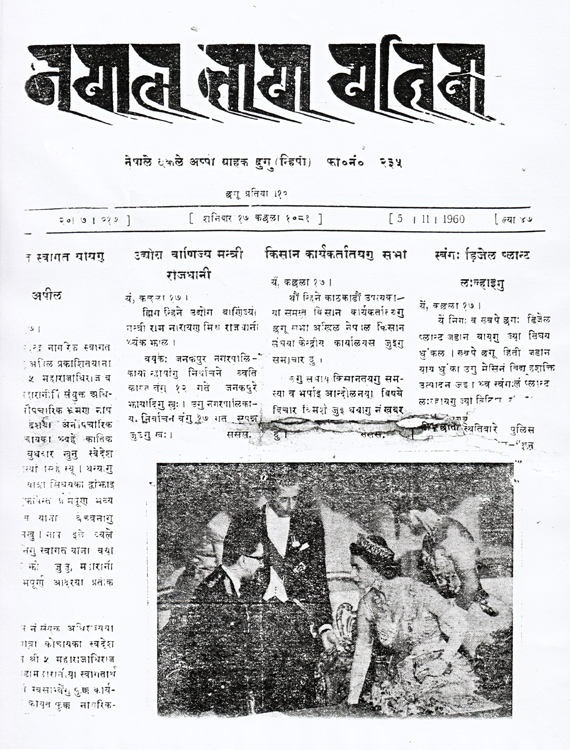
Following the overthrow of the Rana dynasty and the advent of democracy in 1951, restrictions on publication in Newar were removed. Books, magazines and newspapers appeared. A daily newspaper Nepal Bhasa Patrika began publication in 1955. Textbooks were published and Newar was included in the curriculum. Nepal Rastriya Vidhyapitha recognised Newar as an alternative medium of instruction in the schools and colleges affiliated to it.
Literary societies like Nepal Bhasa Parisad were formed and Chwasa: Pasa returned from exile. In 1958, Kathmandu Municipality passed a resolution that it would accept applications and publish major decisions in Newar in addition to the Nepali language.
Second dark age
Democracy lasted for a brief period, and Newar and other languages of Nepal entered a second Dark Age with the dissolution of parliament and the imposition of the Panchayat system in 1960. Under its policy of "one nation, one language", only the Nepali language was promoted, and all the other languages of Nepal were suppressed as "ethnic" or "local" languages.
In 1963, Kathmandu Municipality's decision to recognize Newar was revoked. In 1965, the language was also banned from being broadcast over Radio Nepal. Those who protested against the ban were put in prison, including Buddhist monk Sudarshan Mahasthavir.
The New Education System Plan brought out in 1971 eased out Nepal's other languages from the schools in a bid to diminish the country's multi-lingual traditions. Students were discouraged from choosing their native language as an elective subject because it was lumped with technical subjects. Nepal's various languages began to stagnate as the population could not use them for official, educational, employment or legal purposes.
Birat Nepal Bhasa Sahitya Sammelan Guthi (Grand Nepal Bhasa Literary Conference Trust), formed in 1962 in Bhaktapur, and Nepal Bhasa Manka Khala, founded in 1979 in Kathmandu, are some of the prominent organizations that emerged during this period to struggle for language rights. The names of these organizations also annoyed the government which, on one occasion in 1979, changed the name of Brihat Nepal Bhasa Sahitya Sammelan Guthi in official media reports.
Some lines by the famous poet Durga Lal Shrestha of this era are as follows:
:घाः जुयाः जक ख्वइगु खः झी :स्याःगुलिं सः तइगु खः :झी मसीनि ! झी मसीनि ! :धइगु चिं जक ब्वैगु खः
:We are crying because we are wounded :We are shouting because of the pain :All in all, we are demonstrating :That we are not dead yet.
Post-1990 People's Movement
After the 1990 People's Movement that brought the Panchayat system to an end, the languages of Nepal enjoyed greater freedom. The 1990 constitution recognized Nepal as a multiethnic and multilingual country. The Nepali language in the Devanagari script was declared the language of the nation and the official language. Meanwhile, all the languages spoken as native languages in Nepal were named national languages.
In 1997, Kathmandu Metropolitan City declared that its policy to officially recognize Nepal Bhasa would be revived. The rest of the city governments in the Kathmandu Valley announced that they too would recognize it. However, critics petitioned the Supreme Court to have the policy annulled, and in 1999, the Supreme Court quashed the decision of the local bodies as being unconstitutional.
Post-2006 People's Movement
A second People's Movement in 2006 ousted the Shah dynasty and Nepal became a republic which gave the people greater linguistic freedom. The 2007 Interim Constitution states that the use of one's native language in a local body or office shall not be barred. However, this has not happened in practice. Organizations with names in Newar are not registered, and municipality officials refuse to accept applications written in the language.{{cite news|title= State affairs
The restoration of democracy has been marked by the privatization of the media. Various people and organizations are working for the development of Newar. Newar has several newspapers, a primary level curriculum, several schools, several FM stations (selected time for Newar programs), regular TV programs and news (on Image TV Channel), Nepal Bhasa Music Award (a part of Image Award) and several websites (including a Wikipedia in Nepal Bhasa).
The number of schools teaching Newar has increased, and Newar is also being offered in schools outside the Kathmandu Valley.
Outside Nepal Mandala
Inscriptions written in Newar occur across Nepal Mandala and outside.
In Gorkha, the Bhairav Temple at Pokharithok Bazaar contains an inscription dated Nepal Sambat 704 (1584 AD), which is 185 years before the conquest of the Kathmandu Valley by the Gorkha Kingdom. The Palanchowk Bhagawati Temple situated to the east of Kathmandu contains an inscription recording a land donation dated Nepal Sambat 861 (1741 AD).
In Bhojpur in east Nepal, an inscription at the Bidyadhari Ajima Temple dated Nepal Sambat 1011 (1891 AD) records the donation of a door and tympanum. The Bindhyabasini Temple in Bandipur in west Nepal contains an inscription dated Nepal Sambat 950 (1830 AD) about the donation of a tympanum.
Outside Nepal, Newar has been used in Tibet. Official documents and inscriptions recording votive offerings made by Newar traders have been found in Lhasa. A copper plate dated Nepal Sambat 781 (1661 AD) recording the donation of a tympanum is installed at the shrine of Chhwaskamini Ajima (Tibetan: Palden Lhamo) in the Jokhang Temple.
Geographic distribution


Newar is spoken by over 800,000 people in Nepal according to the 2021 census.
- In Nepal: Kathmandu Valley (including Kathmandu, Lalitpur, Bhaktapur and Madhyapur Thimi municipalities), Dolakha District, Banepa, Dhulikhel, Bandipur, Bhimphedi (Makwanpur), Panauti, Palpa, Trishuli, Nuwakot, Bhojpur, Chitlang, Narayangarh, Chitwan.
- In India: West Bengal & Sikkim
- In Tibet: Lhasa
With an increase in emigration, various bodies and societies of Newar-speaking people have emerged in countries such as the US, the UK, Australia, and Japan.
Official status
Nepal
Newar was Nepal Mandala's (then only known as Nepal) administrative language from the 14th to the late 18th century. The continued official use of Newari into the Shah dynasty is shown by the 1775 treaty with Tibet, which was written in the language, but it was gradually replaced in official use by Gorkhali. From the early 20th century until democratization, Newar suffered from official suppression. During this period, the use of the language for business and literary purposes was declared illegal, and Newar authors were fined or imprisoned.
The Language Commission of Nepal recommended Bagmati Province to provide Nepal Bhasa (Newar) the status of official language, alongside Tamang. The commission also recommends Nepal Bhasa (Newar) for official status in specific areas and purposes in Koshi Province and Gandaki Province. At local levels, Nepal Bhasa (Newar) has official status in Kathmandu Metropolitan City, Lalitpur Metropolitan City and Kirtipur Municipality Chandragiri Municipality, Shankharapur Municipality, Tarkeshwor Municipality of Kathmandu district; Banepa Municipality, Dhulikhel Municipality of Kavre district; Godavari Municipality of Lalitpur district; and Bhaktapur Municipality, Madhyapur Thimi Municipality of Bhaktapur district have recognized Nepal Bhasa in some ways. Similarly, Bhimeshor Municipality has recognized and made policy-level decisions for Dolakha Nepal Bhasa.
India
Newar is an additional official language in Sikkim for the purpose of preservation of culture and tradition in the state. The official weekly publication Sikkim Herald has a Newar Edition. The Information & Public Relations Department also broadcasts news bulletin in Newar.
Education
Nepal Bhasa is included as elective mother tongue subject in schools by Curriculum Development Committee. Tribhuvan University offers Bachelors, Masters, Mphil and PhD degree in Nepal Bhasa. Expatriates can study Nepal Bhasa at Bishwa Bhasa Campus in Kathmandu. Kathmandu Metropolitan City and Kirtipur Municipality are teaching Nepal Bhasa as a local language. Newar is taught in schools of Sikkim.
Classification
The exact placement of Newar within the Tibeto-Burman language family has been a source of controversies and confusion. Robert Shafer classified Newar as part of his Bodic division of Sino-Tibetan. George Van Driem classified Newar within the Mahakiranti grouping but he later retracted his hypothesis in 2003. Moreover, he proposed a new grouping called "Maha-Newari" which possibly includes Baram–Thangmi.
T. R. Kansakar attributes the difficulty about the placement of Newar to the inability of scholars to connect it with the migration patterns of the Tibeto-Burman speakers. Since Newar separated from rest of the family very early in history, it is difficult or at least arbitrary to reconstruct the basic stratum that contributed to present day Newar speech. He underscored the point that the language evolved from mixed racial/linguistic influences that do not lend easily to a neat classification.
A classification (based on Glover's) indicating a percentage of shared vocabulary within the labeled branch and an approximate time of split:
ɫ "%" indicates lexical similarity/common vocabulary between Newar and the other languages in the branch. The date indicates an approximate time when the language diverged.
ɞ Van Driem labelled this branch as "Parakiranti" and included it together with Kiranti branch to form Maha Kiranti group. However, he would later drop this hypothesis.
ʌ All languages within this branch have extensive Indo-Aryan vocabulary. It is hypothesised that either ancient IndoAryan admixture happened before Newar-Thangmi-Baram split or that Thangmi-Baram borrowed through Newari.
Literature
Main article: Newari literature
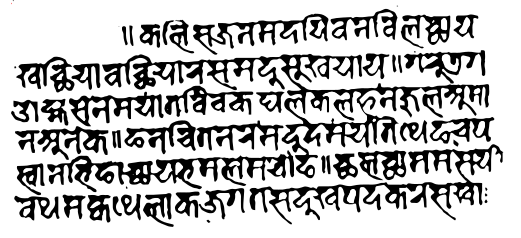

Newar literature has a long history. It has one of the oldest literatures of the Sino-Tibetan languages (together with Chinese, Tibetan, Tangut, Burmese, Yi, etc.)
Drama
Dramas are traditionally performed in open Dabu (stage). Most of the traditional dramas are tales related to deities and demons. Masked characters and music are central elements to such dramas. Most of them are narrated with the help of songs sung at intervals. Such dramas resemble dance in many cases. The theme of most dramas is the creation of a social well-being with morals illustrating the rise, turbulence, and fall of evil. There is fixed dates in the Nepal Sambat (Nepal Era) calendar for the performance of specific drama. Most of the dramas are performed by specific Guthis.
Poetry
Poetry writing constituted a splendid part of medieval Malla aristocracy. Many of the kings were well-renowned poets. Siddhidas Mahaju and Chittadhar Hridaya are two great poets in the language.
Prose fiction
Prose fiction in Newar is a relatively new field of literature compared to other fields. Most fiction was written in poetry form until the medieval era. Consequently, almost all prose fiction belongs to the modern Newar era. Collections of short stories in Newar are more popular than novels.
Story
The art of verbal storytelling is very old in Newar. There are a variety of mythical and social stories that have aided in establishing the norm of Kathmandu valley. Stories ranging from the origin of Kathmandu valley to the temples of the valley and the important monuments have been passed down verbally in Newar and very few exist in written form. However, with an increase in the literacy rate and an awareness among the people, folklore stories are being written down. Stories on other topics are also becoming popular.
Dialects
Kansakar (2011) recognizes three main Newar dialect clusters.
- Western: Tansen (Palpa), Butwal, Nepalgunj, Old Pokhara, Dumre, Bandipur, Ridhi (Gulmi), Baglung, Dotili / Silgadi
- Central: Kathmandu, Lalitpur, Bhaktapur, Thimi, Kirtipur, Chitlang, Lele, Balaju, Tokha, Pharping, Thankot, Dadikot, Balami, Gopali, Bungamati, Badegaon, Pyangaon, Chapagaon, Lubhu, Sankhu, Chakhunti, Gamtsa Gorkha, Badikhel (Pahari), Kavrepalanchok District dialects (Banepa, Nala, Sangaa, Chaukot, Panauti, Dhulikhel, Duti), Khampu, Khopasi
- Eastern: Chainpur, Dharan, Dolakha, Sindhupalchok, Taplejung, Terhathum, Bhojpur, Dhankuta, Narayangadh, Jhapa, Ilam
Kansakar (2011) also gives the following classification of Newar dialects based on verb conjugation morphology.
- Central
- Kathmandu, Lalitpur, Kirtipur, Chitlang, Lele
- Bhaktapur, Thimi
- Eastern
- Dolakha, Tauthali, Jethal, Listikot, Doti
- Pahari (Badikhel)
Kapali (1141 N.S.) gives the following classification of Nepal Bhasa dialects based on mutual intelligibility.
- Nepa Valley (Kathmandu Valley)
- Eastern – includes the region of Bhaktapur, Sakwa and seven villages of Kavre.
- Western – includes Kathmandu and Lalitpur
- Dwalkha- includes Dolakha and Charikot of Dolakha district, Tauthali and Jethal of Sindupalchok district, and Duti of Kavre district.
- Smaller dialects based on locality
- Pyang gaan, a village in Lalitpur
- Smaller dialects based on caste group
- Gopali
- Balami
- Pahari
Other ways Nepal Bhasa is classified are as follows:- ;Bhaktapur :Also known as Khwapey Bhāy ख्वपय् भाय्, this dialect is more archaic than the standard. Variations exist in the use of this form of language in Bhaktapur, Banepa, Panauti, and Dhulikhel. ;Chitlang :This dialect is used in Chitlang, a place south of Kathmandu valley in Makawanpur district. This is one of the biggest Newar bastions at Chitlang. Balami caste predominates there. ;Dolakha :This is the most preserved form of the language and resembles the old Newar. ;Kathmandu-Lalitpur :Kathmandu dialect, also known as Yenmi Bhāy येँमि भाय्, is one of the dominant forms of the language and very close to the standard form of the language used in academia and media. It is also the most widely used dialect. It is spoken especially in Kathmandu. Lalitpur dialect, also known as Yeley Bhāy यलय् भाय्, is the most dominant form of language and is the standard form of language used in academics and media. It is also very widely used dialect. It is especially spoken in Lalitpur. Due to the similarity between Kathmandu and Lalitpur dialects, it is often grouped as one. Almost 95% of Nepal Bhasa publications are in this dialect. ;Pahari :Pahari variation of Nepal Bhasa is spoken among the Pahari caste. ;Pyangaan :A variation of Nepal Bhasa spoken in Pyaangaan town of Lalitpur district.
Religions play a register-like role in dialectical diversity though they are minor. It has been recorded from the Malla period. There are some vocabulary differences used among Newar Hindus and Buddhists but the dialects of Patan and Kathmandu are similar. Hinduism and Buddhism were present at that age and few words in Hinduism and Buddhism of Newar differs. With the recent growth of Christianity, Islam, other religions, and atheism in Nepal, the diversity in the speech registers regarding religious terminology has become more extended, such as omitting the word dyaḥ (द्यः, 'god') after the name of a deity by many people whereas it is retained in Hinduism and Buddhism.
Phonology
Consonants
| Labial | Dental/ | |||||||||||||||||||
|---|---|---|---|---|---|---|---|---|---|---|---|---|---|---|---|---|---|---|---|---|
| Alveolar | Retroflex | (Alveolo-) | ||||||||||||||||||
| palatal | Velar | Glottal | Nasal | voiced | murmured | Stop/ | ||||||||||||||
| Affricate | voiceless | aspirated | voiced | murmured | Fricative | Tap | voiced | murmured | Approximant | voiced | murmured | |||||||||
| 1 | 1 | |||||||||||||||||||
| 2 | ||||||||||||||||||||
| 2 | ||||||||||||||||||||
| 2 | ||||||||||||||||||||
| 2 | ||||||||||||||||||||
| () | 2 | |||||||||||||||||||
| 2 | 2 | |||||||||||||||||||
| 1 | 1 | 1 |
- Only in Kathmandu Newar.
- Only in Dolakha Newar.
; Notes
- Marginal phonemes are in parentheses.
- Allophonic variants are in Square brackets.
- Tap consonants mainly occur as word-medial alternates of //, //, // or // (in Dolakha only).
- // can be heard as [] when occurring before front vowels/glide //.
- In Kathmandu Newar, // only occurs as word-final.
- Affricates // can also shift to retracted sounds [] when occurring before back vowels.
Vowels
| Front | Central | Back | short | long | nasal | short | long | nasal | short | long | nasal | Close | Close-mid | Mid | Open-mid | Open |
|---|---|---|---|---|---|---|---|---|---|---|---|---|---|---|---|---|
| () | () | () | ~ | ~ | ~ | |||||||||||
| 1 | 1 | |||||||||||||||
| 1 | 1 |
- Only in Kathmandu Newar.
- In Kathmandu Newar, the back vowel sounds // occur as [], [], or [].
- In Dolakha Newar, the back vowel sounds //, can occur [], [], or [].
- // and // can also be heard as [], and [].
- The following nasal vowels can also be distinguished in vowel length as //.
Diphthongs
| Front | Central | Back | oral | nasal | oral | nasal | oral | nasal | Diphthong | Close | Mid | Open |
|---|
Writing systems


Main article: Nepal alphabets
Nepal Bhasa is currently written in Nepal Lipi, Ranjana Lipi and Devanagari script. The script originally used, Nepal Lipi or "Nepalese script", fell into disuse at the beginning of the 20th century when writing in the language and the script was banned, which resulted in emergence of Devanagari script. However, in past decades attempts are being made for revival.
Nepal Lipi, also known as Nepal Akha, emerged in the 10th century. Over the centuries, a number of variants of Nepali Lipi have appeared.
Nepal Bhasa has been written in a variety of abugida scripts:
- Gupta script
- Kutila script
- Prachalit script
- Ranjana script
- Bhujinmol script
- Kunmol script
- Kwenmol script
- Litumol script
- Hinmol script
- Golmol script
- Pachumol script
- Devanagari script
Devanagari is the most widely used script at present, as it is common in Nepal and India. Pracalit script, Bhujimol script and Ranjana script were the most widely used script to write Classical Nepalese in ancient times. It is experiencing a revival due to the recent rise of cultural awareness.
Ranjana alphabet
Classical Nepalese materials written in Ranjana can be found in present-day Nepal, East Asia, and Central Asia.
Consonants
Special consonant in Nepal omitted.
| [[File:Ranjana sh.svg | 24px]] ɕ श | [[File:Ranjana ss.svg | 24px]] ʂ ष | [[File:Ranjana s.svg | 24px]] s̪ स | [[File:Ranjana h.svg | 24px]] h ह |
|---|
| [[File:Ranjana ksh.svg | 24px]] kʂ क्ष | [[File:Ranjana tr.svg | 24px]] t̪r त्र | [[File:Ranjana jny.svg | 24px]] d͡ʑɲ ज्ञ |
|---|
Vowels
There are 3 series of vowel diacritics – the -like system, the -like system, and the -like system.
- Use the -like system when applying to , , , , , and
- Use the -like system when applying to , , , , , , , and
- Use the -like system when applying to , , , , , , , , , , , , , , , , , , , , , , , , , , , ,
Note that many of the consonants mentioned above (e.g. , , , etc.) occur only in loan words and mantras.
Consonant-free vowels
Numerals
Main article: Newar numerals
- The numerals used in Ranjana script are as follows (from 0 to 9):
| [[File:Ranjana 0.svg | 24px]] 0 | [[File:Ranjana 1.svg | 24px]] 1 | [[File:Ranjana 2.svg | 24px]] 2 | [[File:Ranjana 3.svg | 24px]] 3 | [[File:Ranjana 4.svg | 24px]] 4 | [[File:Ranjana 5.svg | 24px]] 5 | [[File:Ranjana 6.svg | 24px]] 6 | [[File:Ranjana 7.svg | 24px]] 7 | [[File:Ranjana 8.svg | 24px]] 8 | [[File:Ranjana 9.svg | 24px]] 9 |
|---|
Devanagari orthography
Modern Newar is written generally with the Devanagari script, although formerly it was written in the Ranjana and other scripts. The letters of the Nagari alphabet are traditionally listed in the order vowels (monophthongs and diphthongs), anusvara and visarga, stops (plosives and nasals) (starting in the back of the mouth and moving forward), and finally the liquids and fricatives, written in IAST as follows (see the tables below for details):
:a ā i ī u ū ṛ ṝ ḷ ḹ; e ai o au :ṃ ḥ :k kh g gh ṅ; c ch j jh ñ; ṭ ṭh ḍ ḍh ṇ; t th d dh n; p ph b bh m :y r l v; ś ṣ s h
Kathmandu Newar does not use ñ for the palatal nasal but instead writes this sound with the ligature as for example in the word nyā 'five'. Orthographic vowel length (i vs ī and u vs ū) represents a difference of vowel length while the vowels with no orthographic length (a and ā) is indicated with the visarga (e.g. khāḥ (**IPA: **) 'is').
Vowels
The vowels, called mā ākha (माआखः), meaning "mother letters", used in Newar are:
| Orthography | अ | अः | आ | आः | इ | ई | उ | ऊ | ऋ | ॠ | ऌ | ॡ | ए | ऐ | ओ | औ | अँ | अं | अय् | आय् | एय् | |||||||||||||||||||||
|---|---|---|---|---|---|---|---|---|---|---|---|---|---|---|---|---|---|---|---|---|---|---|---|---|---|---|---|---|---|---|---|---|---|---|---|---|---|---|---|---|---|---|
| Roman |
Even though ऋ, ॠ, ऌ, ॡ are present in Newar, they are rarely used. Instead, some experts suggest including अय् (ay) and आय् (aay) in the list of vowels.
Consonants
The consonants, called bā ākha (बाआखः), meaning "father letters", used in Newar are:
| क | ख | ग | घ | ङ | ङ्ह | च | छ | ज | झ | ञ | ञ्ह | ट | ठ | ड | ढ | ण | ण्ह | त | थ | द | ध | न | न्ह | प | फ | ब | भ | म | म्ह | य | ह्य | र | ह्र | ल | ल्ह | व | व्ह | श | ष | स | ह | क्ष | त्र | ज्ञ |
|---|
ङ्ह, ञ्ह, ण्ह, न्ह, म्ह, ह्य, ह्र, ल्ह and व्ह are sometimes included in the list of consonants as they have a specific identity in Nepal.
The use of ङ and ञ was very common in the old form of language. However, in the new form, especially in writing, the use of these characters has diminished. The use of ण, त, थ, द, ध, न, श, ष, क्ष, त्र, ज्ञ is limited by the new grammar books to the loan words only.
Complex/compound consonants
Besides the consonants mentioned above, combined consonants called chinā ākha (चिना आखः) are used.
Numerals
Main article: Newari numerals
- The same numerals in Devanagari are:
Romanization
Nepala Bhasa Roman Transliteration (NBRT) was introduced in 2021, with some modifications to International Alphabet of Sanskrit Transliteration.
Grammar
Newar language is one of the few Tibeto-Burman languages with a clusivity distinction.
Noun cases
Noun cases in Newar have six cases and are differentiated based on whether the term in question is animate or inanimate. The following charts provides case endings that can be affixed on the end of nouns, pronouns, and adjectives in IAST transliteration for contemporary and old (or "classical") Newar.
| Locative | -e, -ay, -ī | X | X | X | X |
|---|
| Locative | -s | -(s)ke, -yāke | X | -(s)ke, -yāke | -paniske |
|---|
Indo-Aryan loanwords
Newar is one of the most Aryanized Sino-Tibetan languages. Below are some basic words borrowed from Indo-Iranian languages:
| Words | Origin (orig. word) | Meaning |
|---|---|---|
| Abu | Persian | Father |
| Ākha | Sanskrit | Letter |
| La:h (ल:) | Sanskrit (Jala:h) | Water |
| Kaa:sa | Sanskrit | Bronze |
| Ka:h | Pali (Kana) | Blind (Original meaning in Pali was "one-eyed") |
| Ka:n | Sanskrit | Thorn |
| Kaji | Arabic | leader |
| Kimi (कीमी) | Sanskrit (Krmi) | Hookworm |
| Khaapaa (खापा) | Pali | Door (Original meaning in Pali was "door panel") |
| Khicha: (खिचा) | Sanskrit (Kukkura:h) | Dog |
| Ga:n | Sanskrit | Bell |
| Dya:h | Sanskrit (Dev) | Deity |
| Naa:n | Sanskrit | Name |
| Nhya:h | Sanskrit (Na:sika) | Nose |
| Bhay | Sanskrit | Language |
| Dey (देय) | Sanskrit | country |
| Bhukha | Sanskrit | Earthquake |
| Manu | Sanskrit | Person |
| Manda:h | Sanskrit | Circle |
| Mhu:tu | Sanskrit (Mukh) | Mouth |
| Gha:h | Sanskrit | Water pot |
| Dekhā | Sanskrit | Initiation |
| Pukhuri | Sanskrit | Pool |
| Niga:h | Sanskrit | City |
| Gām | Sanskrit | Village |
| Lhā | Sanskrit | Hand |
Notes
References
Citations
Bibliography
References
- "The Sikkim Official Languages Act". Government of Sikkim.
- ''Nepal Bhasa Sahityaya Itihas: History of Nepalbhasa Literature.''Tuladhar, Prem Shanti (2000). Kathmandu: Nepal Bhasa Academy. {{ISBN. 99933-56-00-X. Page 37: "The early new rulers cultivated Newari language. Kings Prithvi Narayan Shah, Rana Bahadur and Rajendra Bikram Shah composed poetry and wrote many plays in Newari".
- Levy, Robert I. (1990) ''Mesocosm: Hinduism and the Organization of a Traditional Newar City in Nepal.'' Delhi: Motilal Banarsidass Publishers. {{ISBN. 81-208-1038-4. Page 15:"Following the advent of the Shahs, the Gorkhali language became the court language, and Newari was replaced as the language of administration".
- Malla, kamal. History of the Nepal. Kathmandu, Nepal: Rolwaling press. p. 155
- {{Cite OED. Newar
- (2023). "प्रदेश सरकारी कामकाजको भाषा ऐन, २०८०". Ministry of Internal Affairs and Law, Bagmati Province.
- Shakya, Daya R.. (1998). "In Naming a Language". Journal of Newar Studies.
- (2024). "The Diachronic Annotated Corpus of Newar: From manuscript to morphosyntax". Cahiers de Linguistique Asie Orientale.
- Maharjan, Resha. (2018). "The Journey of Nepal Bhasa: From Decline to Revitalization (M.Phil. thesis)". UIT The Arctic University of Norway.
- Gellner, David N.. (1986). "Language, caste, religion and territory: Newar identity ancient and modern". European Journal of Sociology / Archives Européennes de Sociologie.
- Pal, Pratapaditya. (1974). "The arts of Nepal II.: Painting.". Brill Archive.
- Regmi, Dilli Raman. (2007). "Medieval Nepal Part II". Rupa and Co.
- Burghart, Richard. (1984). "The Formation of the Concept of Nation-State in Nepal". The Journal of Asian Studies.
- Malla, Kamal Prakash. (1989). "Nepal: Perspectives on Continuity and Change". Centre for Nepal and Asian Studies, Tribhuvan University.
- Tumbahang, Govinda Bahadur. (2010). "Marginalization of Indigenous Languages of Nepal". Contributions to Nepalese Studies.
- Vajracharya, Suwarn. (2014). "Language Politics and State Policy in Nepal: A Newar Perspective". University of Tsukuba.
- Malla, Kamal P.. "The Occupation of the Kathmandu Valley and its Fallout".
- Grandin, Ingemar. "Between the market and Comrade Mao: Newar cultural activism and ethnic/political movements (Nepal)".
- "UNESCO Atlas of the World's Languages in Danger".
- Bajracharya, Srizu. (23 November 2019). "Newar flavours in the 3rd Nepal Bhasa Literature Festival".
- "Nepali, Tamang, Nepal Bhasha official languages of Bagmati".
- "Nepal Bhasa as official language in metropolis".
- "'राजधानी प्रदेश' र 'नेवा राज्य' : केही भ्रमको खण्डन".
- (2006). "नेपालमण्डल". Nepal Mandal Anusandhan Guthi.
- "Save Nepa Valley Movement Homepage".
- (31 May 2018). "बाहिरी चक्रपथ र स्याटलाइट शहर: विकासको नाममा आत्महत्या !".
- (October 2025). "रञ्जनाको साैन्दर्यमा युवा मुग्ध".
- "नेवार जाति र वर्तमान अवस्था".
- (2018). "भक्तपुर नगरपालिका स्थानीय पाठ्यक्रम २०७५". Bhaktapur Municipality.
- "'राजधानी प्रदेश' र 'नेवा राज्य' : केही भ्रमको खण्डन".
- "नेपालको जिल्ला प्रशासन पुनर्गठनको रिपोर्ट २०१३". Government of Nepal.
- "एकल राष्ट्र–राज्यको धङधङी". Kantipur Publication Limited.
- Widdess, Professor Richard. (2013-12-02). "Dāphā: Sacred Singing in a South Asian City: Music, Performance and Meaning in Bhaktapur, Nepal". Ashgate Publishing, Ltd..
- Pal, Pratapaditya. (1974). "The arts of Nepal II.: Painting.". Brill Archive.
- "Celestial Advice".
- "Classical Newari Literature".
- Alsop, Ian. (11 March 2021). "Christians at the Malla Court: The Capuchin 'piccolo libro'". Asian Art.
- (2011). "The Catalogue of the Hodgson Collection in the British Library". European Bulletin of Himalayan Research.
- Poudel, Nayanath. (17 June 2023). "nevāra śabdako prācīnatā". [[Gorkhapatra]].
- Vannini, Fulgentius. (1977). "Christian Settlements in Nepal During the Eighteenth Century". For copies, Capuchin Ashram.
- Thapa, Lekh Bahadur. (1 November 2013). "Roots: A Khas story". The Kathmandu Post.
- Hodgson, B. H.. (1841). "Illustrations of the literature and religion of the Buddhists". Serampore.
- Lienhard, Siegfried (1992). ''Songs of Nepal: An Anthology of Nevar Folksongs and Hymns.'' New Delhi: Motilal Banarsidas. {{ISBN. 81-208-0963-7. Page 3.
- "एकल राष्ट्र–राज्यको धङधङी". Kantipur Publication Limited.
- Clark, T. W.. (1973). "Current Trends in Linguistics". Walter de Gruyter.
- (June 2003). "The kings song". Himal Southasian.
- "साझा प्रकाशन एक झलक".
- (5 March 2022). "नेपाल भाषा नामको औपचारिक पुनःस्थापना सम्बन्धी सूचनाको हकद्वारा प्राप्त मन्त्रीपरिषद्को निर्णय (व्यक्तिगत अभिलेखको उतार)".
- (9 September 1995). "It's Nepal Bhasa". The Rising Nepal.
- (9 September 1995). "अबदेखि "नेपाल भाषा"". Gorkhapatra.
- (14 November 1998). "Mass media directed to use Nepal Bhasa". The Rising Nepal.
- (14 November 1998). "'नेपाल भाषा' शब्दको प्रयोग गर्न निर्देशन". Gorkhapatra.
- (2013). "Major highlights". Central Bureau of Statistics.
- David N. Gellner (1986). ''Language, caste, religion and territory: Newar identity ancient and modern'', European Journal of Sociology, p.102-148
- Malla, Kamal P.. (1981). "Linguistic Archaeology of the Nepal Valley: A Preliminary Report". [[University of Cambridge]].
- (1990). "Mesocosm: Hinduism and the Organization of a Traditional Newar City in Nepal". University of California Press.
- Shrestha, Purushottam Lochan. (2001). "Tripura ra Yuthunimama Durbara". Bhaktapur Offset Prints.
- Shrestha, Purushottam Lochan. (2001). "Tripura ra Yuthunimama Durbara". Bhaktapur Offset Prints.
- Malla, Kamal P. "The Earliest Dated Document in Newari: The Palmleaf from Uku Bahah NS 234/AD 1114". Kailash.
- Vaidya, Dr. Janak Lal. (4 November 1994). "nepāla bhāṣā sāhityayā dhāḥ". Kheluita.
- Turin, Mark. (2000). "Shared words, shared history? The case of Thangmi and Late Classical Newar". Newâh Vijñâna.
- (1985). "The Gopalarajavamsavali". Franz Steiner Verlag Wiesbaden GMBH.
- Gutschow, Niels. (1997). "The Nepalese Caitya: 1500 Years of Buddhist Votive Architecture in the Kathmandu Valley". Edition Axel Menges.
- Bajracharya, Chunda (1985). ''Mallakalya Chhun Sanskriti'' ("Some Customs of the Malla Period"). Kathmandu: Kashinath Tamot for Nepal Bhasa Study and Research Centre.
- Kalapura, Jose. (2008). "Nepal Inscribed: Christian Missionaries in Nepal in the 18th century". Proceedings of the Indian History Congress.
- Dhaubhadel, Om Prasad. (September 2020). "''Ranajita Malla ra satbahale rajkumara haru''". Bhaktapur Municipality.
- Gellner, David N.. (1986). "Language, caste, religion and territory: Newar identity ancient and modern". European Journal of Sociology / Archives Européennes de Sociologie.
- Shrestha, Bal Gopal. (January 1999). "The Newars: The Indigenous Population of the Kathmandu Valley in the Modern State of Nepal". CNAS Journal.
- Levy, Robert I. (1990) ''Mesocosm: Hinduism and the Organization of a Traditional Newar City in Nepal.'' Delhi: Motilal Banarsidass Publishers. {{ISBN. 81-208-1038-4. Page 15.
- Los Angeles County Museum of Art and Pal, Pratapaditya (1985) ''Art of Nepal: A Catalogue of the Los Angeles County Museum of Art Collection.'' University of California Press. {{ISBN. 978-0-520-05407-3. Page 19.
- (1962). "Triratna Saundarya Gatha". Nepal Sanskritik Parishad.
- Singh, Phatte Bahadur. (September 1979). "Nepali Biharya Aitihasik Pristabhumi ("Historical Background of Nepali Bihar")". Kathmandu: Nepal Bhasa Sahitya Pala, Tri-Chandra Campus.
- Hutt, Michael. (December 1986). "Diversity and Change in the Languages". Tribhuvan University.
- Tumbahang, Govinda Bahadur. (September 2009). "Process of Democratization and Linguistic (Human) Rights in Nepal". Tribhuvan University Journal.
- Lienhard, Siegfried (1992). ''Songs of Nepal: An Anthology of Nevar Folksongs and Hymns.'' New Delhi: Motilal Banarsidas. {{ISBN. 81-208-0963-7. Page 4.
- LeVine, Sarah and Gellner, David N. (2005). ''Rebuilding Buddhism: The Theravada Movement in Twentieth-Century Nepal.'' Harvard University Press. {{ISBN. 0674019083, 9780674019089. Pages 47–49.
- Hridaya, Chittadhar (1982, third ed.) ''Jheegu Sahitya'' ("Our Literature"). Kathmandu: Nepal Bhasa Parisad. Page 8.
- Manandhar, T. (7 March 2014). "Voice Of The People". The Kathmandu Post.
- Malla, Kamal P.. "The Occupation of the Kathmandu Valley and its Fallout".
- Shrestha, Bal Gopal. (January 1999). "The Newars: The Indigenous Population of the Kathmandu Valley in the Modern State of Nepal)". CNAS Journal.
- Gurung, Kishor. (Nov–Dec 1993). "What is Nepali Music?". Himal.
- शुक्रराज अस्पताल स्मारिका २०५७, Page 52, नेपालभाषाको पुनर्जागरणमा शुक्रराज शास्त्री by सह-प्रा. प्रेमशान्ति तुलाधर
- Bajracharya, Phanindra Ratna (2003). ''Who's Who in Nepal Bhasha.'' Kathmandu: Nepal Bhasa Academy. Page 27.
- (13 November 2009). "Sugata Saurabha: An Epic Poem from Nepal on the Life of the Buddha by Chittadhar Hridaya". Oxford Scholarship Online.
- Shrestha, Siddhicharan (1992). ''Siddhicharanya Nibandha ("Siddhicharan's Essays").'' Kathmandu: Phalcha Pithana. Page 73.
- LeVine, Sarah and Gellner, David N. (2005). ''Rebuilding Buddhism: The Theravada Movement in Twentieth-Century Nepal.'' Harvard University Press. {{ISBN. 0-674-01908-3, {{ISBN. 978-0-674-01908-9. Pages 47–49.
- Tewari, Ramesh Chandra. (1983). "Socio-Cultural Aspects of Theravada Buddhism in Nepal". The Journal of the International Association of Buddhist Studies.
- Bajracharya, Phanindra Ratna (2003). ''Who's Who in Nepal Bhasha.'' Kathmandu: Nepal Bhasa Academy. {{ISBN. 99933-560-0-X. Page 225.
- (15 February 2010). "History of Nepali Journalism". Nepal Press Institute.
- (1 July 1997). "Sandhya Times". Sandhya Times.
- Whelpton, John. (2005). "A History of Nepal". Cambridge University Press.
- Timalsina, Ramji. (Spring 2011). "Language and Political Discourse in Nepal". Itahari: Itahari Research Centre, Circle of English Teachers (CET).
- Hangen, Susan. (2007). "Creating a "New Nepal": The Ethnic Dimension". Washington: East-West Center.
- (January 1995). "Education in the Mother Tongue: The Case of Nepal Bhasa (Newari)". CNAS Journal.
- Maharjan, Harsha Man. (2009). "They' vs 'We': A Comparative Study on Representation of Adivasi Janajati Issues in Gorkhapatra and Nepal Bhasa Print Media in the Post Referendum Nepal (1979–1990)". Social Inclusion Research Fund.
- {{lang. new. नेपालभाषाया न्हूगु पुलांगु म्ये मुना ब्वः१
- Eagle, Sonia. (1999). "The Language Situation in Nepal". Scribd.
- (2001). "Constitution of Nepal 1990". Nepal Democracy.
- Limbu, Ramyata. (21 June 1999}}{{Dead link). "Attempt to Limit Official Language to Nepali Resented". IPS.
- (January 2009). "The Interim Constitution of Nepal, 2063 (2007)". UNDP Nepal.
- (18 July 2013). "Jigu Nan Dhayegu Du". Sandhya Times.
- "Nepal Bhasa Wikipedia". new.wikipedia.org.
- Rai, Ganesh. (11 April 2012). "९७ विद्यालयमा नेपालभाषा पढाइने ("Nepal Bhasa to be taught in 97 schools")". Kantipur.
- Hridaya, Chittadhar (ed.) (1971). ''Nepal Bhasa Sahityaya Jatah.'' Kathmandu: Nepal Bhasa Parisad. Page 113.
- ''Jhee'' (February–March 1975). Kathmandu: Nepal Bhasa Bikas Mandal. Page 9.
- Hridaya, Chittadhar (ed.) (1971). ''Nepal Bhasa Sahityaya Jatah.'' Kathmandu: Nepal Bhasa Parisad. Pages 255–256.
- Hridaya, Chittadhar (ed.) (1971). ''Nepal Bhasa Sahityaya Jatah.'' Kathmandu: Nepal Bhasa Parisad. Page 47.
- Shrestha, Bal Gopal. (2005). "Ritual and Identity in the Diaspora: The Newars in Sikkim". Bulletin of Tibetology.
- (20 September 2013). "Himalaya Darpan". Himalaya Darpan.
- "Newar". Ethnologue.
- "सरकारी कामकाजको भाषाका आधारहरूको निर्धारण तथा भाषासम्बन्धी सिफारिसहरू (पञ्चवर्षीय प्रतिवेदन- साराांश) २०७८".
- (22 June 2017). "Nepal Bhasa as official language in metropolis". The Kathmandu Post.
- (November 2021). "स्थानीय तहमा नेपालभाषा सम्बन्धी सूचनाको हकद्वारा प्राप्त सूचनाको संगालो (व्यक्तिगत अभिलेखको उतार)".
- "कीर्तिपुर नगर साँस्कृतिक संरक्षित क्षेत्र सम्बन्धमा व्यवस्था गर्न बनेको ऐन, २०७८".
- "About Sikkim".
- "𑐳𑐶𑐎𑑂𑐎𑐶𑐩 𑐴𑐾𑐬𑐮𑑂𑐜".
- "IPR department's eNEWS bulletin in Newar language". Government of Sikkim.
- "मातृभाषा पाठ्यक्रम".
- (28 August 2021). "TU Introduces MPhil, PhD In Nepal Bhasa". Gorakhapatra.
- "Departments".
- (1 September 2022). "Eight local levels in Kathmandu implement local curriculum". My Republica.
- "Sikkim asks schools to introduce 11 local languages in curriculum".
- (1955). "Classification of the Sino-Tibetan languages". Word (Journal of the Linguistic Circle of New York).
- (2004). "Newar-Thangmi Lexical Correspondences and the Linguistic Classification of Thangmi". Journal of Asian and African Studies.
- Tej R. Kansakar. (June 1981). "Newari Language and Linguistics: Conspectus". CNAS Journal.
- (1970). "Tone systems of the Tibeto-Burman languages of Nepal 2: Lexical lists and comparative studies". Department of Linguistics University of Illinois.
- Vannini, Fulgentius. (1977). "Christian Settlements in Nepal During the Eighteenth Century". For copies, Capuchin Ashram.
- Kansakar, Tej R. 2011. ''A sociolinguistic survey of Newar / Nepal Bhasa''. Linguistic Survey of Nepal (LinSuN), Tribhuvan University, Kathmandu, Nepal.
- "नेपालभाषा लेखन सहयोगी". Self published.
- "नेपाल भाषा कार्यान्वयन कसरी गर्न सकिन्छ?".
- (22 June 2020). "Bibliography of Nepalbhasa Dictionaries".
- (2010). "A Grammar of Pahari, PhD Dissertation". Tribhuvan University.
- "नेपालभाषाया प्यांगां भाषिका". Ratna Printing Press.
- Genetti, Carol. (2003). "Dolakhā Newār". London & New York: Routledge..
- Hargreaves, David. (2003). "Kathmandu Newar (Nepāl Bhāśā)". London & New York: Routledge..
- (2006). "Newār (Nepāl Bhāsā)". LINCOM.
- "After being largely replaced by Devanagari, Nepal Bhasa scripts are making a comeback".
- [[Siegfried Lienhard. Lienhard, Siegfried]] (1992). ''Songs of Nepal: An Anthology of Nevar Folksongs and Hymns.'' New Delhi: Motilal Banarsidas. {{ISBN. 81-208-0963-7. Page 2.
- ''Nepal Bhasa Wyaakarana'' (page 2) by Tuyubahadur Maharjan, published by Nepal Bhasa Academy
- (13 December 2021). "Nepala Bhasa Roman Transliteration (NBRT)".
- Malla, Kamal P.. (1985). "The Newar Language: A Working Outline". Institute for the Study of Languages and Cultures of Asia and Africa.
- (2006). "Newar (Nepāl Bhāsā)". Lincom Europa.
- Otter, Felix. (2021). "A Course in Reading Classical Newari: Selections from the Vetālapañcaviṃśati". xasia eBooks.
- From the review article on "Dictionary of classical Newari compiled from manuscript sources." With the financial support of Toyota Foundation, Japan, Nepal Bhasa Dictionary Committee. Cwasā Pāsā. Kathmandu: Modern Printing Press, Jamal 2000, pp. XXXV, 530. {{ISBN. 99933-31-60-0"
This article was imported from Wikipedia and is available under the Creative Commons Attribution-ShareAlike 4.0 License. Content has been adapted to SurfDoc format. Original contributors can be found on the article history page.
Ask Mako anything about Newar language — get instant answers, deeper analysis, and related topics.
Research with MakoFree with your Surf account
Create a free account to save articles, ask Mako questions, and organize your research.
Sign up freeThis content may have been generated or modified by AI. CloudSurf Software LLC is not responsible for the accuracy, completeness, or reliability of AI-generated content. Always verify important information from primary sources.
Report