From Surf Wiki (app.surf) — the open knowledge base
New Zealand pound
Currency of New Zealand from 1840 until 1967

Currency of New Zealand from 1840 until 1967
| Field | Value |
|---|---|
| image_1 | New Zealand 1 pound note obverse series 2.jpg |
| image_title_1 | New Zealand one pound note |
| image_2 | 1940 New Zealand Penny, Reverse, Proof.png |
| image_title_2 | New Zealand one penny coin |
| date_of_introduction | 1840 |
| using_countries | New Zealand, Cook Islands, Niue, Pitcairn Islands, Tokelau |
| subunit_ratio_1 | |
| subunit_name_1 | shilling |
| subunit_ratio_2 | |
| subunit_name_2 | penny |
| symbol | £ |
| symbol_subunit_1 | s or / |
| symbol_subunit_2 | d |
| used_coins | d, 1d, 3d, 6d, 1/–, 2/–, 2/6 |
| used_banknotes | 10/–, £1, £5, £10, £50 |
| issuing_authority | Reserve Bank of New Zealand |
| issuing_authority_website | |
| date_of_withdrawal | 1967 |
| replaced_by_currency | New Zealand dollar |
| obsolete | yes |
The pound (symbol £, £N.Z. for distinction) was the currency of New Zealand from 1933 until 1967, when it was replaced by the New Zealand dollar. Prior to this, New Zealand used the pound sterling since the Treaty of Waitangi in 1840. Like the pound sterling, it was subdivided into 20 shillings (abbreviation s or /) each of 12 pence (symbol d).
History
Up until the outbreak of the First World War, the New Zealand pound was at parity with one pound sterling.
As a result of the Great Depression of the early 1930s, the New Zealand agricultural export market to the UK was badly affected. Australian banks, which controlled the New Zealand exchanges with London, devalued the New Zealand pound to match the value of the Australian pound in 1933, from parity or £NZ 1 = £1 sterling to £NZ 1 = 16s sterling (£0.8). In 1948, it returned to parity with sterling or £NZ 1 = £1 sterling.
In 1967, New Zealand decimalised its currency, replacing the pound with the dollar at a rate of $NZ 2 = £NZ 1 (or $NZ 1 = 10/– NZ). In November of that year, the British government devalued sterling from £1 sterling = US$2.80 to US$2.40, but the New Zealand dollar was devalued even more from $NZ 1 = US$1.40 to US$1.12 in order to match the value of the Australian dollar.
Coins
Initially, British and Australian coins circulated in New Zealand. The devaluation of the New Zealand pound relative to sterling in the 1930s led to the issue of distinct New Zealand coins in 1933, in denominations of 3d, 6d, 1/– (one shilling), 2/– (or florin) and 2/6 (half-crown), minted in 50% silver until 1946 and in copper-nickel from 1947. In 1940, bronze d and 1d coins were introduced. All these denominations were the same size and weight as their equivalents in the Australian and UK coinage (although Australia never minted a half-crown). When the UK introduced the nickel-brass twelve sided threepenny bit, New Zealand continued to use the smaller silver coin until decimalisation in 1967.
| Reverse Image | Value | Equivalent in cents (c) | Technical Parameters | Description | Date of | Diameter | Thickness | Mass | Composition | Edge | Obverse | Reverse | Issue | Withdrawal | ||
|---|---|---|---|---|---|---|---|---|---|---|---|---|---|---|---|---|
| [[File:1940 New Zealand Half-penny, reverse.png | frameless | 65px]] | d (half penny) | 0.4167c | 26 mm | 5.7 g | Bronze | Plain | King George VI (1940–52) | |||||||
| Queen Elizabeth II (1953–67) | A Māori hei-tiki (neck pendant) with ornamental tukutuku patterns on each side | 1940 | ||||||||||||||
| [[File:1940 New Zealand Penny, Reverse, Proof.png | frameless | 78px]] | 1d (one penny) | 0.8333c | 31 mm | 9.5 g | A tūī perched in a setting of yellow kōwhai blossoms | |||||||||
| [[File:1933 Threepence, New Zealand, Reverse.png | frameless | 40px]] | 3d (three pence) | 2.5c | 16 mm | 1.4 g | 50% silver (1933–1946) | |||||||||
| Cupronickel (1947–1967) | Plain | King George V (1933–1936) | ||||||||||||||
| King George VI (1937–1952) | ||||||||||||||||
| Queen Elizabeth II (1953–1967) | Two carved patu (Māori weapons) crossed with lanyards or thongs attached, with "3d" between their blades | 1933 | ||||||||||||||
| [[File:1934 New Zealand Sixpence, Reverse.png | frameless | 48px]] | 6d (six pence) | 5c | 19 mm | 2.9 g | Continuously milled | A huia perched on a branch | 31 October 20061 | |||||||
| [[File:1933 Shilling, New Zealand, Reverse.png | frameless | 58px]] | 1/– (one shilling) | 10c | 23 mm | 5.7 g | A figure of a Māori warrior in warlike attitude carrying a taiaha | |||||||||
| [[File:1933 New Zealand Florin, Reverse, Proof.png | frameless | 71px]] | 2/– (2 shillings, one florin) | 20c | 28.5 mm | 11.3 g | A kiwi facing left | |||||||||
| [[File:1933 New Zealand Half-Crown, Reverse, Proof.png | frameless | 88px]] | 2/6 ( shillings, 2 shillings and 6 pence, half crown) | 25c | 32 mm | 14.1 g | Arms of New Zealand on a background of Māori carvings. | |||||||||
| [[File:1953 New Zealand Crown, Reverse, Proof.png | frameless | 97px]] | 5/– (crown, five shillings) | 50c | 38.8 mm | 28.3 g | 50% silver (1935, 1949) | |||||||||
| Cupronickel (1953) | Commemorative only2 | |||||||||||||||
| Notes: {{olist | The sixpence, shilling, and florin (2 shilling), although rarely seen in circulation, remained legal tender as late as 2006, being used as the identical size and value of its decimal successors: the 5c (cents), 10c, and 20c coins respectively. They were demonetised on 31 October 2006, when the 5c coin and the original 10c and 20c coins were withdrawn from circulation. | Three commemorative crowns were issued in 1935, 1949, and 1953. Example Coronation crown shown; see: New Zealand crown |
Three commemorative crowns were minted: the Waitangi crown in 1935, a crown to commemorate a proposed royal visit in 1940, and a crown to commemorate the coronation of Queen Elizabeth II.
Banknotes
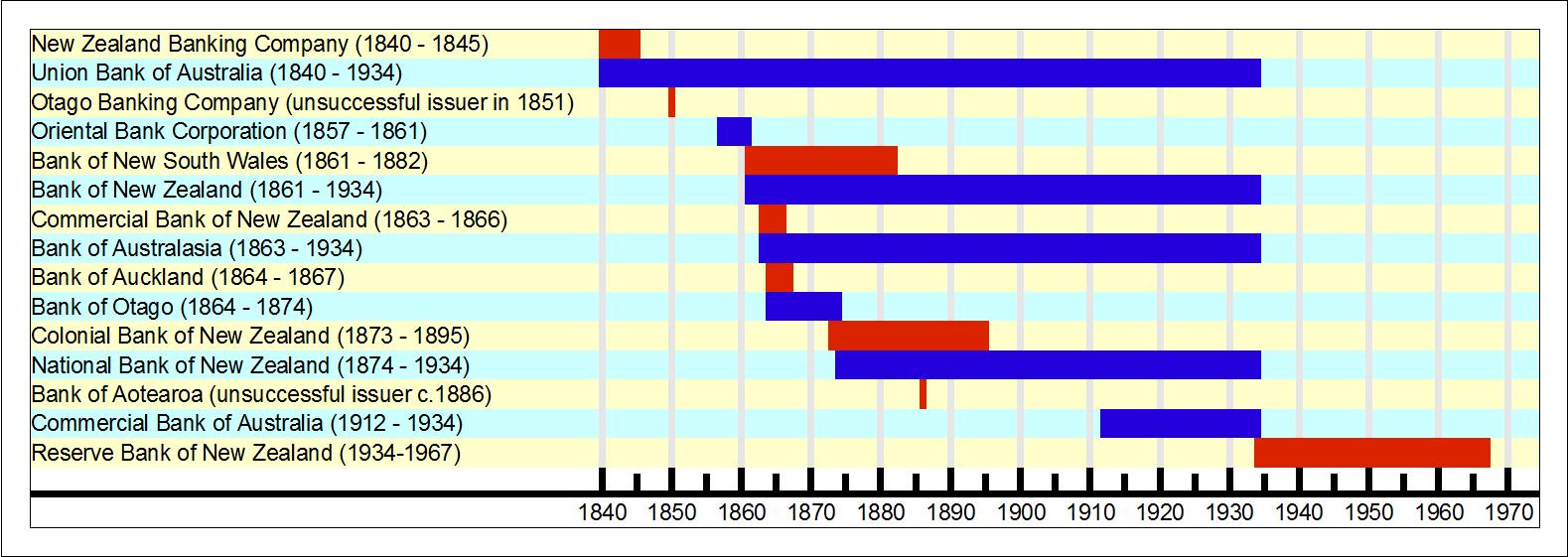
Until 1934, private trading banks issued notes. The first bank notes were issued in New Zealand in March 1840 by the Union Bank of Australia at Britannia, now Wellington, then the New Zealand Banking Company followed in September 1840 at Kororareka, now Russell. These banks issued notes in New Zealand:
- Union Bank of Australia (March 1840 – July 1934)
- New Zealand Banking Company (September 1840 – January 1845)
- Colonial Bank of Issue (1847–1856)
- Otago Banking Company (unsuccessful issuer in 1851)
- Oriental Bank Corporation (1857 – May 1861)
- Bank of New South Wales (May 1861 – July 1934)
- Bank of New Zealand (October 1861 – July 1934)
- Commercial Bank of New Zealand (1863–1866)
- Bank of Australasia (1863 – July 1934)
- Bank of Auckland (December 1864 – June 1867)
- Bank of Otago (1864–1874)
- Colonial Bank of New Zealand (1873 – November 1895)
- National Bank of New Zealand (1874 – July 1934)
- Bank of Aotearoa (unsuccessful issuer )
- Commercial Bank of Australia (1912 – July 1934)
Between 1852 and 1856, the Colonial Bank of Issue was the only banknote issuing body. Public distrust of these notes soon led to their redemption with Union Bank notes. The discovery of gold in 1861 encouraged competing banks into New Zealand leading to a variety of note issue. By 1924, public demand for convenience in usage led to the six remaining issuing banks agreeing a "Uniform" standard size and colour for each denomination.
When the Reserve Bank of New Zealand was established on 1 August 1934 by the Reserve Bank of New Zealand Act 1933, it became the sole issuer of notes. This government agency introduced notes for 10/–, £1, £5 and £50. In 1940, £10 notes were added. Only two series of £1 notes were printed. The first (1934–40) featured the portrait of Matutaera Te Pukepuke Te Paue Te Karato Te-a-Pōtatau Tāwhiao, the second (1940–67) featured Captain James Cook.
The last circulating second series banknotes of the New Zealand pound, at the time of decimalisation in 1967, are described in the following table.
| Image | Value | Dimensions | Main Colour | Description | Date of issue | Obverse | Reverse | Obverse | Reverse | Watermark | ||
|---|---|---|---|---|---|---|---|---|---|---|---|---|
| [[File:New Zealand 10 shilling note obverse series 2.jpg | 125px]] | [[File:New Zealand 10 shilling note reverse series 2.jpg | 125px]] | 10/- | ||||||||
| (ten shillings) | 7 × 3½ in (178 × 89 mm) | Brown | Captain James Cook, | |||||||||
| Coat of arms of New Zealand | Kiwi, | |||||||||||
| Signing of the Treaty of Waitangi | Kīngi Tāwhiao | 1940 | ||||||||||
| [[File:New Zealand 1 pound note obverse series 2.jpg | 125px]] | [[File:New Zealand 1 pound note reverse series 2.jpg | 125px]] | £1 | Purple | HMS Endeavour at sea | ||||||
| [[File:New Zealand 5 pound note obverse series 2.jpg | 125px]] | [[File:New Zealand 5 pound note reverse series 2.jpg | 125px]] | £5 | Blue | Fantail, | ||||||
| Lake Pukaki and Aoraki / Mount Cook | ||||||||||||
| [[File:New Zealand 10 pound note obverse series 2.jpg | 125px]] | [[File:New Zealand 10 pound note reverse series 2.jpg | 125px]] | £10 | Green | Captain James Cook, | ||||||
| Crowned escutcheon, sailing ship | Ponga, | |||||||||||
| scene with sheep and tī kōuka (cabbage tree) | ||||||||||||
| [[File:New Zealand 50 pound note obverse series 2.jpg | 125px]] | [[File:New Zealand 50 pound note reverse series 2.jpg | 125px]] | £50 | Red | Tūī, | ||||||
| dairy farm scene and Mount Taranaki |
Present status
Coins and uncancelled notes issued by the six private trading banks operating in 1934 as well as the Reserve Bank of New Zealand are still redeemable at the RBNZ offices in Wellington. The RBNZ has an obligation to redeem private bank notes. Under the 1933 Reserve Bank Act the privately held gold was confiscated and paid for in RBNZ banknotes.
In all cases, the currency's value to collectors is now far higher than its face value, due to its rarity. A prime example is a first issue Union Bank £1 from the 1840s returned to New Zealand in 1934, for redemption at face value, by its owner in the United States. Today a similar note would be valued in excess of £10,000 sterling. £NZ.50 notes of the Reserve Bank are also extremely rare and fetch a high price from collectors. The note signed by Chief Cashier T. P. Hanna in uncirculated condition could fetch as high as $NZ.25,000 according to the premier value listing for New Zealand notes and coins (some other lesser valued notes signed by Hanna exist).
Notes
References
- Hawke, G.R., "The Making of New Zealand: an Economic History" (1985)
- Grant. Anthony W., "Premier: the New Zealand Coin and Banknote Catalogue" 2011
References
- (May 1952). "Reserve Bank of New Zealand. Bulletin 1952-05: Iss 5". Reserve Bank Of New Zealand.
- (2012). "The Banknote Book". www.BanknoteNews.com.
This article was imported from Wikipedia and is available under the Creative Commons Attribution-ShareAlike 4.0 License. Content has been adapted to SurfDoc format. Original contributors can be found on the article history page.
Ask Mako anything about New Zealand pound — get instant answers, deeper analysis, and related topics.
Research with MakoFree with your Surf account
Create a free account to save articles, ask Mako questions, and organize your research.
Sign up freeThis content may have been generated or modified by AI. CloudSurf Software LLC is not responsible for the accuracy, completeness, or reliability of AI-generated content. Always verify important information from primary sources.
Report