From Surf Wiki (app.surf) — the open knowledge base
New Zealand Division of the Royal Navy

| Field | Value | |
|---|---|---|
| unit_name | New Zealand Division of the Royal Navy | |
| image | HMS Philomel (1890).jpg | |
| caption | The cruiser , "Cradle of the Navy" | |
| dates | 1921–1941 | |
| country | ||
| branch | [[File:Naval Ensign of the United Kingdom.svg | 23px]] Royal Navy |
| type | Military formation | |
| battles | ||
| disbanded | ||
| notable_commanders |
- World War II
- American Theater
- Battle of the River Plate
- American Theater
The New Zealand Division of the Royal Navy also known as the New Zealand Station was formed in 1921 and remained in existence until 1941. It was the precursor to the Royal New Zealand Navy. Originally, the Royal Navy was solely responsible for the naval security of New Zealand. The passing of the Naval Defence Act 1913 created the New Zealand Naval Forces as a separate division within the Royal Navy.
History
At its establishment in 1848, the Australia Station encompassed Australia and New Zealand. Under the Australasian Naval Agreement 1887 the colonial governments of Australia and New Zealand secured a greater naval presence in their waters, agreed that two ships would always be based in New Zealand waters and agreed contributions to funding that presence.
In 1901 the Commonwealth of Australia became independent of the United Kingdom. The Australian Squadron was disbanded in 1911 and the Australia Station passed to the Commonwealth Naval Forces. The Australia Station was reduced to cover Australia and its island dependencies to the north and east, excluding New Zealand and its surrounds, which was transferred under the command of the Commander-in-Chief, China and called the New Zealand Naval Forces.
Captain Alan Hotham was appointed as Captain of on 24 May 1920, and made Commodore, Second Class, in command of the NZ Naval Forces or New Zealand Station.
On 1 January 1921, the New Zealand Naval Forces, which had formerly been under the command of the China Station, were renamed the New Zealand Division of the Royal Navy.
Captain Hotham was also appointed First Naval Member of the New Zealand Naval Board. In the 1923 New Zealand Birthday Honours, he was made a Companion of the Order of the Bath,in recognition of valuable services rendered in organising, recruiting, and training for the New Zealand Division, and as naval adviser to the New Zealand Government. His appointment in New Zealand expired in July 1923, when he returned to the Admiralty.
The light cruiser HMS Philomel had had a significant association with New Zealand since the creation of the New Zealand Naval Forces. The ship was worked hard during the first years of the First World War. By the end of 1916, her engines were giving trouble and her stern glands were worn out. A lengthy and costly refit was required. To avoid this, and the cost for a ship which was nearly at the end of her operational life, the Admiralty decided to give her to New Zealand. She was dispatched there to be paid off. The ship arrived in Wellington Harbour in March 1917. A large portion of her Royal Navy crew were returned to England to be assigned elsewhere. Armament removed, Philomel was recommissioned as a depot ship in Wellington, supporting minesweeping operations until May 1919.
In March 1921, on the creation of the Royal Navy's New Zealand Division, Philomel was recommissioned as a training ship. She steamed from her berth at Wellington to the dockyard at the Devonport Naval Base in Auckland. Moored alongside the training jetty, she was operated as a new recruit training ship, under the command of a series of officers from the Royal Navy including, for nearly six months in 1923, Commander Augustus Agar VC. Training armament was installed and in 1925, her boilers and engines were removed to create more accommodation space. Further accommodation, in the form of wooden cabins, was later constructed on her deck. In October 1941, on the creation of the Royal New Zealand Navy, Philomel was recommissioned as the training base .
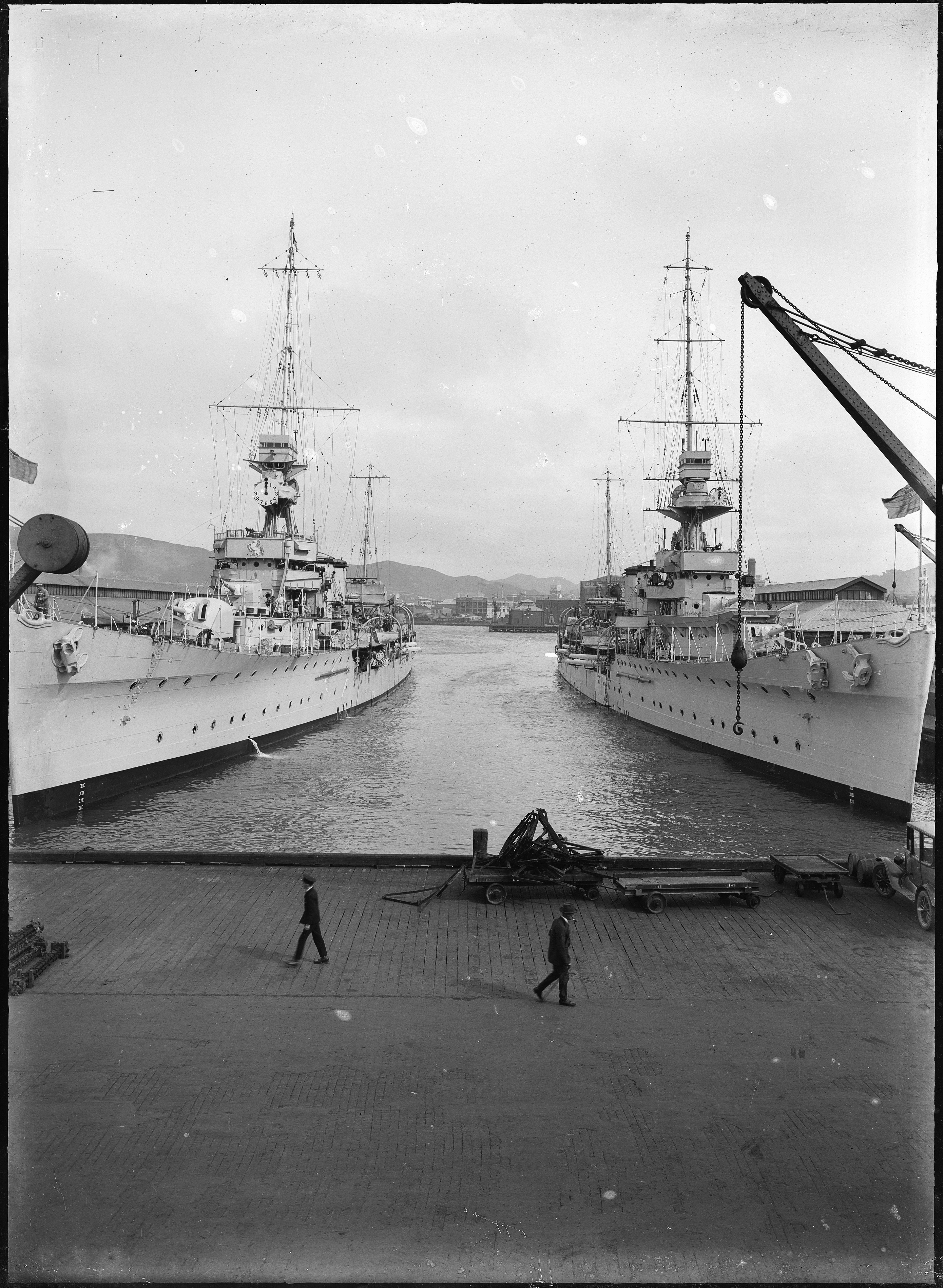
The division was funded by Wellington and increasingly manned by New Zealanders. It operated 14 ships over a period of 21 years, including the cruisers HMS Achilles and HMS Leander, the training minesweeper HMS Wakakura, and the cruiser which was recommissioned as a base training establishment.
In 1922, the crew of Chatham donated a cup to the New Zealand Football Association. This became the Chatham Cup, New Zealand's equivalent of the British FA Cup, and its premier knockout football trophy.
Veronica assisted survivors in the aftermath of the 1931 Hawke's Bay earthquake in New Zealand. Having berthed in the Port of Napier only three hours before the earthquake, she radioed Auckland for help, which was provided by the light cruisers and . She was subsequently docked for inspection for possible bottom damage as the seabed had risen up under her.
From 1932 to 1938 the Royal Navy's activities in New Zealand were under a rear-admiral; Rear-Admiral Fischer Watson from 1932-35.
In August 1937 HMS Leander, on a journey from Europe to New Zealand, carried out an aerial survey of Henderson, Oeno and Ducie Islands, in the south-east Pacific, east of the International Date Line. On each island, a British flag was planted and an inscription was nailed up proclaiming: "This island belongs to H.B.M. King George VI."
The New Zealand-crewed cruiser HMS Achilles fought at the Battle of the River Plate in late 1939.
The Commodore's appointment was abolished and forces brought directly under the New Zealand Chief of the Naval Staff from October 1940. The New Zealand Division of the Royal Navy became the Royal New Zealand Navy (RNZN) from 1 October 1941.
Advent of the Royal New Zealand Navy
When Britain went to war against Germany in 1939, New Zealand promptly declared war and expanded its naval forces. In recognition that the naval force was now largely self-sufficient and independent of the Royal Navy, the New Zealand Division of the Royal Navy became the Royal New Zealand Navy (RNZN) in 1941. There were:
- 2 Cruisers
- 2 Escort Vessels
- 1 Survey Vessel
- 1 Minesweeping Vessel
The prefix "royal" was granted by King George VI on 1 October 1941 and ships thereafter were prefixed with HMNZS (His/Her Majesty's New Zealand Ship).
Ships of the New Zealand Division
Sortable list covering the period from the inception of the New Zealand Division of the Royal Navy in 1921 to the formation of the Royal New Zealand Navy on 1 October 1941.
| Image | Name | Pennant | Class | Type | Com | Decom | Fate/notes | ||||
|---|---|---|---|---|---|---|---|---|---|---|---|
| [[File:HMNZS Achilles SLV AllanGreen.jpg | 140px]] | HMS Achilles | 70 | Cruiser | {{sclass | Leander | cruiser | 4 | 1931}} | 1936 | 1941 |
| [[File:HMS Auckland (L61) IWM FL 1201.jpg | 140px]] | L61 | Convoy sloop | 1938 | 1939 | Nominated only. | |||||
| [[File:HMS Chatham AllanGreen2.jpg | 140px]] | Cruiser | {{sclass2 | Town | cruiser | 4 | 1910}} | 1920 | 1924 | ||
| [[File:HMS Diomede As Built.jpg | 140px]] | D92 | Cruiser | 1926 | 1935 | Replaced by Achilles in 1936 | |||||
| [[File:HMS Dunedin a.green.jpg | 140px]] | D93 | Cruiser | 1924 | 1937 | Replaced by Leander in 1937 | |||||
| [[File:1917 HMS Laburnum.jpg | 140px]] | T48 | Convoy sloop | 1922 | 1935 | ||||||
| [[File:British light cruiser HMS Leander (75) underway at sea in 1945.jpg | 140px]] | HMS Leander | Cruiser | {{sclass | Leander | cruiser | 4 | 1931}} | 1937 | 1941 | |
| [[File:HMS Leith.jpg | 140px]] | L36 | Convoy sloop | 1934 | 1939 | Acquired by the Royal Danish Navy in 1949 and renamed HDMS Galathea. Circumnavigated the world in 1950–52 doing deep-sea oceanographic research. | |||||
| L61 | Fleet oiler | 1924 | 1937 | oil hulk 1937–1947 | |||||||
| [[File:HMS Philomel 1890 IWM Q 42688.jpg | 140px]] | Cruiser | 1921 | 1941 | "Cradle of the Navy." 1914–1921 was HMS Philomel in the NZ Naval Forces. 1941–1947 became HMNZS Philomel in the RNZN | ||||||
| [[File:StateLibQld 1 149387 Puriri (ship).jpg | 140px]] | HMS Puriri | T02 | Minesweeper | Converted merchant ship | 1941 | 1941 | 14 May 1941 struck a German mine 9 mi northeast of the Whangarei heads and sank with the loss of five crew members. | |||
| [[File:HMS Torch (1894) AWM A02550.jpeg | 140px]] | HMS Torch | Convoy sloop | 1921 | 1924 | 1914–1921 was HMS Torch in the NZ Naval Forces. Also called a gunboat. Wrecked in Chatham Islands. | |||||
| T67 | Convoy sloop | 1920 | 1934 | ||||||||
| [[File:HMS Wellington FL21547.jpg | 140px]] | U65 | Convoy sloop | 1935 | 1947 | Survives as a museum ship moored on the River Thames, London. | |||||
| [[File:WakakuraInLyttleton.jpg | frameless | 140x140px]] | HMS Wakakura | T00 | Minesweeper | 1926 | 1941 | 1941–1945 was HMNZS Wakakura in the RNZN |
Commanders
Officers who commanded the New Zealand Division/Station include:
| Rank | Name | Title | Term began |
|---|---|---|---|
| Commodore | Alan Hotham | March 1921 | |
| Commodore | Alister Beal, CMG, DSO | August 1923 | |
| Commodore | George Swabey, DSO | 18 June 1926 | |
| Commodore | Geoffrey Blake, CB, DSO | 19 July 1929 | |
| Rear Admiral | Fischer Watson, DSO | 26 February 1932 | |
| Rear Admiral | The Hon. Edmund Drummond, MVO | March 1935 | |
| Commodore | Irvine Glennie | June 1938 | |
| Commodore | James Rivett-Carnac | CO HMNZS Leander & Commodore Commanding New Zealand Squadron | December 1938 |
| Commodore | Henry Horan, DSC | First Naval Member | December 1939 |
| Commodore | Edward Parry | First Naval Member of New Zealand Naval Board | May 1940 - October 1940 |
Irvine Glennie had the following posts:
- 24.03.1936 - 08.06.1938 Commanding Officer, HMNZS Achilles (cruiser) & Flag Captain to Rear-Admiral Commanding New Zealand Station
- 08.06.1938 - 01.1939 Promoted to Commodore, 2nd Class. Commanding Officer, HMNZS Achilles (cruiser) & till 14.11.1938 Commodore Commanding New Zealand Squadron
As of 22 April 1938, Captain Henry Horan was appointed a Commodore, 2nd class, and had the posts of:
- 22.04.1938 - 07.06.1938 Commodore Commanding New Zealand Station & First Naval Member of Naval Board (HMS Achilles)
- 08.06.1938 - 31.12.1940 Chief of Naval Staff, New Zealand, and First Naval Member of the Naval Board [Navy Office, Wellington]
- 01.01.1940 - 30.04.1940 Chief of Naval Staff and First Naval Member of Naval Board and Commodore Commanding New Zealand Squadron (HMS Leander)
After October 1940, Commodore Parry became the first Chief of Naval Staff and First Naval Member from October 1941 to June 1942.
Notes
References
- Hocken Collections, 75 Years of the New Zealand Navy bulletin 17, August 1996
- Walters, Sydney David (1956) The Royal New Zealand Navy: Official History of World War II, Department of Internal Affairs, Wellington. Chapter 1b: Genesis of Royal New Zealand Navy
References
- Dennis 2008, p. 54.
- "Australian Naval Defence and the 1887 Colonial". Sheffield Hallam University.
- Dennis 2008, p. 53.
- "Alan Geoffrey Hotham - The Dreadnought Project".
- McGibbon 2000, pp. 45–46.
- (12 July 1965). "Adml. Sir A. Hotham". [[The Times]].
- {{London Gazette. (1 June 1923)
- Maisel, Ephraim. (2013). "The Foreign Office and foreign policy, 1919-1926". [[Liverpool University Press]].
- McGibbon 2000, p. 353.
- (1991). "An Association with Soccer: The NZFA Celebrates Its First 100 Years". [[New Zealand Football]].
- (15 January 1975). "Ducie Atoll: Its history, physiography and biota". Atoll Research Bulletin.
- New Zealand Electronic Text Centre, [https://nzetc.victoria.ac.nz/tm/scholarly/tei-WH2Navy-a6.html Appendix Vi — Members Of New Zealand Naval Board{{!Appendix VI: Members of the New Zealand Naval Board]
- "The Royal New Zealand Navy". New Zealand History.
- "Royal Navy History".
- "Danish Naval History: HDMS Galathea". Navalhistory.dk.
- Tonson, A.E. [http://www.navyhistory.org.au/hms-puriri-1938-nz-navy/ ''HMS Puriri 1938, NZ Navy''], article in Naval Historical Review – March 1983
- [http://www.petemesley.com/wrecks%20Puriri.htm HMNZS ''Puriri''] {{webarchive. link. (24 November 2009)
- [http://www.gulabin.com/armynavy/pdf/Senior%20Royal%20Navy%20Appointments%201900-.pdf Senior Royal Navy Appointments] {{webarchive. link. (11 July 2011)
- /Service Records/Navy List, via [https://www.unithistories.com/officers/RN_officersH6.html Horan, Henry]
- Navy List, via [http://www.unithistories.com/officers/RN_officersP.html#Parry_WE Royal Navy (RN) Officers 1939–1945]
This article was imported from Wikipedia and is available under the Creative Commons Attribution-ShareAlike 4.0 License. Content has been adapted to SurfDoc format. Original contributors can be found on the article history page.
Ask Mako anything about New Zealand Division of the Royal Navy — get instant answers, deeper analysis, and related topics.
Research with MakoFree with your Surf account
Create a free account to save articles, ask Mako questions, and organize your research.
Sign up freeThis content may have been generated or modified by AI. CloudSurf Software LLC is not responsible for the accuracy, completeness, or reliability of AI-generated content. Always verify important information from primary sources.
Report