From Surf Wiki (app.surf) — the open knowledge base
New York Penn Station
Major rail hub in New York City

Major rail hub in New York City
| Field | Value | ||||
|---|---|---|---|---|---|
| name | Pennsylvania Station | ||||
| New York, NY | |||||
| style | Amtrak | ||||
| image | {{Photomontage | ||||
| photo1a | Moynihan Train Hall interior, Dec_27_2022.jpgMoynihan Train Hall | ||||
| photo2a | Penn Station concourse.jpgMain concourse under Madison Square Garden | ||||
| spacing | 2 | ||||
| position | center | ||||
| color_border | white | ||||
| color | white | ||||
| size | 260 | ||||
| caption | Moynihan Train Hall (top) and the station's main concourse (below) | ||||
| address | Bounded by 7th & 9th Avenues and 31st & 33rd Streets | ||||
| (under Madison Square Garden and in James A. Farley Building) | |||||
| borough | Midtown Manhattan, New York City | ||||
| country | United States | ||||
| owned | Amtrak | ||||
| line | Northeast Corridor (Hell Gate Line) | ||||
| Empire Corridor (West Side Line) | |||||
| platform | 11 island platforms | ||||
| tracks | 21 | ||||
| connections | {{Unbulleted list | ||||
| {{NYCS Broadway-Seventh south | time | bullets}} at | |||
| {{NYCS Eighth south | time | bullets}} at | |||
| {{rint | metro | link | Port Authority Trans-Hudson}} PATH: JSQ–33, HOB–33, JSQ–33 (via HOB) (at 33rd Street) | ||
| accessible | Yes | ||||
| code | |||||
| iata | ZYP | ||||
| zone | Zone 1 (LIRR) | ||||
| Zone 1 (NJ Transit) | |||||
| opened | [](pennsylvania-station-1910-1963) | ||||
| rebuilt | 1963– | ||||
| mpassengers | |||||
| {{rail pass box | system | Amtrak | passengers= annually | pass_year=}} | |
| {{rail pass box | system | LIRR | passengers=69,722,560 annually; based on average arrivals and departures | pass_year=2017}} | |
| services_collapsible | yes | ||||
| services | {{Adjacent stations | ||||
| system1 | Amtrak | ||||
| line1 | Acela Express | left1=Newark Penn | right1=Stamford | ||
| line2 | Vermonter | left2=Newark Penn | right2=Stamford | ||
| line3 | Northeast Regional | left3=Newark Penn | right3=New Rochelle | ||
| line4 | Adirondack | left4=Yonkers | |||
| line5 | Berkshire Flyer | left5=Yonkers | note-mid5=(seasonal) | ||
| line6 | Cardinal | left6=Newark Penn | |||
| line7 | Carolinian | left7=Newark Penn | |||
| line8 | Crescent | left8=Newark Penn | |||
| line9 | Empire Service | left9=Yonkers | |||
| line10 | Ethan Allen Express | left10=Yonkers | |||
| line11 | Keystone Service | left11=Newark Penn | |||
| line12 | Lake Shore Limited | left12=Croton–Harmon | |||
| line13 | Maple Leaf | left13=Yonkers | |||
| line14 | Palmetto | left15=Newark Penn | |||
| line15 | Pennsylvanian | left14=Newark Penn | |||
| line16 | Silver Meteor | left16=Newark Penn | |||
| system18 | LIRR | ||||
| line19 | Port Washington | right19=Woodside | to-right19=Port Washington | ||
| line20 | Hempstead | right20=Woodside | |||
| line21 | Port Jefferson | right21=Woodside | |||
| line22 | Oyster Bay | right22=Jamaica | note-mid22=limited service | ||
| line23 | Ronkonkoma | right23=Woodside | to-right23=Ronkonkoma | ||
| line24 | Montauk | right24=Jamaica | |||
| line25 | Cannonball | right25=Westhampton | |||
| line26 | Far Rockaway | right26=Woodside | |||
| line27 | Babylon | right27=Woodside | |||
| line28 | West Hempstead | right28=Woodside | |||
| line29 | Long Beach | right29=Woodside | |||
| line30 | Belmont Park | right30=Woodside | |||
| system31 | NJ Transit | ||||
| line32 | Northeast Corridor | left32=Secaucus Junction | |||
| line33 | North Jersey Coast | left33=Secaucus Junction | |||
| line34 | Montclair-Boonton | left34=Secaucus Junction | |||
| line35 | Morristown | left35=Secaucus Junction | |||
| line36 | Raritan Valley | left36=Secaucus Junction | |||
| line37 | Gladstone | left37=Secaucus Junction | |||
| other_services_header | Former services | ||||
| other_services_collapsible | yes | ||||
| other_services | {{Adjacent stations | ||||
| system1 | Amtrak | ||||
| line2 | Cape Codder | right2=Stamford | note-mid2=1986–1996 | ||
| line3 | Hilltopper | left3=Newark, New Jersey | right3=Stamford | note-mid3=1978–1979 | |
| line4 | Metroliner | left4=Newark, New Jersey | note-mid4=1971–2006 | ||
| line5 | Montrealer | left5=Newark, New Jersey | right5=Rye | note-mid5=1972–1995 | |
| line6 | National Limited | left6=Newark, New Jersey | note-mid6=1971–1979 | ||
| line7 | Broadway Limited | left7=Newark, New Jersey | note-mid7=1971–1995 | ||
| line8 | Three Rivers | left8=Newark, New Jersey | note-mid8=1995–2005 | ||
| line9 | Silver Star | left9=Newark Penn | note-mid9=1971–2024 | ||
| system10 | NJ Transit | ||||
| line10 | ACES | left10=Newark Penn | note-mid10=2009–2011 | ||
| other_services2_header | Future services | ||||
| other_services2_collapsible | yes | ||||
| other_services2 | {{Adjacent stations | ||||
| system1 | Amtrak | ||||
| line2 | Northeast Regional | to-left2=Norfolk, Newport News or Christiansburg | left2=Newark Penn | right2=Jamaica | to-right2=Ronkonkoma |
| system3 | Metro-North Railroad | ||||
| line4 | New Haven Penn | right4=Hunts Point | |||
| line5 | Port Jervis | left5=Secaucus Junction | right5= | to-right5=New York | |
| system6 | NJ Transit | ||||
| line7 | Pascack Valley | left7=Secaucus Junction | right7= | to-right7=New York | |
| line8 | Main | left8=Secaucus Junction | right8= | to-right8=New York | |
| line9 | Bergen County | left9=Secaucus Junction | right9= | to-right9=New York}} | |
| embedded | {{Infobox historic site | ||||
| embed | yes | ||||
| other_name | Interactive map | ||||
| coordinates | |||||
| image_map |
the modern intercity rail station in New York City
New York, NY (under Madison Square Garden and in James A. Farley Building) Empire Corridor (West Side Line) | New York City Subway: | at | at | PATH: JSQ–33, HOB–33, JSQ–33 (via HOB) (at 33rd Street) | NYCT Bus:
MTA Bus: | Flixbus: Eastern Shuttle | Tripper Bus | Vamoose Bus
Zone 1 (NJ Transit)
Pennsylvania Station (also known as New York Penn Station or simply Penn Station) is the main intercity railroad station in New York City and the busiest transportation facility in the Western Hemisphere, serving more than 600,000 passengers per weekday .{{efn|The breakdown of Penn Station's ridership:
- Commuter and intercity rail comprise about 355,000 daily weekday passengers.
- LIRR has an average of 233,340 daily weekday passengers.
- NJ Transit has an average of 93,305 daily weekday passengers.
- Amtrak has an average of 28,487 daily passengers, when annual totals are averaged.
- The two subway stations have a combined average of approximately 200,000 daily weekday passengers. However, this only includes entries and not exits.
- The remainder of the ridership, around 75,000 passengers, may use other transportation such as buses, taxis, or ride-sharing, and may include passengers exiting from the subway.
Penn Station has 21 tracks fed by seven tunnels, including its two North River Tunnels, four East River Tunnels, and one Empire Connection tunnel. It is at the center of the Northeast Corridor, a passenger rail line that connects New York City with Boston to its north and Philadelphia, Baltimore, and Washington, D.C. to its south, along with various intermediate stations. Intercity trains are operated by Amtrak, which owns the station, while commuter rail services are operated by the Long Island Rail Road (LIRR) and NJ Transit (NJT). Connections are available within the complex to the New York City Subway and buses.
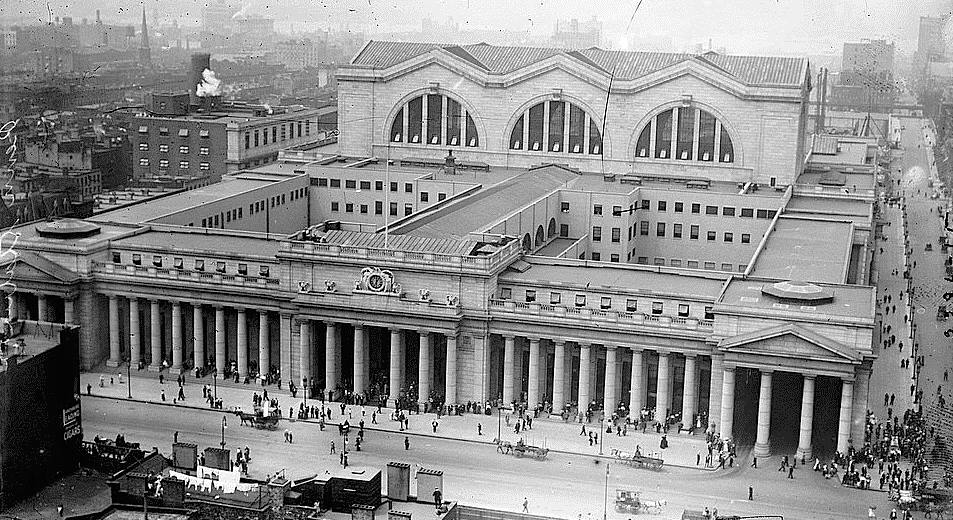
Penn Station is named for the Pennsylvania Railroad (PRR), its builder and original owner, and shares its name with several stations in other cities. The original Pennsylvania Station was an ornate station building designed by McKim, Mead, and White and considered a masterpiece of the Beaux-Arts style. Completed in 1910, it enabled direct rail access to New York City from the south for the first time. Its head house and train shed were torn down in 1963 at a time of low train ridership, with the rail infrastructure reconstituted as the smaller underground station that survives today. The New York Times editorial board described the demolition of the original station as a "monumental act of vandalism", and its destruction galvanized the modern historic preservation movement.
The 2020s saw the opening of Moynihan Train Hall, an expansion of Penn Station into the Farley Post Office building, as well as expansion of the LIRR concourse and a new direct entrance from 33rd Street. Prospective further plans call for reconstruction of the core of the station, which has seen competing proposals regarding the station's relationship to Madison Square Garden, the potential reopening of the Gimbels passageway to Herald Square, and the construction of an annex one block south with new platforms to add capacity and connect to the Gateway Program tunnels under the Hudson River.
History
Planning and construction
Main article: New York Tunnel Extension
Until the early 20th century, the PRR's rail network terminated on the western side of the Hudson River (once known locally as the North River) at Exchange Place in Jersey City, New Jersey. Manhattan-bound passengers boarded ferries to cross the Hudson River for the final stretch of their journey.
The rival New York Central Railroad's line ran down Manhattan from the north under Park Avenue and terminated at Grand Central Depot (later replaced by Grand Central Terminal) at 42nd Street. Many proposals for a cross-Hudson connection were advanced in the late 19th century, but financial panics in the 1870s and 1890s scared off potential investors. In any event, none of the proposals advanced during this time were considered feasible.
An early proposal for a bridge was considered but rejected. The alternative was to tunnel under the river, but this was infeasible for steam locomotive use. The development of the electric locomotive at the turn of the 20th century made a tunnel feasible. In 1901, PRR president Alexander Cassatt announced the railroad's plan to enter New York City by tunneling under the Hudson and building a grand station on the West Side of Manhattan south of 34th Street. The station would sit in Manhattan's Tenderloin district, a historical red-light district known for its corruption and prostitution.
Beginning in June 1903, the two single-track North River Tunnels were bored from the west under the Hudson River. A second set of four single-track tunnels, the East River Tunnels, were bored from the east under the East River, linking the new station to Queens, the PRR-owned Long Island Rail Road, and Sunnyside Yard in Queens, where trains would be maintained and assembled. Construction was completed on the Hudson River tunnels on October 9, 1906, and on the East River tunnels on March 18, 1908.
Original structure
Main article: Pennsylvania Station (1910–1963)
.jpg)
A small portion of Penn Station opened on September 8, 1910, in conjunction with the opening of the East River Tunnels, and LIRR riders gained direct railroad service to Manhattan. On November 27, 1910, Penn Station was fully opened to the public. With the station's full opening, the PRR became the only railroad to enter New York City from the south.
During half a century of operation by the Pennsylvania Railroad (1910–1963), scores of intercity passenger trains arrived and departed daily to Chicago and St. Louis on "Pennsy" rails and beyond on connecting railroads to Miami and the west. Along with Long Island Rail Road trains, Penn Station saw trains of the New Haven and the Lehigh Valley railroads. A side effect of the tunneling project was to open the city up to the suburbs, and within 10 years of opening, two-thirds of the daily passengers coming through Penn Station were commuters.
The station put the Pennsylvania Railroad at comparative advantage to its competitors offering direct service from Manhattan to the west and south. Other railroads began their routes at terminals in Weehawken, Hoboken, Pavonia and Communipaw which required passengers from New York City to take the interstate Hudson Tubes (now PATH) or ferries across the Hudson River before boarding their trains. By 1945, at its peak, more than 100 million passengers a year traveled through Penn Station.
By the late 1950s, intercity rail passenger volumes had declined dramatically with the coming of the Jet Age and the Interstate Highway System. The station's exterior had become somewhat grimy, and due to its vast scale, the station was expensive to maintain. A renovation covered some of the grand columns with plastic and blocked off the spacious central hallway with a new ticket office. The Pennsylvania Railroad optioned the air rights, which called for the demolition of the head house and train shed, to be replaced by an office complex and a new sports complex, while the tracks of the station would remain untouched.
Plans for the new Penn Plaza and Madison Square Garden were announced in 1962. In exchange for the air rights to Penn Station, the PRR would receive a smaller underground station at no cost and a 25 percent stake in the new Madison Square Garden Complex. Modern architects rushed to save the ornate building, but to no avail; demolition of the above-ground head house began in October 1963. A giant steel deck was placed over the tracks and platforms to allow rail service to continue during construction. Photographs of the day showed passengers waiting for trains even as the head house was demolished around them. This was possible because most of the rail infrastructure (including the waiting room, concourses, and boarding platforms) was below street level.
The demolition of the Penn Station head house was controversial and caused outrage internationally. "One entered the city like a god. One scuttles in now like a rat," the architectural historian Vincent Scully famously wrote of the original station. The controversy over the demolition of such a well-known landmark, and its deplored replacement, is often cited as a catalyst for the architectural preservation movement in the United States. Within the decade, Grand Central Terminal was protected under the city's new landmarks preservation act, a protection upheld by the courts in 1978 after a challenge by Grand Central's owner, Penn Central (the corporate successor of the PRR, following its merger with the rival New York Central Railroad).
Under Madison Square Garden

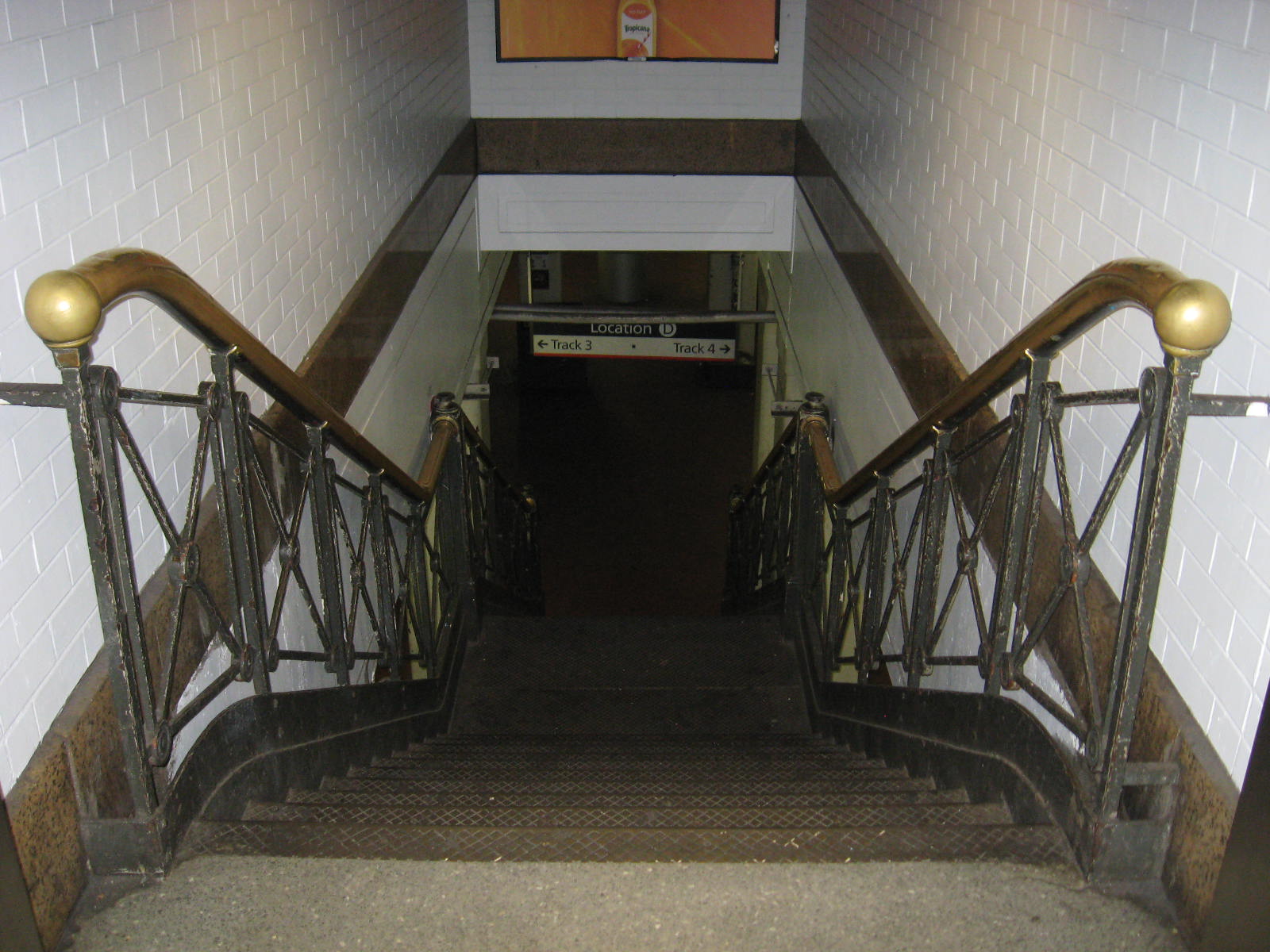
Post-1968, the core Penn Station has been underground, sitting below Madison Square Garden, 33rd Street, and Two Penn Plaza. The core has three levels: concourses on the upper two levels and train platforms on the lowest. The two levels of concourses, while renovated and expanded during the construction of Madison Square Garden, are original to the 1910 station, as are the tracks and platforms.
Over the following decades, various renovations attempted to add service and some concourse space. The West End Concourse under Eighth Avenue opened in 1986. In 1987, a rail connection to the West Side Rail Yard opened, and in 1991, the opening of the Empire Connection allowed Amtrak to consolidate all of its New York City trains at Penn Station; previously, trains from the Empire Corridor terminated at Grand Central Terminal, a legacy of the two stations' respective roots in separate railroads.
In 1994, the station was renovated to add the 34th Street LIRR entrance and central corridor, along with artwork and improved waiting and concession areas. The new entrance consisted of a 90 ft structure with a glass and brick facade, a clock salvaged from the original station, and air-conditioning units for the terminal. In 2002, the NJ Transit concourse was created in space previously occupied by retail and Amtrak office space, although the concourse could only be accessed from the Amtrak entrance on 32nd Street. Plans for a new entrance from 31st Street to the NJ Transit concourse were announced in 2006, and the entrance opened in 2009. In 2020, the ticketed waiting room on the main concourse was renovated by Amtrak and NJ Transit to include furniture with USB outlets, an additional entrance, and a lactation suite.
After the September 11 attacks, security was increased and passenger flow curtailed. In 2002, $100 million of work added security features such as lighting, cameras, and barricades. The taxiway under Madison Square Garden, which ran from 31st Street to 33rd Street at mid-block, was permanently closed off with concrete Jersey barriers. Escalators providing direct access to the lobby of Madison Square Garden were closed and later removed. The underground Gimbels Passageway connecting pedestrians to 34th Street–Herald Square has been sealed off since 1986, after decades of safety concerns and sexual assaults.
Despite the modest renovations, the underground Penn Station continued to be criticized as "reviled", "dysfunctional", and a low-ceilinged "catacomb" lacking charm, especially when compared to the much larger and more ornate Grand Central Terminal. The New York Times, in an editorial supporting development of an enlarged terminal, said that "Amtrak's beleaguered customers...scurry through underground rooms bereft of light or character," and Times transit reporter Michael M. Grynbaum called Penn Station "the ugly stepchild of the city's two great rail terminals." After its nadir in the 1960s, ridership exploded in subsequent decades, a situation never contemplated by the structure's designers. By the 2010s, the station operated at almost three times its intended capacity; over 600,000 passengers used the station daily in 2019.
Expansion and renovation


In the early 1990s, U.S. Senator Daniel Patrick Moynihan proposed building a new station in the James A. Farley Building, the city's former main post office across the street which was designed by the same firm as the original Penn Station; Moynihan had shined shoes in the original station as a boy. Many redevelopment or expansion concepts were proposed over the 1990s and 2000s, but none reached fruition until funding from the 2009 American Recovery and Reinvestment Act enabled the expansion of the West End Concourse of the LIRR under the Farley Building in 2016.
In 2016 New York Governor Andrew Cuomo announced plans for the renovation of Penn Station and redevelopment of the Farley Building to include a new train hall, calling his plan the Empire Station Complex. Moynihan Train Hall opened in January 2021 and was named for the man who had conceived it. The $1.6 billion, 255,000 ft2 renovation retained the landmarked Beaux Arts Farley Building, added a central atrium with a glass roof, and provided access to Amtrak and LIRR trains, receiving the 2021 Prix Versailles for passenger stations. A new 33rd Street entrance to the LIRR concourse opened at the same time.
Following the opening of the 33rd Street entrance, the LIRR concourse was doubled in width from 30 to, and the ceilings were raised to a minimum height of 18 ft by removing seven "head knockers", low-hanging steel beams only 6 ft above the concourse's floor which were part of the original Penn Station; the expansion was completed in March 2023. 33rd Street between Seventh and Eighth Avenues was converted into a pedestrian plaza and permanently closed to vehicular traffic, opening in June 2024 as part of a $65 million project funded by Vornado.
Services
The station is served by 1,300 arrivals and departures per day, twice as many as there were during the 1970s. There are more than 600,000 subway, commuter rail and Amtrak passengers who use the station on an average weekday, or up to 1,000 every ninety seconds. It is the busiest passenger transportation facility in the United States and in North America. Beyond the subway entrances of the Penn Station, also the new iconic 7Av/33St entrance and the 7Av/34St entrance are open 24/7.
Operations
Penn Station currently operates in a hybrid mode, with some trains turning back at the station and others running through the station. Almost all Amtrak trains servicing the Northeast Corridor run through Penn Station in either revenue-to-revenue or revenue-to-non-revenue mode, while LIRR and NJT operate both turning trains and through-running trains. This hybrid regime is optimized for the peak commuter demand between the suburbs and Manhattan, with a highly optimized operating plan for each railroad that results in unbalanced service.
During the morning peak period, many commuter trains are "through-run" to storage yards after dropping off passengers, a mode of operation which requires the shortest station dwell times and helps achieve maximum throughput. Roughly one-third of LIRR trains arriving from the east between 6:00 AM and 10:00 AM continue on to the West Side Yard, and a similar percentage of NJT trains arriving from the west continue on to Sunnyside Yard in Queens. The afternoon peak operation is similar but in reverse. The balance of daily trains turn at the station, either running back in revenue service or "deadheading" back to outlying termini to return for another trip or to await the next peak period.
The following table summarizes peak hour train movements:
| Railroad | AM Peak | PM Peak | LIRR | NJT | Amtrak |
|---|
In summary, about 193 commuter trains turn around in Penn Station during the combined Peak service periods, and 111 commuter trains run-through to West Side or Sunnyside Yards. As both yards are at their practical capacity, any major increase in revenue-to-storage through-running would require major expansion of yard capacity.
Intercity rail
Amtrak

Amtrak owns the station and uses it for the following services:
- Acela to Boston (northern terminus) and Washington D.C. (southern terminus)
- Adirondack to Montreal
- Berkshire Flyer to Pittsfield
- Cardinal to Chicago
- Carolinian to Charlotte
- Crescent to New Orleans
- Empire Service to Albany–Rensselaer and Niagara Falls, NY
- Ethan Allen Express to Burlington
- Keystone Service to Harrisburg
- Lake Shore Limited to Chicago
- Maple Leaf to Toronto
- Pennsylvanian to Pittsburgh
- Northeast Regional to Boston or Springfield (northern termini) and Washington D.C., Roanoke, Newport News, Richmond, or Norfolk (southern termini)
- Palmetto to Savannah
- Silver Meteor to Miami
- Vermonter to Washington D.C. (southern terminus) and St. Albans (northern terminus) All except the Acela, Northeast Regional and Vermonter originate and terminate at Penn Station. Amtrak normally uses tracks 5–12 alongside New Jersey Transit and shares tracks 13–16 with the LIRR and NJ Transit.
Commuter rail
Long Island Rail Road
The following Long Island Rail Road (LIRR) services originate and terminate at Penn Station:
- Babylon Branch to Babylon
- Belmont Park Branch seasonal service to Belmont Park
- Far Rockaway Branch to Far Rockaway
- Hempstead Branch to Hempstead
- Long Beach Branch to Long Beach
- Montauk Branch to Speonk and Montauk
- Oyster Bay Branch to Oyster Bay
- Port Jefferson Branch to Huntington and Port Jefferson
- Port Washington Branch to Port Washington
- Ronkonkoma Branch to Ronkonkoma with connecting service to Greenport
- West Hempstead Branch to West Hempstead
All branches connect at Jamaica station except the Port Washington Branch. Jamaica station also connects to Airtrain JFK for service to John F. Kennedy International Airport.
Normally, the LIRR uses tracks 17 to 21 exclusively and shares tracks 13 to 16 with Amtrak and NJT. The LIRR uses tracks 11 and 12 on rare occasions.
NJ Transit


The following NJ Transit Rail Operations (NJT) branches originate and terminate at Penn Station:
- Montclair-Boonton Line to Montclair State University station, with connecting service west to Hackettstown.
- Morris and Essex Lines, consisting of the Morristown Line to Dover via Morristown and the Gladstone Branch to Gladstone.
- Northeast Corridor Line to Trenton
- North Jersey Coast Line to Long Branch and Bay Head
- Raritan Valley Line to Raritan and High Bridge
NJT normally uses tracks 1 to 4 exclusively, as these four tracks end at bumper blocks to their east. NJT shares tracks 5 through 12 with Amtrak, and occasionally uses tracks 13 to 16, which are shared with Amtrak and the LIRR.
Rapid transit
New York City Subway
Connections are available to the following New York City Subway stations:
- From Penn Station:
- at 34th Street–Penn Station, under Eighth Avenue
- at 34th Street–Penn Station, under Seventh Avenue
- From Herald Square, one block east at Sixth Avenue:
- at 34th Street–Herald Square station, under Broadway & Sixth Avenue
PATH
Connections are also available to the PATH system at 33rd Street station, under Sixth Avenue on Herald Square. The JSQ-33 and HOB-33 services terminate at 33rd Street on weekdays, and are combined into the JSQ-33 (via HOB) service on late nights, weekends and holidays.
Bus and coach
New York City Bus
The following MTA Regional Bus Operations buses stop near Penn Station:
- M7 (Lenox, Columbus, Amsterdam, Sixth and Seventh Avenues): southbound to Greenwich Village, via Seventh Avenue; or northbound to Harlem via Sixth, Amsterdam, and Lenox Avenues
- M20 (Seventh and Eighth Avenues/Varick and Hudson Streets): northbound to Lincoln Center via Eighth Avenue; or southbound to South Ferry via Seventh Avenue
- M34 Select Bus Service (34th Street Crosstown): westbound to Javits Center; or eastbound to FDR Drive
- M34A Select Bus Service (34th Street Crosstown): westbound to Port Authority Bus Terminal; or eastbound to Waterside Plaza and Kips Bay
- Q32 (Fifth and Madison Avenues): northbound only, to Jackson Heights, Queens
Intercity coaches
Intercity bus service to and from Penn Station is provided by Vamoose Bus, Tripper Bus, and Go Buses. Vamoose Bus runs buses from a stop near Penn Station to Bethesda, Maryland; Arlington, Virginia; and Lorton, Virginia. Tripper Bus runs buses from a stop near Penn Station to Bethesda, Maryland and Arlington, Virginia. Go Buses runs buses from a stop near Penn Station to Newton, Massachusetts and Cambridge, Massachusetts.
Most intercity and commuter bus services to and from midtown Manhattan use the Port Authority Bus Terminal, located approximately 0.5 miles (0.8 kilometers) to the north of Penn Station.
Proposed Metro-North service
Main article: Penn Station Access
The Metropolitan Transportation Authority plans to bring Metro-North Railroad commuter trains to Penn Station as part of its Penn Station Access project. The East Side Access project, which was completed in 2023, has freed up track and platform space at Penn Station by redirecting some LIRR trains from Penn Station to Grand Central Madison. This new capacity, as well as track connections resulting from the East Side Access project, will allow Metro-North trains on the New Haven Line to run to Penn Station via Amtrak's Hell Gate Bridge.
Four new local Metro-North stations in the Bronx are planned as part of this project, at Co-op City, Morris Park, Parkchester/VanNest, and Hunts Point. The MTA also proposes a second service from the Metro-North's Hudson Line to Penn Station using Amtrak's West Side Line in Manhattan. The Penn Station Access project would provide direct rides from Connecticut, Westchester County, the Lower Hudson Valley, and the Bronx to West Midtown; ease reverse-commuting from Manhattan and the Bronx to Westchester County, the Lower Hudson Valley, and Connecticut; and provide transportation service to areas of the Bronx without direct subway service.
Station layout


Penn Station does not have a unified design or floor plan but rather is divided into separate Amtrak, LIRR and NJ Transit concourses with each concourse maintained and styled differently by its respective operator. The Amtrak and NJ Transit concourses are located on the first level below the street level while the Long Island Rail Road concourse is two levels below street level.
Platform widths vary, with eight of the 11 platforms in the range of 19–20 feet wide. Platform 6 is the narrowest, at 17 feet, while Platform 1 is slightly wider, at 22 feet. Platform 10 is the widest platform, used exclusively by LIRR and nominally 38 feet wide.
The main concourse, now primarily used by NJ Transit which was principally used by Amtrak until the opening of the Moynihan Train Hall in 2021, is at the west end of the station directly beneath Madison Square Garden. It was created out of the original station's waiting rooms and main concourse, though few remnants of the original still exist in the space. It was renovated in the early 2000s in anticipation of Acela service and includes an enclosed waiting area for ticketed passengers with seats, outlets and Wi-Fi. The ticketed waiting room underwent a $7.2 million renovation from 2019 to 2020 that was funded jointly between Amtrak and NJ Transit. The renovation included new furniture and fixtures that feature seats with electrical and USB outlets, an upgraded ceiling with new LED lighting, a new information desk, a second entrance in close proximity to the NJ Transit concourse that provides improved access towards the Seventh Avenue side of the Station, two new Passenger Information Display Systems boards that display NJ Transit departure information and a lactation suite for nursing mothers.
The LIRR's connecting concourse runs below West 33rd Street between Seventh and Eighth Avenues, as it has since the original station opened in 1910. Significant renovations were made to the LIRR areas over a three-year period ending in 1994, including the opening of the Central Corridor passageway and the addition of a new entry pavilion on 34th Street. The 34th Street entry pavilion measures 40 by across by 92 ft tall and has a glass tower and two air-cooling shafts. The West End Concourse, west of Eighth Avenue, opened in 1986, and was widened and lengthened to cover tracks 5 through 21 in 2017.
The NJ Transit concourse near Seventh Avenue opened in 2002 out of existing retail and Amtrak office space. A new street-level entrance to this concourse at the corner of 31st Street and Seventh Avenue opened in September 2009. Previously, NJ Transit used space in the Amtrak concourse.
In December 2017, Amtrak and Zyter released a mobile app called FindYourWay to help commuters navigate around Penn Station, though Zyter also plans to roll out the app at other large Amtrak stations. The station's three providers use different official addresses for the station.
- Amtrak: 351 West 31st Street
- LIRR: 34th Street at 7th and 8th Avenues
- NJ Transit: 31st Street and 7th Avenue File:Blizzard of 2015- Empty Penn Station (16192638879).jpg|LIRR concourse in 2015 File:NewYorkPenn02LB.jpg|Amtrak concourse File:LIRR East End Gateway 20210204 224316486.jpg|East End Gateway at 7th Avenue File:Penn Station entrance.jpg|8th Avenue entrance File:Moynihan Train Hall - Entrance (51878229291).jpg|Entrance in the Farley Post Office Building
| Track 1 | ← NJ Transit toward New Jersey |
|---|
Tracks and surrounding infrastructure
Penn Station is configured with 11 platforms, 21 tracks, and four interlockings. The station's platforms and tracks are numbered from south to north. Tracks 1–4 are stub-end tracks ending at the eastern end of the platform and are used exclusively by NJ Transit, as they do not connect to the East River Tunnels.
The station is accessed via seven single-track tunnels: two North River Tunnels under the Hudson River, four East River Tunnels under the East River, and one shorter Empire Tunnel under the West Side of Manhattan. Each under-river tunnel is approximately 3 miles long, while the Empire Tunnel is approximately 0.3 miles long. The interlockings that control the station complex are designated 'A', 'C', 'JO', and 'KN'. On the west side of the station, 'A' and 'KN' interlockings route trains to and from the North River Tunnels, the Empire Tunnel, and the West Side Yard. On the east side, two interlockings ('C' and 'JO') route trains to and from the four East River tunnels; each interlocking connects two of the tunnel tracks to only 17 of the 21 platform tracks, as tracks 1-4 do not connect to the east.
From the east, the East River Tunnels' lines 1 and 2 (the more southerly tubes) can only access tracks 5–17 and are used by most Amtrak and NJ Transit trains, while the East River Tunnels' lines 3 and 4 (the more northerly tubes) can only access tracks 14–21 and are mostly used by LIRR. From the west, the North River Tunnels can access tracks 1–19, while the Empire Connection can only access tracks 1–9 and the LIRR's West Side Yard can only access tracks 10–21.
All station tracks are powered by 12 kV overhead wire. Tracks 5–21 also have 750 V DC third rail. Due to the lack of proper ventilation in the tunnels and station, only electric locomotives and dual-mode locomotives are scheduled to enter Penn Station. Diesel-only NJT trains terminate at Hoboken Terminal or Newark Penn Station, and diesel-only LIRR trains terminate at or prior to Long Island City. The established throughput capacity of the tunnels is 24-25 trains per hour in each direction for the North River Tunnels and 20-21 trains per hour in the peak direction for the East River Tunnels.
Trains on track 18 open their doors only on the north side (platform 10).
2017–2018 service disruptions and track improvements
Since the early 2010s, Amtrak had planned to fix the deteriorating rails and infrastructure around Penn Station, but due to the prioritization of other projects, applied only minimal fixes. In early 2017, this culminated in numerous power outages, derailments, and delays due to track maintenance delays. There were frequent service disruptions to train schedules caused by the deterioration of its tracks and their supporting infrastructure, as well as in those of the East River and North River tunnels that respectively connect the station to Long Island and New Jersey.
A string of early 2017 service disruptions started on March 23, 2017, when an Acela train derailed, causing delays for the day. On April 3, a NJ Transit train derailed at a known problem site, where repairs had been deferred. This caused four days of reduced service along the Northeast Corridor for both Amtrak and NJ Transit, because the incident damaged the switch that connects Tracks 1–8 to the North River tunnels. This closure caused a cascading failure, delaying Amtrak and Long Island Rail Road trains on the unaffected tracks.
On April 14, a New Jersey Transit train became stuck in the North River tunnels, causing the station to grow crowded with waiting passengers. After an Amtrak police officer used a Taser on a man who was acting disruptively, rumors of gunshots sparked a stampede that injured 16 people. Following the stampede, U.S. Senator Chuck Schumer called on Amtrak to centralize law enforcement response.
As a result of these incidents, the Long Island Rail Road had proposed taking over Penn Station from Amtrak to improve maintenance, and New Jersey has suggested withholding state payments to Amtrak. Amtrak has discussed accelerating major maintenance work, even at the cost of further disruptions, to more quickly stabilize infrastructure and decrease more future incidents that could potentially cause even greater disruption.
On April 28, 2017, Amtrak announced that it would perform some track maintenance during the summer over a period of one and a half months. Five tracks were closed for repairs as part of the reconstruction work, severely reducing track capacity in a situation media outlets deemed "the summer of hell". Many affected NJ Transit passengers were diverted to take the PATH instead. Some Amtrak trains from the Empire Corridor were routed to Grand Central instead of Penn Station. Regular service resumed on September 5, 2017.
Amtrak made further improvements to Penn Station's trackage in summer 2018. As a result, some Empire Corridor trains were rerouted again to Grand Central. The Lake Shore Limited and Cardinal to Chicago were truncated or rerouted because of this work.
Planning and redevelopment

Resurgence of train ridership in the 21st century has pushed the current Pennsylvania Station under Madison Square Garden to capacity, leading to several proposals to renovate or rebuild the station, often characterized as correcting for the 1960s demolition of the original facility.
Alliance for a New Penn StationIn 2013, the Regional Plan Association and Municipal Art Society formed the Alliance for a New Penn Station, advocating for limiting the extension of Madison Square Garden's operating permit to ten years and soliciting designs from architectural firms to move the arena. Garden officials called the plans "pie-in-the-sky", but on July 24, 2013, the New York City Council voted 47–1 to give the Garden a ten-year operating permit, after which the owners would have to move or seek permission anew. In January 2016, at the same time he announced the development of Moynihan Train Hall, New York governor Andrew Cuomo announced he would solicit proposals for the redevelopment of the station under the Garden as a public-private partnership called the Empire Station Complex.
In June 2023, nearing the end of the ten-year permit granted in 2013, the MTA, Amtrak, and NJ Transit filed a report stating Madison Square Garden was no longer compatible with Penn Station, saying, "MSG's existing configuration and property boundaries impose severe constraints." On September 14, 2023, the New York City Council voted 48–0 to renew the operating permit for Madison Square Garden for five years, the shortest-ever granted to the Garden by the city.
Station reconstruction
In April 2021, MTA officials under governor Andrew Cuomo proposed two options to reconstruct the Penn Station building under Madison Square Garden, to be financed by the development of 10 new office and residential towers in the surrounding neighborhood: one retained the existing two-level concourse, the other envisioned a taller single-level concourse with a glass atrium in the former midblock taxiway, and either could also demolish the Hulu Theater for a new Eighth Avenue entrance. Opponents alleged the tower development would disproportionately benefit real-estate firm Vornado Realty Trust, which would develop several new towers without paying property taxes.
In November 2021, after Cuomo resigned, governor Kathy Hochul attempted to advance reconstruction by selecting the one-level plan and slightly reducing the size of the office tower development, and in June 2022 she announced a call for architects and engineers to submit preliminary designs. FXCollaborative was announced as designer that September with the assistance of John McAslan.
In February 2023, Vornado declared it would no longer invest in new office space due to lack of demand following the COVID-19 pandemic, and that June Hochul announced that Penn Station reconstruction would be "decoupled" from any office tower development. Also in June, private developer ASTM North America unveiled an unsolicited private reconstruction plan, with both a 55-foot tall Eighth Avenue entrance and a 105-foot tall midblock atrium.
After the second Trump administration took office, in March 2025 another outside interest group, Grand Penn Community Alliance, unveiled their own classical-style reconstruction proposal aimed at appealing to the new administration, which included moving Madison Square Garden across Seventh Avenue in a development deal. In April 2025, transportation secretary Sean Duffy announced the U.S. Department of Transportation would take over reconstruction from the MTA, and in May he selected former New York City Transit Authority president Andy Byford to lead the reconstruction effort. In response to the federal takeover, Hochul said that New York State would no longer pay $1.3 billion that it had previously expected to contribute to the project. Duffy announced later that year that work would begin in 2027 and would cost $7 billion, and Amtrak's solicitation for a master developer indicated it was open to proposals that would redevelop parts of the surrounding neighborhood as well. Three finalist designs had been identified by January 2026.
Gateway Program
Main article: Gateway Program (Northeast Corridor)
The Gateway Program is the planned expansion and renovation of the Northeast Corridor between Newark, New Jersey, and New York City to alleviate the bottleneck under the Hudson River and allow for refurbishment of the existing North River Tunnels. Two new tunnels would add 25 cross-Hudson train slots during rush hours and could connect to a 7-track, 4-platform terminal annex to Penn Station to its south. Some previously planned improvements were also incorporated into the Gateway plan.
The Gateway Program was unveiled in 2011, one year after the cancellation of the somewhat-similar Access to the Region's Core (ARC) project, and was originally projected to cost $13.5 billion and take 14 years to build. Construction of a "tunnel box" that would preserve right-of-way on Manhattan's West Side began in September 2013, using $185 million in recovery and resilience funding awarded after Hurricane Sandy in 2012. In 2015, Amtrak said that damage done to the existing trans-Hudson tunnels by Sandy had made their replacement urgent. That year, Amtrak reported that environmental and design work was underway, estimated the project cost at $20 billion, and said construction would last four to five years.
A draft environmental impact statement was released in July 2017, but the first Trump administration delayed consideration of it. Unblocking the project was a stated priority of the Biden administration, and the project was approved in May 2021. Federal funding was included in the Biden administration's Bipartisan Infrastructure Bill, which became law in November 2021, and Biden announced in 2023 that the federal government was committing as much as $11 billion of the $16.1 billion price tag, with the states of New York and New Jersey splitting the rest. Construction began in late 2023 and was underway as of 2025.
Advocacy and funding controversy
In August 2025, the editorial board of the New York Daily News reported that the Regional Plan Association received support from Amtrak to operate the Build Gateway Now coalition and contended that this compromised the group's independence in debates over Penn Station and the Gateway Program. RPA's fiscal year 2023 Form 990 discloses that this coalition work was supported by Amtrak, noting a grant of $350,000 for 18 months beginning in January 2022 and a renewed grant of $500,000 for 18 months beginning in January 2024, and it describes activities that include research, communications, and advocacy such as testifying at Gateway Development Commission board meetings. Amtrak documentation identifies RPA president Tom Wright as a co-chair of the Penn Station Working Advisory Group convened in 2024.
Southern expansion
In January 2020, Governor Andrew Cuomo unveiled a proposed southern annex to Penn Station, part of his vision for the Empire Station Complex. The annex would include eight new tracks with four platforms and would involve demolishing the entire block bounded by 30th and 31st streets between Seventh and Eighth avenues, directly south of the existing station, as well as parts of the two blocks to the east and west. The new tracks would connect to and take advantage of the new capacity provided by the Hudson River tunnels built as part of the Gateway Program. The necessity of new tracks has been debated by regional advocacy groups who suggest that service improvements to enable regional through-running could similarly boost capacity. The southern terminal, which could cost as much as $16.7 billion, never proceeded; in March 2025 Governor Kathy Hochul said she no longer supported demolition of the block, and in August 2025 Amtrak said it was abandoning the expansion in favor of reconstructing the existing station and exploring other capacity improvements such as through-running.
References
Notes
Citations
Bibliography
- Includes track diagram.
References
- "NJ Transit Facts at a Glance". New Jersey Transit.
- Kiefer, Eric. (February 21, 2018). "How Many Riders Use NJ Transit's Hoboken Train Station?". Hoboken Patch.
- "2017 Ridership Book". MTA Long Island Rail Road.
- Kimmelman, Michael. (April 24, 2019). "When the Old Penn Station Was Demolished, New York Lost Its Faith". The New York Times.
- Leonard, Devin. (January 10, 2018). "The Most Awful Transit Center in America Could Get Unimaginably Worse". Bloomberg L.P.
- Penner, Larry. (January 7, 2014). "Reopen the Forgotten Hilton Passageway". Observer.
- Vielkind, Jimmy. (January 7, 2020). "Cuomo Says State Will Acquire Manhattan Block to Expand Penn Station". [[The Wall Street Journal]].
- Brenzel, Kathryn. (November 3, 2021). "Hochul downsizes Cuomo's Penn Station plan". The Real Deal.
- {{Cite Cudahy-Hudson
- Roberts, Sam. (January 18, 2013). "The Birth of Grand Central Terminal". The New York Times.
- (2016). "New York – Penn Station, NY (NYP)". Amtrak.
- Donovan, Frank P. Jr.. (1949). "Railroads of America". Kalmbach Publishing.
- Keys, C. M.. (July 1910). "Cassatt and His Vision:Half a Billion Dollars Spent in Ten Years to Improve a Single Railroad – The End of a Forty-Year Effort to Cross the Hudson". [[World's Work.
- Klein, Aaron E. (January 1988). "History of the New York Central". Bison Books.
- (December 12, 1901). "Pennsylvania's Tunnel Under North River; Property Already Acquired for the Great New York Terminal". The New York Times.
- McLowery, Randall. (February 18, 2014). "The Rise and Fall of Penn Station – American Experience". PBS.
- Mills, William Wirt. (1908). "Pennsylvania Railroad tunnels and terminals in New York City". Moses King.
- (1912). "The Subways and Tunnels of New York: Methods and Costs, with an Appendix on Tunneling Machinery and Methods and Tables of Engineering Data". John Wiley & Sons.
- (October 10, 1906). "The Pennsylvania Opens Its Second River Tube; A Real Experience Tramping Through the Bores".
- (March 19, 1908). "Fourth River Tube Through; Last of Pennsylvania-Long Island Tunnels Connected – Sandhogs Celebrate.".
- (September 9, 1910). "Day Long Throng Inspects New Tube; 35,000 Persons Were Carried on the First Day of Pennsylvania's Tunnel Service.".
- (November 27, 1910). "Pennsylvania Opens Its Great Station; First Regular Train Sent Through the Hudson River Tunnel at Midnight.". The New York Times.
- (March 1, 1976). "Pennsylvania Railroad Company – American railway".
- Kimmelman, Michael. (April 24, 2019). "When the Old Penn Station Was Demolished, New York Lost Its Faith". [[The New York Times]].
- Gray, Christopher. (May 20, 2001). "'The Destruction of Penn Station'; A 1960's Protest That Tried to Save a Piece of the Past". The New York Times.
- Tolchin, Martin. (October 29, 1963). "Demolition Starts At Penn Station; Architects Picket; Penn Station Demolition Begun; 6 Architects Call Act a 'Shame'".
- [http://www.greatamericanstations.com/Stations/NYP "New York – Penn Station, NY (NYP)"] {{Webarchive. link. (October 7, 2013 , ''Great American Stations Project''. 2013 Amtrak. Retrieved October 5, 2013)
- (October 30, 1963). "Farewell to Penn Station". [[The New York Times]].
- Herbert Muschamp, "Architecture View; In This Dream Station Future and Past Collide," New York Times, June 20, 1993.
- Kamin, Blair. (January 23, 2005). "New Randolph station works within its limits". The Chicago Tribune.
- Gray, Christopher. (May 20, 2001). "Streetscapes/'The Destruction of Penn Station'; A 1960's Protest That Tried to Save a Piece of the Past".
- Weinstein, Jon. (January 29, 2013). "Grand Central Terminal At 100: Legal Battle Nearly Led To Station's Demolition". NY1.
- "New York – Penn Station, NY (NYP)".
- Washington, Ruby. (December 12, 1986). "New Concourse Opens at Pennsylvania Station". The New York Times.
- Doherty, Matthew. (November 7, 2004). "Far West Side Story". The New York Times.
- (April 7, 191). "Travel Advisory; Grand Central Trains Rerouted To Penn Station". [[The New York Times]].
- Johnson, Kirk. (July 7, 1988). "Amtrak Trains To Stop Using Grand Central". The New York Times.
- Barron, James. (April 8, 1991). "Riding the Past From Grand Central". The New York Times.
- Ain, Stewart. (October 9, 1994). "High Marks for New Penn Station". The New York Times.
- Lambert, Bruce. (May 1, 1994). "Neighborhoos Report: Midtown; At Penn Station, The Future Pulls In, Recalling the Past". The New York Times.
- Medina, Toni. (September 18, 2002). "Commissioner Fox Unveils New 7th Avenue Concourse at Penn Station N. Y. – NJ TRANSIT – New Jersey".
- Ain, Stewart. (October 9, 1994). "High Marks for New Penn Station". The New York Times.
- Rife, Judy. (November 12, 2006). "NJ Transit plans to add Penn Station entrance".
- Medina, Toni. (August 31, 2009). "New Street Entrance to NJ Transit Concourse Opens at NY Penn Station – NJ TRANSIT – New Jersey".
- (September 1, 2009). "NJ Transit opens new entrance to Penn Station".
- (November 23, 2020). "NJ Transit, Amtrak complete refresh of ticketed waiting area at New York Penn Station". Mass Transit Magazine.
- Lueck, Thomas J.. (June 17, 2003). "Threats and Responses: Security; Schumer Praises Work for Safer Penn Station, but Wants More".
- (July 14, 2010). "City Planning Commission July 14, 2010 / Calendar No. 31 C 100049 ZSM". City Planning Commission.
- (November 28, 2010). "Remembering the Gimbels tunnel". New York Post.
- Rasmussen, Frederick N.. (April 21, 2007). "From the Gilded Age, a monument to transit". [[The Baltimore Sun]].
- (November 2, 2007). "A Station Worthy of New York". The New York Times.
- Grynbaum, Michael M.. (October 18, 2010). "The Joys and Woes of Penn Station at 100". The New York Times.
- Hsu, Cindy. (December 30, 2020). "Gov. Andrew Cuomo Cuts Ribbon On Moynihan Train Hall, Says Its Opening Is A Hopeful Sign For 2021".
- Lynch, Dennis. (September 29, 2016). "Moynihan Train Hall On Track For 2020".
- (March 3, 2014). "New York State Pushes for Penn Station Plan". [[The Wall Street Journal]].
- Warerkar, Tanay. (June 15, 2017). "Penn Station's West End Concourse finally opens to the public".
- (January 7, 2016). "Cuomo Lays Out Renovation Plan for Penn Station and Farley Post Office".
- Coburn, Jesse. (December 28, 2020). "NYC's Moynihan Train Hall opens Friday to LIRR commuters".
- Guse, Clayton. (June 20, 2017). "Penn Station is officially getting a massive expansion".
- Goldbaum, Christina. (December 30, 2020). "New Train Hall Opens at Penn Station, Echoing Building's Former Glory". The New York Times.
- "The World Selections for Airports, Campuses, Passenger Stations and Sportsmark the opening of the Prix Versailles 2021". World Prix Versailles Organization.
- Dejtiar, Fabian. (July 27, 2021). "Prix Versailles 2021: World Selections for Airports, Campuses, Passenger Stations and Sports announced". Architecture Daily.
- Vantuono, William. (December 31, 2020). "LIRR East End Gateway Opens".
- (September 6, 2018). "news – Governor Cuomo Announces New Main Entrance to Penn Station and Expansion of LIRR Concourse".
- Duggan, Kevin. (March 8, 2022). "That's using your head! MTA takes out 'head knocker' beams from Penn Station".
- Nessen, Stephen. (March 9, 2022). "Penn Station 'head knockers' are coming down".
- (September 6, 2022). "'Crummy Terminal' NYers Endured for 50 Years Gets Its Makeover. See Penn's New LIRR Concourse".
- (April 6, 2023). "Long Island Rail Road Concourse and East End Gateway".
- Barone, Vincent. (September 6, 2018). "Midtown block could permanently close for Penn project".
- Mocker, Greg. (June 24, 2024). "Public plaza opens at Penn Station in NYC".
- Cole, Jacqueline. (June 25, 2024). "$65M Penn Station promenade opens with restaurants, walking space and more".
- Small, Eddie. (April 30, 2024). "Vornado spending $65M to spruce up area around Penn Station for commuters".
- Castillo, Alfonso A.. (April 29, 2024). "Area around Penn Station undergoing $65 million revitalization".
- Leonard, Devin. (January 10, 2018). "The Most Awful Transit Center in America Could Get Unimaginably Worse". Bloomberg Business Week.
- Randolph, Eleanor. (March 28, 2013). "Transplanting Madison Square Garden".
- Sciarrino, Robert. (December 26, 2013). "How to squeeze 1,200 trains a day into America's busiest transit hub".
- Empire State Development. [http://www.esd.ny.gov/Subsidiaries_Projects/MSDC/MSDCAboutUs.html "About Moynihan Station."] {{Webarchive. link. (January 27, 2016 . Retrieved March 7, 2011.)
- {{cite enc-nyc
- "Penn Station". [[Metropolitan Transportation Authority]].
- (April 2021). "NY Penn Station Master Plan WHITE PAPER Through-Running". Amtrak; MTA; NJ Transit.
- {{NYCS const. map
- {{Cite NYC bus map. M
- "Our Bus Stops — Vamoose Bus".
- "Our Pick-Up and Drop-Off Locations — Tripper Bus".
- "Metro-North Penn Station Access". [[Metropolitan Transportation Authority]].
- "Metro-North Penn Station Access". [[Metropolitan Transportation Authority]].
- (December 12, 2016). "MTACC Quarterly Progress Report to CPOC Penn Station Access Project Overview: December 12, 2016". [[Metropolitan Transportation Authority]].
- "Station Directory – Penn Station, NY". NJ Transit.
- Krueger, Alyson. (June 5, 2021). "A Complete Guide to NYC's Penn Station".
- Goldbaum, Christina. (December 30, 2020). "New Train Hall Opens at Penn Station, Echoing Building's Former Glory". The New York Times.
- "Amtrak – Stations – New York, NY – Penn Station (NYP)".
- (November 20, 2020). "NJ Transit and Amtrak Complete the Refresh of the Ticketed Waiting Area at New York Penn Station".
- Vantuono, Willian. (December 31, 2020). "LIRR East End Gateway Opens". Simmons-Boardman Publishing Inc..
- Castillo, Afonso A.. (July 1, 2012). "LIRR plans major Penn Station makeover".
- Schaer, Sidney C.. (October 23, 1994). "As LIRR Renovation Ends, Who's Laughing Now?". Newsday.
- (January 8, 1995). "POSTINGS: For the Dashing Commuter; L.I.R.R. Finishing 34th St. Pavilion".
- Warerkar, Tanay. (June 15, 2017). "Penn Station's West End Concourse finally opens to the public".
- (September 18, 2002). "Commissioner Fox Unveils New 7th Avenue Concourse at Penn Station N.Y.". NJ Transit.
- Fahim, Kareem. (November 6, 2006). "New Penn Station Entrance Is Planned by N.J. Transit". The New York Times.
- (August 31, 2009). "New street entrance to NJ Transit concourse opens at NY Penn Station".
- McGeehan, Patrick. (December 13, 2017). "Lost in Penn Station? Amtrak Has an App to Guide You". The New York Times.
- [http://web.mta.info/lirr/AlternateRoute/PennStation.htm "Penn Station"] {{Webarchive. link. (September 4, 2019 , station layout, mta.info)
- (April 24, 2017). "Metro-North/LIRR Committee Meeting".
- (February 22, 2016). "Amtrak Northeast Corridor Employee Timetable No. 6".
- (May 14, 2012). "Long Island Rail Road Timetable No. 4".
- (February 22, 2016). "Amtrak Northeast Corridor Employee Timetable No. 6".
- (May 14, 2012). "Long Island Rail Road Timetable No. 4".
- LaForgia, Michael. (October 9, 2017). "Before Derailments at Penn Station, Competing Priorities Led to Disrepair". The New York Times.
- (April 6, 2017). "Amtrak Knew of Flaw That Caused Penn Station Derailment". The New York Times.
- (April 25, 2017). "Amtrak Said to Weigh Extended Track Closings for Penn Station Repairs". The New York Times.
- Rubinstein, Dana. (May 5, 2014). "Clock ticking on Hudson crossings, Amtrak warns". Capital.
- "Rail officials say derailment disruptions could last days". AP News.
- (April 15, 2017). "Penn Station stampede: 16 injured in chaos amid false reports of gun shots". Fox News.
- (April 23, 2017). "Schumer: Boost communication after Penn Station stampede".
- (April 27, 2017). "Amtrak Plans to Close Several Penn Station Tracks for Major Repairs". The New York Times.
- "LIRR mulls suing Amtrak over Penn Station derailments". News 12 Long Island.
- McGeehan, Patrick. (May 2, 2017). "Amtrak's Plan for Penn Station Repairs Calls for 44 Days of Closed Tracks". The New York Times.
- McGeehan, Patrick. (September 1, 2017). "Summer Was Not So Hellish for Commuters at Penn Station". The New York Times.
- Saul, Emily. (July 9, 2017). "'Summer of Hell' at Penn Station kicks off this week".
- McGeehan, Patrick. (August 3, 2017). "This Summer, PATH Is on the Big Stage". The New York Times.
- Coyne, Matt. (June 12, 2017). "6 Amtrak trains to use Grand Central Terminal this summer".
- Wolfe, Jonathan. (September 5, 2017). "New York Today: 'Summer of Hell' Comes to an End". The New York Times.
- (September 5, 2017). "Full service resumes at Penn Station after 8 weeks of repair work". ABC7 New York.
- (April 10, 2018). "Amtrak Announces Summer Infrastructure Renewal Work – Amtrak Media". Amtrak Media.
- (June 8, 2018). "New York-Chicago Direct Train Shuts Down for First Time in Over a Century". The New York Times.
- Wilson, Colleen. (February 25, 2021). "NJ Transit to benefit from Penn Station expansion. Here are the details".
- Rubinstein, Dana. (October 10, 2018). "Urbanists again aim to remake Penn Station and insist this time it will be different".
- Alberts, Hana R.. (May 29, 2013). "Four Plans For A New Penn Station Without MSG, Revealed!".
- Randolph, Eleanor. (June 2013). "Bit by Bit, Evicting Madison Square Garden". The New York Times.
- Higgs, Larry. (January 6, 2016). "Gov. Cuomo unveils grand plan to rebuild N.Y. Penn Station". The Star-Ledger.
- "6th Proposal of Governor Cuomo's 2016 Agenda: Transform Penn Station and Farley Post Office Building Into a World-Class Transportation Hub".
- Kvetenadze, Téa. (June 6, 2023). "MTA report says MSG and Penn Station are no longer compatible, fueling debate over the arena's future". [[New York Daily News]].
- (September 14, 2023). "NYC officials set to give James Dolan five-year permit for Madison Square Garden — but battle over site is brewing". [[New York Post]].
- Guse, Clayton. (April 21, 2021). "MTA leaders unveil shiny new vision for NYC's cramped, crowded Penn Station".
- (April 21, 2021). "Here's What a Transformed NYC's Penn Station Will Look Like".
- Gannon, Devin. (April 22, 2021). "See what a renovated Penn Station could look like".
- Sommerfeldt, Chris. (June 9, 2022). "Gov. Hochul forges ahead with NYC Penn Station redesign plan that stands to benefit major campaign donor". [[New York Daily News]].
- (November 3, 2021). "With Cuomo Gone, Hochul Revises Plan for Penn Station". The New York Times.
- Higgs, Larry. (November 4, 2021). "N.Y.'s gov unveils new plan to redo Penn Station". [[The Star Ledger]].
- Siff, Andrew. (June 9, 2022). "Hochul Announces Major Step Toward NY Penn Station Revamp; Plan Faces Opposition". [[NBC News]].
- Higgs, Larry. (June 9, 2022). "Designs for reimagined N.Y. Penn Station due in July, but obstacles, objections remain". [[The Star Ledger]].
- Guse, Clayton. (September 21, 2022). "Penn Station rebuild to be overseen by architectural firm behind London's King's Cross station, MTA says". [[New York Daily News]].
- Klein, Kristine. (September 22, 2022). "FXCollaborative, WSP, and John McAslan + Partners to redesign Penn Station". The Architect's Newspaper.
- Chen, Stefanos. (February 16, 2023). "Developer Delays Penn Station Project, Citing Economic Conditions". The New York Times.
- McGeehan, Patrick. (June 26, 2023). "A New Penn Station Is Coming, With or Without Office Towers, Hochul Says". The New York Times.
- (June 28, 2023). "Private Firm Announces Competing Vision for Penn Station Redesign".
- McCarthy, Craig. (April 18, 2025). "'Grand' plan for Penn Station linked to Trump donor could give glimpse of NYC transit hub's future after fed takeover". New York Post.
- Chen, Stefanos. (April 17, 2025). "Trump Administration Says It Will Take Over Renovation of Penn Station". The New York Times.
- Brodsky, Robert. (April 17, 2025). "Duffy makes Amtrak lead in Penn Station renovation, rebukes MTA".
- Chen, Stefanos. (May 23, 2025). "Byford, Once New York's 'Train Daddy,' Set to Lead Penn Station Overhaul". The New York Times.
- Simko-Bednarski, Evan. (May 23, 2025). "Trump taps Andy Byford, NYC's 'Train Daddy,' to head Penn Station rebuild".
- Dhaliwal, Naveen. (April 17, 2025). "Trump administration taking control of Penn Station renovation". CBS News.
- Taylor, Sri. (August 27, 2025). "New York Penn Station $7 Billion Overhaul to Begin Work in 2027".
- McGeehan, Patrick. (August 27, 2025). "Penn Station Renovation Will Begin in 2027, Officials Say".
- Nessen, Stephen. (November 14, 2025). "Federal takeover of Penn Station could be Trojan horse for new Midtown skyscrapers".
- Valenti, John. (January 21, 2026). "3 developers named to shortlist for Penn Station transformation project".
- Khalifeh, Ramsey. (January 21, 2026). "Penn Station overhaul narrows to 3 finalists with differing visions for Madison Square Garden".
- (February 2011). "Gateway Project". Amtrak.
- McGeehan, Patrick. (February 7, 2011). "With One Plan for a Hudson Tunnel Dead, Senators Offer Another Option". The New York Times.
- (November 6, 2013). "West Side Construction Project May Bring New Rail Tunnel Pathways To …".
- Rouse, Karen. (December 6, 2012). "Amtrak asks Congress for emergency funding for flood protection". The Record.
- Goldmark, Alex. (December 13, 2012). "Amtrak asks for subsidies in wake of Hurricane Sandy". Transportation Nation.
- Higgs, Larry. (May 5, 2015). "Take a ride inside the aging Hudson River train tunnels that would cost billions to replace (VIDEO)".
- Bazeley, Alex. (July 6, 2017). "The Hudson Tunnel Project is expected to cost $12.9 billion".
- (July 6, 2017). "Price for New York-New Jersey rail tunnel rises to $12.9B". ABC News.
- Ngo, Emily. (November 16, 2020). "Schumer: Trump Holding Gateway 'Hostage,' but Biden Will Advance It".
- McGeehan, Patrick. (May 28, 2021). "At Long Last, a New Rail Tunnel Under the Hudson River Can Be Built". The New York Times.
- Laing, Keith. (November 10, 2021). "Gateway Tunnel Is in Line for Funds From Infrastructure Bill, Says Amtrak CEO". Bloomberg L.P..
- Kanno-Youngs, Zolan. (January 31, 2023). "Biden Offers Millions for New York Rail Tunnel, Courtesy of His Infrastructure Law". The New York Times.
- McGeehan, Patrick. (November 3, 2023). "New Phase of Gateway Tunnel Project in Hudson River to Begin". The New York Times.
- McGeehan, Patrick. (July 5, 2022). "Hudson River Tunnel Project Moves Ahead as States Agree to Share Costs".
- McGeehan, Patrick. (September 11, 2023). "13 Years Later, Construction to Restart on Hudson River Rail Tunnel". The New York Times.
- (August 24, 2025). "Long-trusted nonprofit sells its independence to Amtrak, casting doubt on Penn Station views". New York Daily News.
- (February 6, 2024). "Return of Organization Exempt From Income Tax, FY2023 Form 990". Regional Plan Association.
- "The Gateway Program". Regional Plan Association.
- (September 17, 2024). "Penn Station Working Advisory Group Meeting Summary". Amtrak.
- Siff, Andrew. (January 6, 2020). "Cuomo: 8 New Tracks to Be Added to NY Penn Station".
- Higgs, Larry. (January 6, 2020). "Penn Station expansion will make getting to NYC easier, Cuomo says". [[The Star-Ledger]].
- Hallum, Mark. (January 6, 2020). "Empire Station complex plan includes big rail expansion for Penn Station: Cuomo".
- Hicks, Nolan. (December 25, 2023). "Shelved Penn Station fixes could avoid $17 billion expansion — if transit agencies actually work together: Post investigation".
- Haag, Matthew. (July 21, 2022). "The Penn Station $7 Billion Fix-Up Moves Ahead: Here's What to Know". The New York Times.
- Hicks, Nolan. (August 23, 2024). "Amtrak Wants to Sell Us a Very Expensive Penn Station Expansion".
- Oreskes, Michael. (March 20, 2025). "Hochul's Retreat on Penn Station Expansion, Will Spare Entire Block from Demolition".
This article was imported from Wikipedia and is available under the Creative Commons Attribution-ShareAlike 4.0 License. Content has been adapted to SurfDoc format. Original contributors can be found on the article history page.
Ask Mako anything about New York Penn Station — get instant answers, deeper analysis, and related topics.
Research with MakoFree with your Surf account
Create a free account to save articles, ask Mako questions, and organize your research.
Sign up freeThis content may have been generated or modified by AI. CloudSurf Software LLC is not responsible for the accuracy, completeness, or reliability of AI-generated content. Always verify important information from primary sources.
Report