From Surf Wiki (app.surf) — the open knowledge base
Neverita didyma
Species of mollusc

Species of mollusc
- Albula didyma Röding, 1798
- Glossaulax didyma (Röding, 1798)
- Natica ampla Iwakawa, 1900
- Natica chemnitzii Récluz in Chenu, 1843 (doubtful synonym)
- Natica didyma (Röding, 1798)
- Natica glaucina Lamarck, J.B.P.A. de, 1822
- Natica lamarckiana Reeve, L.A., 1855
- Natica petiveriana Récluz, C. in Chenu, J.C., 1843
- Natica problematica Reeve, L.A., 1855
- Natica robusta Dunker, R.W., 1860
- Neverita bicolor Philippi, 1849
- Neverita didyma (Röding, 1798)
- Polinices didyma (Röding, 1798)
- Polinices ephebus Hedley, 1915
- Polinices papyracea Busch, von dem in Philippi, R.A., 1845
- Polinices (Glossaulax) aulacoglossa Pilsbry, H.A. & E.G. Vanatta, 1908, "1909"
- Polinices (Glossaulax) ephebus Hedley, C., 1915
Neverita didyma, common name the bladder moon snail or moon shell, is a species of predatory sea snail, a marine gastropod mollusc in the family Naticidae, the moon snails. Like all naticids, this species is a carnivore and a predator.
Subspecies
- Neverita didyma ampla (Philippi, 1849)
- Neverita didyma hayashii (Azuma, 1961)
- Neverita didyma hosoyai (Kira, 1959)
Description
The size of an adult shell of this species varies between 20 mm and 90 mm. The shell is smooth, glossy and thick. The spiral tip isn't sticking out which is why the shell looks like a ball. The shell is always plain white sometimes with pearly pastel shades with a narrow white spiral at the spire sometimes with irregular blotches of colors. The underside of the shell includes a brown blotch with a small depression. The operculum is smooth and it's made out of a thin horn-like material that's yellow. The snail has tentacles which has opaque white bands on them.
Common misidentifications
The snail is mistaken for Polinices mammatus, the bosom moon snail that has a teardrop shaped shell and has an underside which is completely white with a bump instead of a depression. The Ball moon snail is less shy and doesn't retract immediately into its shell than the Bosom moon snail.
Eytomology
The snail gets its "moon" part of the name because its aperture is shaped like a crescent moon. The "didyma" part of the name either means "testicles" or "twins". The "ball" part of the name is because the overall shape of the shell is almost shaped like a ball.
Distribution
This marine species is found in the Yellow Sea or off the coast of the Madagascar, Mozambique, South Africa of the Indian Ocean and Australia.
Habitat
The snail is commonly seen in sandy and muddy shores usually at night or a cool day. The snail is usually ploughing through sand for hunting near beaches with seagrass. It is often found hunting for button snails. Its predator is Argyrops spinifer.
Culinary use
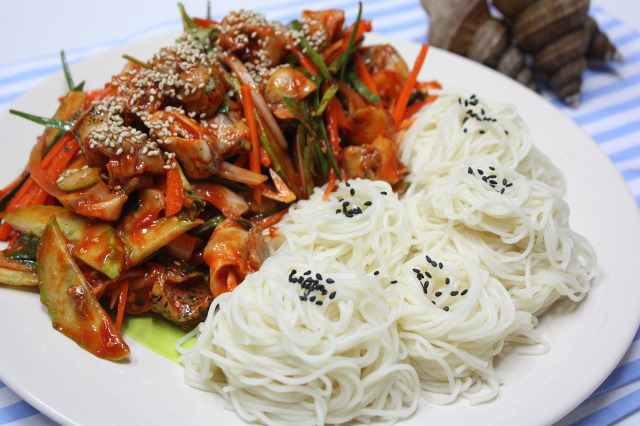
In Korean cuisine the snails are used in a dish called golbaengi-muchim (moon snail salad). It is usually collected using fishing nets at depths of 2-10 m.
References
- Dautzenberg, Ph. (1929). Mollusques testacés marins de Madagascar. Faune des Colonies Francaises, Tome III
- MacNae, W. & M. Kalk (eds) (1958). A natural history of Inhaca Island, Mozambique. Witwatersrand Univ. Press, Johannesburg. I-iv, 163 pp.
- Branch, G.M. et al. (2002). Two Oceans. 5th impression. David Philip, Cate Town & Johannesburg
- Kilburn, R.N. & Rippey, E. (1982) Sea Shells of Southern Africa. Macmillan South Africa, Johannesburg, xi + 249 pp. page(s): 71
- Steyn, D.G. & Lussi, M. (1998) Marine Shells of South Africa. An Illustrated Collector’s Guide to Beached Shells. Ekogilde Publishers, Hartebeespoort, South Africa, ii + 264 pp. page(s): 50
- Hollman M. (2008) Naticidae. In Poppe G.T. (ed.) Philippine marine mollusks, vol. 1: 482-501, pls 186-195. Hackenheim: Conchbooks.
- Torigoe K. & Inaba A. (2011) Revision on the classification of Recent Naticidae. Bulletin of the Nishinomiya Shell Museum 7: 133 + 15 pp., 4 pls
References
- {{WRMS species. 568320. ''Neverita didyma'' (Röding, 1798)
- http://www.wildsingapore.com/wildfacts/mollusca/gastropoda/naticidae/didyma.htm
- https://bie.ala.org.au/species/https://biodiversity.org.au/afd/taxa/a8e66e09-b2b5-4fee-9d2d-fefb2a55b9c6
- https://worldspecies.org/ntaxa/2669073/i
This article was imported from Wikipedia and is available under the Creative Commons Attribution-ShareAlike 4.0 License. Content has been adapted to SurfDoc format. Original contributors can be found on the article history page.
Ask Mako anything about Neverita didyma — get instant answers, deeper analysis, and related topics.
Research with MakoFree with your Surf account
Create a free account to save articles, ask Mako questions, and organize your research.
Sign up freeThis content may have been generated or modified by AI. CloudSurf Software LLC is not responsible for the accuracy, completeness, or reliability of AI-generated content. Always verify important information from primary sources.
Report