From Surf Wiki (app.surf) — the open knowledge base
Netherlands and weapons of mass destruction
none
none
Although the Netherlands does not have weapons of mass destruction made by itself, the country participates in NATO's nuclear weapons sharing arrangements and trains for delivering US nuclear weapons. These weapons were first stored in the Netherlands in 1960.
The Netherlands is also one of the producers of components that can be used for creating deadly agents, chemical weapons and other kinds of weapons of mass destruction. Several Dutch companies provided the United States, Israel and Pakistan with components for these weapons.
The Netherlands ratified the Geneva Protocol on 31 October 1930. It also ratified the Biological Weapons Convention on 10 April 1972 and the Chemical Weapons Convention on 30 June 1995.
United States-NATO nuclear weapons sharing
The Netherlands ratified the Nuclear Non-Proliferation Treaty (NPT) on 2 May 1975.
In the past (1960s till 1990s), the Netherlands took part in the deployment of NATO nuclear artillery shells for its self-propelled howitzers and missile artillery units. These 8 inch shells and warheads for Honest John, and later Lance, missiles were stored at the special ammunition stores at 't Harde and Havelterberg. These weapons are no longer operational.
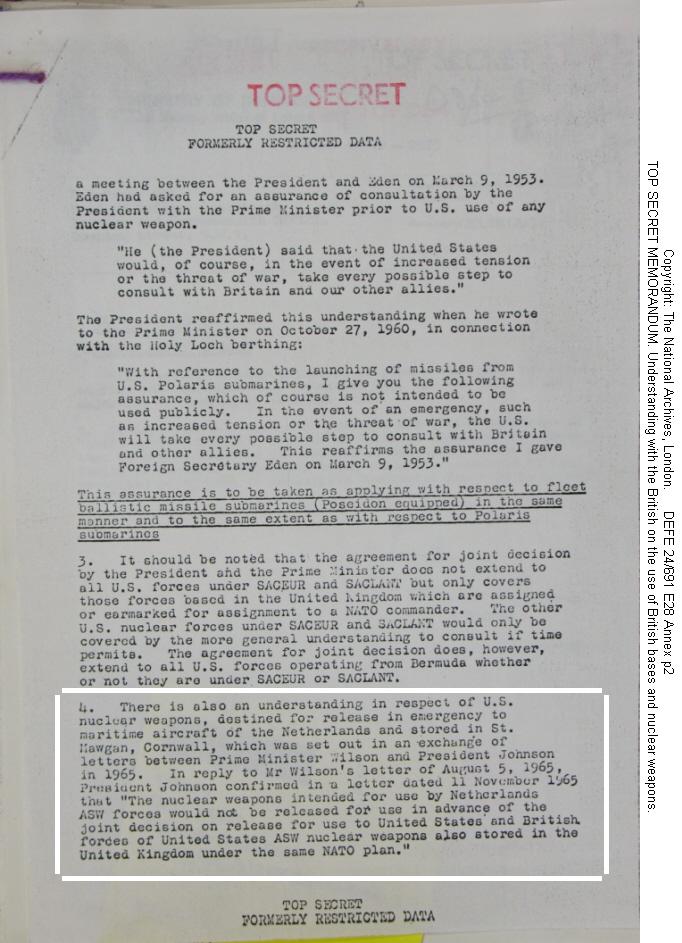
The NDBs were stored under U.S. Marine guard at RAF St. Mawgan, Cornwall, UK, which also held 60 similar weapons for the use of RAF Shackleton and Nimrod aircraft. The storage arrangements were agreed in 1965 between the British Prime Minister Harold Wilson and President Johnson in a secret memorandum now declassified in the UK archives. The National Archives, London. DEFE 24/691 E28 p6.
At present (2008), the USAF still provides 22 tactical B61 nuclear bombs for use by the Netherlands under the NATO nuclear weapons sharing agreement. These weapons are stored at Volkel Air Base and, in time of war, they may be delivered by Royal Netherlands Air and Space Force F-35 warplanes. (The Dutch government has never formally admitted or denied the presence of these weapons, but former prime ministers Dries van Agt and Ruud Lubbers both acknowledged their presence in 2013.)
The U.S. insists that its forces control the weapons and that no transfer of the nuclear bombs or control over them is intended "unless and until a decision were made to go to war, at which the [NPT] treaty would no longer be controlling", so there is no breach of the NPT.
Dutch production of precursors to chemical weapons
Alongside companies from the United Kingdom, France, Germany, the United States, Belgium, Spain, India, and Brazil, Dutch companies provided Iraq with the chemicals used as precursors to produce chemical weapons for use against Iran in the Iran–Iraq War.
Suffering from chemical warfare during the Iran–Iraq War (1980–1988), 2000 Iranians submitted an indictment some years ago with a Tehran court against nine companies that had provided Saddam Hussein with such chemicals, and 455 American and European companies, two thirds being German, provided aid to Iraq during its war with Iran. The United Nations published a 12,000-page report about the conflict and named the companies involved.
Poison gas experiments
On 20 February 2008, it was revealed that the Netherlands had conducted chemical warfare experiments with nerve gas in the early 1950s. These experiments were conducted by the TNO organization on the request of the Defense Department. They consisted of the use of sarin, tabun, soman, and a modified French gas called Stof X (Substance X), which was more poisonous than sarin. The experiments were carried out on animals in the village of Harskamp and on the Vliehors bombing range, located on the island of Vlieland. After 1956, the only experiments were those conducted jointly with France and Belgium in the desert of Algeria, which utilized 6 kilograms of Stof X. The reason behind these experiments was the fear of an attack by the Soviet Union.
References
Sources
- , Contained in an exchange of letters between Prime Minister Harold Wilson and Pres Lyndon B.Johnson, declassified 2002, and now in the UK National Archives, London filed as DEFE 24/691-E28
References
- (2021). "US Nuclear Weapons in the Netherlands: A First Appraisal {{!}} National Security Archive".
- (2022). "Nuclear Weapons in the Tweede Kamer: Analysis of Nuclear Motions in the Dutch House of Representatives in Times of Contestation". Global Studies Quarterly.
- Kristensen, Hans. (February 2005). "U.S. Nuclear Weapons in Europe".
- (10 June 2013). "22 atoombommen in kluizen basis Volkel". [[RTL Nederland]].
- (4 December 2013). "Een typisch geval van klassenjustitie (2)". [[RTL Nederland]].
- Brian Donnelly, [[Foreign and Commonwealth Office]]. "The Nuclear Weapons Non-Proliferation Articles I, II and VI of the Treaty on the Non-Proliferation of Nuclear Weapons". Agency for the Prohibition of Nuclear Weapons in Latin America and the Caribbean.
- [http://www.bndestem.nl/algemeen/binnenland/nederland-deed-in-jaren-50-proeven-met-gifgas-1.581237 NRC newspaper, 19 feb. 2008]
This article was imported from Wikipedia and is available under the Creative Commons Attribution-ShareAlike 4.0 License. Content has been adapted to SurfDoc format. Original contributors can be found on the article history page.
Ask Mako anything about Netherlands and weapons of mass destruction — get instant answers, deeper analysis, and related topics.
Research with MakoFree with your Surf account
Create a free account to save articles, ask Mako questions, and organize your research.
Sign up freeThis content may have been generated or modified by AI. CloudSurf Software LLC is not responsible for the accuracy, completeness, or reliability of AI-generated content. Always verify important information from primary sources.
Report