From Surf Wiki (app.surf) — the open knowledge base
Neptune
Eighth planet from the Sun

Eighth planet from the Sun
| Field | Value | ||||||||
|---|---|---|---|---|---|---|---|---|---|
| name | Neptune | ||||||||
| symbol | [[File:Neptune symbol (bold).svg | 24px | ♆ | class=skin-invert]], [[File:Neptune monogram (fixed width).svg | 24px | ⯉ | class=skin-invert]] | ||
| image | Neptune Voyager2 color calibrated.png | ||||||||
| caption | Neptune in true colour, taken by Voyager 2 in August 1989; at centre is the Great Dark Spot | ||||||||
| background | LightBlue | ||||||||
| discovery_ref | |||||||||
| discoverer | {{plainlist | ||||||||
| discovered | 23 September 1846 | ||||||||
| pronounced | , | ||||||||
| {{cite dictionary | title | Neptune | first=Elizabeth | last=Walter | date=21 April 2003 | dictionary=Cambridge Advanced Learner's Dictionary | publisher=Cambridge University Press | edition=2nd | isbn=978-0-521-53106-1}} |
| adjectives | Neptunian (), Poseidean | ||||||||
| named_after | Latin Neptunus, via French Neptune | ||||||||
| orbit_ref | Orbital elements refer to the Neptune barycentre and Solar System barycentre. These are the instantaneous osculating values at the precise J2000 epoch. Barycentre quantities are given because, in contrast to the planetary centre, they do not experience appreciable changes on a day-to-day basis from the motion of the moons. | ||||||||
| epoch | J2000 | ||||||||
| apsis | helion | ||||||||
| aphelion | 30.33 AU | ||||||||
| perihelion | 29.81 AU | ||||||||
| time_periastron | 2042-Sep-04 | ||||||||
| semimajor | 30.07 AU | ||||||||
| eccentricity | |||||||||
| period | {{plainlist | ||||||||
| * 89,666 Neptunian solar days<ref name | "planet_years" | ||||||||
| synodic_period | 367.49 days | ||||||||
| avg_speed | |||||||||
| mean_anomaly | |||||||||
| inclination | to ecliptic | ||||||||
| 6.43° to Sun's equator | |||||||||
| 0.74° to invariable plane{{cite journal | |||||||||
| title | The solar system's invariable plane | ||||||||
| last1 | Souami | first1=D. | last2=Souchay | first2=J. | |||||
| journal | Astronomy & Astrophysics | ||||||||
| volume | 543 | id=A133 | page=11 | date=July 2012 | |||||
| doi | 10.1051/0004-6361/201219011 | bibcode=2012A&A...543A.133S | doi-access=free }} | ||||||
| asc_node | |||||||||
| arg_peri | |||||||||
| satellites | 16 | ||||||||
| mean_radius | |||||||||
| equatorial_radius | Refers to the level of 1 bar atmospheric pressure | ||||||||
| 3.883 Earths | |||||||||
| polar_radius | |||||||||
| 3.829 Earths | |||||||||
| flattening | |||||||||
| surface_area | |||||||||
| 14.94 Earths | |||||||||
| volume | |||||||||
| 57.74 Earths | |||||||||
| mass | |||||||||
| 17.147 Earths | |||||||||
| 5.15 Suns | |||||||||
| density | Based on the volume within the level of 1 bar atmospheric pressure | ||||||||
| surface_grav | 11.27 m/s2 | ||||||||
| moment_of_inertia_factor | (estimate) | ||||||||
| escape_velocity | 23.5 km/s | ||||||||
| rotation | |||||||||
| 16 h 6 m 36 s<ref name | "planet_years"/ | ||||||||
| sidereal_day | 0.673 day | ||||||||
| 16 h 6 min 36 s | |||||||||
| rot_velocity | |||||||||
| axial_tilt | 28.32° (to orbit) | ||||||||
| right_asc_north_pole | |||||||||
| 299.36° | |||||||||
| declination | 43.46° | ||||||||
| albedo | 0.290 (bond) | ||||||||
| 0.442 (geom.) | |||||||||
| temp_name1 | 1 bar level | ||||||||
| mean_temp_1 | 72 K | ||||||||
| temp_name2 | 0.1 bar | ||||||||
| mean_temp_2 | 55 K | ||||||||
| magnitude | 7.67 to 8.00 | ||||||||
| abs_magnitude | −6.9 | ||||||||
| angular_size | 2.2–2.4″ | ||||||||
| atmosphere_ref | |||||||||
| scale_height | |||||||||
| atmosphere_composition | {{plainlist | ||||||||
| * {{val | 80 | 3.2 | u | %}} hydrogen | |||||
| * {{val | 19 | 3.2 | u | %}} helium | |||||
| * {{val | 1.5 | 0.5 | u | %}} methane |
the planet
- Johann Galle
- Urbain Le Verrier
- John Couch Adams
- 164.8 yr
- 60,195 days
- 89,666 Neptunian solar days 6.43° to Sun's equator 0.74° to invariable plane{{cite journal 3.883 Earths 3.829 Earths 14.94 Earths 57.74 Earths 17.147 Earths 5.15 Suns
16 h 6 m 36 s 16 h 6 min 36 s 299.36° 0.442 (geom.)
- hydrogen
- helium
- methane
- ~0.019% hydrogen deuteride
- ~0.00015% ethane
- Icy volatiles: }} Neptune is the eighth and farthest known planet orbiting the Sun. It is the fourth-largest planet in the Solar System by diameter, the third-most-massive planet, and the densest giant planet. It is 17 times the mass of Earth. Compared to Uranus, its neighbouring ice giant, Neptune is slightly smaller, but more massive and denser. Being composed primarily of gases and liquids, it has no well-defined solid surface. Neptune orbits the Sun once every 164.8 years at an orbital distance of 30.1 AU. It is named after the Roman god of the sea and has the astronomical symbol [File:Neptune symbol (fixed width).svg representing [Neptune's trident.
Neptune is not visible to the unaided eye and is the only planet in the Solar System that was not initially observed by direct empirical observation. Rather, unexpected changes in the orbit of Uranus led Alexis Bouvard to hypothesise that its orbit was subject to gravitational perturbation by an unknown planet. After Bouvard's death, the position of Neptune was mathematically predicted from his observations, independently, by John Couch Adams and Urbain Le Verrier. Neptune was subsequently directly observed with a telescope on 23 September 1846 by Johann Gottfried Galle within a degree of the position predicted by Le Verrier. Its largest moon, Triton, was discovered shortly thereafter, though none of the planet's remaining moons were located telescopically until the 20th century.
The planet's distance from Earth gives it a small apparent size, and its distance from the Sun renders it very dim, making it challenging to study with Earth-based telescopes. Only the advent of the Hubble Space Telescope and of large ground-based telescopes with adaptive optics allowed for detailed observations. Voyager 2, which flew by Neptune on 25 August 1989, remains the only spacecraft to visit the planet. Like the gas giants (Jupiter and Saturn), Neptune's atmosphere is composed primarily of hydrogen and helium, along with traces of hydrocarbons and possibly nitrogen, but contains a higher proportion of ices such as water, ammonia and methane. Similar to Uranus, its interior is primarily composed of ices and rock; both planets are normally considered "ice giants" to distinguish them. Along with Rayleigh scattering, traces of methane in the outermost regions make Neptune appear faintly blue.
In contrast to the strongly seasonal atmosphere of Uranus, which can be featureless for long periods of time, Neptune's atmosphere has active and consistently visible weather patterns. At the time of the Voyager 2 flyby in 1989, the planet's southern hemisphere had a Great Dark Spot comparable to the Great Red Spot on Jupiter. In 2018, a newer main dark spot and smaller dark spot were identified and studied. These weather patterns are driven by the strongest sustained winds of any planet in the Solar System, as high as 2100 km/h. Because of its great distance from the Sun, Neptune's outer atmosphere is one of the coldest places in the Solar System, with temperatures at its cloud tops approaching 55 K. Temperatures at the planet's centre are approximately 5400 K. Neptune has a faint and fragmented ring system (labelled "arcs"), discovered in 1984 and confirmed by Voyager 2.
History
Discovery
Main article: Discovery of Neptune
Some of the earliest known telescopic observations ever, Galileo's drawings on 28 December 1612 and 27 January 1613 (New Style) contain plotted points that match what is now known to have been the positions of Neptune on those dates. Both times, Galileo seems to have mistaken Neptune for a fixed star when it appeared close—in conjunction—to Jupiter in the night sky. Hence, he is not credited with Neptune's discovery. At his first observation in December 1612, Neptune was almost stationary in the sky because it had just turned retrograde that day. This apparent backward motion is created when Earth's orbit takes it past an outer planet. Because Neptune was only beginning its yearly retrograde cycle, the motion of the planet was far too slight to be detected with Galileo's small telescope. In 2009, a study suggested that Galileo was at least aware that the "star" he had observed had moved relative to fixed stars.
In 1821, Alexis Bouvard published astronomical tables of the orbit of Uranus. Subsequent observations revealed substantial deviations from the tables, leading Bouvard to hypothesize that an unknown body was perturbing the orbit through gravitational interaction.
Independently from Adams, Urbain Le Verrier developed his own calculations in 1845–1846 that pointed to an undiscovered planet, but aroused no enthusiasm among his compatriots. In June 1846, upon seeing Le Verrier's first published estimate of a suspected undiscovered planet's longitude and its similarity to Adams's estimate, Airy persuaded James Challis to search for it. Challis vainly scoured the sky throughout August and September. Challis had, in fact, observed Neptune a year before the planet's subsequent discoverer, Johann Gottfried Galle, and on two occasions, 4 and 12 August 1845. However, his out-of-date star maps and poor observing techniques meant that he failed to recognize the observations as such until he carried out later analysis. Challis was full of remorse but blamed his neglect on his maps and the fact that he was distracted by his concurrent work on comet observations.
Meanwhile, Le Verrier sent a letter and urged Berlin Observatory astronomer Galle to search with the observatory's refractor. Heinrich d'Arrest, a student at the observatory, suggested to Galle that they could compare a recently drawn chart of the sky in the region of Le Verrier's predicted location with the current sky to seek the displacement characteristic of a planet, as opposed to a fixed star. On the evening of 23 September 1846, the day Galle received the letter, he discovered Neptune just northeast of Iota Aquarii, 1° from the "five degrees east of Delta Capricorn" position Le Verrier had predicted it to be, about 12° from Adams's prediction, and on the border of Aquarius and Capricornus according to the modern IAU constellation boundaries.
In the wake of the discovery, there was a nationalistic rivalry between the French and the British over who deserved credit for the discovery. Eventually, an international consensus emerged that Le Verrier and Adams deserved joint credit. Since 1966, Dennis Rawlins has questioned the credibility of Adams's claim to co-discovery, and the issue was re-evaluated by historians with the return in 1998 of the "Neptune papers" (historical documents) to the Royal Observatory, Greenwich.
Naming
Shortly after its discovery, Neptune was referred to simply as "the planet exterior to Uranus" or as "Le Verrier's planet". The first suggestion for a name came from Galle, who proposed the name Janus. In England, Challis put forward the name Oceanus.
Claiming the right to name his discovery, Le Verrier quickly proposed the name Neptune for this new planet, though falsely stating that this had been officially approved by the French Bureau des Longitudes. In October, he sought to name the planet Le Verrier, after himself, and he had loyal support in this from the observatory director, François Arago. This suggestion met with stiff resistance outside France. French almanacs quickly reintroduced the name Herschel for Uranus, after that planet's discoverer Sir William Herschel, and Leverrier for the new planet.
Struve came out in favour of the name Neptune on 29 December 1846, to the Saint Petersburg Academy of Sciences, after the colour of the planet as viewed through a telescope. Soon, Neptune became the internationally accepted name. In Roman mythology, Neptune was the god of the sea, identified with the Greek Poseidon. The demand for a mythological name seemed to be in keeping with the nomenclature of the other planets, all of which were named for deities in Greek and Roman mythology.One could argue that it is true except for the 'Earth', which in the English language is the name of a Germanic deity, Erda. The IAU policy is that one may call the Earth and the Moon by any name commonly used in the language. According to the IAU, 'Terra' and 'Luna' are not the official names of planet Earth and its moon:
Most languages today use some variant of the name "Neptune" for the planet. In Chinese, Vietnamese, Japanese, and Korean, the planet's name was translated as "sea king star" (海王星). In Mongolian, Neptune is called mn (Далайн ван), reflecting its namesake god's role as the ruler of the sea. In modern Greek, the planet is called Poseidon (Ποσειδώνας, el), the Greek counterpart of Neptune. In Hebrew, he (רהב), from a Biblical sea monster mentioned in the Book of Psalms, was selected in a vote managed by the Academy of the Hebrew Language in 2009 as the official name for the planet, even though the existing Latin term he (נפטון) is commonly used. In Māori, the planet is called Tangaroa, named after the Māori god of the sea. In Nahuatl, the planet is called Tlāloccītlalli, named after the rain god Tlāloc. In Thai, Neptune is referred to by the Westernised name th (ดาวเนปจูน) but is also called th (ดาวเกตุ, ), after Ketu (केतु), the descending lunar node, who plays a role in Hindu astrology. In Malay, the name Waruna, after the Hindu god of seas, is attested as far back as the 1970s, but was eventually superseded by the Latinate equivalents Neptun (in Malaysian) or Neptunus (in Indonesian).
The usual adjectival form is Neptunian. The nonce form Poseidean (), from Poseidon, has also been used,
Status
From its discovery in 1846 until the discovery of Pluto in 1930, Neptune was the farthest known planet. When Pluto was discovered, it was considered a planet, and Neptune thus became the second-farthest known planet, except for a 20-year period between 1979 and 1999 when Pluto's elliptical orbit brought it closer than Neptune to the Sun, making Neptune the ninth planet from the Sun during this period. The increasingly accurate estimations of Pluto's mass from ten times that of Earth's to far less than that of the Moon and the discovery of the Kuiper belt in 1992 led many astronomers to debate whether Pluto should be considered a planet or as part of the Kuiper belt. In 2006, the International Astronomical Union defined the word "planet" for the first time, reclassifying Pluto as a "dwarf planet" and making Neptune once again the outermost-known planet in the Solar System.
Physical characteristics

Neptune's mass of 1.024 kg is intermediate between Earth and the larger gas giants: it is 17.15 times that of Earth but just 1/19th that of Jupiter.The mass of Earth is 5.9722 kg, giving a mass ratio
:\tfrac{M_\text{Neptune}}{M_\text{Earth}} = \tfrac{1.02 \times 10^{26}}{5.97 \times 10^{24}} = 17.15. The mass of Uranus is 8.6810 kg, giving a mass ratio
:\tfrac{M_\text{Uranus}}{M_\text{Earth}} = \tfrac{8.68 \times 10^{25}}{5.97 \times 10^{24}} = 14.54. The mass of Jupiter is 1.8986 kg, giving a mass ratio
:\tfrac{M_\text{Jupiter}}{M_\text{Neptune}} = \tfrac{1.90 \times 10^{27}}{1.02 \times 10^{26}} = 18.63. Mass values from Its gravity at 1 bar is 11.27 m/s2, 1.15 times the surface gravity of Earth, and surpassed only by Jupiter. Neptune's equatorial radius of 24,764 km is nearly four times that of Earth. Neptune, like Uranus, is an ice giant, a subclass of giant planet, because they are smaller and have higher concentrations of volatiles than Jupiter and Saturn. In the search for exoplanets, Neptune has been used as a metonym: discovered bodies of similar mass are often referred to as "Neptunes", just as scientists refer to various extrasolar bodies as "Jupiters".
Internal structure
Neptune's internal structure resembles that of Uranus. Its atmosphere forms about 5 to 10% of its mass and extends perhaps 10 to 20% of the way towards the core. Pressure in the atmosphere reaches about 10 GPa, or about 10 atmospheres. Increasing concentrations of methane, ammonia and water are found in the lower regions of the atmosphere.
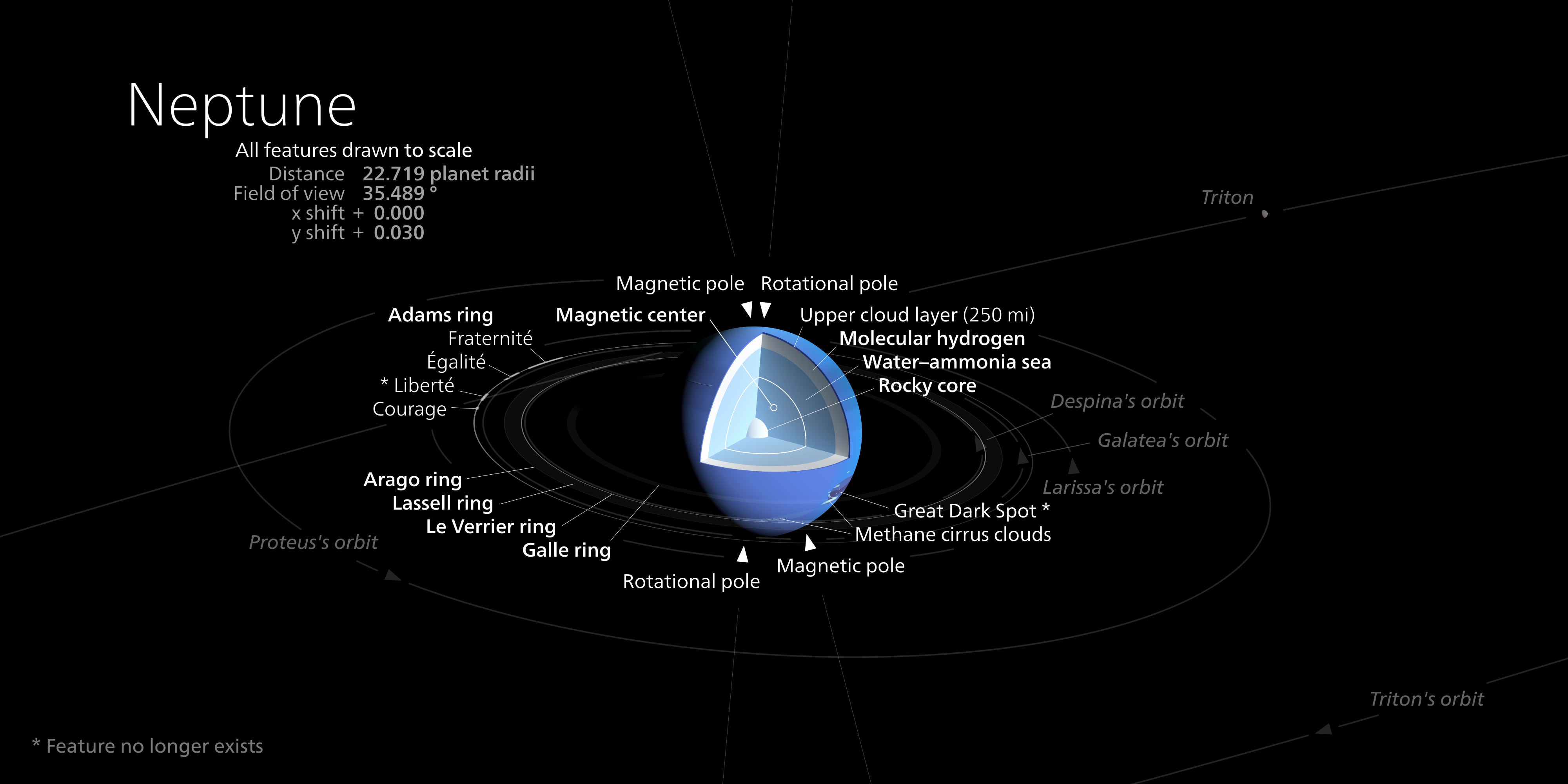
The mantle is equivalent to 10 to 15 Earth masses and is rich in water, ammonia and methane. The mantle may consist of a layer of ionic water in which the water molecules break down into a soup of hydrogen and oxygen ions, and deeper down superionic water in which the oxygen crystallizes but the hydrogen ions float around freely within the oxygen lattice. At a depth of 7,000 km, the conditions may be such that methane decomposes into diamond crystals that rain downwards like hailstones. Scientists believe that this kind of diamond rain occurs on Jupiter, Saturn, and Uranus. Very-high-pressure experiments at Lawrence Livermore National Laboratory suggest that the top of the mantle may be an ocean of liquid carbon with floating solid 'diamonds'.
The core of Neptune is likely composed of iron, nickel and silicates, with an interior model giving a mass about 1.2x that of Earth. The pressure at the centre is 7 Mbar (700 GPa), about twice as high as that at the centre of Earth, and the temperature may be 5400 K.
Atmosphere
At high altitudes, Neptune's atmosphere is 80% hydrogen and 19% helium. A trace amount of methane is present. Prominent absorption bands of methane exist at wavelengths above 600 nm, in the red and infrared portion of the spectrum. As with Uranus, this absorption of red light by atmospheric methane is part of what gives Neptune its faint blue hue, which is more pronounced for Neptune's due to concentrated haze in Uranus's atmosphere.{{cite web | access-date=30 October 2023 | archive-date=31 October 2023 | archive-url=https://web.archive.org/web/20231031014930/https://science.nasa.gov/solar-system/planets/neptune/why-uranus-and-neptune-are-different-colors/ | url-status=live
Neptune's atmosphere is subdivided into two main regions: the lower troposphere, where temperature decreases with altitude, and the stratosphere, where temperature increases with altitude. The boundary between the two, the tropopause, lies at a pressure of 0.1 bar. The stratosphere then gives way to the thermosphere at a pressure lower than 10−5 to 10−4 bars (1 to 10 Pa). The thermosphere gradually transitions to the exosphere.
Models suggest that Neptune's troposphere is banded by clouds of varying compositions depending on altitude. The upper-level clouds lie at pressures below one bar, where the temperature is suitable for methane to condense. For pressures between one and five bars (100 and 500 kPa), clouds of ammonia and hydrogen sulfide are thought to form. Above a pressure of five bars, the clouds may consist of ammonia, ammonium sulfide, hydrogen sulfide and water. Deeper clouds of water ice should be found at pressures of about 50 bar, where the temperature reaches 273 K. Underneath, clouds of ammonia and hydrogen sulfide may be found.
High-altitude clouds on Neptune have been observed casting shadows on the opaque cloud deck below. There are high-altitude cloud bands that wrap around the planet at constant latitudes. These circumferential bands have widths of 50–150 km and lie about 50–110 km above the cloud deck.
Neptune's spectra suggest that its lower stratosphere is hazy due to condensation of products of ultraviolet photolysis of methane, such as ethane and ethyne. The stratosphere is home to trace amounts of carbon monoxide and hydrogen cyanide. The stratosphere of Neptune is warmer than that of Uranus due to the elevated concentration of hydrocarbons.
For reasons that remain obscure, the planet's thermosphere is at an anomalously high temperature of about 750 K. The planet is too far from the Sun for this heat to be generated by ultraviolet radiation. One candidate for a heating mechanism is atmospheric interaction with ions in the planet's magnetic field. Other candidates are gravity waves from the interior that dissipate in the atmosphere. The thermosphere contains traces of carbon dioxide and water, which may have been deposited from external sources such as meteorites and dust.
Colour
Neptune's atmosphere is faintly blue in the optical spectrum, only slightly more saturated than the blue of Uranus's atmosphere. Early renderings of the two planets greatly exaggerated Neptune's colour contrast "to better reveal the clouds, bands and winds", making it seem deep blue compared to Uranus's off-white. The two planets had been imaged with different systems, making it hard to directly compare the resulting composite images. This was revisited with the colour normalised over time, most comprehensively in late 2023.
File:Neptune Full.jpg|Original 2-colour (orange-green) NASA/JPL image from Voyager 2, with exaggerated colour File:Neptune - Voyager 2 (29347980845) flatten crop.jpg|Colour recalibrated in 2016 (Justin Cowart), preserving some enhancement for contrast File:Neptune Voyager2 color calibrated.png|Colour recalibrated in 2023 (Patrick Irwin), approximating the true colour
Magnetosphere
Neptune's magnetosphere consists of a magnetic field that is strongly tilted relative to its rotational axis at 47° and offset of at least 0.55 radius (~13,500 km) from the planet's physical centre—resembling Uranus's magnetosphere. Before the arrival of Voyager 2 to Neptune, it was hypothesised that Uranus's sideways rotation caused its tilted magnetosphere. In comparing the magnetic fields of the two planets, scientists now think the extreme orientation may be characteristic of flows in the planets' interiors. This field may be generated by convective fluid motions in a thin spherical shell of electrically conducting liquids (probably a combination of ammonia, methane and water), resulting in a dynamo action.
The dipole component of the magnetic field at the magnetic equator of Neptune is about 14 microteslas (0.14 G). The dipole magnetic moment of Neptune is about 2.2 T·m3 (14 μT·R**N3, where R**N is the radius of Neptune). Neptune's magnetic field has a complex geometry that includes relatively large contributions from non-dipolar components, including a strong quadrupole moment that may exceed the dipole moment in strength. By contrast, Earth, Jupiter and Saturn have only relatively small quadrupole moments, and their fields are less tilted from the polar axis. The large quadrupole moment of Neptune may be the result of an offset from the planet's centre and geometrical constraints of the field's dynamo generator.
Neptune's bow shock, where the magnetosphere begins to slow the solar wind, occurs at a distance of 34.9 times the radius of the planet. The magnetopause, where the pressure of the magnetosphere counterbalances the solar wind, lies at a distance of 23–26.5 times the radius of Neptune. The tail of the magnetosphere extends out to at least 72 times the radius of Neptune, and likely much farther.

Measurements by Voyager 2 in extreme-ultraviolet and radio frequencies revealed that Neptune has faint and weak but complex and unique aurorae; however, these observations were limited in time and did not contain infrared. Subsequent astronomers using the Hubble Space Telescope have not glimpsed the aurorae, in contrast to the more well-defined aurorae of Uranus. In March 2025, aurorae on Neptune were pictured for the first time by combining visible light images from the Hubble Space Telescope with near-infrared (NIR) images from the James Webb Space Telescope. The relevant data were taken in June 2023. The James Webb Space Telescope attempted to learn the spectrography of Neptune's atmosphere and it was able to find trihydrogen cations () which is generated during an aurora and is considered as a clear indicator of auroral activity on both gas giants and ice giants. The nature of Neptune's aurorae is greatly influenced by the peculiar nature of its magnetic field. Unlike the Earth, Jupiter or Saturn, Neptune's magnetic poles are not aligned with the planet's rotational poles which is why Neptune's aurorae mostly occur around its mid-latitude areas instead of its poles like on Earth or Jupiter.
Climate

Neptune's weather is characterized by extremely dynamic storm systems, with winds reaching speeds of almost 600 m/s—exceeding supersonic flow. More typically, by tracking the motion of persistent clouds, wind speeds have been shown to vary from 20 m/s in the easterly direction to 325 m/s westward. At the cloud tops, the prevailing winds range in speed from 400 m/s along the equator to 250 m/s at the poles. The general pattern of winds showed prograde rotation at high latitudes vs. retrograde rotation at lower latitudes. The difference in flow direction is thought to be a "skin effect" and not due to any deeper atmospheric processes. At 70°S latitude, a high-speed jet travels at a speed of 300 m/s. Due to seasonal changes, the cloud bands in the southern hemisphere of Neptune have been observed to increase in size and albedo. This trend was first seen in 1980. The long orbital period of Neptune results in seasons lasting 40 Earth years.
Neptune differs from Uranus in its typical level of meteorological activity. Voyager 2 observed weather phenomena on Neptune during its 1989 flyby, but no comparable phenomena on Uranus during its 1986 flyby.
The abundance of methane, ethane and acetylene at Neptune's equator is 10–100 times greater than at the poles. This is interpreted as evidence for upwelling at the equator and subsidence near the poles, as photochemistry cannot account for the distribution without meridional circulation.
In 2007, it was discovered that the upper troposphere of Neptune's south pole was about 10 K warmer than the rest of its atmosphere, which averages about 73 K. The temperature differential is enough to let methane, which elsewhere is frozen in the troposphere, escape into the stratosphere near the pole. The relative "hot spot" is due to Neptune's axial tilt, which has exposed the south pole to the Sun for the last quarter of Neptune's year, or roughly 40 Earth years. As Neptune slowly moves towards the opposite side of the Sun, the south pole will be darkened and the north pole illuminated, causing the methane release to shift to the north pole.
Storms

In 1989, the Great Dark Spot, an anticyclonic storm system spanning 13000 x 6,600 km, was discovered by NASA's Voyager 2 spacecraft. The storm resembled the Great Red Spot of Jupiter. Some five years later, on 2 November 1994, the Hubble Space Telescope did not see the Great Dark Spot on the planet. Instead, a new storm similar to the Great Dark Spot was found in Neptune's northern hemisphere.
The is another storm, a white cloud group farther south than the Great Dark Spot. This nickname first arose during the months leading up to the Voyager 2 encounter in 1989, when they were observed moving at speeds faster than the Great Dark Spot (and images acquired later would subsequently reveal the presence of clouds moving even faster than those that had initially been detected by Voyager 2). The Small Dark Spot is a southern cyclonic storm, the second-most-intense storm observed during the 1989 encounter. It was initially completely dark, but as Voyager 2 approached the planet, a bright core developed, which can be seen in most of the highest-resolution images. In 2018, a newer main dark spot and smaller dark spot were identified and studied. In 2023, the first ground-based observation of a dark spot on Neptune was announced.
Neptune's dark spots are thought to occur in the troposphere at lower altitudes than the brighter cloud features, so they appear as holes in the upper cloud decks. As they are stable features that can persist for several months, they are thought to be vortex structures. Often associated with dark spots are brighter, persistent methane clouds that form around the tropopause layer. The persistence of companion clouds shows that some former dark spots may continue to exist as cyclones even though they are no longer visible as a dark feature. Dark spots may dissipate when they migrate too close to the equator or possibly through some other, unknown mechanism.

In 1989, Voyager 2s Planetary Radio Astronomy (PRA) experiment observed around 60 lightning flashes, or Neptunian electrostatic discharges emitting energies over . A plasma wave system (PWS) detected 16 electromagnetic wave events with a frequency range of at magnetic latitudes 7–33˚. These plasma wave detections were possibly triggered by lightning over 20 minutes in the ammonia clouds of the magnetosphere.
During Voyager 2's closest approach to Neptune, the PWS instrument provided Neptune's first plasma wave detections at a sample rate of 28,800 samples per second. The measured plasma densities range from 10−3 – 10−1 cm3. Neptunian lightning may occur in three cloud layers, with microphysical modelling suggesting that most of these occurrences happen in the water clouds of the troposphere or the shallow ammonia clouds of the magnetosphere. Neptune is predicted to have 1/19 the lightning flash rate of Jupiter and to display most of its lightning activity at high latitudes. However, lightning on Neptune seems to resemble lightning on Earth rather than Jovian lightning.
Internal heating
Neptune's more varied weather when compared to Uranus is due in part to its higher internal heating. The upper regions of Neptune's troposphere reach a low temperature of 51.8 K. At a depth where the atmospheric pressure equals 1 bar, the temperature is 72.00 K. Deeper inside the layers of gas, the temperature rises steadily. As with Uranus, the source of this heating is unknown, but the discrepancy is larger: Uranus only radiates 1.1 times as much energy as it receives from the Sun; whereas Neptune radiates about 2.61 times as much energy as it receives from the Sun.
Neptune is over 50% farther from the Sun than Uranus and receives only ~40% of Uranus's amount of sunlight; however, its internal energy is still enough for the fastest planetary winds in the Solar System. Depending on the thermal properties of its interior, the heat left over from Neptune's formation may be sufficient to explain its current heat flow, though it is harder to explain Uranus's lack of internal heat while preserving the apparent similarity between the two planets.
Orbit and rotation

The average distance between Neptune and the Sun is (about 30.1 astronomical units (AU), the mean distance from the Earth to the Sun), and it completes an orbit on average every 164.79 years, subject to a variability of around ±0.1 years. The perihelion distance is 29.81 AU, and the aphelion distance is 30.33 AU. Neptune's orbital eccentricity is only 0.008678, making it the planet in the Solar System with the second most circular orbit after Venus. The orbit of Neptune is inclined 1.77° compared to that of Earth.
On 11 July 2011, Neptune completed its first full barycentric orbit since its discovery in 1846; it did not appear at its exact discovery position in the sky because Earth was in a different location in its 365.26-day orbit. Because of the motion of the Sun in relation to the barycentre of the Solar System, on 11 July, Neptune was not at its exact discovery position in relation to the Sun—if the more common heliocentric coordinate system is used, the discovery longitude was reached on 12 July 2011.
The axial tilt of Neptune is 28.32°, which is similar to the tilts of Earth (23°) and Mars (25°). As a result, Neptune experiences seasonal changes similar to those on Earth. The long orbital period of Neptune means that the seasons last for forty Earth years. Its sidereal rotation period (day) is roughly 16.11 hours. Because its axial tilt is comparable to Earth's, the variation in the length of its day over the course of its long year is not any more extreme.
Because Neptune is not a solid body, its atmosphere undergoes differential rotation. The wide equatorial zone rotates with a period of about 18 hours, which is slower than the 16.1-hour rotation of the planet's magnetic field. By contrast, the reverse is true for the polar regions where the rotation period is 12 hours. This differential rotation is the most pronounced of any planet in the Solar System, and it results in strong latitudinal wind shear.
Formation and resonances
Formation
Main article: Formation and evolution of the Solar System, Nice model

The formation of the ice giants, Neptune and Uranus, has been difficult to model precisely. Current models suggest that the matter density in the outer regions of the Solar System was too low to account for the formation of such large bodies from the traditionally accepted method of core accretion, and various hypotheses have been advanced to explain their formation. One is that the ice giants were not formed by core accretion but from instabilities within the original protoplanetary disc and later had their atmospheres blasted away by radiation from a nearby massive OB star.
An alternative concept is that they formed closer to the Sun, where the matter density was higher, and then subsequently migrated to their current orbits after the removal of the gaseous protoplanetary disc. This hypothesis of migration after formation is favoured due to its ability to better explain the occupancy of the populations of small objects observed in the trans-Neptunian region. The current most widely accepted explanation of the details of this hypothesis is known as the Nice model, which is a dynamical evolution scenario that explores the potential effect of a migrating Neptune and the other giant planets on the structure of the Kuiper belt.
Orbital resonances
Main article: Kuiper belt, resonant trans-Neptunian object, Neptune trojan

Neptune's orbit has a profound impact on the region directly beyond it, known as the Kuiper belt. The Kuiper belt is a ring of small icy worlds, similar to the asteroid belt but far larger, extending from Neptune's orbit at 30 AU out to about 55 AU from the Sun. Much in the same way that Jupiter's gravity dominates the asteroid belt, Neptune's gravity dominates the Kuiper belt. Over the age of the Solar System, certain regions of the Kuiper belt became destabilised by Neptune's gravity, creating gaps in its structure. The region between 40 and 42 AU is an example.
There do exist orbits within these empty regions where objects can survive for the age of the Solar System. These resonances occur when Neptune's orbital period is a precise fraction of that of the object, such as 1:2, or 3:4. If, say, an object orbits the Sun once for every two Neptune orbits, it will only complete half an orbit by the time Neptune returns to its original position. The most heavily populated resonance in the Kuiper belt, with over 200 known objects, is the 2:3 resonance. Objects in this resonance complete 2 orbits for every 3 of Neptune, and are known as plutinos because the largest of the known Kuiper belt objects, Pluto, is among them. Although Pluto crosses Neptune's orbit regularly, the 2:3 resonance makes it so that they can never collide. The 3:4, 3:5, 4:7 and 2:5 resonances are less populated.
Neptune has a number of known trojan objects occupying both the Sun–Neptune and Lagrangian points—gravitationally stable regions leading and trailing Neptune in its orbit, respectively. Neptune trojans can be viewed as being in a 1:1 resonance with Neptune. Some Neptune trojans are remarkably stable in their orbits, and are likely to have formed alongside Neptune rather than being captured. The first object identified as associated with Neptune's trailing Lagrangian point was . Neptune has a temporary quasi-satellite, . The object has been a quasi-satellite of Neptune for about 12,500 years and it will remain in that dynamical state for another 12,500 years.
Moons
Main article: Moons of Neptune
.png)
Neptune has 16 known moons. Triton is the largest Neptunian moon, accounting for more than 99.5% of the mass in orbit around Neptune,Mass of Triton: 2.14 kg. Combined mass of 12 other known moons of Neptune: 7.53 kg, or 0.35%. The mass of the rings is negligible. and is the only one massive enough to be spheroidal. Triton was discovered by William Lassell just 17 days after the discovery of Neptune itself. Unlike all other large planetary moons in the Solar System, Triton has a retrograde orbit, indicating that it was captured rather than forming in place; it was probably once a dwarf planet in the Kuiper belt. It is close enough to Neptune to be locked into a synchronous rotation, and it is slowly spiralling inward because of tidal acceleration. It will eventually be torn apart, in about 3.6 billion years, when it reaches the Roche limit. In 1989, Triton was the coldest object that had yet been measured in the Solar System, with estimated temperatures of 38 K. This very low temperature is due to Triton's very high albedo which causes it to reflect a lot of sunlight instead of absorbing it.
Neptune's second-known satellite (by order of discovery), the irregular moon Nereid, has one of the most eccentric orbits of any satellite in the Solar System. The eccentricity of 0.7512 gives it an apoapsis that is seven times its periapsis distance from Neptune.\tfrac{r_{a}}{r_{p}} = \tfrac{2}{1-e} - 1 = 2/0.2488 - 1 \approx 7.039.
From July to September 1989, Voyager 2 discovered six moons of Neptune. Of these, the irregularly shaped Proteus is notable for being as large as a body of its density can be without being pulled into a spherical shape by its own gravity. Although the second-most-massive Neptunian moon, it is only 0.25% the mass of Triton. Neptune's innermost four moons—Naiad, Thalassa, Despina and Galatea—orbit close enough to be within Neptune's rings. The next-farthest out, Larissa, was originally discovered in 1981 when it had occulted a star. This occultation had been attributed to ring arcs, but when Voyager 2 observed Neptune in 1989, Larissa was found to have caused it. Five new irregular moons discovered between 2002 and 2003 were announced in 2004. A new moon and the smallest yet, Hippocamp, was found in 2013 by combining multiple Hubble images. Because Neptune was the Roman god of the sea, Neptune's moons have been named after lesser sea gods.
Planetary rings
Main article: Rings of Neptune

Neptune has a planetary ring system, though one much less substantial than that of Saturn and Uranus. The rings may consist of ice particles coated with silicates or carbon-based material, which most likely gives them a reddish hue. The three main rings are the narrow Adams Ring, 63,000 km from the centre of Neptune, the Le Verrier Ring, at 53,000 km, and the broader, fainter Galle Ring, at 42,000 km. A faint outward extension to the Le Verrier Ring has been named Lassell; it is bounded at its outer edge by the Arago Ring at 57,000 km.
The first of these planetary rings was detected in 1968 by a team led by Edward Guinan. In the early 1980s, analysis of this data along with newer observations led to the hypothesis that this ring might be incomplete. Evidence that the rings might have gaps first arose during a stellar occultation in 1984 when the rings obscured a star on immersion but not on emersion. Images from Voyager 2 in 1989 settled the issue by showing several faint rings.
The outermost ring, Adams, contains five prominent arcs now named Courage, Liberté, Egalité 1, Egalité 2 and Fraternité (Courage, Liberty, Equality and Fraternity). The existence of arcs was difficult to explain because the laws of motion would predict that arcs would spread out into a uniform ring over short timescales. Astronomers now estimate that the arcs are corralled into their current form by the gravitational effects of Galatea, a moon just inward from the ring.
Earth-based observations announced in 2005 appeared to show that Neptune's rings were much more unstable than previously thought. Images taken from the W. M. Keck Observatory in 2002 and 2003 show considerable decay in the rings when compared to images by Voyager 2. In particular, it seems that the Liberté arc might disappear in as little as one century.
Observation

Neptune is too faint to be visible to the naked eye. The apparent magnitude currently ranges from 7.67 to 7.89 with a mean of 7.78 and a standard deviation of 0.06. It can be outshone by Jupiter's Galilean moons, the dwarf planet Ceres and the asteroids 4 Vesta, 2 Pallas, 7 Iris, 3 Juno, and 6 Hebe. A telescope or strong binoculars will resolve Neptune as a small blue disk, similar in appearance to Uranus. Neptune brightened about 10% between 1980 and 2000 mostly due to the changing of the seasons. Neptune may continue to brighten as it approaches perihelion in 2042. Prior to 1980, the planet was as faint as magnitude 8.0.
Because of the distance of Neptune from Earth, its angular diameter only ranges from 2.2 to 2.4 arcseconds, Ground-based observations using adaptive optics were first successfully carried out in 1997 in Hawaii. Neptune is currently approaching perihelion (closest approach to the Sun) and has been shown to be heating up, with increased atmospheric activity and brightness as a consequence. The new technologies are recording increasingly detailed images of Neptune. Both Hubble and the adaptive-optics telescopes have made discoveries since the mid-1990s, including an increase in the number of known satellites around the outer planets. In 2004 and 2005, five new small satellites of Neptune with diameters between 38 and 61 kilometres were discovered.
From Earth, Neptune goes through apparent retrograde motion every 367 days, resulting in a looping motion against the background stars during each opposition. These loops carried it close to the 1846 discovery coordinates in April and July 2010 and again in October and November 2011.
Neptune's 164-year orbital period means that the planet takes an average of 13 years to move through each constellation of the zodiac. In 2011, it completed its first full orbit of the Sun since being discovered and returned to where it was first spotted northeast of Iota Aquarii.
Observation of Neptune in the radio-frequency band shows that it is a source of both continuous emission and irregular bursts. Both sources are thought to originate from its rotating magnetic field.
Exploration
Main article: Exploration of Neptune

]] Voyager 2 is the only spacecraft that has visited Neptune. The spacecraft closest approach to the planet occurred on 25 August 1989. Because this was the last major planet the spacecraft could visit, it was decided to make a close flyby of the moon Triton, regardless of the consequences to the trajectory, similarly to what was done for Voyager 1s encounter with Saturn and its moon Titan. The images relayed to Earth from Voyager 2 became the basis of a 1989 PBS all-night program, Neptune All Night.
During the encounter, signals from the spacecraft required 246 minutes to reach Earth. Hence, for the most part, Voyager 2 mission relied on planned commands for the Neptune encounter. The spacecraft performed a near-encounter with the moon Nereid before it came within 4,400 km of Neptune's atmosphere on 25 August, then passed close to the planet's largest moon Triton later the same day.
The spacecraft verified the existence of a magnetic field surrounding the planet and discovered that the field was offset from the centre and tilted in a manner similar to the field around Uranus. Neptune's rotation period was determined using measurements of radio emissions and Voyager 2 showed that Neptune had a surprisingly active weather system. Six new moons were discovered, and the planet was shown to have more than one ring.
Since 2018, the China National Space Administration has been studying a concept for a pair of Voyager-like interstellar probes tentatively known as Shensuo. Both probes would be launched in the 2020s and take differing paths to explore opposing ends of the heliosphere; the second probe, IHP-2, would fly by Neptune in January 2038, passing only 1,000 km above the cloud tops, and potentially carry an atmospheric impactor to be released during its approach. Afterwards, it will continue its mission throughout the Kuiper belt toward the heliosphere tail, which is so far unexplored.
After Voyager 2 and IHP-2s flybys, the next step in scientific exploration of the Neptunian system is considered to be an orbital mission; most proposals have been by NASA, most often for a Flagship orbiter. In 2003, there was a proposal in NASA's "Vision Missions Studies" for a "Neptune Orbiter with Probes" mission that does Cassini-level science. A subsequent proposal, that was not selected, was for Argo, a flyby spacecraft to be launched in 2019, that would visit Jupiter, Saturn, Neptune, and a Kuiper belt object. The focus would have been on Neptune and its largest moon Triton to be investigated around 2029.
The proposed New Horizons 2 mission might have done a close flyby of the Neptunian system, but it was later scrapped. A proposal for the Discovery Program is that the Trident spacecraft would conduct a flyby of Neptune and Triton; however, the mission was not selected for Discovery 15 or 16. Neptune Odyssey is another concept for a Neptune orbiter and atmospheric probe that was studied as a possible large strategic science mission by NASA; it would have launched between 2031 and 2033, and arrive at Neptune by 2049. However, for logistical reasons the Uranus Orbiter and Probe mission was selected as the ice giant orbiter mission recommendation, with top priority ahead of the Enceladus Orbilander.
Two notable proposals for a Triton-focused Neptune orbiter mission that would be costed right between the Trident and Odyssey missions (under the New Frontiers program) are Triton Ocean World Surveyor and Nautilus, with cruise stages taking place in the 2031–47 and 2041–56 time periods, respectively. Neptune is a potential target for China's Tianwen-5, which could arrive in 2058.
Notes
References
| display-authors = 6
|display-authors=etal
|access-date = 23 February 2024 |archive-date = 23 February 2024 |archive-url = https://web.archive.org/web/20240223160326/https://sites.google.com/carnegiescience.edu/sheppard/home/newuranusneptunemoons |url-status = live
Bibliography
- {{Cite book
- {{Cite book
References
- (23 December 2023). "Modelling the seasonal cycle of Uranus's colour and magnitude, and comparison with Neptune". Monthly Notices of the Royal Astronomical Society.
- Hamilton, Calvin J.. (4 August 2001). "Neptune". Views of the Solar System.
- {{OED. Neptunian
- (September 2004). "Enabling Exploration with Small Radioisotope Power Systems". NASA.
- Yeomans, Donald K.. "HORIZONS Web-Interface for Neptune Barycenter (Major Body=8)". [[JPL Horizons On-Line Ephemeris System]].
- "HORIZONS Planet-center Batch call for September 2042 Perihelion". NASA/JPL.
- Seligman, Courtney. "Rotation Period and Day Length".
- Williams, David R.. (3 October 2024). "Neptune Fact Sheet". NASA.
- (May 29, 2020). "Planetary Physical Parameters". NASA Jet Propulsion Laboratory.
- (2015). "Planetary Sciences". Cambridge University Press.
- Kennett, Carolyn. (2022). "Uranus and Neptune". Reaktion Books.
- (2018). "Report of the IAU Working Group on Cartographic Coordinates and Rotational Elements: 2015". Celestial Mechanics and Dynamical Astronomy.
- "Encyclopedia - the brightest bodies".
- Espenak, Fred. (20 July 2005). "Twelve Year Planetary Ephemeris: 1995–2006". NASA.
- (10 November 2017). "Neptune".
- Chang, Kenneth. (18 October 2014). "Dark Spots in Our Knowledge of Neptune". [[The New York Times]].
- (10 November 2017). "Exploration {{!}} Neptune".
- (13 November 2007). "Neptune overview". NASA.
- (31 May 2022). "Gemini North Telescope Helps Explain Why Uranus and Neptune Are Different Colors - Observations from Gemini Observatory, a Program of NSF's NOIRLab, and other telescopes reveal that excess haze on Uranus makes it paler than Neptune".
- (22 February 1991). "High Winds of Neptune: A Possible Mechanism". [[Science (journal).
- Littmann, Mark. (2004). "Planets Beyond: Discovering the Outer Solar System". [[Dover Publications]].
- Britt, Robert Roy. (2009). "Galileo discovered Neptune, new theory claims". NBC News.
- (2006). "John Couch Adams' account of the discovery of Neptune". [[University of St Andrews]].
- Adams, J. C.. (13 November 1846). "Explanation of the observed irregularities in the motion of Uranus, on the hypothesis of disturbance by a more distant planet". [[Monthly Notices of the Royal Astronomical Society]].
- Airy, G.B.. (13 November 1846). "Account of some circumstances historically connected with the discovery of the planet exterior to Uranus". Monthly Notices of the Royal Astronomical Society.
- Challis, J.. (13 November 1846). "Account of observations at the Cambridge observatory for detecting the planet exterior to Uranus". Monthly Notices of the Royal Astronomical Society.
- Sack, Harald. (12 December 2017). "James Challis and his failure to discover the planet Neptune".
- Gaherty, Geoff. (12 July 2011). "Neptune Completes First Orbit Since Its Discovery in 1846". space.com.
- Levenson, Thomas. (2015). "The Hunt for Vulcan ... and how Albert Einstein Destroyed a Planet, Discovered Relativity, and Deciphered the Universe". Random House.
- Williams, Matt. (14 September 2015). "The gas (and ice) giant Neptune".
- (December 2004). "The case of the pilfered planet – did the British steal Neptune?".
- [[#Moore. Moore]] (2000):206
- Littmann, Mark. (2004). "Planets Beyond, Exploring the Outer Solar System". [[Dover Publications]].
- (2003). "In Search of Planet Vulcan: The ghost in Newton's clockwork universe". Basic Books.
- Gingerich, Owen. (October 1958). "The naming of Uranus and Neptune". Astronomical Society of the Pacific Leaflets.
- Hind, J. R.. (1847). "Second report of proceedings in the Cambridge Observatory relating to the new Planet (Neptune)". Astronomische Nachrichten.
- (2007). "Introduction to Planetary Science". Springer.
- (17 December 2008). "Planet and Satellite Names and Discoverers". U.S. Geological Survey.
- "Planetary linguistics". nineplanets.org.
- (31 October 2010). "Sao Hải Vương – 'Cục băng' khổng lồ xa tít tắp". Kenh14.
- (25 April 2010). "Greek Names of the Planets".
- Ettinger, Yair. (31 December 2009). "Uranus and Neptune get Hebrew names at last". [[Haaretz]].
- Belizovsky, Avi. (31 December 2009). "אוראנוס הוא מהיום אורון ונפטון מעתה רהב". [[Hayadan]].
- Ian. (25 September 2019). "Planetary Linguistics {{!}} Latin, Greek, Sanskrit & Different Languages".
- Mohamed, Kadir. (1975). "Waruna". Titiwangsa.
- (2017). "Neptun". Dewan Bahasa dan Pustaka Malaysia.
- (2016). "Neptunus". Badan Pengembangan dan Pembinaan Bahasa Indonesia.
- though the usual adjectival form of ''Poseidon'' is ''Poseidonian'' ({{IPAc-en. ˌ. p. ɒ. s. aɪ. ˈ. d. oʊ. n. i. ən).''The Century Dictionary'' (1914)
- Long, Tony. (21 January 2008). "Jan. 21, 1979: Neptune Moves Outside Pluto's Wacky Orbit".
- (17 November 2006). "Neptune Data Sheet".
- (1997). "Pluto and Charon". University of Arizona Press.
- Weissman, Paul R.. (September 1995). "The Kuiper Belt". [[Annual Review of Astronomy and Astrophysics]].
- (1999). "The Status of Pluto:A clarification".
- (24 August 2006). "IAU 2006 General Assembly: Resolutions 5 and 6". IAU.
- Boss, Alan P.. (2002). "Formation of gas and ice giant planets". Earth and Planetary Science Letters.
- (18 May 2006). "Trio of Neptunes and their Belt". [[European Southern Observatory.
- (2006). "Water-ammonia ionic ocean on Uranus and Neptune?". Geophysical Research Abstracts.
- Shiga, David. (1 September 2010). "Weird water lurking inside giant planets".
- Kerr, Richard A.. (October 1999). "Neptune May Crush Methane into Diamonds". Science.
- Kaplan, Sarah. (25 August 2017). "It rains solid diamonds on Uranus and Neptune". [[The Washington Post]].
- (September 2017). "Formation of diamonds in laser-compressed hydrocarbons at planetary interior conditions". Nature Astronomy.
- Kane, Sean. (29 April 2016). "Lightning storms make it rain diamonds on Saturn and Jupiter". [[Business Insider]].
- Baldwin, Emily. (21 January 2010). "Oceans of diamond possible on Uranus and Neptune".
- (30 July 2004). "Shock Compressing Diamond to a Conducting Fluid". Physical Review Letters.
- (8 November 2009). "Melting temperature of diamond at ultrahigh pressure". Nature Physics.
- "Interior Models of Jupiter, Saturn and Neptune". University of Rostock.
- Hubbard, W.B.. (1997). "Neptune's Deep Chemistry". Science.
- (14 June 1995). "Hubble Space Telescope Observations of Neptune". Hubble News Center.
- Ferreira, Becky. (4 January 2024). "Uranus and Neptune Reveal Their True Colors - Neptune is not as blue as you've been led to believe, and Uranus's shifting colors are better explained, in new research.". [[The New York Times]].
- Williams, Matt. (14 September 2015). "The gas (and ice) giant Neptune".
- Andrews, Robin George. (18 August 2023). "Neptune's Clouds Have Vanished, and Scientists Think They Know Why - A recent study suggests a relationship between solar cycles and the atmosphere of the solar system's eighth planet.". [[The New York Times]].
- (16 August 2023). "Neptune's Disappearing Clouds Linked to the Solar Cycle".
- (1 November 2023). "Evolution of Neptune at near-infrared wavelengths from 1994 through 2022". Icarus.
- (1999). "Ultraviolet Spectrometer Observations of Neptune and Triton". Science.
- (February 2024). "Modelling the seasonal cycle of Uranus's colour and magnitude, and comparison with Neptune". Monthly Notices of the Royal Astronomical Society.
- (30 October 1998). "Catalog Page for PIA01492".
- "The subtle color difference between Uranus and Neptune".
- Oxford, University of. "New images reveal what Neptune and Uranus really look like".
- Elkins-Tanton, Linda T.. (2006). "Uranus, Neptune, Pluto, and the Outer Solar System". Chelsea House.
- (March 2004). "Convective-region geometry as the cause of Uranus' and Neptune's unusual magnetic fields". [[Nature (journal).
- (1991). "The magnetic field of Neptune". Journal of Geophysical Research.
- (15 December 1989). "Magnetic Fields at Neptune". Science.
- (1997). "Neptune: Magnetic Field and Magnetosphere". University of California, Los Angeles.
- Lamy, L.. (9 November 2020). "Auroral emissions from Uranus and Neptune". The Royal Society.
- (11 August 2004). "ESA Portal – Mars Express discovers auroras on Mars". European Space Agency.
- (26 March 2025). "NASA's Webb Captures Neptune's Auroras For First Time". NASA Webb Mission Team.
- Lavoie, Sue. (8 January 1998). "PIA01142: Neptune Scooter". NASA.
- (22 September 1989). "Neptune's Wind Speeds Obtained by Tracking Clouds in Voyager Images". Science.
- Burgess]] (1991):64–70.
- (15 May 2003). "Brighter Neptune Suggests A Planetary Change of Seasons". Hubble News Center.
- (October 2007). "Evidence for methane escape and strong seasonal and dynamical perturbations of Neptune's atmospheric temperatures". [[Astronomy & Astrophysics]].
- (18 September 2007). "A Warm South Pole? Yes, On Neptune!". [[ESO]].
- Lavoie, Sue. (16 February 2000). "PIA02245: Neptune's blue-green atmosphere". NASA JPL.
- (1995). "Hubble Space Telescope Imaging of Neptune's Cloud Structure in 1994". Science.
- Lavoie, Sue. (29 January 1996). "PIA00064: Neptune's Dark Spot (D2) at High Resolution". NASA JPL.
- Stirone, Shannon. (22 December 2020). "Neptune's Weird Dark Spot Just Got Weirder – While observing the planet's large inky storm, astronomers spotted a smaller vortex they named Dark Spot Jr.". [[The New York Times]].
- "Mysterious Neptune dark spot detected from Earth for the first time". [[ESO]].
- (15 February 2018). "A New Dark Vortex on Neptune". The American Astronomical Society.
- (2003). "The altitude of Neptune cloud features from high-spatial-resolution near-infrared spectra". Icarus.
- (2001). "EPIC Simulations of Bright Companions to Neptune's Great Dark Spots". Icarus.
- (2000). "The unusual dynamics of new dark spots on Neptune". Bulletin of the American Astronomical Society.
- "Happy birthday Neptune". ESA/Hubble.
- Borucki, W.J.. (1989). "Predictions of lightning activity at Neptune". Geophysical Research Letters.
- (2020). "Atmospheric Electricity at the Ice Giants". Space Science Reviews.
- (1989). "Plasma observations near Neptune: Initial results from Voyager 2". Science.
- (1999). "Lightning on Neptune". Icarus.
- (June 2023). "Giant Planet Lightning in Nonideal Gases". [[The Planetary Science Journal]].
- Lindal, Gunnar F.. (1992). "The atmosphere of Neptune – an analysis of radio occultation data acquired with Voyager 2". Astronomical Journal.
- (2004). "Class 12 – Giant Planets – Heat and Formation". Colorado University, Boulder.
- (6 December 2001). "Planetary Sciences". Cambridge University Press.
- Meeus, Jean. (1998). "Astronomical Algorithms". Willmann-Bell.
- "Planetary Fact Sheet".
- McKie, Robin. (9 July 2011). "Neptune's first orbit: a turning point in astronomy". [[The Guardian]].
- (13 November 2007). "Neptune: Facts & Figures". NASA.
- Atkinson, Nancy. (26 August 2010). "Clearing the Confusion on Neptune's Orbit".
- Lakdawalla, Emily. (19 August 2010). "Doh! RT @lukedones: From Bill Folkner at JPL: Neptune will reach the same ecliptic longitude it had on Sep. 23, 1846, on July 12, 2011.".
- (16 November 2007). "Horizons Output for Neptune 2010–2011".
- Williams, David R.. (6 January 2005). "Planetary Fact Sheets". NASA.
- (9 August 1991). "Interior Structure of Neptune: Comparison with Uranus". Science.
- (January 2003). "Cloud Structures on Neptune Observed with Keck Telescope Adaptive Optics". [[The Astronomical Journal]].
- (May 2002). "The Formation of Uranus and Neptune among Jupiter and Saturn". [[The Astronomical Journal]].
- Hansen, Kathryn. (7 June 2005). "Orbital shuffle for early solar system". Geotimes.
- Desch, S.J.. (2007). "Mass Distribution and Planet Formation in the Solar Nebula". The Astrophysical Journal.
- (January 2009). "Resolved debris disc emission around η Telescopii: a young solar system or ongoing planet formation?". [[Astronomy & Astrophysics]].
- (1997). "Collisional Erosion in the Primordial Edgeworth-Kuiper Belt and the Generation of the 30–50 AU Kuiper Gap". The Astrophysical Journal.
- (1999). "Large Scattered Planetesimals and the Excitation of the Small Body Belts". Icarus.
- "List of Transneptunian Objects". Minor Planet Center.
- Jewitt, David. (2004). "The Plutinos". UCLA.
- Varadi, F.. (1999). "Periodic Orbits in the 3:2 Orbital Resonance and Their Stability". The Astronomical Journal.
- Davies, John. (2001). "Beyond Pluto: Exploring the outer limits of the solar system". [[Cambridge University Press]].
- (July 2003). "Resonance Occupation in the Kuiper Belt: Case Examples of the 5:2 and Trojan Resonances". [[The Astronomical Journal]].
- (10 September 2010). "Detection of a Trailing (L5) Neptune Trojan". [[Science (journal).
- (2012). "(309239) 2007 RW10: a large temporary quasi-satellite of Neptune". Astronomy and Astrophysics Letters.
- (May 2006). "Neptune's capture of its moon Triton in a binary–planet gravitational encounter". [[Nature (journal).
- (1989). "Tidal evolution in the Neptune-Triton system". Astronomy and Astrophysics.
- Wilford, John N.. (29 August 1989). "Triton May Be Coldest Spot in Solar System". [[The New York Times]].
- (21 November 2017). "Triton - NASA Science".
- (19 October 1990). "Temperature and Thermal Emissivity of the Surface of Neptune's Satellite Triton". [[Science (journal).
- (7 October 2016). "12.3: Titan and Triton".
- (January 2010). "Triton: Neptune's Moon".
- (15 November 1989). "The Voyager 2 Encounter with the Neptunian System". [[Science (journal).
- Brown, Michael E.. "The Dwarf Planets". California Institute of Technology, Department of Geological Sciences.
- (2004). "Discovery of five irregular moons of Neptune". Nature.
- (18 August 2004). "Five new moons for planet Neptune". BBC News.
- Grush, Loren. (20 February 2019). "Neptune's newly discovered moon may be the survivor of an ancient collision".
- O"Callaghan, Jonathan. (21 September 2022). "Neptune and Its Rings Come Into Focus With Webb Telescope - New images from the space-based observatory offer a novel view of the planet in infrared.". [[The New York Times]].
- Cruikshank, Dale P.. (1996). "Neptune and Triton". [[University of Arizona Press]].
- Blue, Jennifer. (8 December 2004). "Nomenclature Ring and Ring Gap Nomenclature". USGS.
- Wilford, John N.. (10 June 1982). "Data Shows 2 Rings Circling Neptune". [[The New York Times]].
- (1982). "Evidence for a Ring System of Neptune". Bulletin of the American Astronomical Society.
- (August 1986). "Towards a theory for Neptune's arc rings". [[The Astronomical Journal]].
- (September 1990). "Five stellar occultations by Neptune: Further observations of ring arcs". [[Icarus (journal).
- Cox, Arthur N.. (2001). "Allen's Astrophysical Quantities". Springer.
- (13 November 2007). "Planets: Neptune: Rings". NASA.
- (1998). "Neptune's Partial Rings: Action of Galatea on Self-Gravitating Arc Particles". Science.
- (26 March 2005). "Neptune's rings are fading away".
- See the respective articles for magnitude data.
- [[#Moore. Moore]] (2000):207.
- Cruikshank, D.P.. (1 March 1978). "On the rotation period of Neptune". Astrophysical Journal Letters.
- (1999). "Adaptive Optics Imaging of Neptune and Titan with the W.M. Keck Telescope". Bulletin of the American Astronomical Society.
- (18 February 2000). "Neptune through Adaptive Optics".
- (1 August 1997). "First ground-based adaptive optics observations of Neptune and Proteus". Planetary and Space Science.
- Engvold, Oddbjorn. (10 May 2007). "Reports on Astronomy 2003-2005 (IAU XXVIA): IAU Transactions XXVIA". Cambridge University Press.
- Phillips, Cynthia. (5 August 2003). "Fascination with Distant Worlds". [[SETI Institute]].
- [[#Burgess. Burgess]] (1991):46–55.
- Standage. 2000
- (20 August 2011). "Thirty-four years after launch, Voyager 2 continues to explore".
- (9 January 2019). "Exploring the solar system boundary". Scientia Sinica Informationis.
- (16 April 2021). "China to launch a pair of spacecraft towards the edge of the solar system".
- Clark, Stephen. (25 August 2015). "Uranus, Neptune in NASA's sights for new robotic mission".
- (2004). "Outstanding Science in the Neptune System From an Aerocaptured Vision Mission". Bulletin of the American Astronomical Society.
- Hansen, Candice. "Argo – A Voyage Through the Outer Solar System". Space and Technology Policy Group, LLC.
- (23 March 2019). "Exploring Triton With Trident: A Discovery-Class Mission".
- (August 2020). "Neptune Odyssey: Mission to the Neptune-Triton System". NASA Science.
- (19 January 2023). "Origins, Worlds, and Life: A Decadal Strategy for Planetary Science and Astrobiology 2023-2032". National Academies Press.
- (7 June 2021). "Triton Ocean Worlds Surveyor concept study".
- (12 December 2023). "The Science Case for Nautilus: A Multi-Flyby Mission Concept to Triton". AGU.
- (21 December 2023). "China's plans for outer Solar System exploration". The Planetary Society.
This article was imported from Wikipedia and is available under the Creative Commons Attribution-ShareAlike 4.0 License. Content has been adapted to SurfDoc format. Original contributors can be found on the article history page.
Ask Mako anything about Neptune — get instant answers, deeper analysis, and related topics.
Research with MakoFree with your Surf account
Create a free account to save articles, ask Mako questions, and organize your research.
Sign up freeThis content may have been generated or modified by AI. CloudSurf Software LLC is not responsible for the accuracy, completeness, or reliability of AI-generated content. Always verify important information from primary sources.
Report