From Surf Wiki (app.surf) — the open knowledge base
Nepali Army
Land warfare branch of the Nepalese Armed Forces

Land warfare branch of the Nepalese Armed Forces
| Field | Value | ||
|---|---|---|---|
| unit_name | Nepali Army | ||
| native_name | नेपाली सेना | ||
| image | Nepali_Army_Unit_Insignia_Image.png | ||
| image_size | 200px | ||
| caption | Emblem of the Nepali Army | ||
| start_date | |||
| country | |||
| type | Army | ||
| role | Land warfare | ||
| size | |||
| command_structure | Nepalese Armed Forces | ||
| website | nepalarmy.mil.np | ||
| current_commander | President of Nepal | ||
| commander1_label | Supreme Commander-in-chief | ||
| commander2 | Flag of the Chief of Army Staff of Nepali Army.svg General Ashok Raj Sigdel | ||
| commander2_label | Chief of Army Staff | ||
| commander3 | Lieutenant General Pradeep Jung KC | ||
| commander3_label | Vice Chief of the Army Staff | ||
| commander4 | Lieutenant General Ganesh Kumar Shrestha | ||
| commander4_label | Assistant Chief of the Army Staff | ||
| garrison | Jangi Adda, Bhadrakali, Kathmandu, Bagmati Province | ||
| garrison_label | Army Headquarters | ||
| nickname | Gorkhali Army | ||
| motto | Better to die than to be a coward | ||
| colors_label | Colours | ||
| battles | {{collapsible list | ||
| titlestyle | background:transparent;text-align:left;font-weight:normal; | ||
| title | See list: | ||
| notable_commanders | {{plainlist | ||
| anniversaries | Maha Shivaratri | ||
| decorations | |||
| identification_symbol | [[File:Flag_of_Nepal_Army.jpg | border | 200px]] |
| identification_symbol_label | Flag |
|In the Indian subcontinent
- 1763 Mughal Bengal Subah invasion of Nepal
- Battle of Sindhuli
- Battle of Kirtipur
- Battle of Kathmandu
- Battle of Bhaktapur
- Sino−Nepalese War
- Gurkha−Sikh War
- Anglo−Nepalese War
- Nepalese−Tibetan War
- Indian Rebellion of 1857
- First Waziristan Campaign
- Second Waziristan Campaign
- Third Waziristan Campaign
- Nepalese Civil War (1996–2006) Outside of the Indian subcontinent
- World War I (see Nepalese casualties)
- Third Anglo−Afghan War
- World War II (see Nepalese casualties)
- Somali Civil War
- Second Sudanese Civil War
- Sierra Leone Civil War
- Eritrean−Ethiopian War
- 1999 East Timorese crisis
- Syrian Civil War
- Kalu Pande
- Ram Krishna Kunwar
- Vamsharaj Pande
- Abhiman Singh Basnyat
- Damodar Pande
- Amar Singh Thapa
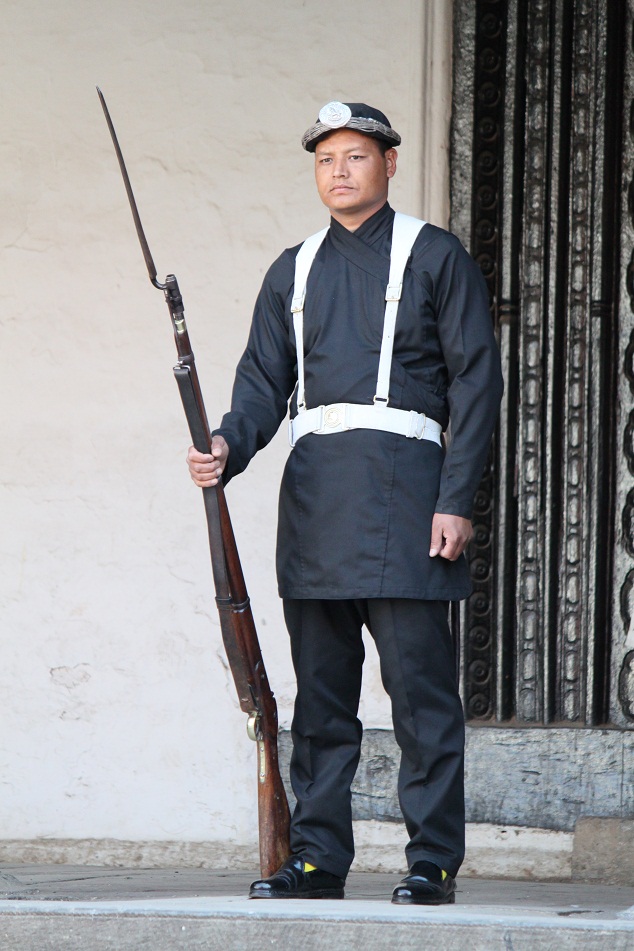
The Nepali Army (), also referred to as the Gorkhali Army (; see Gorkhas), formerly known as "Royal Nepal Army" is the land service branch of the Nepali Armed Forces. After the Gorkha Kingdom was founded in 1559, its army was established in 1560, and initially became known as the Gorkhali Army.
Later it was known as the Royal Nepali Army (RNA) following the Unification of Nepal, when the Gorkha Kingdom expanded its territory to include the whole country, by conquering and annexing the other states in the region, resulting in the establishment of a single united Hindu monarchy over all of Nepal. It was officially renamed simply to the Nepali Army on 28 May 2008, upon the abolition of the 240-year-old Nepalese monarchy, and of the 449-year-old rule of the Shah dynasty, shortly after the end of the Maoist insurgency.
The Nepali Army has participated in various conflicts throughout its history, going as far back as the Nepali unification campaign launched by Prithvi Narayan Shah of the Gorkha Kingdom. It has engaged in an extensive number of battles within South Asia, and continues to take part in global conflicts as part of United Nations peacekeeping coalitions. The Nepali Army is headquartered in Kathmandu and the incumbent Chief of Army Staff is General Ashok Raj Sigdel.
History

The Nepal unification campaign was a turning point in the history of the Nepali army. Since unification was not possible without a strong army, the management of the armed forces had to be exceptional. Apart from the standard Malla-era temples in Kathmandu, the army organized itself in Gorkha. After the Gorkhali troops captured Nuwakot, the hilly northern part of Kathmandu (Kantipur) in 1744, the Gorkhali armed forces came to be known as the Royal Nepali Army.
Their performance impressed their enemies so much that the British East India Company started recruiting Nepali troops into their forces. British troops called the new soldiers "Gurkhas". The Nepal–Sikh war began shortly after, in 1809 and the Anglo-Nepalese War in 1814. It became even more involved in the British Indian Army until independence, remaining an independent entity (since it was a protected state of the British Raj until 1947, though nominal autonomy had been achieved in 1923). In 1946, the Royal Nepali Army troops were led by Commanding General Baber Shamsher Jang Bahadur Rana at the Victory Parade in London.
Prior to 2006, the Royal Nepali Army was under the control of the King of Nepal. Following the 2006 Democracy Movement () on 18 May, a bill was passed by the Nepali parliament curtailing royal power, which included renaming the army to simply the Nepali Army.{{Cite news |access-date = 2006-09-23 |archive-date = 13 July 2007 |archive-url = https://web.archive.org/web/20070713123241/http://news.bbc.co.uk/1/hi/world/south_asia/4998666.stm |url-status = live
Organization

The Nepali Army has about 95,000 infantry army and air service members protecting the sovereignty of Nepal. In August 2018, The Himalayan Times estimated total army forces to be around 96,000 while The Kathmandu Post estimated it to be 92,000.
Supreme Command
The position of the Supreme Commander of the Nepalese Army is the President of the Federal Democratic Republic of Nepal. Until 2006, the King of Nepal (monarchy abolished) was in control of all military forces in the country. The National Army was renamed from Royal Nepalese Army to Nepalese Army after the recent national conversion from a monarchy to a republic on 4th Jestha 2063 B.S.
National Defence Council
This Council has seven members, the Prime Minister, the Defence Minister, the Chief of the Army Staff, Foreign Minister, Finance Minister, Home Minister and the Chief Secretary.
The President of Nepal is the Supreme Commander-in-Chief.
Divisions
The Nepalese Army is divided into eight divisions, one each in the seven provinces and one in the Kathmandu Valley.
In addition there are at least 7 independent units:
- Army Aviation Directorate
- Special Forces Brigade
- VVIP Security
- Artillery Brigade
- Signals Brigade
- Engineers Brigade
- Air Defense Brigade
Chiefs of the Nepali Army
The chiefs of the Nepali Army were mostly drawn from noble Chhetri families from the Gorkha Kingdom such as the Pande dynasty, Kunwar family, Basnyat dynasty, and Thapa dynasty before the rule of the Rana dynasty. During the Shah monarchy, the officers were drawn from these aristocratic families. During the Rana dynasty, the Ranas claimed the position as their birthright. The first army chief of was King Prithvi Narayan Shah who drafted and commanded the army. The first civilian army chief was Kalu Pande, a Kaji who had a significant role in the unification campaign. He was considered head of the army due to his undertaking of army duties and responsibilities, not by a formal title.
Bhimsen Thapa, Mukhtiyar from 1806 to 1837, was the first person to be given the title Commander-in-Chief as head of the army. King Rajendra Bikram Shah appointed Bhimsen to the post and praised him for his long service to the nation. However, on 14 June 1837, the King took over command of all battalions previously under the charge of various courtiers, and became the commander-in-chief. Immediately after the incarceration of the Thapas in 1837, Dalbhanjan Pande and Rana Jang Pande were the joint heads of the military administration. Rana Jang was removed after three months in October 1837.
Since the command of Mukhtiyar Bhimsen, only seven army chiefs were non-Rana- Chhetris, including Shahs (Thakuris), until 1951. The commander-in-chief title was replaced by Chief of the Army Staff (COAS) from General Singha Pratap Shah in 1979.
Operations
Conflicts defending the Kingdom of Nepal
- Battle against Mir Qasim (1763)
- Battle of Pauwa Gadhi against Captain Kinloch (1767)
- Anglo-Nepali War (1814–1816)
- First Nepal-Tibet War
- Nepal-China War (1788–1792)
- Nepal-Tibet War (1855–1856)
- Nepali Civil War (1996–2006)
Battles during the unification of Nepal
Main article: Unification of Nepal
- Battle of Kirtipur
- Battle of Kathmandu
- Battle of Bhaktapur
- Limbuwan–Gorkha War
- Invasion of Doti Kingdom
International conflicts
- Indian Sepoy Mutiny
- World War I (Casualties)
- Waziristan War
- Afghan War (1919)
- World War II
- Hyderabad Action (1948)
International operations
The Nepali Army has contributed more than 100,000 peacekeepers to a variety of United Nations-sponsored peacekeeping missions such as:
- United Nations Interim Force in Lebanon (UNIFIL),
- UNOSOMII the United Nations Protection Force (UNPROFOR), UN Operational Mission Somalia II,
- MINUSTAH the United Nations Mission in Haiti,
- UNAMSILan 800-man battalion was sent to serve in the peacekeeping mission in Sierra Leone,
- UNMISThe Nepali Army sent a protection company of 200 personnel for the United Nations Mission In Sudan. The Redeployment Coordination Headquarters (RCHQ) at Kassala was also manned by the Nepali contingent. The RCHQ was intended to monitor withdrawals from the eastern sectors of the UNMIS area under the Sudan Comprehensive Peace Accord.
- UNDOF,
- MINUSMAFor the first time, the Nepali Army sent an EOD company of 140 personnel specially dedicated to the improvised explosive device (IED) and ordnance disposal mission in Mali.
US-Nepal military relations
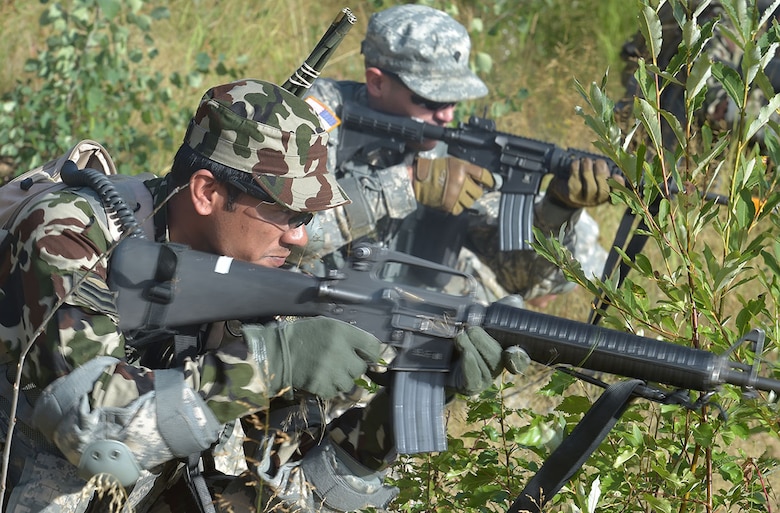
The US-Nepali military relationship focuses on support for democratic institutions, civilian control of the military, and the professional military ethic. Both countries have had extensive contact over the years. Nepali Army units have served with distinction alongside American forces in places such as Haiti, Iraq, and Somalia.
US-Nepali military engagement continues today through the International Military Education and Training (IMET) program, Enhanced International Peacekeeping Capabilities (EIPC) program, Global Peace Operations Initiative (GPOI), and various conferences and seminars. The US military sends many Nepali Army officers to America to attend military schools, such as the Command and General Staff College and the US Army War College. The IMET budget for FY2001 was $220,000.
The EIPC program is an inter-agency program between the US Department of Defense and US Department of State to increase the pool of international peacekeepers and to promote interoperability. Nepal received about $1.9 million in EIPC funding.
The US Commander in Chief, Pacific Command (CINCPAC) coordinates military engagement with Nepal through the Office of Defense Cooperation (ODC). The ODC Nepal is located in the American Embassy in Kathmandu.
Units
The first four army units are the Shreenath, Kali Baksh (Kalibox), Barda Bahadur, and Sabuj companies, founded in August 1762 by King Prithvi Narayan Shah with the Gurung, Magar, Chhetri and Thakuri clans, well before the unification of Nepal. The Purano Gorakh Company was founded in February 1763 and is the army's fifth oldest unit.

- Shree Nath Battalionestablished 1762
- Shree Kali Buksh Battalionestablished 1762
- Shree Barda Bahadur Battalionestablished 1762
- Shree Sabuj Battalionestablished 1762
- Shree Purano Gorakh Battalionestablished 1763
- Shree Devi Datta Battalionestablished 1783
- Shree Naya Gorakh Battalionestablished 1783
- Shree Bhairavi Dal Battalionestablished 1785
- Shree Singhanath Battalionestablished 1786 (commando)
- Shree Shreejung Battalionestablished 1783
- Shree Ranabhim Battalionestablished 1783
- Shree Naya Shree Nath Battalionestablished 1783
- Shree Vajradal Companyestablished 1806
- Shree Shree Mehar Battalionestablished 1779
- Shree "The Famous" Mahindra Dal Battalionestablished 1844
- Shree Rajdal Regiment (Artillery) (currently expanded to three additional independent Artillery regiments)
- Shree Ganeshdal Battalionestablished 1846 (signals and communications)
- Shree Ranabam Battalion established 1847
- Shree Nepal Cavalryestablished 1849, Household Cavalry ceremonial unit since 1952
- Shree Durga Bhanjan Campanyestablished 1862
- Shree Kali Prasad Battalion (Engineers)established 1863
- Shree Bhairavnath Battalionestablished 1910 (parachute battalion)
- Shree Bhagvati Prasad Companyestablished 1927
- Shree Khadga Dal Battalionestablished 1937
- Shree Parshwavarti Companyestablished 1936 (served as PM's bodyguard unit and disbanded in 1952)
- Shree Gorkah Bahadur Battalionestablished 1952 (infantry unit, then developed for royal guard duty)
- Shree Jagadal Battalion (air defence)
- Shree Yuddha Kawaj Battalion (mechanized infantry)
- Shree Mahabir Battalion (Rangers Battalion, equivalent to the US Army Rangers (part of the Nepali Army Special Operation Force))
- Shree Chandan Nath Battalionestablished 2004 (infantry unit)
- Shree Tara Dal Battalionestablished 2002 (infantry unit)
- Shree Ramban Companyestablished 2003
- Shree No 1 Disaster Management Battalionestablished 2012
- Shree No 2 Disaster Management Battalionestablished 2012
Schools
- Nepalese Army Command and Staff College, Shivapuri
- Nepalese Army War College, Nagarkot
- Nepalese Military Academy, Kharipati
- Nepalese Army Recruit Training Center, Trishuli
- Nepalese Army Jungle Warfare School, Amlekhgunj
- Nepalese Army High Altitude and Mountain Warfare School, Mustang
- Nepalese Army Intelligence School, Kharipati
- Nepalese Army Logistics School, Chhauni
- Birendra Peace Keeping Operation Training Center, Panchkhal
- Nepalese Army Para Training School, Maharajgunj
- Nepalese Army EME school, Kharipati
Female participation in Nepal Army
The unofficial participation of women in Nepal Army was first during the Anglo-Nepalese War on Battle of Nalapani. Battle of Nalapani was the first battle of the Anglo-Nepalese War of 1814–1816, fought between the forces of the British East India Company and Nepal, then ruled by the Gorkha Kingdom. Nepalese women were heavily involved in this battle supporting the male Gurkha warriors. With no firearms in hand, Nepalese women fought British troops with stones and wood.
According to the Nepal Army YouTube channel programme Nepali Senama Mahila Sahabhagita (documentary) - Episode 405, the official participation of women in the Nepal Army started in 1961 in the post of Nurse. Now the regular forces also include a significant number of female soldiers holding key appointments and commands. The timeline of official women's participation in the Nepal Army is as follow:
- 1961 - Nurses
- 1965 - Parachute folding women team
- 1969 - Medical doctors
- 1998 - Lawyers
- 2004 - Engineering
- 2011 - Aviation
Notable female officers of Nepal Army
- Brigadier General Dr. Radha Shah - First woman to become Brigadier General of Nepal Army
- Brigadier General Dr. Narvada Thapa - First female staff of Nepal Army to get doctorate degree (P.Hd)
- Brigadier General Dr. Sarita K.C - First Nepalese army female personnel to join UN Peacekeeping mission (UNIFIL)
- Major Kriti Rajbhandari - First woman observer military liaison officer from Nepal Army
- Colonel Yvetta Rana - First woman officer of Judge Advocate General Department of Nepal Army
- Colonel Sovana Rayamajhi - First woman officer (Computer Engineer) to join the Information Technology Department of Nepal Army
- Major Niru Dhungana - One of the first female military pilots
- Major Anita Ale Magar - One of the first female military pilots
- Major Shristhi Khadka - First woman company commander of Nepal Army
Equipment
The majority of equipment used by the army is imported from other countries. India is the army's largest supplier of arms and ammunition as well as other logistical equipment, which are often furnished under generous military grants. Germany, the United States, Belgium, Israel, and South Korea have also either supplied or offered arms to the Nepali Army.
The army's first standard rifle was the Belgian FN FAL, which it adopted in 1960. Nepali FALs were later complemented by unlicensed, Indian-manufactured variants of the same weapon, as well its British counterpart, the L1A1 Self-Loading Rifle. Beginning in 2002 these were officially supplemented in army service by the American M-16 rifle, which took the FAL's place as the army's standard service rifle. Nevertheless, the FAL and its respective variants remain the single most prolific weapon in Nepali army service, with thousands of second-hand examples being supplied by India as late as 2005.
Small arms
| Weapon | Image | Origin | Type | Calibre | Notes | Pistols | Submachine guns | Rifles and Carbines | Machine guns | ||||||||||
|---|---|---|---|---|---|---|---|---|---|---|---|---|---|---|---|---|---|---|---|
| Browning Hi-Power | [[File:FN_Hi_Power.jpg | 150px]] | Belgium United States | Semi-automatic pistol | 9×19mm Parabellum | last = Hogg | first = Ian | title = Jane's Infantry Weapons | date= 1991 | edition= 17 | page= 747 | publisher = Macdonald and Jane's Publishers Ltd | isbn= 978-0710609632}} | ||||||
| Heckler & Koch MP5 | [[File:HK_MP5_noBG.png | 150px]] | West Germany | Submachine gun | 9×19mm Parabellum | ||||||||||||||
| Sten | [[File:Sten_Mk_II_IMG_4781_(Nemo5576)_noBG.png | 150px]] | United Kingdom | ||||||||||||||||
| Sterling | [[File:Sterling_SMG2.JPG | 150px]] | |||||||||||||||||
| last=Sharma | first=Haridev | editor-last=Tripathi | editor-first=Devi Prasad | title=Nepal in Transition: A Way Forward | date=2012 | page=57 | publisher=Vij Books India Pvt Ltd | location=New Delhi | isbn=978-9381411070}} | [[File:Uzi-nobg.png | 150px]] | Israel | |||||||
| INSAS | [[File:INSAS_Rifle.jpg | 150px]] | India | Assault rifle | 5.56×45mm | title=Wikileaks news: Why Nepal king Gyanendra shed power | url=http://economictimes.indiatimes.com/news/politics-and-nation/wikileaks-news-why-nepal-king-gyanendra-shed-power/articleshow/9881252.cms | access-date=29 May 2014 | newspaper=The Economic Times | date=6 September 2011 | archive-date=29 January 2018 | archive-url=https://web.archive.org/web/20180129005026/https://economictimes.indiatimes.com/news/politics-and-nation/wikileaks-news-why-nepal-king-gyanendra-shed-power/articleshow/9881252.cms | url-status=live}} | ||||||
| Heckler & Koch G36 | [[File:Gewehr_G36_noBG.png | 150px]] | Germany | ||||||||||||||||
| M16 | [[File:M16A1_brimob.jpg | 150px]] | United States | Standard service rifle of the Nepali Army. | |||||||||||||||
| CAR-15 | [[File:USAF_GAU_5A_noBG.png | 150px]] | Carbine | ||||||||||||||||
| M4 carbine | [[File:M4_PEO_Soldier.jpg | 150px]] | |||||||||||||||||
| Daewoo K2 | [[File:K2C1_Assault_rifle.jpg | 150px]] | South Korea | Assault rifle | |||||||||||||||
| IWI Galil | [[File:Galil_noBG.png | 150px]] | Israel | ||||||||||||||||
| IWI Tavor | [[File:IWI-Tavor-TAR-21w1.jpg | 150px]] | Used by Army Special Forces, Ranger Battalion. | ||||||||||||||||
| IWI Tavor X95 | [[File:MicroTavorX95MARS-white.jpg | 150px]] | Used by Army Special Forces, Ranger Battalion. Often seen with GL40 UBGL, shown to be OTB compatible. | ||||||||||||||||
| Norinco CQ | [[File:NORINCO Type CQ 5'56x45mm assault rifle.jpg | 150px]] | China | closed quarter Assault Rifles | |||||||||||||||
| IWI Galil ACE | [[File:IWI_3686.jpg | 150px]] | 7.62×39mm | Limited use by Military Police. | |||||||||||||||
| AKM | [[File:AKM_automatkarbin_-_7,62x39mm.jpg | 150px]] | Soviet Union | Confiscated from Maoist guerrillas during insurgency. | |||||||||||||||
| Type 56 | [[File:Type_56_mod02_noBG.png | 150px]] | China | 300 purchased from China in 2010. | |||||||||||||||
| L1A1 SLR | [[File:SLRL1A1.jpg | 150px]] | United Kingdom | Battle rifle | 7.62×51mm | Unlicensed Indian variant designated 1A1. | |||||||||||||
| FN FAL | [[File:FN_FAL_compilation.jpg | 150px]] | Belgium | ||||||||||||||||
| Heckler & Koch PSG1 | [[File:MSG_90_rifle_PSG_1_rifle_2014_noBG.jpg | 150px]] | West Germany | ||||||||||||||||
| / Germany | Sniper rifle | ||||||||||||||||||
| Ishapore 2A1 | [[File:Ishapore_2A1.jpg | 150px]] | India | Bolt-action rifle | date=November 2025}} | ||||||||||||||
| FN Minimi | [[File:FN_MINIMI_Standard_Right.jpg | 150px]] | Belgium | Light machine gun | 5.56×45mm | 5,500 purchased from Belgium in 2002. Principal LMG/SAW | |||||||||||||
| M249 | [[File:PEO_M249_Para_ACOG.jpg | 150px]] | Belgium United States | 300 supplied as military aid from the US. Functionally identical to FN Minimi | |||||||||||||||
| Bren L4A4 | [[File:Bren_wog.jpg | 150px]] | First Czechoslovak Republic (design) | ||||||||||||||||
| United Kingdom | 7.62×51mm | Used in outposts and basic automatic fire training | |||||||||||||||||
| FN MAG | [[File:FN_MAG_white_background.jpg | 150px]] | Belgium | General-purpose machine gun | Principal GPMG, used on vehicle mounts. | ||||||||||||||
| W85 heavy machine gun | [[File:TankBiathlon2016Final-11 (cropped).jpg | 150px]] | China | Heavy machine gun | 12.7×108mm | fitted on several of the Army’s armoured vehicles and armoured cars |
Heavy weapons
| Weapon | Image | Origin | Type | Calibre | Notes | Air defence | Artillery | Mortar | |||||||
|---|---|---|---|---|---|---|---|---|---|---|---|---|---|---|---|
| Bofors L/70 | [[File:Bofors_automatic_gun_L70.png | 150px]] | Sweden | Anti-aircraft gun | 40mm | ||||||||||
| QF 3.7-inch AA gun | [[File:Swartkops_Air_Defence2.JPG | 150px]] | United Kingdom | 94mm | 45 in service. | ||||||||||
| OTO Melara Mod 56 | [[File:L5_Pack_Howitzer_Clyde,_Otago,_New_Zealand.jpg | 150px]] | Italy | Pack howitzer | 105mm | last = Christopher F. Foss | title = Jane's Armour and Artillery | year = 2001 | edition= 2002 | page= 740 | publisher = Macdonald and Jane's Publishers Ltd | isbn= 978-0710623096}} | |||
| 120-PM-43 | [[File:120_mm_regimental_mortar_M1943.jpg | 150px]] | Soviet Union | Mortar | 120mm | url=http://armstrade.sipri.org/armstrade/page/trade_register.php | title=Trade Registers | publisher=Armstrade.sipri.org | access-date=2013-06-20 | archive-date=14 April 2010 | archive-url=https://web.archive.org/web/20100414022558/http://armstrade.sipri.org/armstrade/page/trade_register.php | url-status=dead }} | |||
| M 29 | [[File:Mortar_M29.jpg | 150px]] | United States | Mortar | 81mm |
Vehicles
| Vehicle | Image | Origin | Type | Quantity | Notes | Armoured cars | Armoured personnel carriers | ||||||||
|---|---|---|---|---|---|---|---|---|---|---|---|---|---|---|---|
| Daimler Ferret | [[File:Daimler_Ferret_armoured_car_picture-015.JPG | 150px]] | United Kingdom | Scout car | 40 | Ferret Mk4 variant. | |||||||||
| Casspir | [[File:Mechem_Casspir_Mk_II_(9686200019).jpg | 150px]] | South Africa | MRAP | url=http://www.defenceweb.co.za/index.php?option=com_content&view=article&id=11274:-fact-file-south-african-arms-exports&catid=79:fact-files&Itemid=159 | title=South African Arms Exports | author=Leon Engelbrecht | date=3 January 2011 | access-date=5 November 2014 | archive-date=22 January 2016 | archive-url=https://web.archive.org/web/20160122185017/http://www.defenceweb.co.za/index.php?option=com_content&view=article&id=11274:-fact-file-south-african-arms-exports&catid=79:fact-files&Itemid=159 | url-status=live}} | |||
| Aditya | [[File:Upgraded_Aditya_MRAP.jpg | 150px]] | India | ~124 | |||||||||||
| VN-4 | [[File:NORINCO_VN-4_4x4_VEN.jpg | 150px]] | China | 63 | |||||||||||
| OT-64 | [[File:OT-64_SKOT.jpg | 150px]] | Czechoslovakia | Armoured personnel carrier | 8 | ||||||||||
| WZ551 | [[File:PLA_Hong_Kong_Garrison_ZSL92B.JPG | 150px]] | China | Infantry fighting vehicle | 5 | Acquired from China in 2005. |
Rank structure
Main article: Military ranks of Nepal
Commissioned officers
Other ranks
Notes
References
References
- (15 February 2018). "Nepali Army {{!}} नेपाली सेना".
- (2 March 2019). "Nepal Army to observe Army Day on Monday".
- (9 August 2018). "Thapa to take charge of Nepali Army as acting CoAS".
- "New chief faces daunting task rebuilding Nepal Army's image".
- Birat Anupam. (March 2, 2023). "Nepalese Military History of Aid to British India and Independent India".
- "In a first, NA peacekeepers to dispose explosives under UN mission".
- "NA to deploy 140 soldiers to Mali for peacekeeping – News – :: The Kathmandu Post ::".
- [http://kathmandupost.ekantipur.com/printedition/news/2013-03-09/nepal-army-day-five-nepal-army-battalions-mark-250-years-of-combat-history.html Nepal Army Day]The Kathmandu Post 9 March 2013 {{Webarchive. link. (23 September 2018)
- [https://www.youtube.com/watch?v=l9Baj_IO_Ag Nepali Senama Mahila Sahabhagita - Episode 405]
- . (May 2013). ["Legacies of War in the Company of Peace: Firearms in Nepal"](http://www.smallarmssurvey.org/fileadmin/docs/G-Issue-briefs/NAVA-IB2-Legacies-of-War.pdf). *[[Small Arms Survey]]*.
- Graduate Institute of International Studies. (2003). "Small Arms Survey 2003: Development Denied". Oxford University Press.
- Hogg, Ian. (1991). "Jane's Infantry Weapons". Macdonald and Jane's Publishers Ltd.
- Sharma, Haridev. (2012). "Nepal in Transition: A Way Forward". Vij Books India Pvt Ltd.
- (6 September 2011). "Wikileaks news: Why Nepal king Gyanendra shed power". [[The Economic Times]].
- "Exercise Shanti Prayas III Closing Ceremony". DVIDS.
- Pretty, Ronald. (1983). "Jane's Weapon Systems, 1983–84". Macdonald and Jane's Publishers Ltd.
- Christopher F. Foss. (2001). "Jane's Armour and Artillery". Macdonald and Jane's Publishers Ltd.
- "Trade Registers". Armstrade.sipri.org.
- Leon Engelbrecht. (3 January 2011). "South African Arms Exports".
This article was imported from Wikipedia and is available under the Creative Commons Attribution-ShareAlike 4.0 License. Content has been adapted to SurfDoc format. Original contributors can be found on the article history page.
Ask Mako anything about Nepali Army — get instant answers, deeper analysis, and related topics.
Research with MakoFree with your Surf account
Create a free account to save articles, ask Mako questions, and organize your research.
Sign up freeThis content may have been generated or modified by AI. CloudSurf Software LLC is not responsible for the accuracy, completeness, or reliability of AI-generated content. Always verify important information from primary sources.
Report