From Surf Wiki (app.surf) — the open knowledge base
Nepal Police
National Police Force of Nepal

National Police Force of Nepal
| Field | Value |
|---|---|
| agencyname | Nepal Police |
| nativename | नेपाल प्रहरी |
| patchcaption | Patch of Nepal Police |
| logo | Nepal Police logo.png |
| logocaption | Logo of Nepal Police |
| flagcaption | Flag of Nepal Police |
| motto | सत्य सेवा सुरक्षणम् |
| mottotranslated | Truth, Service & Security |
| formedyear | (2012 B.S.) |
| employees | 79,541 |
| country | Nepal |
| legaljuris | Nepal |
| governingbody | Government of Nepal |
| governingbodyscnd | Ministry of Home Affairs |
| constitution1 | Police Act 2012 |
| headquarters | Naxal, Kathmandu |
| chief1name | Dan Bahadur Karki |
| chief1position | Inspector General of Police (IGP) |
| child1agency | National Police Academy |
| child2agency | Nepal Police Club |
| child3agency | Nepal Police Health Club |
| child4agency | Aasara Drug Rehabilitation Center |
| child5agency | Nepal Police Band |
| unittype | Bureau |
| unitname | |
| officetype | Departments |
| officename | |
| anniversary1 | Nepal Police Day- 23rd of Asoj |
| website |
Nepal Police () is the national and primary national law enforcement agency of Nepal, operating under the Ministry of Home Affairs. It is primarily responsible for maintaining law and order, prevention of crime and crime investigation within the jurisdiction determined by the Constitution of Nepal. Apart from its primary role, Nepal Police conducts a vast array of duties such as VIP protection, Security of Vital Installations, Traffic management, Secret services, Intelligence collection, Riot Control, Disaster management, Hostage rescue and various other Ceremonial roles. Nepal Police is currently led by Inspector General of Police Dan Bahadur Karki since 13 November 2025. He is the 33rd IGP of Nepal Police.
History
Before the Rana Regime (1864–1951 AD)
During the Rana Regime, little was done to institutionalize policing, establishing Milisiya, Thana police Chakki, office of police director general etc. which gradually shaped the Nepal Police into this modern "Nepal Police".
During the period 1951–1990
Nepal saw the dawn of democracy after the fall of the Rana regime. The Police Headquarters was established in 1952 in Kathmandu. Mr. Toran Shamsher J.B. Rana was appointed the first Inspector General of Police. The Police Act, 2012 BS (1955 AD) came into effect. The Police Regulation, 2015 BS (1959 AD) came into effect.
The Parliamentary Government under the multi-party system was adopted for some years which was followed by Panchayat System since 1960. The establishment of the Central Police Training Centre in 1963 A.D.
1990–present
The people's democratic movement of 1990 reinstated the multi-party democratic system. The new constitution of the kingdom was promulgated on 9 November 1991. The Police Reform Commission was constituted in the year 1992 and the modernisation of the police started to come in tune with the aspirations of the people and norms of a multi-party system. The first contingent of police personnel was deployed on a UN mission in 1991. More than 2000 police personnel have already served the international community in blue helmets.
The Nepal Police has total of 79,554 police personnel, and has 2,344 permanent and 507 temporary police offices and units spread all over the country. The present chief is Chandra Kuber Khapung.
Head of Nepal Police
Main article: Inspector General of Police (Nepal)
The Nepalese Police is headed by the Inspector General of Police of Nepal. He reports directly to the Ministry of Home Affairs and is appointed by the Government of Nepal for a tenure of four years, although two IGPs have served for six years.
Organizational structure
Nepal Police is structured into various branches and specialized units to address the country's diverse security, investigative, and administrative needs. There are four Bureaus and five Departments in the Police Headquarters that function to undertake the policing activities of Nepal Police. These branches are designed to uphold public safety, enforce laws, and respond effectively to emerging threats across both urban and rural areas.
Core Operational Branches
Metropolitan Traffic Police Division
- Kathmandu Valley traffic Police Office
Metropolitan Police Range
- Kathmandu Valley Police Office
Provincial Police Offices (PPOs)
- Koshi Province Police Office
- Madhesh Province Police Office
- Bagmati Province Police Office
- Gandaki Province Police Office
- Lumbini province Police Office
- Karnali Province Police Office
- Sudurpaschim Province Police Office
District Police Offices (DPOs)
Specialized Units (Bureaus)
1. [[Central Investigation Bureau]] (CIB)
2. Narcotics Control Bureau (NCB)
3. Anti Human Trafficking Bureau (AHTB)
4. Cyber Bureau
Departments
1. Administration Department
2. Human Resource Development Department
3. Province Coordination Department
4. Operation Department
5. Crime Investigation Department
- Central Polygraph Section Nepal Police has started using for credibility assessment in criminal and internal disciplinary investigations from 6 February 2014. Nepal Police has established "Central Polygraph Section" in Crime Investigation Department at Police Headquarters.
Types of Nepal Police Personnel
1. General Duty Police
- District Police Offices (DPOs) – Local law enforcement in all 77 districts
- Metropolitan Police Ranges – Urban policing in Kathmandu, Lalitpur, Bhaktapur, Pokhara, etc.
- Provincial Police Offices (1–7) – Command centers aligned with Nepal’s federal structure
- Border Police Units – Monitor and secure international borders
- Tourist Police
2. Investigative Police
- Crime Investigation Department (CID)
- Central Investigation Bureau (CIB)
- Cyber Bureau
- Human Trafficking Control Bureau
- Women and Children Service Directorate
3. Traffic Police
- Kathmandu Valley Traffic Police Office
- Regional Traffic Units – Operate in major cities and highways
- Mobile Traffic Patrols – Equipped with GPS and surveillance tool
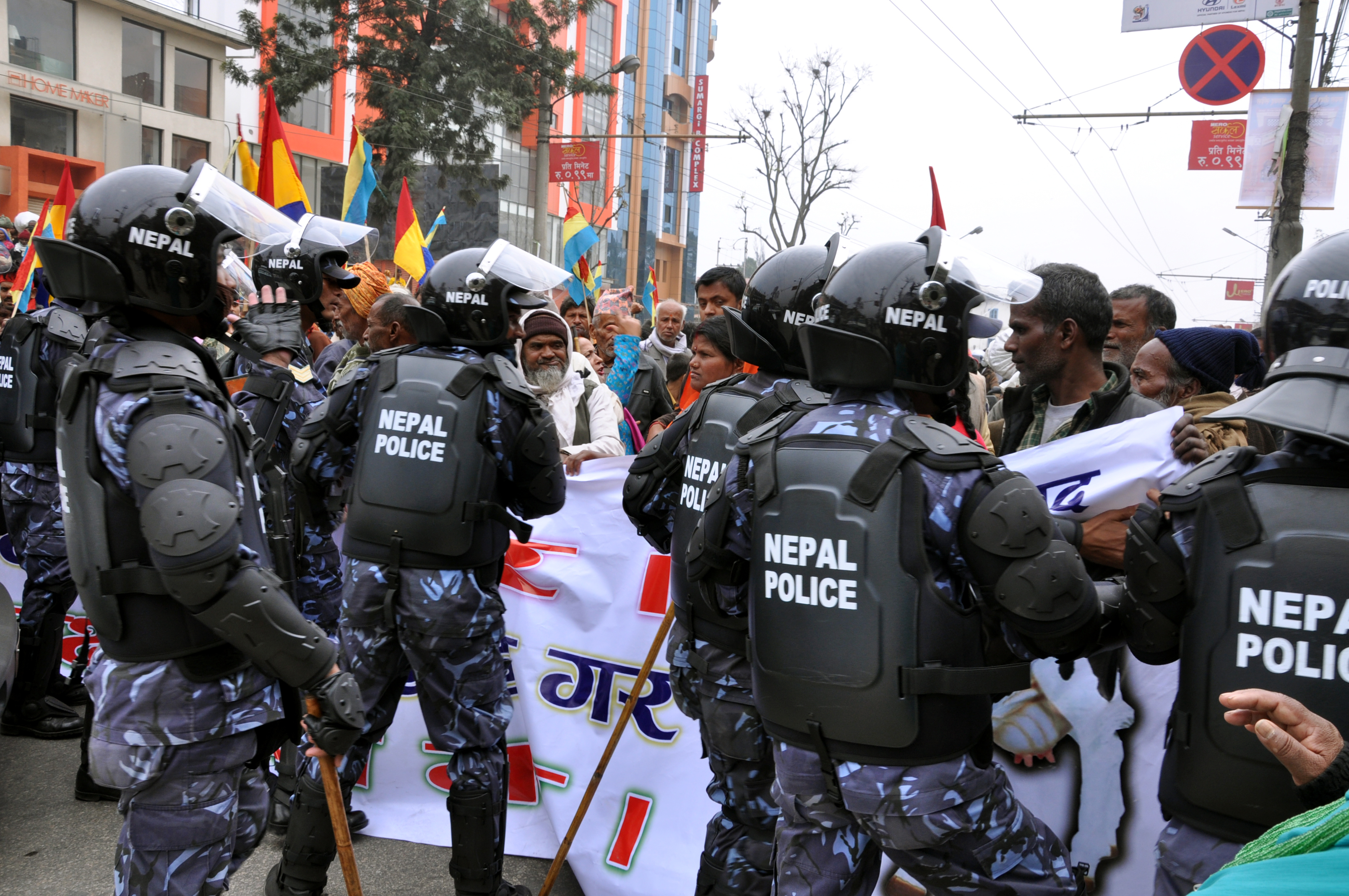
4. Tactical Units and Special Forces
- Special Task Force (STF)
- Riot Control Units
- VIP Security Division
- Anti-Terrorism Task Force
5. Technical Police
- Forensic Science Laboratory
- Communication Directorate
- Training Directorate
- Logistics and Welfare Directorate
- Medical and Engineering Units
6. Training and Academic Units
- National Police Academy
- Regional Training Centers
- Specialized Skill Schools – Cybercrime, disaster response, negotiation
7. Ceremonial and Community Police
Engaged in public outreach, cultural representation, and ceremonial duties.
- Nepal Police Band
- Community Police Units – Promote citizen engagement and safety awareness
- Aasara Drug Rehabilitation Center – Social reintegration programs
List of Additional Inspector General of Police (AIGPs)
These departments are headed either by Additional Inspector General of Police (AIGP) or Deputy Inspector General of Police (DIGP). In addition to the departments, there are the National Police Academy and the Metropolitan Police Office that are being looked by Additional Inspector General of Police.
| AIGP Name | Department/ Bureau | Function |
|---|---|---|
| Uma Prassad Chaturvedi | Operations Department | Coordinates field operations, riot control, and tactical deployments |
| Sushil Singh Rathore | Crime Investigation Department | Oversees criminal investigations nationwide |
| Rajan Adhikari | Human Resource Department | Manages personnel, recruitment, and administrative affairs |
| Himalayan Kumar Shrestha | Administration Department | Leads traffic regulation and enforcement across Nepal |
| Dambar Bahadur BK | Province Coordination Department | Leads traffic regulation and enforcement across Nepal |
| Siddhi Bikram Shah | National Police Academy | Responsible for strategic leadership training and curriculum development |
| Dan Bahadur Karki | Kathmandu Valley Police | Maintains law and order in Kathmandu Valley |
| Manoj Kumar KC | Central Investigation Bureau | Focuses on high-profile and organized crime investigations |
| Purposed | Narcotics Control Bureau | Handles drug-related crimes and international coordination |
| Tribhuvan Int'l Airport Security | Airport perimeter and terminal security and safety |
[[Nepal Police Hospital]]
Nepal Police Hospital was inaugurated by the late king Birendra Bir Bikram Shah Dev on the 27th of Chaitra, 2040 BS. It was established to provide free health services to in-service policemen, their families, and ex-servicemen and their spouses. The hospital commenced OPD services and 25 bedded indoor services through 5 medical doctors, a few nurses, paramedics and administrative staff. The infrastructure then was built with the financial support of the Government of Nepal and the voluntary contribution of the police personnel. Some instruments and equipment were donated by the Government of India and a Japanese club. The Government of Nepal has been bearing all the expenses of the hospital ever since its establishment (infrastructure development, upgrading human resources and equipment). The routine annual budget allocated by the government to the hospital is inadequate to meet the increasing demand for health services for the staff of the Police organization. Therefore, Prahari Kalyan Kosh (Police Welfare Fund) of Nepal Police has established a trust to provide health services to the family members of the serving policemen ex-servicemen and their spouses. The fund supports to purchase of medicines for physically and mentally handicapped and Renal Failure patients. It also provides a variable additional budget every year to further support the above-mentioned group of patients. Though the spectrum of services provided by the hospital in the initial stage was minimal, it had a great positive impact on all the policemen and medical professionals.
[[National Police Academy, Nepal|National Police Academy]]
Head: **AIGP ** Main article: National Police Academy of Nepal
The National Police Academy of Nepal, formerly known as the Sadar Prahari Talim Kendra, is an academic wing of the Nepal Police. It is solely responsible for conducting basic and advanced training programs for the police officers in Nepal. AIGP Tek Prasad Rai is the executive director of this academy. The NPA is the apex body of all Nepal Police Training Institutions in the country. The main objectives of NPA are:
- To conduct foundation training (induction courses) by offering developmental opportunities to senior police officers and technical police officers.
- To prepare police instructors required for the entire police training system in Nepal Police and provide consultancy services.
- To offer and undertake advanced training for senior police officers in the field of leadership, management, and administration, proactive policing, community policing trainer's training, etc.
- To extend prospective and substantive relationships with universities in the relevant subjects and to award academic degrees to the trainees.
- To organize workshops, seminars, symposiums, conferences, and short courses on policing issues.
- To carry out quality research activities (required by Police Headquarters-PHQ) or to act as a research faculty (qualitative research on behalf of PHQ) regarding the police profession to develop analytical capability.
- To extend assistance and advice to police headquarters i.e. consultancy service rendered to PHQ in formulating training policies.
[[Nepal Police School]]
Research and Planning Directorate
Research and Planning (R&P)Directorate of Nepal Police was established in 1987 as the research and planning division. Now, the R&P Directorate is responsible for conducting research on the issues of institutional development and service delivery and making the plans based on the findings of the research. The directorate is responsible for conducting research and formulating plans based on the research.
Altogether 17 Research and planning sections have been established at departmental and regional levels under the R&P Directorate to build a quick network to facilitate research and planning activities of Nepal police.
Uniform
The uniform of the Nepal Police consists of both summer and winter gear.
Regular officers wear a light blue shirt with navy blue pants. Junior ranks wear beret while high-ranked officers wear Peaked cap (with a blue band) with most senior officers with braids on the peak.
Riot police (Special Task Force Police) wear blue DPM pattern camouflage uniforms will ball caps. The winter uniform adds a blue jacket or sweater.
Rank insignia
The Nepal Police has fourteen ranks. Three new ranks, Senior Sub Inspector (SSI), Senior Head Constable (SHC), and Assistant Head Constable (AHC), were recently added to the Nepal Police.
Weapons and Equipments
| Name | Weapon | Type | Caliber | Origin | Note | Handguns | Shotgun | Submachine gun | Assault Rifle/ Battle Rifles | Light Machine Gun | Sniper Rifles | ||
|---|---|---|---|---|---|---|---|---|---|---|---|---|---|
| Beretta 92 | [[File:Interpolitex 2013 (536-8).jpg | frameless | 220x220px]] | Semi-automatic pistol | 9×19mm Parabellum | Italy | |||||||
| Glock 17 | [[File:GLOCK 17 Gen 4 Pistol MOD 45160305.jpg | frameless | 220x220px]] | Semi-automatic pistol | 9×19mm Parabellum | Austria | |||||||
| Pistol Auto 9mm 1A | [[File:Pistol Auto 9 mm 1A - Kolkata 2012-01-23 8779.JPG | frameless | 220x220px]] | Semi-automatic pistol | 9×19mm Parabellum | India | |||||||
| Remington Model 870 | [[File:Rem-870-Police.jpg | frameless | 220x220px]] | Pump action | 12-gauge shotgun | USA | |||||||
| Heckler & Koch MP5 | [[File:Heckler & Koch MP5-1.jpg | frameless | 220x220px]] | Submachine gun | 9×19mm Parabellum | Germany | |||||||
| IWI Uzi | [[File:Uzi of the israeli armed forces.jpg | frameless | 220x220px]] | Submachine gun | .260 Remington | Israel | Deployed in airport security and tactical squads | ||||||
| Sterling submachine gun | [[File:Sterling SMG2.JPG | frameless | 220x220px]] | Submachine gun | 9×19mm Parabellum | United Kingdom | |||||||
| IMI Galil | [[File:Galil noBG.png | frameless | 220x220px]] | Assault rifle | 5.56×45mm NATO | Israel | |||||||
| Colt Commando | [[File:GUU-5P Carbine (7414627680).jpg | frameless | 220x220px]] | Carbine | 5.56×45mm NATO | United States | |||||||
| INSAS rifle | [[File:INSAS Black.JPG | frameless | 220x220px]] | Light machine gun | 5.56×45mm NATO | India | |||||||
| M16 | [[File:The M16A4 Series 5.56mm Rifle.jpg | frameless | 220x220px]] | Assault rifle | 5.56×45mm NATO | United States | |||||||
| L1A1 Self-Loading Rifle | [[File:SLRL1A1.jpg | frameless | 220x220px]] | Light machine gun | United Kingdom | Uses by special units | |||||||
| FN MAG | [[File:FN MAG white background.jpg | frameless | 220x220px]] | GPMG | 7.62 mm | Belgium | Used by garrison and perimeter defense units | ||||||
| Dragunov SVD | [[File:SVDM sniper rifle at Military-technical forum ARMY-2016 01.jpg | frameless | 220x220px]] | Sniper rifle | 7.62×54mmR | Soviet Union | Limited use in special operations |
References
References
- (8 August 2024). "Nepal Police ranks surge by over 200 percent in 30 years amid calls for 27,000 additional personnel".
- "नेपाल प्रहरीको ३१ औं प्रमुखमा दिपक थापा नियुक्त". Onlinekhabar.
- "Nepal Police History".
- (11 March 2010). "A study of DDR and SSR in Nepal (ii)".
- (25 December 2012). "Policing in Nepal: A collection of essays".
- "Everything You Need to Know About Nepal's Role as the World's Leading Contributor to UN Peacekeeping".
- "Nepal's Contributions in UN peacekeeping".
- "Nepal Police UN Section - Introduction".
- "Cabinet appoints Chandra Kuber Khapung as inspector general of Nepal Police".
- (8 August 2024). "Chandra Kuber Khapung conferred with IGP insignia".
- "About IGP". Nepal Police.
- "Exclusion illusions". República.
- "Operation and Crime Investigation Department".
- "Human Resource Department".
- "Crime Investigation Bureau".
- "National Police Academy".
- "Police Uniform {{!}} About Us {{!}} Main Menu Items".
- "Ranks {{!}} About Us {{!}} Main Menu Items".
- Basnet, Madhab. (2 March 2007). "The missing guns?". Nepali Times.
This article was imported from Wikipedia and is available under the Creative Commons Attribution-ShareAlike 4.0 License. Content has been adapted to SurfDoc format. Original contributors can be found on the article history page.
Ask Mako anything about Nepal Police — get instant answers, deeper analysis, and related topics.
Research with MakoFree with your Surf account
Create a free account to save articles, ask Mako questions, and organize your research.
Sign up freeThis content may have been generated or modified by AI. CloudSurf Software LLC is not responsible for the accuracy, completeness, or reliability of AI-generated content. Always verify important information from primary sources.
Report