From Surf Wiki (app.surf) — the open knowledge base
Nelson's Column
Monument in Trafalgar Square, London
Monument in Trafalgar Square, London
| Field | Value |
|---|---|
| monument_name | Nelson's Column |
| image | Nelson's Column, Trafalgar Square, London.JPG |
| caption | Nelson's Column, Trafalgar Square |
| coordinates | |
| location | London, England WC2 |
| United Kingdom | |
| designer | William Railton, Edward Hodges Baily and Sir Edwin Landseer |
| Also: Musgrave Watson, William F. Woodington, John Ternouth and John Edward Carew (sculptors), Grissell and Peto (contractors) | |
| type | Victory column |
| material | Granite and bronze |
| height | 169 ft |
| begin | 1840 |
| complete | 1843 |
| open | 1843 |
| dedicated_to | Admiral Horatio Nelson |
United Kingdom Also: Musgrave Watson, William F. Woodington, John Ternouth and John Edward Carew (sculptors), Grissell and Peto (contractors)
Nelson's Column is a monument in Trafalgar Square in the City of Westminster, Central London, England, United Kingdom, built to commemorate British Royal Navy officer Horatio Nelson's decisive victory at the Battle of Trafalgar over the combined French and Spanish navies, during which he was killed by a French sniper. The monument was constructed between 1840 and 1843 to a design by William Railton at a cost of . It is a column of the Corinthian order built from Dartmoor granite. The statue of Nelson at the top was carved from Craigleith sandstone by sculptor Edward Hodges Baily. The four bronze lions around its base, designed by Sir Edwin Landseer, were added in 1867.
The pedestal is decorated with four bronze relief panels, each 18 ft square, cast from captured French guns. They depict the Battle of Cape St. Vincent, the Battle of the Nile, the Battle of Copenhagen and the death of Nelson at Trafalgar. The sculptors were Musgrave Watson, William F. Woodington, John Ternouth and John Edward Carew, respectively. The ornate capital upon which Nelson stands is by Charles Harriott Smith.
It was refurbished in 2006 at a cost of , at which time it was surveyed and found to be 14 ft shorter than previously supposed.{{citation | access-date=20 May 2010}} The whole monument is 169 ft tall from the bottom of the pedestal to the top of Nelson's hat. The statue of Nelson is 17 ft. Nelson was 5ft 4in tall - a ratio of approx 3:1.
Construction and history

In February 1838, a group of 121 peers, Members of Parliament (MPs) and other gentry formed a committee to raise a monument to Lord Nelson, funded by public subscription, and the government agreed to provide a site in Trafalgar Square, in front of the newly completed National Gallery. A competition was held for designs with an estimated budget of between £20,000 and £30,000. The deadline for submissions was 31 January 1839.
The winning entry, chosen by the sub-committee headed by the Duke of Wellington was a design by William Railton for a Corinthian column, surmounted by a statue of Nelson, and flanked by four sculpted lions. Flights of steps would lead up between the lions to the pedestal of the column. Several other entrants also submitted schemes for columns. The second prize was won by Edward Hodges Baily who suggested an obelisk surrounded by sculptures.
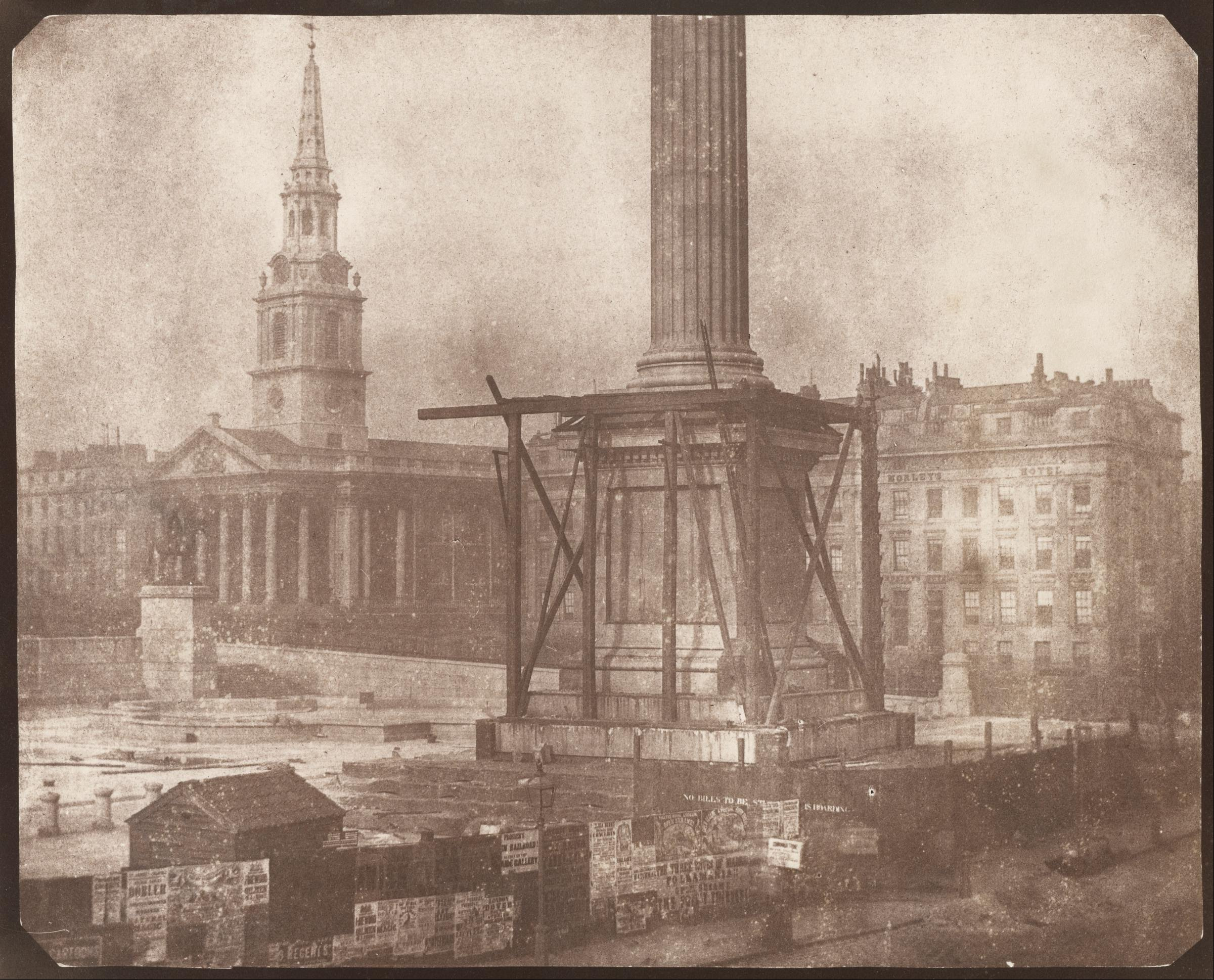
Criticism of the organisation of the competition caused it to be re-run. Railton submitted a slightly revised design, and was once again declared the winner, with the stipulation that the statue of Nelson should be made by Baily. The original plan was for a column 203 ft high, including the base and statue, but this was reduced to 170 ft with a shaft of 98 ft due to concerns over stability. The base was to have been of granite and the shaft of Craigleith sandstone, but before construction began it was decided that the shaft should also be of granite.
Excavations for the brick foundations had begun by July 1840. On 30 September 1840, the first stone of the column was laid by Charles Davison Scott, honorary secretary of the committee (and son of Nelson's secretary, John Scott), at a ceremony conducted, according to the Nautical Magazine, "in a private manner, owing to the noblemen and gentlemen comprising the committee being absent from town". Construction of the monument, by the contractors Grissell and Peto, progressed slowly, and the stonework, ready for the installation of the statue, was not completed until November 1843.
In 1844, the Nelson Memorial Committee ran out of money, having only raised £20,485 in public subscriptions, and the government, in the form of the Office of Woods and Forests took over the project.
Installation of the bronze reliefs on the pedestal did not begin until late 1849, when John Edward Carew's depiction of the death of Nelson was put in place on the side facing Whitehall. This was followed early the next year by William F. Woodington's relief of the Battle of the Nile on the opposite side. Carew's relief was cast by Adams, Christie and Co. of Rotherhithe. It was finally put in place in May 1854.

The 17 ft statue at the top was sculpted by Edward Hodges Baily R.A. from three pieces of Craigleith type sandstone donated by Walter Montagu Douglas Scott, 5th Duke of Buccleuch, former chairman of the Nelson Memorial Committee, from his own quarry at Granton, Edinburgh.
The statue stands on a fluted column built from solid blocks of granite from the Foggintor quarries on Dartmoor.{{cite web | access-date = 24 May 2009
The column also had a symbolic importance to German Nazi leader, Adolf Hitler. If Hitler's plan to invade Great Britain, Operation Sea Lion, had been successful, he planned to move it to Berlin, the capital of Germany.
Lions
The four identical bronze Barbary lions at the column's base were not added until 1867. At one stage they were intended to be of granite, and the sculptor John Graham Lough was chosen to carve them. However, in 1846, after consultations with Railton, he turned down the commission, unwilling to work under the restrictions imposed by the architect.
.jpg)
Thomas Milnes received the commission in 1858, and produced four full-scale models in sandstone, each individualised to represent Peace, War, Vigilance and Determination. These were rejected, and the commission was transferred, again, to Sir Edwin Landseer. Subsequently mill owner Sir Titus Salt bought the statues instead for a civic building at the centre of his workers village, installed on pedestals in 1869. The four sandstone Lions now have Grade II* listed building status.

The sculptures eventually installed were designed by Sir Edwin Landseer in collaboration with Carlo Marochetti. Landseer was a hugely popular painter and the favourite of Queen Victoria. Their design may have been influenced by Marschalko János's lions at each abutment to the Széchenyi Chain Bridge in Budapest, installed six years before the Trafalgar Square lions were commissioned.
Landseer requested casts of a real lion from Turin which did not arrive until 1860. In the meantime, he made sketches of lions at London Zoo and eventually received the corpse of one to work with. Delays in completing the work meant that the corpse started to decompose, leading to some discrepancies in form. The paws, for example, were based on those of a cat, and the sculpted lion's backs are concave rather than convex.
The sculptures were eventually installed in 1867. Landseer was paid £6,000 for his services, and Marochetti £11,000.
In 2011, consultants for the Greater London Authority reported that tourists climbing onto the backs of the lions have caused considerable damage and recommended banning tourists from climbing them.
Refurbishment
The column was renovated and cleaned by sandblasting in 1968.
The column was refurbished in 2006, during which time it was scaffolded from top to bottom for access. Steam cleaning was used, together with gentle abrasives, in order to minimise any harmful impact on the bronze and stonework. The £420,000 cost was covered by Zurich Financial Services, which advertised on the scaffolding for the duration of the work. Before restoration began, laser surveys were taken during which it was found that the column was significantly shorter than the usually quoted 185 ft. In fact, it measures 169 ft from the bottom of the first step to the tip of the admiral's hat.
Publicity stunts and protests
John Noakes of the BBC TV children's programme Blue Peter climbed the column in 1977. Television presenter and entertainer Gary Wilmot climbed the column in 1989 for LWT's Six O' Clock Show to recreate the 'topping out' ceremony of 1843. Dressed in Victorian attire and sporting a boater hat, Wilmot enjoyed tea and sandwiches at the top of the column before climbing down.
The column has also been climbed on several occasions as a publicity stunt to draw attention to social or political causes. Ed Drummond made the first such climb in 1978 for the Anti-Apartheid Movement, making use of the lightning conductor en route. On 30 March 1988, Joe Simpson and John Stevenson climbed the column as part of a Greenpeace Campaign against Acid rain. On 14 June 1992, it was climbed by Martin Cotterrel, Joe Simpson and John Stevenson on behalf of Greenpeace to protest against the first Earth Summit meeting in Brazil. On 13 April 1995, Simon Nadin free-climbed Nelson's Column with Noel Craine, Jerry Moffatt and Johnny Dawes following on top rope, and graded the climb as "E6 6b/5a". This protest this time was on behalf of Survival International to publicize the plight of Canadian Inuit. On 13 May 1998, the Column was climbed by Al Baker, Peter Morris and John Cunningham on behalf of Greenpeace to protest against Old growth logging activity in British Columbia. In May 2003, BASE jumper and stuntman Gary Connery parachuted from the top of the column, in an action designed to draw attention to the Chinese policies in Tibet.
In December 2015, Disney paid £24,000 to cover it in lights to make it resemble a giant lightsaber, to promote Star Wars: The Force Awakens.
On 18 April 2016, in the early hours of the morning, Greenpeace activists climbed up the column and placed a breathing mask on Admiral Lord Nelson in protest of air pollution levels.
Other monuments to Nelson
Main article: Monuments and memorials to Horatio Nelson, 1st Viscount Nelson
The first civic monument to be erected in Nelson's honour was the Nelson Monument, a 44-metre high obelisk on Glasgow Green in Glasgow, Scotland, in 1806. Also in Scotland, the foundation stone for Nelson's Tower at Forres in Moray was laid in 1806 and it was completed in 1812; while the Nelson Monument stands on top of Calton Hill, Edinburgh. In Dublin, Ireland, Nelson's Pillar was erected in 1808 but was destroyed by republicans in 1966, and in the Bull Ring, Birmingham, England, there is a Grade II* listed bronze statue of Nelson by Richard Westmacott, dating from 1809. Westmacott also designed the elaborate monument to Nelson in Liverpool. In Portsmouth, Nelson's Needle, on top of Portsdown Hill, was paid for by the company of after arriving back in Portsmouth. There is a column topped with a decorative urn in the Castle Green, Hereford – a statue was planned in place of the urn, but insufficient money was raised. The Britannia Monument in Great Yarmouth, England (1819), is a 144-foot-high doric column design.
Elsewhere in the world, Nelson's Column in Montreal was erected by both Britons and Canadians in 1809, and there is also a Mount Nelson, near Invermere, British Columbia. As at London, the column in Montreal has the admiral standing with his back to the waves. A much shorter statue of Lord Nelson in Trafalgar Square, Bridgetown, Barbados, is older than its counterpart in London.
Gallery
File:Nelson's column - Battle of Cape St Vincent relief (Musgrave Watson).jpg|The Battle of Cape St. Vincent by Musgrave Watson and William F. Woodington, the relief on the west face of the plinth File:Nelson's column - Battle of the Nile relief (Edward Carew, 1850).jpg|The Battle of the Nile by William F. Woodington, the relief on the north face of the plinth File:Nelson's column - Battle of Copenhagen relief.jpg|The Battle of Copenhagen by John Ternouth, the relief on the east face of the plinth File:Nelson's column - Death of Nelson at Trafalgar.JPG|The Death of Nelson at Trafalgar by John Edward Carew, the relief on the south face of the plinth File:Nelson's Column during the Great Smog of 1952.jpg|The column during the Great Smog of 1952 File:Landseer Lion and Nelson's Column.jpg|One of the Landseer Lions with the column behind, June 2021
References
References
- (1839). "The Selected Design for the Nelson Testimonial". The Art Union.
- White, Colin. (2002). "The Nelson Encyclopaedia". Chatham Publishing / Lionel Leventhal Limited.
- Dictionary of British Sculptors 1660-1851 by Rupert Gunnis
- (12 July 2006). "Nelson's Column is 16ft shorter than everybody thought". The Telegraph.
- "Lot No: 35 An important mid 19th century carved bathstone architect's 1:40 scale model of Nelson's column".
- ''The Civil Engineer and Architect's Journal'', Volume 2, 1839
- (1840). "Report from the Select Committee on Trafalgar Square".
- (1840). "The Nelson Memorial". The Nautical Magazine.
- Hansards Parliamentary Debates, Vol. CXLIV, p.1220
- (6 December 1849). "The Nelson Column, Trafalgar Square". The Times.
- (5 April 1850). "The Nelson Column". The Times.
- "Bronze sculpture founders: a short history". National Portrait Gallery.
- Mace, Rodney. (1976). "Trafalgar Square: Emblem of Empire". Lawrence and Wishart.
- "Granton Quarry".
- (4 September 2011). "The wreck that revealed the Mary Rose". BBC News.
- Timbs, John. (1858). "Curiosities of London".
- MacLean, Rory. (1 October 2007). "London illuminated". The Guardian.
- (30 June 2015). "The lion: A victim of its own power?". BBC News.
- (22 November 1943). "Origins of Nelson Column". The Times.
- "Comparison of Sir Edwin Landseer's and Thomas Milnes's Lions for the Base of Nelson's Column".
- "Victoria Hall including wall, gate-piers and sculpted lions to front area, and railings to rear, Shipley - 1314205 {{!}} Historic England".
- "SALTAIRE SCHOOL INCLUDING WALL, GATE PIERS AND SCULPTED LIONS TO FRONT AREA, AND GATE TO SOUTH SIDE, Shipley - 1300666 {{!}} Historic England".
- "The Desert by Sir Edwin Landseer". Manchester City Galleries.
- Gulliver, Beth. (12 October 2021). "The gruesome story behind the Trafalgar Square lions you probably don't know".
- (19 June 2011). "Ban tourists from Trafalgar Square lions before they destroy them, report says". Telegraph.co.uk.
- (14 April 1968). "Nelson's Column". British Pathé.
- "Project of Nelson's Column Restoration". David Ball Restoration.
- Beresford, David. (21 October 2016). "Anti-apartheid protestors make first ascent of Nelson's Column". The Guardian.
- (17 December 2015). "Video: 'Star Wars: The Force Awakens': Disney pay £24,000 to turn Nelson's Column into a lightsaber". Telegraph.co.uk.
- (18 April 2016). "Eight arrests after Greenpeace protesters scale London monuments". BBC News.
- "Forres, Cluny Hills, Nelson's Monument". Historic Environment Scotland.
- Burns, Patrick. (30 August 2011). "BBC site with photograph". BBC.
- [http://www.funbarbados.com/Sights/S_lordnelson.cfm Lord Nelson Statue] {{webarchive. link. (8 July 2008. FunBarbados.com)
- [http://barbados.org/maps_google.htm?mapPoint=170 Barbados Tourism Encyclopaedia] – Lord Nelson's Bronze Statue
- [http://www.barbados.gov.bb/placesofInterest.htm The Government of Barbados] {{webarchive. link. (13 November 2009 – Lord Nelson's Bronze Statue)
This article was imported from Wikipedia and is available under the Creative Commons Attribution-ShareAlike 4.0 License. Content has been adapted to SurfDoc format. Original contributors can be found on the article history page.
Ask Mako anything about Nelson's Column — get instant answers, deeper analysis, and related topics.
Research with MakoFree with your Surf account
Create a free account to save articles, ask Mako questions, and organize your research.
Sign up freeThis content may have been generated or modified by AI. CloudSurf Software LLC is not responsible for the accuracy, completeness, or reliability of AI-generated content. Always verify important information from primary sources.
Report