From Surf Wiki (app.surf) — the open knowledge base
Nebula
Body of interstellar clouds

Body of interstellar clouds
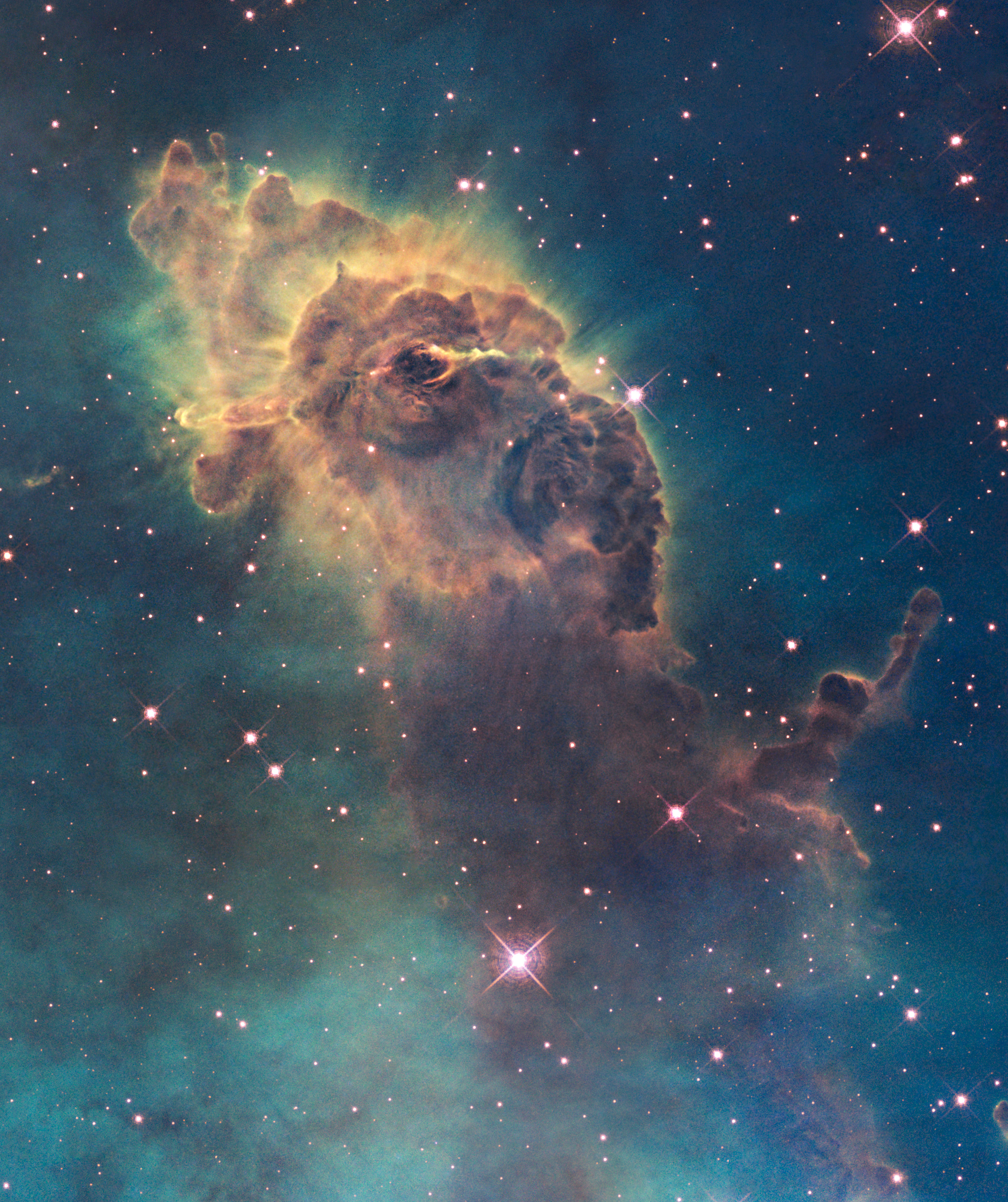
A nebula (; or nebulas) is a distinct luminescent part of interstellar medium, which can consist of ionized, neutral, or molecular hydrogen and also cosmic dust. Nebulae are often star-forming regions, such as the Pillars of Creation in the Eagle Nebula. In these regions, the formations of gas, dust, and other materials "clump" together to form denser regions, which attract further matter and eventually become dense enough to form stars. The remaining material is then thought to form planets and other planetary system objects.
Most nebulae are of vast size; some are hundreds of light-years in diameter. A nebula that is visible to the human eye from Earth would appear larger, but no brighter, from close by. The Orion Nebula, the brightest nebula in the sky and occupying an area twice the angular diameter of the full Moon, can be viewed with the naked eye but was missed by early astronomers. Although denser than the space surrounding them, most nebulae are far less dense than any vacuum created on Earth (10 to 10 molecules per cubic centimeter) – a nebular cloud the size of the Earth would have a total mass of only a few kilograms. Earth's air has a density of approximately 10 molecules per cubic centimeter; by contrast, the densest nebulae can have densities of 10 molecules per cubic centimeter. Many nebulae are visible due to fluorescence caused by embedded hot stars, while others are so diffused that they can be detected only with long exposures and special filters. Some nebulae are variably illuminated by T Tauri variable stars.
Originally, the term "nebula" was used to describe any diffused astronomical object, including galaxies beyond the Milky Way. The Andromeda Galaxy, for instance, was once referred to as the Andromeda Nebula (and spiral galaxies in general as "spiral nebulae") before the true nature of galaxies was confirmed in the early 20th century by Vesto Slipher, Edwin Hubble, and others. Edwin Hubble discovered that most nebulae are associated with stars and illuminated by starlight. He also helped categorize nebulae based on the type of light spectra they produced.
Observational history
Around 150 AD, Ptolemy recorded, in books VII–VIII of his Almagest, five stars that appeared nebulous. He also noted a region of nebulosity between the constellations Ursa Major and Leo that was not associated with any star.{{citation
In 1610, Nicolas-Claude Fabri de Peiresc discovered the Orion Nebula using a telescope. This nebula was also observed by Johann Baptist Cysat in 1618. However, the first detailed study of the Orion Nebula was not performed until 1659 by Christiaan Huygens, who also believed he was the first person to discover this nebulosity.
In 1715, Edmond Halley published a list of six nebulae. {{cite journal
The number of nebulae was then greatly increased by the efforts of William Herschel and his sister, Caroline Herschel. Their Catalogue of One Thousand New Nebulae and Clusters of Stars was published in 1786. A second catalog of a thousand was published in 1789, and the third and final catalog of 510 appeared in 1802. During much of their work, William Herschel believed that these nebulae were merely unresolved clusters of stars. In 1790, however, he discovered a star surrounded by nebulosity and concluded that this was a true nebulosity rather than a more distant cluster.
Beginning in 1864, William Huggins examined the spectra of about 70 nebulae. He found that roughly a third of them had the emission spectrum of a gas. The rest showed a continuous spectrum and were thus thought to consist of a mass of stars.{{cite book
In 1923, following the Great Debate, it became clear that many "nebulae" were in fact galaxies far from the Milky Way.
Slipher and Edwin Hubble continued to collect the spectra from many different nebulae, finding 29 that showed emission spectra and 33 that had the continuous spectra of star light. In 1922, Hubble announced that nearly all nebulae are associated with stars and that their illumination comes from star light. He also discovered that the emission spectrum nebulae are nearly always associated with stars having spectral classifications of B or hotter (including all O-type main sequence stars), while nebulae with continuous spectra appear with cooler stars.{{cite journal | doi-access=free}} Both Hubble and Henry Norris Russell concluded that the nebulae surrounding the hotter stars are transformed in some manner.
Formation

There are a variety of formation mechanisms for the different types of nebulae. Some nebulae form from gas that is already in the interstellar medium while others are produced by stars. Examples of the former case are giant molecular clouds, the coldest, densest phase of interstellar gas, which can form by the cooling and condensation of more diffuse gas. Examples of the latter case are planetary nebulae formed from material shed by a star in late stages of its stellar evolution.
Star-forming regions are a class of emission nebula associated with giant molecular clouds. These form as a molecular cloud collapses under its own weight, producing stars. Massive stars may form in the center, and their ultraviolet radiation ionizes the surrounding gas, making it visible at optical wavelengths. The region of ionized hydrogen surrounding the massive stars is known as an H II region while the shells of neutral hydrogen surrounding the H II region are known as photodissociation region. Examples of star-forming regions are the Orion Nebula, the Rosette Nebula and the Omega Nebula. Feedback from star-formation, in the form of supernova explosions of massive stars, stellar winds or ultraviolet radiation from massive stars, or outflows from low-mass stars may disrupt the cloud, destroying the nebula after several million years.
Other nebulae form as the result of supernova explosions; the death throes of massive, short-lived stars. The materials thrown off from the supernova explosion are then ionized by the energy and the compact object that its core produces. One of the best examples of this is the Crab Nebula, in Taurus. The supernova event was recorded in the year 1054 and is labeled SN 1054. The compact object that was created after the explosion lies in the center of the Crab Nebula and its core is now a neutron star.
Still other nebulae form as planetary nebulae. This is the final stage of a low-mass star's life, like Earth's Sun. Stars with a mass up to 8–10 solar masses evolve into red giants and slowly lose their outer layers during pulsations in their atmospheres. When a star has lost enough material, its temperature increases and the ultraviolet radiation it emits can ionize the surrounding nebula that it has thrown off. The Sun will produce a planetary nebula and its core will remain behind in the form of a white dwarf.
Types
File:Hubble Sees a Stellar "Sneezing Fit" (11467249715).jpg|Herbig–Haro HH 161 and HH 164. File:Omega Nebula.jpg|The Omega Nebula, an example of an emission nebula File:Horsehead-Hubble.jpg|The Horsehead Nebula, an example of a dark nebula. File:NGC6543.jpg|The Cat's Eye Nebula, an example of a planetary nebula. File:PIA04533.jpg|The Red Rectangle Nebula, an example of a protoplanetary nebula. File:SNR 0509.jpg|The delicate shell of SNR B0509-67.5 File:Tycho xrayonly.jpg|Tycho Supernova remnant in X-ray light File:Southern Ring Nebula by Webb Telescope (2022).jpg|Southern Ring Nebula, Planetary Nebula File:Webb captures detailed beauty of Ring Nebula (NIRCam and MIRI images) (weic2320a).jpg|Ring Nebula in the northern constellation of Lyra
Classical types
Objects named nebulae belong to four major groups. Before their nature was understood, galaxies ("spiral nebulae") and star clusters too distant to be resolved as stars were also classified as nebulae, but no longer are.
- H II regions, large diffuse nebulae containing ionized hydrogen
- Planetary nebulae
- Supernova remnants (e.g., Crab Nebula)
- Dark nebulae Not all cloud-like structures are nebulae; Herbig–Haro objects are an example.
Flux Nebulae
Main article: Integrated Flux Nebula
Diffuse nebulae

Most nebulae can be described as diffuse nebulae, which means that they are extended and contain no well-defined boundaries. Diffuse nebulae can be divided into emission nebulae, reflection nebulae and dark nebulae.
Visible light nebulae may be divided into emission nebulae, which emit spectral line radiation from excited or ionized gas (mostly ionized hydrogen);{{cite book | url-access = registration
Reflection nebulae themselves do not emit significant amounts of visible light, but are near stars and reflect light from them. Similar nebulae not illuminated by stars do not exhibit visible radiation, but may be detected as opaque clouds blocking light from luminous objects behind them; they are called dark nebulae.
Although these nebulae have different visibility at optical wavelengths, they are all bright sources of infrared emission, chiefly from dust within the nebulae.
Planetary nebulae
Main article: Planetary nebula

Planetary nebulae are the remnants of the final stages of stellar evolution for mid-mass stars (varying in size between 0.5-~8 solar masses). Evolved asymptotic giant branch stars expel their outer layers outwards due to strong stellar winds, thus forming gaseous shells while leaving behind the star's core in the form of a white dwarf. Radiation from the hot white dwarf excites the expelled gases, producing emission nebulae with spectra similar to those of emission nebulae found in star formation regions. They are H II regions, because mostly hydrogen is ionized, but planetary are denser and more compact than nebulae found in star formation regions.
Planetary nebulae were given their own name by the first astronomical observers who were initially unable to distinguish them from planets, which were of more interest to them. The Sun is expected to spawn a planetary nebula about 12 billion years after its formation.{{cite book
Protoplanetary nebulae
Main article: Protoplanetary nebula
Supernova remnants
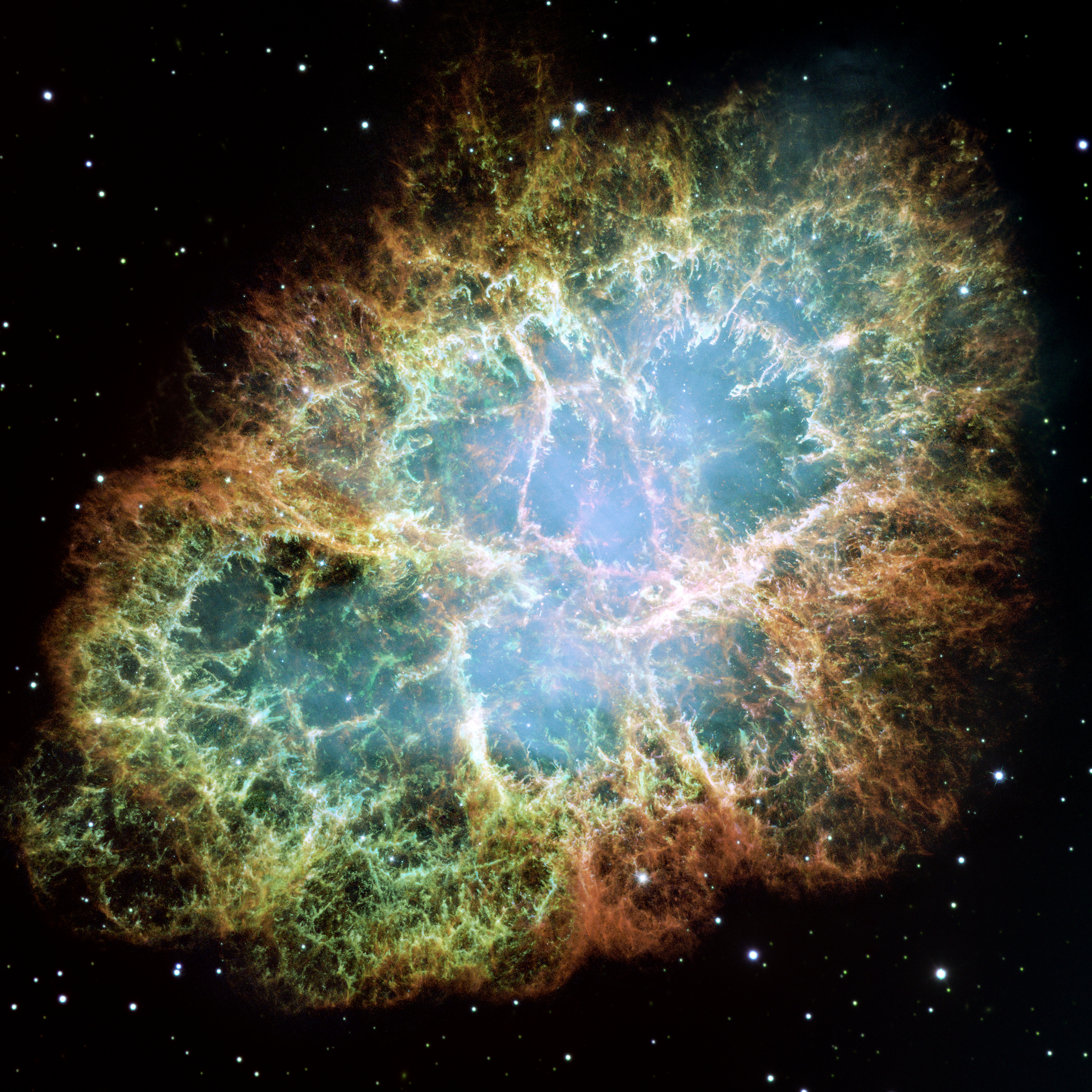
A supernova occurs when a high-mass star reaches the end of its life. When nuclear fusion in the core of the star stops, the star collapses. The gas falling inward either rebounds or gets so strongly heated that it expands outwards from the core, thus causing the star to explode. The expanding shell of gas forms a supernova remnant, a special diffuse nebula. Although much of the optical and X-ray emission from supernova remnants originates from ionized gas, a great amount of the radio emission is a form of non-thermal emission called synchrotron emission. This emission originates from high-velocity electrons oscillating within magnetic fields.
Examples
- Ant Nebula
- Barnard's Loop
- Boomerang Nebula
- Cat's Eye Nebula
- Crab Nebula
- Eagle Nebula
- Eskimo Nebula
- Carina Nebula
- Fox Fur Nebula
- Helix Nebula
- Horsehead Nebula
- Engraved Hourglass Nebula
- Lagoon Nebula
- Orion Nebula
- Pelican Nebula
- Red Square Nebula
- Ring Nebula
- Rosette Nebula
- Tarantula Nebula
- Waterfall Nebula
Catalogs
- Gum catalog (emission nebulae)
- RCW Catalogue (emission nebulae)
- Sharpless catalog (emission nebulae)
- Messier Catalogue
- Caldwell Catalogue
- Abell Catalog of Planetary Nebulae
- Barnard Catalogue (dark nebulae)
- Lynds' Catalogue of Bright Nebulae
- Lynds' Catalogue of Dark Nebulae
References
References
- {{OEtymD. nebula
- ''American Heritage Dictionary of the English Language, Fifth Edition''. S.v. "nebula." Retrieved November 23, 2019, via https://thefreedictionary.com/nebula
- ''Collins English Dictionary – Complete and Unabridged, 12th Edition 2014''. S.v. "nebula." Retrieved November 23, 2019, via https://thefreedictionary.com/nebula
- ''Random House Kernerman Webster's College Dictionary''. S.v. "nebula." Retrieved November 23, 2019, via https://thefreedictionary.com/nebula
- ''The American Heritage Dictionary of Student Science, Second Edition''. S.v. "nebula." Retrieved November 23, 2019, via https://thefreedictionary.com/nebula
- Howell, Elizabeth. (2013-02-22). "In Reality, Nebulae Offer No Place for Spaceships to Hide". Universe Today.
- Clark, Roger N.. (1990). "Visual astronomy of the deep sky". Cambridge University Press.
- (March 19, 2020). "What is a nebula?".
- Jones, Kenneth Glyn. (1991). "Messier's nebulae and star clusters". Cambridge University Press.
- (1921). "Suspected New Stars Recorded in the Old Chronicles and Among Recent Meridian Observations". Publications of the Astronomical Society of the Pacific.
- (1939). "The Crab Nebula, a Probable Supernova". Astronomical Society of the Pacific Leaflets.
- Hoskin, Michael. (2005). "Unfinished Business: William Herschel's Sweeps for Nebulae". [[British Journal for the History of Science]].
- (1786). "Philosophical Transactions". T.N..
- "A stellar sneezing fit". ESA/Hubble Picture of the Week.
- "The Messier Catalog: Diffuse Nebulae". SEDS.
This article was imported from Wikipedia and is available under the Creative Commons Attribution-ShareAlike 4.0 License. Content has been adapted to SurfDoc format. Original contributors can be found on the article history page.
Ask Mako anything about Nebula — get instant answers, deeper analysis, and related topics.
Research with MakoFree with your Surf account
Create a free account to save articles, ask Mako questions, and organize your research.
Sign up freeThis content may have been generated or modified by AI. CloudSurf Software LLC is not responsible for the accuracy, completeness, or reliability of AI-generated content. Always verify important information from primary sources.
Report