From Surf Wiki (app.surf) — the open knowledge base
Nazi symbolism
Symbols used by Nazis and neo-Nazis

Symbols used by Nazis and neo-Nazis
The 20th-century German Nazi Party made extensive use of graphic symbols, especially the swastika, notably in the form of the swastika flag, which became the co-national flag of Nazi Germany in 1933, and the sole national flag in 1935. A very similar flag had represented the Party beginning in 1920.
Nazi symbols and additional symbols have subsequently been used by neo-Nazis.
Swastika
Main article: Swastika#Nazism
The Nazis' principal symbol was the swastika, which the newly established Nazi Party formally adopted in 1920. The formal symbol of the party was the Parteiadler, an eagle atop a swastika.
The black-white-red motif is based on the colours of the flags of the German Empire. This colour scheme was commonly associated with anti-Weimar German nationalists, following the fall of the German Empire. The Nazis denounced the black-red-gold flag of the Weimar Republic (the current flag of Germany).
Heraldry
Under the Nazi regime, government bodies were encouraged to remove religious symbolism from their heraldry. Few German councils actually changed their often ancient symbols. Some, however, did, including Coburg, which replaced the Moor's head representing Saint Maurice on their arms with a sword and swastika, and Thuringia, which added a swastika to the paws of their lion.
Other symbols and insignia
Letters of the Armanen runes invented by Guido von List were used by the SS, particularly the Doppel Siegrune, based on the historical sowilo rune reinterpreted by List to signify 'victory' instead of the sun. Other Armanen runes used by the Nazis and subsequently by neo-Nazis include forms derived from Eihwaz, Tiwaz, Algiz and Othala.
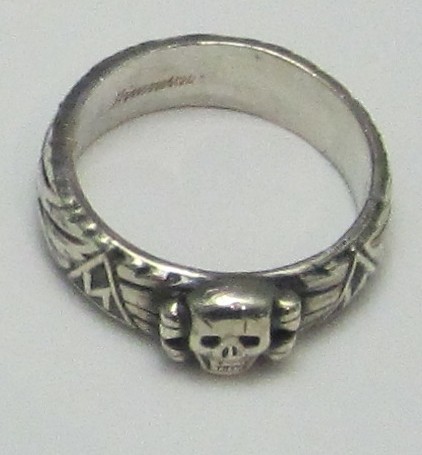
The death's head appears on the SS-Ehrenring presented by Heinrich Himmler to favored members of the SS, and was used as an insignia by the Death's Head Units of the SS that administered the concentration camps.
Units of the Wehrmacht used insignia including the Wolfsangel.
The Ahnenerbe research unit of the SS also used Wilhelm Teudt's neo-heathen Irminsul symbol.
Strasserism, a strand of Nazism with a Third Positionist ideology, used a crossed hammer and sword as its emblem.
Banning of symbols
The public display of Nazi symbols and gestures are today banned by law in many countries, including Australia (since 2024), Austria, Brazil, China, France, Germany (see Strafgesetzbuch section 86a), Latvia, Lithuania, Poland, Russia, Ukraine.
On August 9, 2018, Germany lifted the ban on the usage of swastikas and other Nazi symbols in video games, allowing "games that critically look at current affairs" to be given an age rating instead by the manufacturer, such as USK. The move was made to bring the legislation in line with films and other arts.
Usage by neo-Nazi groups
Many symbols used by the Nazis have further been appropriated by neo-Nazi groups, including a number of runes: the so-called Black Sun, derived from a mosaic floor in Himmler's remodel of Wewelsburg; and the Celtic cross, originally a symbol used to represent pre-Christian and Christian European groups such as the Irish.
Neo-Nazis also employ various number symbols:
- 18, code for Adolf Hitler. The number comes from the position of the letters in the alphabet: A = 1, H = 8.
- 88, code for "Heil Hitler", a phrase used in the Nazi salute. Also used as a reference to the "88 Precepts", a manifesto written by white supremacist David Lane.
- 14, from the Fourteen Words coined by David Lane: "We must secure the existence of our people and a future for white children."
- 14 and 88 are sometimes combined with each other (i.e. 14/88, 8814, 1488). They are also sometimes depicted on dice.
- 271, code for Holocaust denial or minimization. The number "references the conspiratorial claim that only an estimated 271,000 Jews were killed in the Holocaust", according to the Anti-Defamation League.
In 1997, Wolfgang Fröhlich, a Holocaust denier and former district council member for the Freedom Party of Austria, alleged that Adolf Hitler's favorite food was egg dumplings (Eiernockerl). Some restaurants in Austria started advertising the dish as a "daily special" for the 20th of April, which is Hitler's date of birth,
Gallery
File:Parteiadler Nationalsozialistische Deutsche Arbeiterpartei (1933–1945).svg|The Parteiadler of the Nazi Party (1933–1945) File:Totenkopf.svg|SS death's head insignia File:Wolfsangel.svg|Horizontally aligned Wolfsangel, used by the 2nd SS Panzer Division File:Wolfsangel 1.svg|Vertically aligned Wolfsangel, used by the 4th SS Polizei Panzergrenadier Division File:Nazi Odal rune.svg|Winged Odal, used by the 7th SS Volunteer Mountain Division (also used by the American-based "National Socialist Movement" from November 2016 until 2019) File:Schutzstaffel SS.svg|SS Doppel Siegrune, based on the sig Armanen rune, in turn based on the historical sowilo rune File:Algiz.svg|Algiz rune File:Iron Cross (1939).svg|Iron Cross (1939 version) File:Celtic-style crossed circle.svg|A simplified version of the Celtic cross, as used by various neo-Nazi groups File:Sun Cross Swastika.svg|The broken sun cross used by the German Faith Movement and the 5th SS Panzer Division, also used by the Thule Society File:Strasserism Hammer and Sword.svg|The Hammer and Sword utilized by adherents of Strasserism File:Black Sun.svg|The Black Sun used by Esoteric Nazi circles and other neo-Nazi groups File:Black Sun 2.svg|A variation of the Black Sun used by Esoteric Nazi circles and other neo-Nazi groups
References
References
- "History of the Swastika". United States Holocaust Memorial Museum.
- [[Hilmar Hoffmann]], John Broadwin, Volker R. Berghahn. ''The Triumph of Propaganda: Film and National Socialism, 1933–1945''. Berghahn Books, 1997. Pp. 16.
- Slater, Stephen. (2003). "The Complete Book of Heraldry: An International History Of Heraldry And Its Contemporary Uses". Anness Publishing.
- "Hate Symbols: Life Rune - From A Visual Database of Extremist Symbols, Logos and Tattoos". [[Anti-Defamation League]].
- "Hate Symbols: Othala Rune - From A Visual Database of Extremist Symbols, Logos and Tattoos". [[Anti-Defamation League]].
- "Hate Symbols: Neo-Nazi Skull and Crossbones". [[Anti-Defamation League]].
- "Wolfsangel". [[Anti-Defamation League]].
- Wichert, Lasse. (2018). "Personale Mythen des Nationalsozialismus: Die Gestaltung des Einzelnen in literarischen Entwürfen". Wilhelm Fink.
- (8 January 2024). "Nazi salute and hate symbols now outlawed". [[Australian Government]].
- (9 August 2018). "Germany lifts ban on Nazi symbols in video games". [[The Daily Telegraph.
- Chalk, Andy. (9 August 2018). "Germany Lifts Ban on Swastikas in Videogames".
- "Hate Number Symbols: 18". [[Anti-Defamation League]].
- "Hate Number Symbols: 88". [[Anti-Defamation League]].
- "Hate Number Symbols: 14 (words)". [[Anti-Defamation League]].
- "Hate Number Symbols: 14/88". [[Anti-Defamation League]].
- (22 February 2017). "These are the new symbols of hate". CNN.
- "Coded Hate: Extremists Weaponize Seemingly Innocuous Content to Promote Bigotry". [[Anti-Defamation League]].
- Vessely, Rebecca. (12 November 1996). "Germany restricts internet content".
- (21 April 2016). "Some Austrians celebrated 4/20 by eating Hitler's favorite dish". [[The Jerusalem Post]].
- Herbst, Hanna. (20 April 2016). "Hitler-Verehrer servieren zur Feier des Tages Eiernockerl mit Salat". [[Vice News.
- "Hate Symbols: Neo-Nazi Skull and Crossbones". [[Anti-Defamation League]].
- "Wolfsangel". [[Anti-Defamation League]].
- (10 December 2016). "An Alt-Right Makeover Shrouds the Swastikas". The New York Times.
- "Hate Symbols: Celtic Cross". [[Anti-Defamation League]].
This article was imported from Wikipedia and is available under the Creative Commons Attribution-ShareAlike 4.0 License. Content has been adapted to SurfDoc format. Original contributors can be found on the article history page.
Ask Mako anything about Nazi symbolism — get instant answers, deeper analysis, and related topics.
Research with MakoFree with your Surf account
Create a free account to save articles, ask Mako questions, and organize your research.
Sign up freeThis content may have been generated or modified by AI. CloudSurf Software LLC is not responsible for the accuracy, completeness, or reliability of AI-generated content. Always verify important information from primary sources.
Report