From Surf Wiki (app.surf) — the open knowledge base
Natural logarithm
Logarithm to the base of the mathematical constant e
Logarithm to the base of the mathematical constant e
| Field | Value |
|---|---|
| name | Natural logarithm |
| image | Log (2).svg |
| imagesize | 290px |
| imagealt | Graph of part of the natural logarithm function. |
| caption | Graph of part of the natural logarithm function. The function slowly grows to positive infinity as x increases, and slowly goes to negative infinity as x approaches 0 ("slowly" as compared to any power law of x). |
| general_definition | \ln x = \log_{e} x |
| motivation_of_creation | hyperbola quadrature |
| fields_of_application | Pure and applied mathematics |
| domain | \mathbb{R}_{ 0} |
| codomain | \mathbb{R} |
| range | \mathbb{R} |
| plusinf | +∞ |
| vr1 | e |
| f1 | 1 |
| vr2 | 1 |
| f2 | 0 |
| vr3 | 0 |
| f3 | −∞ |
| asymptote | x = 0 |
| root | 1 |
| inverse | \exp x |
| derivative | \dfrac{d}{dx}\ln x = \dfrac{1}{x} , x 0 |
| antiderivative | \int \ln x\,dx = x \left( \ln x - 1 \right) + C |
The natural logarithm of a number is its logarithm to the base of the mathematical constant e, which is an irrational and transcendental number approximately equal to . The natural logarithm of x is generally written as ln x, loge x, or sometimes, if the base e is implicit, simply log x. Parentheses are sometimes added for clarity, giving ln(x), loge(x), or log(x). This is done particularly when the argument to the logarithm is not a single symbol, so as to prevent ambiguity.
The natural logarithm of x is the power to which e would have to be raised to equal x. For example, ln 7.5 is 2.0149..., because . The natural logarithm of e itself, ln e, is 1, because , while the natural logarithm of 1 is 0, since .
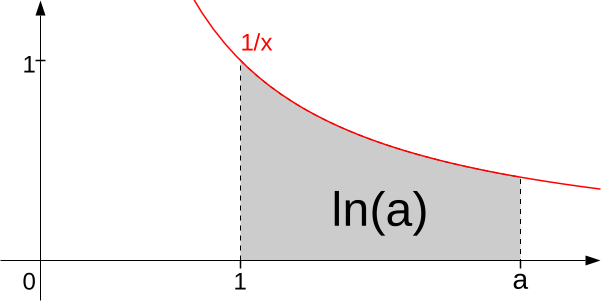
The natural logarithm can be defined for any positive real number a as the area under the curve from 1 to a (with the area being negative when {{math|0
The natural logarithm function, if considered as a real-valued function of a positive real variable, is the inverse function of the exponential function, leading to the identities: \begin{align} e^{\ln x} &= x \qquad \text{ if } x \in \R_{+}\ \ln e^x &= x \qquad \text{ if } x \in \R \end{align}
Like all logarithms, the natural logarithm maps multiplication of positive numbers into addition: \ln( x \cdot y ) = \ln x + \ln y~.
Logarithms can be defined for any positive base other than 1, not only e. However, logarithms in other bases differ only by a constant multiplier from the natural logarithm, and can be defined in terms of the latter, \log_b x = \ln x / \ln b = \ln x \cdot \log_b e.
Logarithms are useful for solving equations in which the unknown appears as the exponent of some other quantity. For example, logarithms are used to solve for the half-life, decay constant, or unknown time in exponential decay problems. They are important in many branches of mathematics and scientific disciplines, and are used to solve problems involving compound interest.
History
Main article: History of logarithms
The concept of the natural logarithm was worked out by Gregoire de Saint-Vincent and Alphonse Antonio de Sarasa before 1649. Their work involved quadrature of the hyperbola with equation , by determination of the area of hyperbolic sectors. Their solution generated the requisite "hyperbolic logarithm" function, which had the properties now associated with the natural logarithm.
An early mention of the natural logarithm was by Nicholas Mercator in his work Logarithmotechnia, published in 1668, although the mathematics teacher John Speidell had already compiled a table of what in fact were effectively natural logarithms in 1619. It has been said that Speidell's logarithms were to the base e, but this is not entirely true due to complications with the values being expressed as integers.
Notational conventions
The notations ln x and loge x both refer unambiguously to the natural logarithm of x, and log x without an explicit base may also refer to the natural logarithm. This usage is common in mathematics, along with some scientific contexts as well as in many programming languages. Including C, C++, Java, SAS, MATLAB, Mathematica, Fortran, and some BASIC dialects In some other contexts such as chemistry, however, log x can be used to denote the common (base 10) logarithm. It may also refer to the binary (base 2) logarithm in the context of computer science, particularly in the context of time complexity.
Generally, the notation for the logarithm to base b of a number x is shown as logb x. So the log of 8 to the base 2 would be .
Definitions
The natural logarithm can be defined in several equivalent ways.
Inverse of exponential
The most general definition is as the inverse function of e^x, so that e^{\ln(x)} = x. Because e^x is positive and invertible for any real input x, this definition of \ln(x) is well defined for any positive x.
Integral definition

The natural logarithm of a positive, real number a may be defined as the area under the graph of the hyperbola with equation between and . This is the integral \ln a = \int_1^a \frac{1}{x},dx. If a is in (0,1), then the region has negative area, and the logarithm is negative.
This function is a logarithm because it satisfies the fundamental multiplicative property of a logarithm: \ln(ab) = \ln a + \ln b.
This can be demonstrated by splitting the integral that defines ln ab into two parts, and then making the variable substitution (so ) in the second part, as follows: \begin{align} \ln ab = \int_1^{ab}\frac{1}{x} , dx &=\int_1^a \frac{1}{x} , dx + \int_a^{ab} \frac{1}{x} , dx\[5pt] &=\int_1^a \frac 1 x , dx + \int_1^b \frac{1}{at} a,dt\[5pt] &=\int_1^a \frac 1 x , dx + \int_1^b \frac{1}{t} , dt\[5pt] &= \ln a + \ln b. \end{align}
In elementary terms, this is simply scaling by 1/a in the horizontal direction and by a in the vertical direction. Area does not change under this transformation, but the region between a and ab is reconfigured. Because the function a/(ax) is equal to the function 1/x, the resulting area is precisely ln b.
The number e can then be defined to be the unique real number a such that .
Properties
The natural logarithm has the following mathematical properties:
- \ln 1 = 0
- \ln e = 1
- \ln(xy) = \ln x + \ln y \quad \text{for }; x 0;\text{and }; y 0
- \ln(x/y) = \ln x - \ln y \quad \text{for }; x 0;\text{and }; y 0
- \ln(x^y) = y \ln x \quad \text{for }; x 0
- \ln(\sqrt[y]{x}) = (\ln x) / y\quad \text{for }; x 0;\text{and }; y \ne 0
- \ln x
- \lim_{x \to 0} \frac{\ln(1+x)}{x} = 1
- \lim_{\alpha \to 0} \frac{x^\alpha-1}{\alpha} = \ln x\quad \text{for }; x 0
- \frac{x-1}{x} \leq \ln x \leq x-1 \quad\text{for}\quad x 0
- \ln{( 1+x^\alpha )} \leq \alpha x \quad\text{for}\quad x \ge 0;\text{and }; \alpha \ge 1
Derivative
The derivative of the natural logarithm as a real-valued function on the positive reals is given by \frac{d}{dx} \ln x = \frac{1}{x}.
How to establish this derivative of the natural logarithm depends on how it is defined firsthand. If the natural logarithm is defined as the integral \ln x = \int_1^x \frac{1}{t},dt, then the derivative immediately follows from the first part of the fundamental theorem of calculus.
On the other hand, if the natural logarithm is defined as the inverse of the (natural) exponential function, then the derivative (for x 0) can be found by using the properties of the logarithm and a definition of the exponential function.
From the definition of the number e = \lim_{u\to 0}(1+u)^{1/u}, the exponential function can be defined as e^x = \lim_{u\to 0} (1+u)^{x/u} = \lim_{h\to 0}(1 + hx)^{1/h} , where u=hx, h=\frac{u}{x}.
The derivative can then be found from first principles. \begin{align} \frac{d}{dx} \ln x &= \lim_{h\to 0} \frac{\ln(x+h) - \ln x}{h} \ &= \lim_{h\to 0}\left[ \frac{1}{h} \ln\left(\frac{x+h}{x}\right)\right] \ &= \lim_{h\to 0}\left[ \ln\left(1 + \frac{h}{x}\right)^{\frac{1}{h}}\right]\quad &&\text{all above for logarithmic properties}\ &= \ln \left[ \lim_{h\to 0}\left(1 + \frac{h}{x}\right)^{\frac{1}{h}}\right]\quad &&\text{for continuity of the logarithm} \ &= \ln e^{1/x} \quad &&\text{for the definition of } e^x = \lim_{h\to 0}(1 + hx)^{1/h}\ &= \frac{1}{x} \quad &&\text{for the definition of the ln as inverse function.} \end{align}
Also, we have: \frac{d}{dx} \ln ax = \frac{d}{dx} (\ln a + \ln x) = \frac{d}{dx} \ln a +\frac{d}{dx} \ln x = \frac{1}{x}.
so, unlike its inverse function e^{ax}, a constant in the function doesn't alter the differential.
Series

Since the natural logarithm is undefined at 0, \ln(x) itself does not have a Maclaurin series, unlike many other elementary functions. Instead, one looks for Taylor expansions around other points. For example, if \vert x - 1 \vert \leq 1 \text{ and } x \neq 0, then \begin{align} \ln x &= \int_1^x \frac{1}{t} , dt = \int_0^{x - 1} \frac{1}{1 + u} , du \ &= \int_0^{x - 1} (1 - u + u^2 - u^3 + \cdots) , du \ &= (x - 1) - \frac{(x - 1)^2}{2} + \frac{(x - 1)^3}{3} - \frac{(x - 1)^4}{4} + \cdots \ &= \sum_{k=1}^\infty \frac{(-1)^{k-1} (x-1)^k}{k}. \end{align}
This is the Taylor series for \ln x around 1. A change of variables yields the Mercator series: \ln(1+x)=\sum_{k=1}^\infty \frac{(-1)^{k-1}}{k} x^k = x - \frac{x^2}{2} + \frac{x^3}{3} - \cdots, valid for |x| \leq 1 and x\ne -1.
Leonhard Euler, disregarding x\ne -1, nevertheless applied this series to x=-1 to show that the harmonic series equals the natural logarithm of \frac{1}{1-1}; that is, the logarithm of infinity. Nowadays, more formally, one can prove that the harmonic series truncated at N is close to the logarithm of N, when N is large, with the difference converging to the Euler–Mascheroni constant.
The figure is a graph of ln(1 + x) and some of its Taylor polynomials around 0. These approximations converge to the function only in the region {{math|−1
A useful special case for positive integers n, taking x = \tfrac{1}{n}, is: \ln \left(\frac{n + 1}{n}\right) = \sum_{k=1}^\infty \frac{(-1)^{k-1}}{k n^k} = \frac{1}{n} - \frac{1}{2 n^2} + \frac{1}{3 n^3} - \frac{1}{4 n^4} + \cdots
If \operatorname{Re}(x) \ge 1/2, then \begin{align} \ln (x) &= - \ln \left(\frac{1}{x}\right) = - \sum_{k=1}^\infty \frac{(-1)^{k-1} (\frac{1}{x} - 1)^k}{k} = \sum_{k=1}^\infty \frac{(x - 1)^k}{k x^k} \ &= \frac{x - 1}{x} + \frac{(x - 1)^2}{2 x^2} + \frac{(x - 1)^3}{3 x^3} + \frac{(x - 1)^4}{4 x^4} + \cdots \end{align}
Now, taking x=\tfrac{n+1}{n} for positive integers n, we get: \ln \left(\frac{n + 1}{n}\right) = \sum_{k=1}^\infty \frac{1}{k (n + 1)^k} = \frac{1}{n + 1} + \frac{1}{2 (n + 1)^2} + \frac{1}{3 (n + 1)^3} + \frac{1}{4 (n + 1)^4} + \cdots
If \operatorname{Re}(x) \ge 0 \text{ and } x \neq 0, then \ln (x) = \ln \left(\frac{2x}{2}\right) = \ln\left(\frac{1 + \frac{x - 1}{x + 1}}{1 - \frac{x - 1}{x + 1}}\right) = \ln \left(1 + \frac{x - 1}{x + 1}\right) - \ln \left(1 - \frac{x - 1}{x + 1}\right). Since \begin{align} \ln(1+y) - \ln(1-y)&= \sum^\infty_{i=1}\frac{1}{i}\left((-1)^{i-1}y^i - (-1)^{i-1}(-y)^i\right) = \sum^\infty_{i=1}\frac{y^i}{i}\left((-1)^{i-1} +1\right) \ &= y\sum^\infty_{i=1}\frac{y^{i-1}}{i}\left((-1)^{i-1} +1\right)\overset{i-1\to 2k}{=}; 2y\sum^\infty_{k=0}\frac{y^{2k}}{2k+1}, \end{align} we arrive at \begin{align} \ln (x) &= \frac{2(x - 1)}{x + 1} \sum_{k = 0}^\infty \frac{1}{2k + 1} {\left(\frac{(x - 1)^2}{(x + 1)^2}\right)}^k \ &= \frac{2(x - 1)}{x + 1} \left( \frac{1}{1} + \frac{1}{3} \frac{(x - 1)^2}{(x + 1)^2} + \frac{1}{5} {\left(\frac{(x - 1)^2}{(x + 1)^2}\right)}^2 + \cdots \right) . \end{align} Using the substitution x=\tfrac{n+1}{n} again for positive integers n, we get: \begin{align} \ln \left(\frac{n + 1}{n}\right) &= \frac{2}{2n + 1} \sum_{k=0}^\infty \frac{1}{(2k + 1) ((2n + 1)^2)^k}\ &= 2 \left(\frac{1}{2n + 1} + \frac{1}{3 (2n + 1)^3} + \frac{1}{5 (2n + 1)^5} + \cdots \right). \end{align}
This is, by far, the fastest converging of the series described here.
The natural logarithm can also be expressed as an infinite product: \ln(x)=(x-1) \prod_{k=1}^\infty \left ( \frac{2}{1+\sqrt[2^k]{x}} \right )
Two examples might be: \ln(2)=\left ( \frac{2}{1+\sqrt{2}} \right )\left ( \frac{2}{1+\sqrt[4]{2}} \right )\left ( \frac{2}{1+\sqrt[8]{2}} \right )\left ( \frac{2}{1+\sqrt[16]{2}} \right )... \pi=(2i+2)\left ( \frac{2}{1+\sqrt{i}} \right )\left ( \frac{2}{1+\sqrt[4]{i}} \right )\left ( \frac{2}{1+\sqrt[8]{i}} \right )\left ( \frac{2}{1+\sqrt[16]{i}} \right )...
From this identity, we can easily get that: \frac{1}{\ln(x)}=\frac{x}{x-1}-\sum_{k=1}^\infty\frac{2^{-k}x^{2^{-k}}}{1+x^{2^{-k}}}
For example: \frac{1}{\ln(2)} = 2-\frac{\sqrt{2}}{2+2\sqrt{2}}-\frac{\sqrt[4]{2}}{4+4\sqrt[4]{2}}-\frac{\sqrt[8]{2}}{8+8\sqrt[8]{2}} \cdots
The natural logarithm in integration
The natural logarithm allows simple integration of functions of the form g(x) = \frac{f'(x)}{f(x)}: an antiderivative of g(x) is given by \ln (|f(x)|). This is the case because of the chain rule and the following fact: \frac{d}{dx}\ln \left| x \right| = \frac{1}{x}, \ \ x \ne 0
In other words, when integrating over an interval of the real line that does not include x=0, then \int \frac{1}{x} ,dx = \ln|x| + C where C is an arbitrary constant of integration.
Likewise, when the integral is over an interval where f(x) \ne 0, :\int { \frac{f'(x)}{f(x)},dx} = \ln|f(x)| + C. For example, consider the integral of \tan (x) over an interval that does not include points where \tan (x) is infinite: \int \tan x ,dx = \int \frac{\sin x}{\cos x} ,dx = -\int \frac{\frac{d}{dx} \cos x}{\cos x} ,dx = -\ln \left| \cos x \right| + C = \ln \left| \sec x \right| + C.
The natural logarithm can be integrated using integration by parts: \int \ln x ,dx = x \ln x - x + C.
Let: u = \ln x \Rightarrow du = \frac{dx}{x} dv = dx \Rightarrow v = x then: \begin{align} \int \ln x ,dx & = x \ln x - \int \frac{x}{x} ,dx \ & = x \ln x - \int 1 ,dx \ & = x \ln x - x + C \end{align}
Efficient computation==
For \ln (x) where x 1, the closer the value of x is to 1, the faster the rate of convergence of its Taylor series centered at 1. The identities associated with the logarithm can be leveraged to exploit this: \begin{align} \ln 123.456 &= \ln(1.23456 \cdot 10^2)\ &= \ln 1.23456 + \ln(10^2)\ &= \ln 1.23456 + 2 \ln 10\ &\approx \ln 1.23456 + 2 \cdot 2.3025851. \end{align}
Such techniques were used before calculators, by referring to numerical tables and performing manipulations such as those above.
Natural logarithm of 10
The natural logarithm of 10, approximately equal to , plays a role for example in the computation of natural logarithms of numbers represented in scientific notation, as a mantissa multiplied by a power of 10: \ln(a\cdot 10^n) = \ln a + n \ln 10.
This means that one can effectively calculate the logarithms of numbers with very large or very small magnitude using the logarithms of a relatively small set of decimals in the range 1, 10).
{{anchor|lnp1}}High precision
To compute the natural logarithm with many digits of precision, the Taylor series approach is not efficient since the convergence is slow. Especially if x is near 1, a good alternative is to use [Halley's method or Newton's method to invert the exponential function, because the series of the exponential function converges more quickly. For finding the value of y to give \exp(y)-x=0 using Halley's method, or equivalently to give \exp(y/2) -x \exp(-y/2)=0 using Newton's method, the iteration simplifies to y_{n+1} = y_n + 2 \cdot \frac{ x - \exp ( y_n ) }{ x + \exp ( y_n ) } which has cubic convergence to \ln (x).
Another alternative for extremely high precision calculation is the formula \ln x \approx \frac{\pi}{2 M(1,4/s)} - m \ln 2, where M denotes the arithmetic-geometric mean of 1 and 4/s, and s = x 2^m 2^{p/2}, with m chosen so that p bits of precision is attained. (For most purposes, the value of 8 for m is sufficient.) In fact, if this method is used, Newton inversion of the natural logarithm may conversely be used to calculate the exponential function efficiently. (The constants \ln 2 and can be pre-computed to the desired precision using any of several known quickly converging series.) Or, the following formula can be used: \ln x = \frac{\pi}{M\left(\theta_2^2(1/x),\theta_3^2(1/x)\right)},\quad x\in (1,\infty)
where \theta_2(x) = \sum_{n\in\Z} x^{(n+1/2)^2}, \quad \theta_3(x) = \sum_{n\in\Z} x^{n^2} are the Jacobi theta functions.
Based on a proposal by William Kahan and first implemented in the Hewlett-Packard HP-41C calculator in 1979 (referred to under "LN1" in the display, only), some calculators, operating systems (for example Berkeley UNIX 4.3BSD), computer algebra systems and programming languages (for example C99) provide a special natural logarithm plus 1 function, alternatively named LNP1, or log1p to give more accurate results for logarithms close to zero by passing arguments x, also close to zero, to a function log1p(x), which returns the value ln(1+x), instead of passing a value y close to 1 to a function returning ln(y). The function log1p avoids in the floating point arithmetic a near cancelling of the absolute term 1 with the second term from the Taylor expansion of the natural logarithm. This keeps the argument, the result, and intermediate steps all close to zero where they can be most accurately represented as floating-point numbers.
In addition to base e, the IEEE 754-2008 standard defines similar logarithmic functions near 1 for binary and decimal logarithms: log2(1 + x) and log10(1 + x).
Similar inverse functions named "expm1", "expm" or "exp1m" exist as well, all with the meaning of .For a similar approach to reduce round-off errors of calculations for certain input values see trigonometric functions like versine, vercosine, coversine, covercosine, haversine, havercosine, hacoversine, hacovercosine, exsecant and excosecant.
An identity in terms of the inverse hyperbolic tangent, \mathrm{log1p}(x) = \log(1+x) = 2 ~ \mathrm{artanh}\left(\frac{x}{2+x}\right),, gives a high precision value for small values of x on systems that do not implement log1p(x).
Computational complexity
Main article: Computational complexity of mathematical operations
The computational complexity of computing the natural logarithm using the arithmetic-geometric mean (for both of the above methods) is \text{O}\bigl(M(n) \ln n \bigr). Here, n is the number of digits of precision at which the natural logarithm is to be evaluated, and M(n) is the computational complexity of multiplying two n-digit numbers.
Continued fractions
While no simple continued fractions are available, several generalized continued fractions exist, including: \begin{align} \ln(1+x) & =\frac{x^1}{1}-\frac{x^2}{2}+\frac{x^3}{3}-\frac{x^4}{4}+\frac{x^5}{5}-\cdots \[5pt] & = \cfrac{x}{1-0x+\cfrac{1^2x}{2-1x+\cfrac{2^2x}{3-2x+\cfrac{3^2x}{4-3x+\cfrac{4^2x}{5-4x+\ddots}}}}} \end{align} \begin{align} \ln\left(1+\frac{x}{y}\right) & = \cfrac{x} {y+\cfrac{1x} {2+\cfrac{1x} {3y+\cfrac{2x} {2+\cfrac{2x} {5y+\cfrac{3x} {2+\ddots}}}}}} \[5pt] & = \cfrac{2x} {2y+x-\cfrac{(1x)^2} {3(2y+x)-\cfrac{(2x)^2} {5(2y+x)-\cfrac{(3x)^2} {7(2y+x)-\ddots}}}} \end{align}
These continued fractions—particularly the last—converge rapidly for values close to 1. However, the natural logarithms of much larger numbers can easily be computed, by repeatedly adding those of smaller numbers, with similarly rapid convergence.
For example, since 2 = 1.253 × 1.024, the natural logarithm of 2 can be computed as: \begin{align} \ln 2 & = 3 \ln\left(1+\frac{1}{4}\right) + \ln\left(1+\frac{3}{125}\right) \[8pt] & = \cfrac{6} {9-\cfrac{1^2} {27-\cfrac{2^2} {45-\cfrac{3^2} {63-\ddots}}}}
- \cfrac{6} {253-\cfrac{3^2} {759-\cfrac{6^2} {1265-\cfrac{9^2} {1771-\ddots}}}}. \end{align}
Furthermore, since 10 = 1.2510 × 1.0243, even the natural logarithm of 10 can be computed similarly as: \begin{align} \ln 10 & = 10 \ln\left(1+\frac{1}{4}\right) + 3\ln\left(1+\frac{3}{125}\right) \[10pt] & = \cfrac{20} {9-\cfrac{1^2} {27-\cfrac{2^2} {45-\cfrac{3^2} {63-\ddots}}}}
- \cfrac{18} {253-\cfrac{3^2} {759-\cfrac{6^2} {1265-\cfrac{9^2} {1771-\ddots}}}}. \end{align} The reciprocal of the natural logarithm can be also written in this way: \frac {1}{\ln(x)} = \frac {2x}{x^2-1}\sqrt{\frac {1}{2}+\frac {x^2+1}{4x}}\sqrt{\frac {1}{2}+\frac {1}{2}\sqrt{\frac {1}{2}+\frac {x^2+1}{4x}}}\ldots
For example: \frac {1}{\ln(2)} = \frac {4}{3}\sqrt{\frac {1}{2} + \frac {5}{8}} \sqrt{\frac {1}{2} + \frac {1}{2} \sqrt{\frac {1}{2} +\frac {5}{8}}} \ldots
Complex logarithms
Main article: Complex logarithm
The exponential function can be extended to a function which gives a complex number as e**z for any arbitrary complex number z; simply use the infinite series with x=z complex. This exponential function can be inverted to form a complex logarithm that exhibits most of the properties of the ordinary logarithm. There are two difficulties involved: no x has ; and it turns out that . Since the multiplicative property still works for the complex exponential function, , for all complex z and integers k.
So the logarithm cannot be defined for the whole complex plane, and even then it is multi-valued—any complex logarithm can be changed into an "equivalent" logarithm by adding any integer multiple of 2iπ at will. The complex logarithm can only be single-valued on the cut plane. For example, or or −, etc.; and although can be defined as 2iπ, or 10iπ or −6iπ, and so on.
Image:NaturalLogarithmRe.png| Image:NaturalLogarithmImAbs.png| Image:NaturalLogarithmAbs.png| Image:NaturalLogarithmAll.png| Superposition of the previous three graphs
Notes
References
de:Logarithmus#Natürlicher Logarithmus
References
- {{Cite OEIS. A001113. Decimal expansion of e
- (1975). "An Introduction to the Theory of Numbers". Oxford.
- (2005). "Mathematics for physical chemistry". [[Academic Press]].
- Weisstein, Eric W.. "Natural Logarithm".
- "Rules, Examples, & Formulas".
- (2001). "Alphonse Antonio de Sarasa and logarithms". [[Historia Mathematica]].
- (September 2001). "The number e". The MacTutor History of Mathematics archive.
- (1991). "A History of Mathematics". AMS Bookstore.
- ""Logarithmic Expansions" at Math2.org".
- [[Leonhard Euler]], Introductio in Analysin Infinitorum. Tomus Primus. Bousquet, Lausanne 1748. Exemplum 1, p. 228; quoque in: Opera Omnia, Series Prima, Opera Mathematica, Volumen Octavum, Teubner 1922
- "A PROCEDURE FOR GENERATING INFINITE SERIES IDENTITIES".
- For a detailed proof see for instance: George B. Thomas, Jr and Ross L. Finney, ''Calculus and Analytic Geometry'', 5th edition, Addison-Wesley 1979, Section 6-5 pages 305-306.
- {{Cite OEIS. A002392. Decimal expansion of natural logarithm of 10
- (1982). "Practically fast multiple-precision evaluation of log(x)". Journal of Information Processing.
- (1999). "Stacs 99".
- (1987). "Pi and the AGM: A Study in Analytic Number Theory and Computational Complexity". Wiley-Interscience.
- (December 1994). "HP 48G Series – Advanced User's Reference Manual (AUR)". [[Hewlett-Packard]].
- (2009-07-14). "HP 50g / 49g+ / 48gII graphing calculator advanced user's reference manual (AUR)". [[Hewlett-Packard]].
- (2002-07-09). "Computation of expm1 = exp(x)−1". Department of Mathematics, Center for Scientific Computing, [[University of Utah]].
- (2017-08-22). "The Mathematical-Function Computation Handbook - Programming Using the MathCW Portable Software Library". [[Springer International Publishing AG]].
This article was imported from Wikipedia and is available under the Creative Commons Attribution-ShareAlike 4.0 License. Content has been adapted to SurfDoc format. Original contributors can be found on the article history page.
Ask Mako anything about Natural logarithm — get instant answers, deeper analysis, and related topics.
Research with MakoFree with your Surf account
Create a free account to save articles, ask Mako questions, and organize your research.
Sign up freeThis content may have been generated or modified by AI. CloudSurf Software LLC is not responsible for the accuracy, completeness, or reliability of AI-generated content. Always verify important information from primary sources.
Report