From Surf Wiki (app.surf) — the open knowledge base
National Front (Czechoslovakia)
| Field | Value |
|---|---|
| colorcode | |
| foundation | 1943 |
| dissolved | 1990 |
| ideology | 1943–1948: |
| Anti-fascism | |
| State socialism | |
| Social democracy | |
| Christian democracy | |
| 1948–1990: | |
| Communism | |
| Marxism–Leninism | |
| Stalinism (until 1956) | |
| country | Czechoslovakia |
| name | National Front of |
| Czechs and Slovaks | |
| native_name | cs |
| sk | |
| newspaper | Mladá fronta |
| (1945–1953) | |
| logo | Emblem of the National Front of Czechs and Slovaks.svg |
| logo_size | 130px |
| headquarters | Prague, Czechoslovakia |
| position | Far-left |
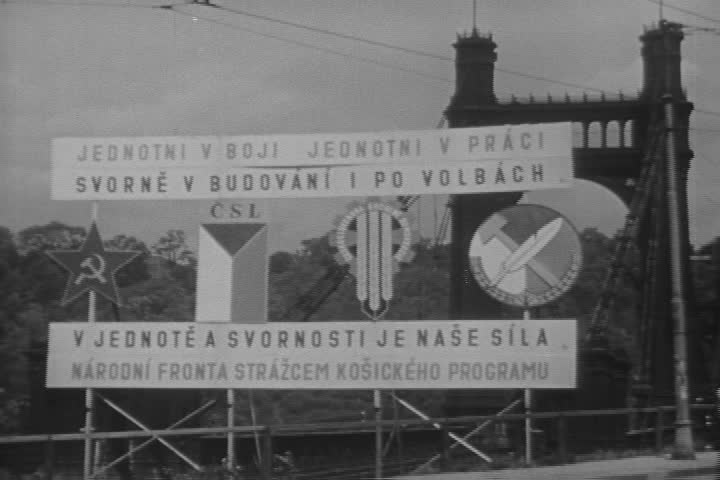
Anti-fascism State socialism Social democracy Christian democracy 1948–1990: Communism Marxism–Leninism Stalinism (until 1956) Czechs and Slovaks sk (1945–1953) The National Front (; ), also known as the National Front of Czechs and Slovaks was a political coalition created in 1943 serving as united front of political parties for liberation of Czechoslovakia, after 1948 organized solely by the Communist Party of Czechoslovakia (KSČ). It was the vehicle for control of all political and social activity by the KSČ.
1943–1948
As World War II began, Czechoslovakia disappeared from the map of Europe. The Czech lands became the Protectorate of Bohemia and Moravia under direct Nazi rule, while Slovakia ostensibly became independent. At the end of World War II, Czechoslovakia was included in the sphere of influence of the Soviet Union. Postwar Czechoslovakia was organized according to a program worked out by the KSČ (whose leaders were in exile in Moscow), and Edvard Beneš, representing the government-in-exile in London—these being the two most important groups seeking the reconstitution of the country. Part of the program was the formation of a popular anti-Nazi coalition of parties. Negotiations began in December 1943 in Moscow. The KSČ and the non-Communist parties had very different ideas about this.
This coalition was established as the "National Front" in April 1945, when a Czechoslovak government came into being in the city of Košice, recently liberated by Soviet troops. The model of government was adopted from similar French tripartisme.
The Slovak People's Party was banned due to its collaboration with the Nazis. The government decided not to allow the re-creation of other pre-war democratic parties, such as the Republican Party of Farmers and Peasants, due to its lead of the Party of National Unity.
The National Front was dominated by the socialist parties: KSČ (which held key ministerial offices), KSS and ČSSD.
The Communists viewed the National Front as a permanent entity, while the remaining parties considered it a temporary coalition until normal conditions would arise in Czechoslovakia. Many quarrels arose between the KSČ and the remaining parties of the National Front in the transitory period 1945–1948.
Political parties (1943–1948)
| Organization | Emblem | Foundation | Seats in the CNA (1946) | Ideology | Range | ||
|---|---|---|---|---|---|---|---|
| Communist Party of Czechoslovakia | [[File:Emblem of the Communist Party of Czechoslovakia.svg | center | 70px]] | 16 May 1921 | 93 | Communism, Marxism–Leninism | Czech lands |
| Communist Party of Slovakia | May 1939 | 21 | Communism, Marxism–Leninism | Slovakia | |||
| Democratic Party | [[File:Emblem of the Democratic Party (Czechoslovakia).svg | 60px]] | December 1944 | 43 | Conservatism, Agrarianism | Slovakia | |
| Czechoslovak Social Democracy | [[File:Czechoslovak Social Democracy.png | 70px]] | 7 April 1878 | 37 | Social democracy, Centrist Marxism | Czech lands | |
| Czechoslovak National Social Party | [[File:Logo of the Czechoslovak National Socialist Party.svg | 70px]] | 4 April 1897 | 55 | Social liberalism, Popular socialism | Czech lands | |
| Czechoslovak People's Party | [[File:Czechoslovak People's Party historical logo.svg | 45px | border]] | 3 January 1919 | 46 | Christian democracy, Social conservatism | Czech lands |
| Freedom Party | [[File:Logo of the Freedom Party (Slovakia).svg | 70px]] | March 1946 | 3 | Christian democracy, Republicanism | Slovakia | |
| Labour Party | March 1946 | 2 | Social democracy | Slovakia |
1948–1990
The KSČ definitively seized power in Czechoslovakia on 25 February 1948. The other parties were quickly purged of their more courageous elements, and also dropped their original ideologies. The Front took on a character similar to similar alliances in the Communist bloc. All member parties accepted the "leading role" of the KSČ as a condition of their continued existence.
After the 1948 coup, the member parties were:
- Communist Party of Czechoslovakia (KSČ), incorporated also the ČSSD in June 1948
- Communist Party of Slovakia (CPS), merged with the KSČ in September 1948
- Czechoslovak People's Party (ČSL)
- Czechoslovak Socialist Party (ČSS), which had dropped "National" from its name
- (Slovak) Freedom Party (SSL)
- Party of Slovak Revival (SSO) (a pro-Communist reincarnation of the Democratic Party)
The nonsocialist members of the Front were allowed to maintain their existence. Some sources say that it was just an act by KSČ to keep up an appearance of plurality. However, no one could take part in the political process without KSČ approval.
The other parties were structured just like the Communists, with a secretariat, central committee, and Presidium. Despite their actual impotence and subservience, they retained significant memberships through the entire Communist era. In 1984, the CPP had about 66,000 members, and the CNSP had about 17,000 members. Voters were presented with a single list of National Front-approved candidates, which was usually approved by margins of well over 99 percent against fewer than one percent who either rejected the list or cast blank or spoiled ballots. Non-KSČ candidates were represented, but seats were allocated in accordance with a set quota that guaranteed a large Communist majority.
In 1969, the country was re-organized as a federation of the Czech Socialist Republic and Slovak Socialist Republic. Separate National Front organizations for each federal component were set up, which nominated candidates for the Czech National Council and Slovak National Council.
In other Communist states, there were similar coalitions with identical names (in East Germany) or similar names, (Poland, Bulgaria, and Vietnam).
Political parties (1948–1990)

| Organization | Emblem | Foundation | Ideology | Range | ||
|---|---|---|---|---|---|---|
| Communist Party of Czechoslovakia | [[File:Emblem of the Communist Party of Czechoslovakia.svg | center | 70px]] | 16 May 1921 | Communism, Marxism–Leninism | Czech lands |
| Communist Party of Slovakia | May 1939 | Communism, Marxism–Leninism | Slovakia | |||
| Party of Slovak Revival | 23 March 1948 | Christian socialism | Slovakia | |||
| Czechoslovak People's Party | [[File:Czechoslovak People's Party historical logo.svg | 45px | border]] | 3 January 1919 | Christian socialism | Czech lands |
| Czechoslovak Socialist Party | [[File:Logo of the Czechoslovak Socialist Party.svg | 65px]] | 4 April 1897 | Liberal socialism | Czech lands | |
| Freedom Party | [[File:Logo of the Freedom Party (Slovakia).svg | 70px]] | March 1946 | Liberal socialism | Slovakia |
Other civil organizations

After the 1948 coup, the National Front was converted into a broad-based patriotic organization that controlled nearly all organized activity in the country, excluding only religion. Thus the Front was extended to include mass organizations that were not political parties. Among the other member organizations which were made full members were:
- Revolutionary Trade Union Movement (to which all unions belonged)
- Czechoslovak Socialist Youth Union (1.5 million members)
- Union for Czechoslovak-Soviet Friendship
- Czechoslovak Union of Women (1 million members)
- Czechoslovak Red Cross
- Union of Agricultural Cooperatives
- Union of Anti-Fascist Fighters
- Svazarm (Union for Cooperation with the Army)
- National Peace Committee
- Physical Culture Association
- Union of Philatelists
All these groups were given the standard Communist organization, and Party members held all controlling positions in these, even as they did not send elected deputies to parliament. This ensured that no secular organization could exist wholly independent of KSČ leadership. These groups permeated workplaces, schools, and neighborhoods. As with the Front, many of these organizations added Czech and Slovak regional components in 1969 and after.
End of the National Front
After the Velvet Revolution of 1989 ended Communist rule, the National Front was dissolved.
Electoral history
National Assembly elections
| Election | Votes | % | Seats | +/– | Position |
|---|---|---|---|---|---|
| 1948 | 6,424,734 | 89.2% | 300 | 1st | |
| 1954 | 8,484,102 | 97.9% | 68 | 1st | |
| 1960 | 9,059,838 | 99.9% | 68 | 1st | |
| 1964 | 9,412,309 | 99.9% | 1st |
House of the People and House of Nations elections
References
References
- La Checoslovaquia de hoy. 1982, page 33 (in Spanish)
- (February 7, 2010). "Hace 20 años desapareció el Frente Nacional". [[Radio Prague]].
- [http://countrystudies.us/czech-republic/38.htm Czech Republic/Czechoslovakia: Stalinization] [[Library of Congress Country Studies]]
This article was imported from Wikipedia and is available under the Creative Commons Attribution-ShareAlike 4.0 License. Content has been adapted to SurfDoc format. Original contributors can be found on the article history page.
Ask Mako anything about National Front (Czechoslovakia) — get instant answers, deeper analysis, and related topics.
Research with MakoFree with your Surf account
Create a free account to save articles, ask Mako questions, and organize your research.
Sign up freeThis content may have been generated or modified by AI. CloudSurf Software LLC is not responsible for the accuracy, completeness, or reliability of AI-generated content. Always verify important information from primary sources.
Report