From Surf Wiki (app.surf) — the open knowledge base
National emblem of China
none
none
| Field | Value |
|---|---|
| color | #DE2929 |
| name | National Emblem of the People's Republic of China |
| image | National Emblem of the People's Republic of China (2).svg |
| image_width | 200 |
| armiger | People's Republic of China |
| year_adopted |
the People's Republic of China's emblem
The National Emblem of the People's Republic of China is a national symbol of the People's Republic of China and contains in a red circle a representation of Tiananmen Gate. Above Tiananmen Gate are the five stars found on the national flag, with four small five-pointed stars surrounding a large five-pointed star in a semi-circle. The outer border of the red circle shows sheaves of wheat and the inner sheaves of rice, which together represent agricultural workers. At the center of the bottom portion of the border is a cog-wheel that represents industrial workers.
The national emblem of the People's Republic of China was created by a design team composed of Liang Sicheng, Lin Huiyin, Li Zongjin, Mo Zongjiang, Zhu Changzhong and others from the Department of Architecture of Tsinghua University. The emblem was proposed at the second session of the 1st National Committee of the Chinese People's Political Consultative Conference on 23 June 1950, and adopted at the eighth session of the Central People's Government Council on June 28 of the same year. The legal status of this version of the national emblem was later written to the national constitution.
The emblem officially symbolizes the revolutionary struggles of the Chinese people since the May Fourth Movement and the coalition of the proletariat which succeeded in founding the People's Republic of China. The gear and ears of grain symbolize the workers and peasants of China, Tiananmen symbolizes the fighting spirit of the Chinese people, and the five stars symbolize the great unity of the people of the whole country under the leadership of the Chinese Communist Party.
History
Republic of China
Beiyang period
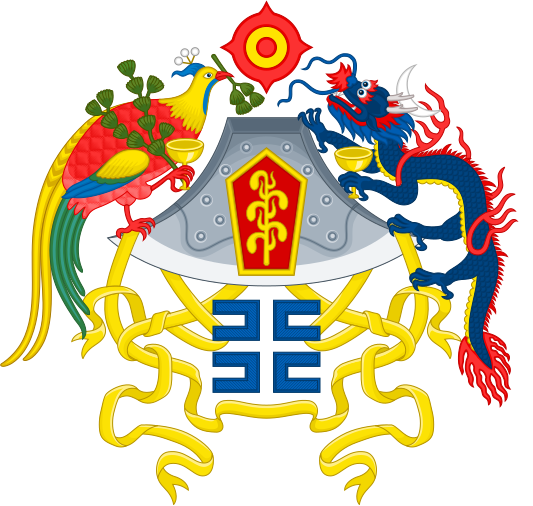
Main article: Twelve Symbols national emblem
The Empire of China during the Manchu-led Qing dynasty did not have an official state emblem, but the flag featured the azure dragon on a plain yellow field with a red sun of the three-legged crow in the upper left corner. It became the first national flag of China and is usually referred to as the Yellow Dragon Flag.
Following the end of Manchu rule, new national symbols were deemed necessary by the leaders to represent the changed circumstances. The renowned writers Lu Xun, Qian Daosun, and Xu Shoushang from the Ministry of Education were tasked with designing a new national emblem. It was presented on August 28, 1912, and was adopted as national emblem in February 1913. President-Emperor Yuan Shikai continued its use during his short imperial reign from 1915 to 1916. The emblem is based on the ancient symbols of the Twelve Ornaments. These are first mentioned as already ancient in the Book of Documents by Emperor Shun, who was one of the legendary Three Sovereigns and Five Emperors. Oral tradition holds that he lived sometime between 2294 and 2184 BC. According to the book, the emperor wished for the symbols to be used on official robes of the state.
Nationalist period

Main article: Blue Sky with a White Sun
The Northern Expedition led by Generallissimo Chiang Kai-shek and the Kuomintang party led to the overthrow of the fractious yet internationally recognized Beiyang government in 1928. This ushered in a one-party state under the Kuomintang known as the Nanjing decade. The state emblem was therefore replaced with the Kuomintang Blue Sky with a White Sun party symbol. The "Blue Sky, White Sun, and a Wholly Red Earth" flag has remained the flag of the Republic of China to this day. During this period, under the KMT's political tutelage, the Blue Sky with a White Sun Flag shared the same prominence as the ROC flag. A common wall display consisted of the KMT flag perched on the left and the ROC flag perched on the right, each tilted at an angle with a portrait of National Father Sun Yat-sen displayed in the center. After the promulgation of the Constitution of the Republic of China, the party flag was removed from such a display and the national flag was moved to the center.
Since the ROC government moved to Taiwan and especially in the years since the end of martial law the Kuomintang flag has lost some of its prominence. However, it is still frequently seen on KMT party buildings in political rallies and other meetings of KMT and the pan-blue coalition.
People's Republic of China

_logo.svg)
The first communist government in China known as the Chinese Soviet Republic had the emblem adopted in 1934. It consisted of a hammer and sickle on a globe, and the grain ears are placed under and on both sides of the earth. Above the earth and the five-pointed star is written the "Chinese Soviet Republic" on the top, and the "Workers of the world, unite!" written on the bottom.
On July 10, 1949, the government held a public competition for the design of the national emblem, however no satisfactory designs were selected. Therefore, on September 27, 1949, the First Plenary Session of Chinese People's Political Consultative Conference decided to invite designers for the proposals of the national emblem and two groups from two universities were selected in September 1949. Three proposals were selected for the first round discussion:
- The designers from China Central Academy of Fine Arts, Zhang Ding, Zhang Guangyu, Zhou Lingzhao and Zhong Ling, handed out their proposals with 5 variations on September 25, 1949. The symbolism of their first design was: The red star symbolizes Communism and the CCP. The cog and wheat/rice symbolizes unification of industrial workers and peasants. The rising earth with China in red symbolizes the socialist revolution in China and the world revolution ideal on Asian countries. 31 rays behind the earth symbolizes the 31 provincial administrative divisions at that time. The name of the People's Republic of China is written on the red ribbon below. The design was based on their design of the emblem of Charter of the Chinese People's Political Consultative Conference, and was influenced by Socialist heraldry of the Eastern Bloc.
- The designers from the Department of Architecture at Tsinghua University, Liang Sicheng, Lin Huiyin, Mo Zongjiang, Zhu Changzhong, Li Zongjin and Gao Zhuang, handed their proposal on October 30, 1949. According to their proposal, the design was a mixture of traditional Chinese culture and Maoist New Democratic Revolution ideals. The design imitated the style of mirrors in Han dynasty, symbolizing brightness. The disc was made of jade, a symbol of peace and unity. Decorative carvings on the disc was in Tang dynasty style. The stars from national flag and a cog were placed in the center of the disc, surrounded by wheats, symbolizing unity of working class and socialism. The red ribbon tied a smaller jade ring, symbolising the unification of Chinese people.
- The other proposal by Zhang Ding, Zhang Guangyu, Zhou Lingzhao, was a perspective depiction of Tian'anmen gate.
Emblem of China Draft CAFA 1949-9.jpg|Proposals of China Central Academy of Fine Arts, September 25, 1949 PRC_Emblem_Draft_Lin_Huiyin.jpg|Proposal of Tsinghua University, October 30, 1949

Members of the first Charter of the Chinese People's Political Consultative Conference committee discussed these three proposals on June 10, 1950. The result of the discussion was, the China Central Academy of Fine Arts proposal was too colourful to be regarded as trademarks, and proposal from Tsinghua University was regarded as bourgeois due to its use of traditional symbols. The committee suggested the groups include the Tian'anmen Gate, a symbol of Chinese revolution that served as the location of the May Fourth Movement and foundation ceremony of the People's Republic of China on October 1, 1949.
The two groups then worked on a second round of proposals. The second round proposals from Tsinghua University were based on standardized design of the Tian'anmen Gate on the emblem and red and yellow were chosen as the main colours.
Draft Zhangding.jpg|Proposal of China Central Academy of Fine Arts No.1 - June 15, 1950 Emblem of China Draft CAFA 1950-1.jpg|Proposal of China Central Academy of Fine Arts No.2 Drafted Emblem of China THU 2.jpg|Proposal of Tsinghua University No.1 Drafted Emblem of China THU 4.png|Proposal of Tsinghua University No.2 Drafted Emblem of China THU No.9.png|Proposal of Tsinghua University No.3 Drafted Emblem of China THU 3.png|Proposal of Tsinghua University
At the Chinese People's Political Consultative Conference committee meeting on June 15, proposals from Tsinghua University were chosen and the committee suggested "Combine the design of No.1 and No.3. with outer ring of No.1 and content of No.3".
Tsinghua University presented their new design and their proposal was selected and officially made the national emblem on 20 September 1950 by the Central People's Government. The selected design was further standardized and simplified by Gao Zhuang and was confirmed on August 18, 1950.
Emblem of China Draft THU 1950-6-17.jpg|Initial design. June 17, 1950 National Emblem of China 1950-6-17 Draft Sketch.png|Sketch of the initial design. June 20, 1950 National Emblem of China 1950-6-17 Draft Colorized.png|Initial design. June 20, 1950
Symbolism
The emblem is described as being "composed of patterns of the national flag": ...The red color of the flag symbolizes revolution and the yellow color of the stars the golden brilliant rays radiating from the vast red land. The design of four smaller stars surrounding a bigger one signifies the unity of the Chinese people under the leadership of the Communist Party of China (CPC).
—China Yearbook 2004 According to The Description of the National Emblem of the People's Republic of China (中华人民共和国国徽图案说明), these elements taken together symbolize the revolutionary struggles of the Chinese people since the May Fourth Movement and the coalition of the proletariat which succeeded in founding the People's Republic of China.
Construction
The Law of the People's Republic of China on the National Emblem sets the standards of the national emblem. National standard of China: GB 15093-2008 specifies the construction, material and color of the national emblem.
| Proportion | Construction | ||
|---|---|---|---|
| [[File:GB 15093-2008 Pic 2.jpg | 250px]] | [[File:GB 15093-2008 Pic 3.jpg | 250px]] |
Emblems of subdivisions
Before the Communist takeover of mainland China, the ROC had provinces design their own emblems. Only two emblems were used so far. On April 15, 1985, Taiyuan City officially announced its emblem, becoming the first city in the People's Republic of China to have a city emblem. Hong Kong and Macao each have their own emblem. The National People's Congress have passed the standardized use of the two special administrative regions' emblems. Under Chinese law since November 1997, only Hong Kong and Macau are allowed to have their own emblems and other localities that had them had to stop using theirs. This rule was ignored in 2011 when the city of Chengdu chose the Golden Sun Bird found under the city's Jinsha site as its emblem.
Cities
File:Sun and Immortal Bird Emblem in Jinsha.svg|Chengdu File:廣州市市徽 (1926-1949).svg|Guangzhou (1926–1949) File:Kunming Emblem.svg|Kunming (1922–1949)
Special administrative regions
File:Regional Emblem of Hong Kong.svg|Hong Kong File:Regional Emblem of Macau.svg|Macau
Historical emblems
File:Seal of Ming dynasty.svg|Imperial Seal of the Ming dynasty. File:Seal of Qing dynasty.svg|Imperial Seal of the Qing dynasty. File:Seal of the Taiping heavenly kingdom.svg|Taiping Heavenly Kingdom (1851–1864) File:Twelve Symbols national emblem of China.svg|National emblem of the Republic of China (1912–1927) and the Empire of China (1915–1916) File:National Emblem of the Republic of China.svg|Blue Sky with a White Sun emblem of the Republic of China (1928–present) and the Roundel of the Republic of China Air Force (1991–present) File:Roundel of the Republic of China (1927–1940) – Central Government.svg|Roundel of the Republic of China Air Force (1928–1991) File:Roundel of the Republic of China (1949–1991).svg|Roundel of the Republic of China Air Force (1928–1991), light version File:Emblem of Chinese Taipei for Olympic games.svg|Emblem of Chinese Taipei used during the Olympic Games (1981–present) File:Taiwanese passport seal.svg|Emblem of the Republic of China with encircling text as depicted on ROC passports (2021–present) File:National Emblem of the Chinese Soviet Republic.svg|Emblem of the Chinese Soviet Republic (1934–1937) File:Seal of the North Shanxi Autonomous Government.svg|North Shanxi Autonomous Government (1937–1939) File:Emblem of Mengjiang.svg|Mengjiang (1939–1945) File:Emblem of the Emperor of Manchukuo.svg|Imperial Seal of Manchukuo (1932–1945) File:Seal of the Shanghai International Settlement pre-WWI.svg|Shanghai International Settlement (pre WWI) File:Seal of the Shanghai International Settlement.svg|Shanghai International Settlement File:Emblem of the Republic of China-Nanjing 1940-1945.svg|Emblem of the National Reorganized Government of the Republic of China (1940–1945) File:Seal of the People’s Government of the People’s Republic of China.svg|Seal of the People's Government of the People's Republic of China (1949–1959) File:National Emblem of the People's Republic of China (2).svg|Emblem of the People's Republic of China (1950–present)
References
References
- Williams, C.A.S. (2001). "Chinese Symbolism and Art Motifs". [[Tuttle Publishing]].
- [https://archive.today/20160316204443/http://www.kongfz.cn/17944719/pic/ 国徽图案参考资料], Reference on proposals of national emblem, 1949.
- link. (2013-05-14 , 拟制国徽图案说明, Explanation of national emblem proposal)
- [https://web.archive.org/web/20090922221016/http://news.xinhuanet.com/collection/2009-09/18/content_12073990.htm 到底是谁设计了国徽,新华网]
- [http://www.bjd.com.cn/pwjc/bjrw/200608/t20060821_72269.htm 正投影 国徽设计中亮丽的一笔] {{webarchive. link. (2013-05-14)
- "国徽诞生记 清华大学建筑学院教授 秦佑国".
- [http://dangshi.people.com.cn/n/2012/0926/c85037-19121023-1.html 高庄:命运多舛的国徽浮雕定型设计者]
- [http://english.gov.cn/2005-08/16/content_23488.htm Description of the National Emblem from Chinese Government web portal.] {{webarchive. link. (2012-05-02)
- [http://english.gov.cn/2005-08/16/content_23394.htm National flag] {{webarchive. link. (2007-06-04)
- [[s:zh:中共中央办公厅、国务院办公厅关于禁止自行制作和使用地方旗、徽的通知. 中共中央办公厅、国务院办公厅关于禁止自行制作和使用地方旗、徽的通知]] (Chinese Communist Central Governmental Notice to Ban Making and Using Local Flags and Emblems)
- (2011-12-30). "Chengdu Unveils its New City Logo". news.ifeng.com.
- "Seal of the People's Government of the People's Republic of China".
This article was imported from Wikipedia and is available under the Creative Commons Attribution-ShareAlike 4.0 License. Content has been adapted to SurfDoc format. Original contributors can be found on the article history page.
Ask Mako anything about National emblem of China — get instant answers, deeper analysis, and related topics.
Research with MakoFree with your Surf account
Create a free account to save articles, ask Mako questions, and organize your research.
Sign up freeThis content may have been generated or modified by AI. CloudSurf Software LLC is not responsible for the accuracy, completeness, or reliability of AI-generated content. Always verify important information from primary sources.
Report