From Surf Wiki (app.surf) — the open knowledge base
National Bolshevik Party
Banned Political party in Russia

Banned Political party in Russia
| Field | Value | |||||||
|---|---|---|---|---|---|---|---|---|
| name | National Bolshevik Party | |||||||
| native_name | Национал-большевистская партия | |||||||
| flag | [[File:National Bolshevik Party flag.svg | 200px | border]] | |||||
| abbreviation | NBP, Nazbols | |||||||
| colorcode | ||||||||
| leader | Eduard Limonov | |||||||
| founders | {{ublist | class=nowrap | ||||||
| Eduard Limonov<ref>{{Cite web | url | http://www.bbc.co.uk/blogs/adamcurtis/posts/the_years_of_stagnation_and_th | title = BBC – Adam Curtis – THE YEARS OF STAGNATION AND THE POODLES OF POWER | date = 18 January 2012 | access-date = 4 August 2014}} | |||
| Yegor Letov<ref name | "auto" | |||||||
| Aleksandr Dugin<ref>{{cite web | date | 21 September 2008 | title=Нацбол.ру - Нацбол должен знать - Декларация о создании НБП | url=http://www.nazbol.ru:80/rubr28/index0/249.html | url-status=dead | archive-url=https://web.archive.org/web/20080921193029/http://www.nazbol.ru/rubr28/index0/249.html | archive-date=21 September 2008 | access-date=2 September 2018}} |
| founded | ||||||||
| legalised | ||||||||
| banned | ||||||||
| successor | The Other Russia | |||||||
| National Bolshevik Front | ||||||||
| headquarters | Bunker NBP, st. Maria Ulyanova, 17, bldg. 1, Moscow | |||||||
| newspaper | Limonka | |||||||
| membership | 56,500+ (March 2007 ) | |||||||
| ideology | National Bolshevism | |||||||
| position | Syncretic | |||||||
| affiliation1_title | Coalition | |||||||
| affiliation1 | National Salvation Front | |||||||
| The Other Russia | ||||||||
| colours | Red White Black | |||||||
| anthem | "Гимн НБП" | |||||||
| () | ||||||||
| website | eng.nbp-info.ru | |||||||
| footnotes | ||||||||
| country | Russia |
| Eduard Limonov | Yegor Letov | Aleksandr Dugin National Bolshevik Front The Other Russia () The National Bolshevik Party (, NBP) operated from 1993 to 2007 as a Russian political party with a political program of National Bolshevism. The NBP became a prominent member of The Other Russia coalition of opposition parties. Its members were known as Nazbols ().
There have been smaller NBP groups in other countries. Its official publication, the newspaper Limonka, derived its name from the party leader's surname and from the idiomatic Russian word for a grenade. The main editor of Limonka was for many years, Aleksey Volynets. Russian courts banned the organization and it never officially registered as a political party. In 2010, its leader Eduard Limonov founded a new political party, called The Other Russia of E. V. Limonov.
Ideology
Party platform
The NBP believes in the National Bolshevik ideas that arose during the Russian Civil War, such as those from Nikolai Ustryalov, who came to believe that Bolshevism could be modified to serve nationalistic purposes. His followers, the Smenovekhovtsy, who then came to regard themselves as National Bolsheviks, borrowed the term from Ernst Niekisch, who was a German politician initially associated with left-wing politics and later the National Bolshevik ideology.
The NBP has denied any links to fascism, stating that all forms of antisemitism, xenophobia, and racism were against the party's principles. The NBP has historically defended Stalinism, although later on the party said it did not wish to re-create that system. The party is described as a mixture of far-left and far-right ideology, including among its members Sovietism' nostalgics as well as skinheads, with the hammer and sickle (which replace the swastika) in a white circle on a red background as party's flag.
On 29 November 2004, participants of the general congress of the NBP adopted a new party program. According to the program, "the main goal of the National Bolshevik Party is to change Russia into a modern, powerful state, respected by other countries and peoples and beloved by its own citizens" by ensuring the free development of civil society, the independence of the media, and social justice. The NBP was highly critical of Vladimir Putin's government and argued that state institutions, such as the bureaucracy, the police, and the courts, were corrupt and authoritarian.
Counterculture
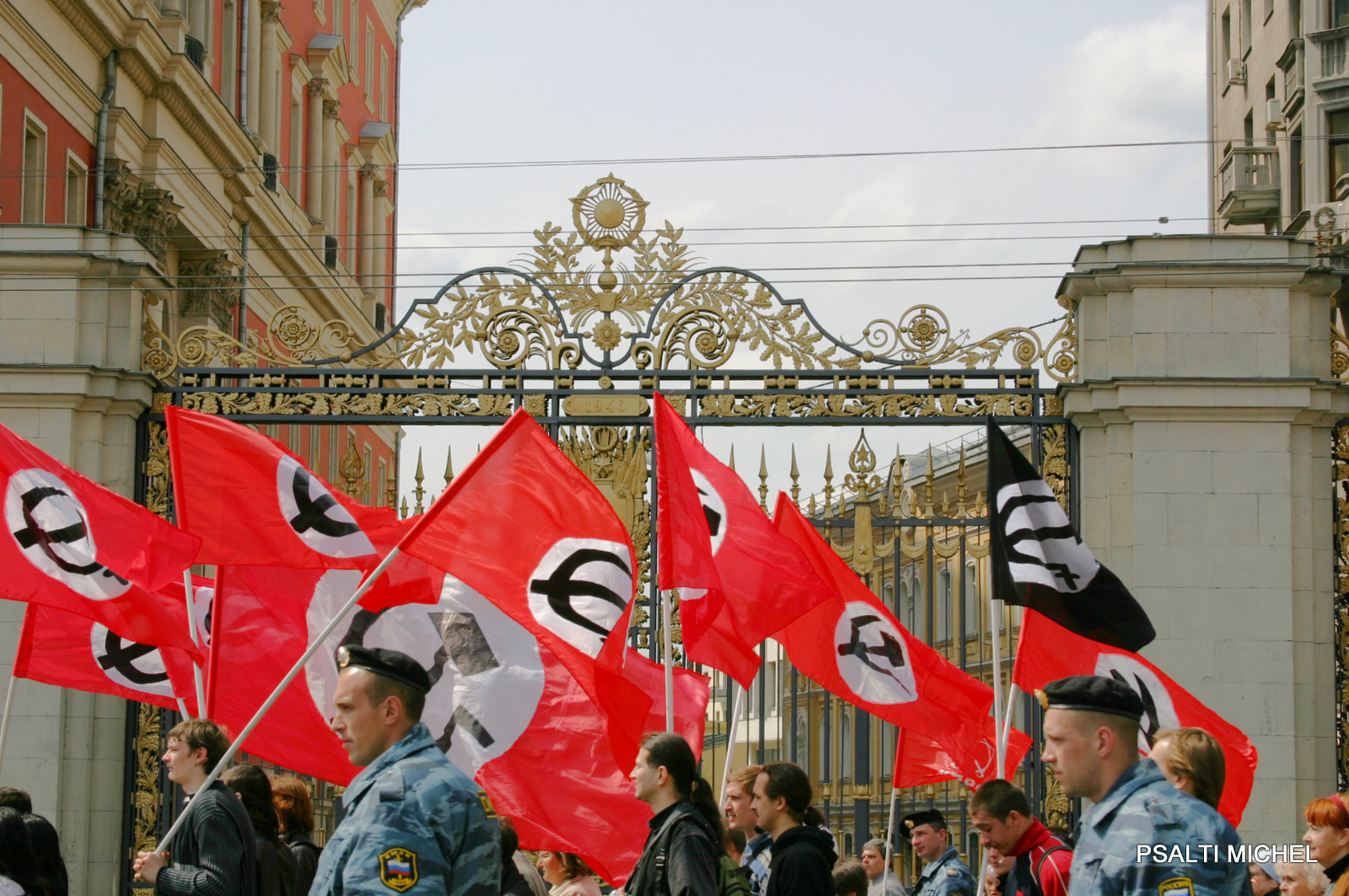
Since its formation, the National Bolshevik Party had relationships with Russian counterculture. National Bolsheviks often used shock aesthetics from the punk subculture in their propaganda. NBP attracted a significant number of artists, punk musicians and rock bands.
Criticism
Some Western critics commented on its heavy use of totalitarian and fascist symbols and what they called its "national-patriotic demagoguery", and academics have described the group as neo-fascist. In the Russian media, the National Bolshevik Party was usually referred to as a far-left youth movement; however, some critics (including ex-members) allege that the NBP is an organisation dedicated to carry out a colour revolution in Russia.
Party symbols
The symbols of the National Bolshevik Party are a combination of communist, National Socialist, and Imperial Russian symbols; the party nonetheless denied any link to fascism and National Socialism.
Motto
The popular motto, "Russia is Everything, the Rest is Nothing!" («Россия — всё, остальное — ничто!»), served as a powerful encapsulation of the movement's ultranationalist worldview. This slogan expressed the party's absolute prioritization of Russian identity, culture, and sovereignty over all foreign influences or globalist ideals. It reflected the NBP's ideological synthesis of nationalism and revolutionary socialism, framing Russia as a sacred entity whose interests were paramount, while dismissing the outside world as irrelevant or hostile.
Greeting
The Russian National Bolsheviks adopted the provocative greeting "Yes, Death!" («Да, смерть!») as a symbolic rejection of bourgeois values and a dramatic expression of revolutionary zeal. This slogan encapsulated the party's militant ethos and its embrace of political martyrdom and struggle, reflecting its fusion of radical leftist and ultranationalist ideologies. As Stephen Shenfield notes in Russian Fascism: Traditions, Tendencies and Movements, the greeting served as a stark emblem of the NBP's nihilistic defiance and ideological extremism.
History
Origins (1993–1998)

In 1992, Eduard Limonov founded the National Bolshevik Front (NBF) as an amalgamation of six minor groups. Aleksandr Dugin was among the earliest members and was instrumental in convincing Limonov to enter politics. The party first attracted attention in 1992 when two members were arrested for possessing grenades. The incident gave the NBP publicity for a boycott campaign they were organizing against Western goods. The NBF joined forces with the National Salvation Front, which was a broad coalition of Russian communists and nationalists.
The FNS was one of the leading groups involved in the 1993 Russian constitutional crisis, and Limonov participated in the clashes near the White House in Moscow on the side of the Anti-Yeltsin opposition. When others within the coalition began to speak out against the NBF, it withdrew from the alliance. On 1 May 1993, Limonov and Dugin signed a declaration of founding the NBP. On 28 November 1994, Limonov founded the newspaper Limonka, the official organ of the NBP.
In 1998, Dugin left the NBP as a result of a conflict with other members of the party. This led to the party moving further left in Russia's political spectrum, and led to members of the party denouncing Dugin and his group as fascists. Dugin later established the Eurasia Party, that endorses a significantly more radical nationalist and socially conservative view of National Bolshevism.
Arrest of Eduard Limonov (2001–2003)
Limonov and some National Bolsheviks were jailed in April 2001 on charges of terrorism, the forced overthrow of the constitutional order, and the illegal purchase of weapons. Based on an article published in Limonka under Limonov's byline, the government accused Limonov of planning to start an armed insurgency in Kazakhstan.
After the arrest of the leader, members of the party started activities (including direct action stunts) against Putin's government. In 2002, members of the NBP participated in a common demonstration of far-left forces in a Moscow a demonstration called Anticapitalism-2002. National Bolsheviks clashed with riot police. In 2003, Limonov was released from Lefortovo Prison.
In opposition to the government (2004–2007)

Since 2004, the NBP has formed alliances with other opposition forces, both far-left and right-wing. In 2004, Limonov signed the declaration titled "Russia without Putin." In August 2006, an anti-Limonovist faction of the NBP that was right-wing formed the National Bolshevik Front.
The NBP became a prominent member of The Other Russia coalition of opposition parties. In 2007, the NBP members took part in a Dissenters' March and other subsequent demonstrations against the government.
Outlawed and aftermath (2007–2010)

The NBP was banned by a Russian lower court in June 2005; the Russian Supreme Court overturned that ban on 16 August 2005. In November 2005, the Russian Supreme Court upheld a ban on the party on the grounds that the NBP called itself a political party without being registered as such. On 7 August 2007, the Russian Supreme Court confirmed the decision of the Moscow City Court of 19 April to ban the party as an extremist organization.
In 2009, NBP members took part in Strategy-31, a series of civic protests in support of the right to peaceful assembly. In July 2010, the National Bolsheviks founded a new political party, The Other Russia of E. V. Limonov.
Direct actions
The NBP often used non-violent direct-action stunts, mostly against prominent political figures.
Notable direct actions
On 24 August 1999, the NBP occupied a tower of the Club of Military Seamen in Sevastopol on Ukraine's Independence Day. Some of the operatives were sentenced to prison. During the Prince Charles' tour of the Baltic states in 2001, a member of the Latvian branch of the NBP hit Charles' face with a flower in an act of protest against the war in Afghanistan. During the 2002 Prague summit, National Bolsheviks threw tomatoes at George Robertson to protest against the extension of NATO and American imperialism.
On 3 March 2004, National Bolsheviks occupied the United Russia headquarters in Moscow and protested against government policy. On 22 June 2004, National Bolsheviks occupied Germany's Trade Embassy in Moscow on the anniversary of the German invasion of the Soviet Union. They hung a banner with an inscription "Never forget! Never forgive!" On 2 August 2004, a group of National Bolsheviks occupied the office of the Health and Social Development Ministry building in Moscow to protest against the social benefits reform. Police arrested most of the participants, and on 12 December 2004, seven National Bolsheviks were each sentenced to five years in prison. On 14 December 2004, NBP members occupied the presidential-administration visitors' room to protest against government policy. Police arrested thirty-nine National Bolsheviks, with many of them being sentenced to prison.
On 25 September 2006, National Bolsheviks occupied the Ministries of Finances building in Moscow to protest against liberal economic policy.
International groups
The National Bolshevik Party founded branches across the post-Soviet states. Relatively strong branches of the party existed in Latvia, Ukraine, and Belarus. Several small groups often made up of Russian immigrants that are named National Bolshevik Party have existed in countries across Europe and North America. Most of them did not have official registration.
Latvia
Latvia's NBP has had members hold office in Riga, and has executed notable publicity stunts, but it remains largely marginal there. The Latvian branch has been led by Vladimir Linderman and Benes Ayo. In 2003, Linderman was accused of storing explosives and of calling for the overthrow of the political system. He left Latvia and moved to Russia. In 2005, during the visit of George W. Bush in Latvia, local national Bolsheviks and the Vanguard of Red Youth organized meetings "against American imperialism". Police broke up a demonstration and arrested its participants. The Latvian NBP was also active in anti-capitalist demonstrations and in anti-Nazi blockades during Remembrance Day of the Latvian Legionnaires.
Ukraine
Largely based in Eastern Ukraine, the NBP initially joined forces with another small parties and signed a "Declaration of the Kiev Council of Slav Radical Nationalists" together with Ukrainian nationalists. Later, Ukrainian national Bolsheviks were active in demonstrations against Ukrainian nationalists on the anniversary of the founding of the Ukrainian Insurgent Army. National Bolsheviks also organized actions against the rapprochement of Ukraine–NATO relations. During the Orange Revolution, the Ukrainian NBP decided to not support any side. National Bolsheviks also formed armed troop interbrigades and participated in the war in Donbas.
European Court of Human Rights decision
In September 2021, the European Court of Human Rights found that there was a violation of Article 11 of the European Convention on Human Rights on account of the dissolution of the NBP association in 2004 and on account of the refusal to register the NBP political party, and awarded €10,000 jointly to the children of Limonov and four of his followers.
Notable members
Current
Until banning of the NBP in 2007
Media depictions
Films
- Sud nad prizrakom (2002)
- Saratov (2002)
- Fuck off Mr. Bond! (2002)
- Da, smert (2004)
- Zuby drakona (2005)
- Les Enfants terribles de Vladimir Vladimirovitch Poutine (2006)
- The Revolution That Wasn't (2008)
- Utopie Russe (2014)
- Can't Get You Out of My Head (TV series) (2021)
Books
By Eduard Limonov
- Anatomy of a Hero (1997)
- My Political Biography (2002)
- Russian Psycho (2003)
- The Other Russia (2003)
By other authors
- Ultranormalnost (2005), a novel by Natan Dubovitskiy
- Generation of Limonka (2005), a collection of short stories by multiple young Russian authors
- The Gospel of the Extremist (2005), a novel by Roman Konoplev
- Sankya (2006), a novel by Zakhar Prilepin
- The Way of the Hongweibin (2006), a novel by Dmitri Zhvaniya
- A Russian Diary: A Journalist's Final Account of Life, Corruption, and Death in Putin's Russia a book by Anna Politkovskaya
- Truth of the Trenches of the Chechen War (2007), a collection of articles by multiple Russian authors
- 12 Who Don't Agree (2009), a non-fiction book by Valery Panyushkin
- Girls of the Party (2011), a photo-album by Sergei Belyak
- Limonka to Prison (2012), a novel by NBP political prisoners
- Limonov (2011), a biographical novel by Emmanuel Carrère
- Religion of the Furious (2013), a novel by Ekaterina Rysk
Other
- Orda, a comic book by Igor Baranko
Notes
References
Bibliography
- The Beast Reawakens (1997) by Martin A. Lee
References
- (18 January 2012). "BBC – Adam Curtis – THE YEARS OF STAGNATION AND THE POODLES OF POWER".
- "Punk and national-bolshevism".
- (21 September 2008). "Нацбол.ру - Нацбол должен знать - Декларация о создании НБП".
- (15 January 2006). "Верховный суд России отменил запрет Национал-большевистской партии".
- (12 July 2006). "Лимонов использует НБП незаконно. И вообще он не Лимонов".
- "Другая Россия – информация, все новости".
- Borenstein, Eliot. (2004). "Review of National Bolshevism: Stalinist Mass Culture and the Formation of Modern Russian National Identity, 1931-1956". The Slavic and East European Journal.
- (21 October 2015). "Pussy Riot's Musical Precursors? The National Bolshevik Party Bands, 1994–2007". Popular Music and Society.
- Yasmann, Victor. (29 April 2005). "Russia: National Bolsheviks, The Party Of 'Direct Action'".
- (15 December 2015). "Дмитрий Шостакович - Гимн НБП".
- "Пой, партия, пой!".
- Stolyarova, Galina (6 March 2007) [http://www.sptimesrussia.com/index.php?action_id=2&story_id=20875 Thousands Take to City Streets for Protest]. Sptimesrussia.com. Retrieved on 23 February 2014.
- (2014). "Russian Nationalism, Foreign Policy and Identity Debates in Putin's Russia: New Ideological Patterns after the Orange Revolution". [[Columbia University Press]].
- [http://www.ng.ru/politics/2010-07-12/2_limonov.html Лимонов готов стать гламурным политиком]. Ng.ru (12 July 2010). Retrieved on 23 February 2014.
- [https://web.archive.org/web/20090515120326/http://www.nazbol.ru/rubr28/index0/253.html "National Bolshevik Party – FAQ"]. Retrieved 23 February 2014.
- (12 July 2013). "Édouard Limonov, l'imprécateur des lettres russes".
- "Программа Национал-Большевистской Партии".
- [https://web.archive.org/web/20071017132229/http://nbp-info.ru/cat107/index.html "Program of the National Bolshevik Party"]. Retrieved 23 February 2014.
- [http://www.socionauki.ru/journal/articles/126841/ Феномен национал-большевистского движения: идеологический, социальный и культурный аспекты]. socionauki.ru
- "Making post-Soviet counterpublics: the aesthetics of Limonka and the National-Bolshevik Party | Request PDF".
- (23 October 2013). "Punk and national-bolshevism « NBP-INFO".
- (7 August 2016). "Pussy Riot's Musical Precursors? The National Bolshevik Party Bands, 1994–2007". Popular Music and Society.
- (18 August 2013). "Russian punks: The ideology, music and lifestyle".
- (7 December 2010). "The National-Bolshevik Party and Arctogaia: two neo-fascist groupuscules in the post-Soviet political space". [[Patterns of Prejudice]].
- "russ.ru".
- "Национал-большевизм: конец темы".
- "Александр Дугин: НБП не имеет права на существование, её лидер – вампир - Правая.ru - Радикальная ортодоксия".
- (2016). "Russian Fascism: Traditions, Tendencies and Movements". Routledge.
- Lee, p. 314
- Lee, p. 320
- Lee, p. 321
- "Эдуард Лимонов, Писатель, политик".
- Lee, pp. 328–9
- (21 September 2008). "Нацбол.ру - Нацбол должен знать - Декларация о создании НБП".
- "ВОС".
- (2017). "Why fascists took over the Reichstag but have not captured the Kremlin: a comparison of Weimar Germany and post-Soviet Russia". Nationalities Papers.
- "The Second Russia".
- (14 April 2001). "Famous writer and National Bolshevic leader Eduard Limonov really arrested".
- (8 April 2008). "Russia: National Bolsheviks, The Party Of 'Direct Action'". Radio Free Europe/Radio Liberty.
- (22 December 2008). "НБП-ИНФО :: ФОТО :: Антикапитализм-2002".
- Олег Бородин. (14 September 2013). "Антикап 2002 Площадь Маяковского 480".
- [https://www.voanews.com/a/a-13-a-2003-06-30-30-ultranationalist-66320042/543382.html "Russian Writer is Released from Prison"]. Retrieved 30 June 2006.
- (29 October 2005). "Declaration Of Public Movement "Russia Without Putin"".
- [http://majorityrights.com/index.php/weblog/comments/an_interview_with_the_leader_of_the_nbf_roman_golovkin/ "An Interview with the Leader of the NBF (Roman Golovkin)"] {{Webarchive. link. (14 January 2010 . 6 September 2007. Retrieved 23 February 2014.)
- [http://www.rferl.org/featuresarticle/2007/03/e6afa38b-be72-4ce0-91a4-c32374c14424.html "Police Clash With Anti-Kremlin Protesters"]. [[Radio Free Europe]]/[[Radio Liberty]]. 3 March 2007. Retrieved 23 February 2014.
- "Верховный суд РФ подтвердил законность запрета НБП".
- "Перечень некоммерческих организаций, в отношении которых судом принято вступившее в законную силу решение о ликвидации или запрете деятельности по основаниям, предусмотренным ФЗ "О противодействии экстремистской деятельности" - Минюст России".
- [http://grani.ru/Politics/Russia/activism/strategy31/m.183186.html Питерские нацболы арестованы за участие в акции у Гостиного двора]. Grani.ru. 1 November 2010.
- [http://www.rosbalt.ru/piter/2010/01/27/707552.html Нацболы через суд требуют разрешить акцию "Стратегия-31"]. Rosbalt.ru. 27 January 2010.
- "От нацболов к Павленскому. Краткая хроника русского акционизма".
- "1999. Захват Башни моряков. Севастополь, НБП".
- (18 January 2007). "НБП-ИНФО :: ФОТО :: Захват башни клуба моряков в Севастополе".
- "Hugs and handshakes with public keep Meghan Markle's bodyguards on their toes".
- (2 September 2018). "Latvia flower-attacker spared jail".
- AP Archive. (30 July 2015). "WRAP Tomato incident, Robertson, Ukraine delegates, family photo".
- "Национал-большевики захватили общественную приемную".
- AP Archive. (21 July 2015). "Protest outside German offices on war anniversary".
- (2 August 2004). "Национал-большевики захватили Минздрав".
- "Газета.Ru - За захват здания Минздрава лимоновцы получили по 5 лет тюрьмы".
- "Условный захват президентской приемной".
- ""Побои" за Минфин".
- "Грани.Ру: За захват Минфина нацболов обвинили в хулиганстве".
- AP Archive. (24 July 2015). "Leftist protestors chain themselves to Finance Ministry in anti-Putin protest".
- [http://eng.nbp-info.ru/409.html Interview to the "Revolt" French magazine]. eng.nbp-info.ru. 15 February 2004. {{webarchive. link. (1 May 2007)
- Shenfield, Stephen. (2001). "Russian Fascism: Traditions, Tendencies, Movements". M.E. Sharpe.
- Muizneiks, N. (2005) "Latvia" in [[Cas Mudde. Mudde, Cas]] ''Racist Extremism in Central and Eastern Europe'', Routledge, {{ISBN. 0415355931 pp. 101–128
- [http://www.d-pils.lv/view_article.php?article=20548 Айо Бенес — магистр биологии и профессор НБП]. D-pils.lv (23 March 2005). Retrieved on 23 February 2014.
- [http://limonka.nbp-info.ru/293_article_1141140237.html Лимонка: Бенес Айо] {{webarchive. link. (6 July 2012)
- [http://www.d-pils.lv/news/49658# «Красный магистр» Бенес Айо: «Мы готовим такое!..»]. D-pils.lv (8 November 2005). Retrieved on 23 February 2014.
- [http://rus.tvnet.lv/novosti/politika/17774-bjenjes_ayo_kogda_ja_doshjel_do_45_kg_mjenja_prishlos_vipustit Бенес Айо: Когда я дошел до 45 кг, меня пришлось выпустить] {{Webarchive. link. (1 March 2014 . Rus.tvnet.lv. Retrieved on 23 February 2014.)
- [https://web.archive.org/web/20120706195955/http://nbp-info.ru/new/photo/070505_bush/index.html Рига: Акция против Джорджа Буша]. nbp-info.ru. 7 May 2005
- "Estonia sends "National Bolshevik" back to Finland".
- (21 July 2015). "Anti-Bush protest broken up by police".
- "Акция против Джорджа Буша и задержание Рига, 7 мая 2005".
- [https://web.archive.org/web/20130309004411/http://nbp-info.ru/new/photo/160306_riga/ День сопротивления в Риге. 16 марта 2006]. nbp-info.ru
- [https://web.archive.org/web/20130309004411/http://nbp-info.ru/new/photo/160305_riga/index.html Рига: Акция протеста против шествия нацистов 16 марта 2005]. nbp-info.ru
- [http://www.axt.org.uk/antisem/archive/archive1/ukraine/ukraine.htm Ukraine] {{webarchive. link. (4 December 2007 . Axt.org.uk. Retrieved on 23 February 2014.)
- link. (25 April 2011 . Nbp.kharkov.ua. Retrieved on 23 February 2014.)
- link. (27 January 2010 . Nbp.kharkov.ua. Retrieved on 23 February 2014.)
- [http://www.novorosinform.org/news/id/14371 "Нацболы отбили атаку карателей в ЛНР"]. {{webarchive. link. (13 November 2014.)
- (7 February 2018). "Нацболы отбили атаку карателей".
- "HUDOC - European Court of Human Rights".
- Franz Nicolay. (2016). "The Humorless Ladies of Border Control: Touring the Punk Underground from Belgrade to Ulaanbaatar". The New Press.
- Жвания, Дмитрий. (2012-07-09). "Сергей Курёхин: "Национал-большевизм — это свежий ветер и подвижничество"". Sensus Novus.
- [http://www.ultraculture.ru/217/ Поколение Лимонки] {{webarchive. link. (25 October 2014 . ultraculture.ru)
- [http://ru.delfi.lt/archive/okopnaya-pravda-chechenskoj-vojny.d?id=16975435 Окопная правда Чеченской войны]. ru.delfi.lt
- "Захар Прилепин представляет: Лимонка в тюрьму".
- "Лимонка в тюрьму worldbookreview.ru".
This article was imported from Wikipedia and is available under the Creative Commons Attribution-ShareAlike 4.0 License. Content has been adapted to SurfDoc format. Original contributors can be found on the article history page.
Ask Mako anything about National Bolshevik Party — get instant answers, deeper analysis, and related topics.
Research with MakoFree with your Surf account
Create a free account to save articles, ask Mako questions, and organize your research.
Sign up freeThis content may have been generated or modified by AI. CloudSurf Software LLC is not responsible for the accuracy, completeness, or reliability of AI-generated content. Always verify important information from primary sources.
Report