From Surf Wiki (app.surf) — the open knowledge base
Nasal bridge
Bony part of the nose, overlying the nasal bones
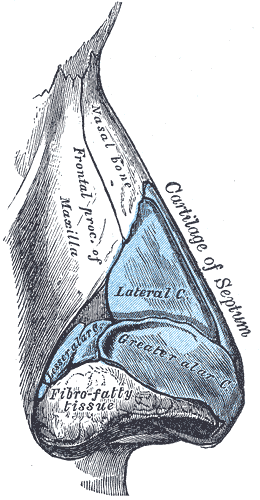
Bony part of the nose, overlying the nasal bones

The nasal bridge is the upper part of the nose, where the nasal bones and surrounding soft tissues provide structural support. While commonly discussed in human anatomy, nasal bridges exist in various forms across many vertebrates, particularly mammals. The shape, size, and function of the nasal bridge are influenced by evolutionary adaptations, playing a key role in respiration, sense of smell, and thermoregulation.
Anatomy
Humans
In humans, the nasal bridge is the elevated region of the nose between the eyes. It is primarily formed by the two small, oblong nasal bones, which meet at the midline to form the internasal suture. The nasal bridge extends from the nasal root, where the nose meets the forehead, to the lower edge of the nasal bones. Laterally, it reaches the inner canthi, the medial corners of the eyes, creating a saddle-shaped contour across the upper nose.
The height and shape of the nasal bridge vary among individuals and populations, reflecting genetic diversity and environmental adaptations. A high nasal bridge, often associated with a proportionally elongated nasal passage, is observed with greater frequency in populations indigenous to cold climates. This morphology is hypothesized to enhance the conditioning of inhaled air through increased surface area for heat and moisture exchange, which mitigates the physiological stress of frigid, desiccating atmospheric conditions. By contrast, a lower nasal bridge is more prevalent in populations originating from warm, humid environments, where airflow efficiency may be prioritized. However, this morphology is a polygenic trait shaped by complex genetic, developmental, and environmental factors, leading to substantial variation within and between populations.
The procerus muscle, a small pyramidal muscle in the glabella, creates horizontal wrinkles on the nasal bridge. It is involved in facial expressions such as frowning and those associated with attentional control, and it indirectly helps shield the eyes from bright light. Because it contributes to wrinkle formation, it is often targeted in non-surgical facial rejuvenation treatments, such as botulinum toxin injections.
Animals
The nasal bridge, or its analogies, varies widely across animal species. In canines, the nasal bridge is typically elongated, supporting extensive nasal passages, though brachycephalic breeds exhibit a notably shortened structure due to selective breeding. In birds, the nasal bones are often fused with the skull.
Association with epicanthic folds
Low-rooted nasal bridges are closely associated with epicanthic folds. A lower nasal bridge is more likely to cause an epicanthic fold, and vice versa.
Dysmorphology
A lower or higher than average nasal bridge in humans can be a sign of various genetic disorders, such as fetal alcohol syndrome. A flat nasal bridge can be a sign of Down syndrome (Trisomy 21), Fragile X syndrome, 48,XXXY variant Klinefelter syndrome, or Bartarlla-Scott syndrome. A broad nasal bridge can be a sign of Snijders Blok–Campeau syndrome.
An appearance of a widened nasal bridge can be seen with dystopia canthorum, which is a lateral displacement of the inner canthi of the eyes. Dystopia canthorum is associated with Waardenburg syndrome.
References
References
- "Anatomy of the Nose". [[National Human Genome Research Institute]].
- (March 2017). "Wnt/Tcf1 pathway restricts embryonic stem cell cycle through activation of the Ink4/Arf locus". PLOS Genetics.
- (August 2011). "Climate-related variation of the human nasal cavity". American Journal of Physical Anthropology.
- Hopkins, Claire. (2016). "Gray's Anatomy: The Anatomical Basis of Clinical Practice". [[Elsevier]].
- (June 2010). "The fluid dynamics of canine olfaction: unique nasal airflow patterns as an explanation of macrosmia". Journal of the Royal Society, Interface.
- (2016). "Clinical Anatomy and Physiology for Veterinary Technicians". [[Elsevier]].
- (April 2020). "Birds have peramorphic skulls, too: anatomical network analyses reveal oppositional heterochronies in avian skull evolution". Communications Biology.
- (May 2017). "Functional and evolutionary consequences of cranial fenestration in birds". Evolution; International Journal of Organic Evolution.
- (1989). "Growing Young". McGraw Hill.
- "Klinefelter Syndrome Clinical Presentation".
- (October 2020). "A second cohort of CHD3 patients expands the molecular mechanisms known to cause Snijders Blok-Campeau syndrome". European Journal of Human Genetics.
- (March 17, 2004). "Genetic Hearing Loss". UTMB, Dept. of Otolaryngology..
- (2006). "Waardenburg syndrome". Indian Journal of Dermatology, Venereology and Leprology.
This article was imported from Wikipedia and is available under the Creative Commons Attribution-ShareAlike 4.0 License. Content has been adapted to SurfDoc format. Original contributors can be found on the article history page.
Ask Mako anything about Nasal bridge — get instant answers, deeper analysis, and related topics.
Research with MakoFree with your Surf account
Create a free account to save articles, ask Mako questions, and organize your research.
Sign up freeThis content may have been generated or modified by AI. CloudSurf Software LLC is not responsible for the accuracy, completeness, or reliability of AI-generated content. Always verify important information from primary sources.
Report