From Surf Wiki (app.surf) — the open knowledge base
Narco-submarine
Submersible used by drug smugglers

Submersible used by drug smugglers
A narco-submarine (also called a drug sub or narco-sub) is a type of custom ocean-going, self-propelled, semi-submersible or fully submersible vessel built by (or for) drug smugglers.
Newer semi-submersibles are almost fully submersible in order to reduce the likelihood of detection by visual, radar, sonar, or infrared systems. Some contemporary narco-subs are capable of crossing the Atlantic Ocean.{{cite journal |url=https://www.yahoo.com/news/why-seas-suddenly-swimming-drug-223400474.html |title=Why Our Seas Are Suddenly Swimming With Drug-Running Narcosubs
History
During the Prohibition in the United States, bootleggers used low-profile riverboats to evade authorities.
In the 1980s, go-fast boats were the smuggling vessel of choice in many parts of the world. Go-fast boats became more vulnerable to radar detection as radar technology improved, leading to the development of semi-submersibles.
In 1988, an uncrewed 21 ft submarine was found off Boca Raton, Florida. It was designed to be towed by a boat and submerged by remote control. The sub was empty, but officials and authorities believe it was used for smuggling after it was realized the hatch could be opened only from the outside.
2000s
In 2006 a "submarine" was seized 166 km southwest of Costa Rica. The U.S. Coast Guard dubbed it Bigfoot because they heard rumors of their existence, but had never seen any prior to this find. In 2006, the U.S. detected three vessels in total, and they estimated between twenty-five and forty semi-subs departed from South America in 2007.
In 2006, a 10 metre sub was discovered on the north coast of Spain. While its use is unconfirmed, it is speculated to have been built by, or for, narco-traffickers.
In March 2006, according to a press release, the Calabrian criminal organization 'Ndrangheta ordered a shipment of nine tons of cocaine to be transported by a narco-submarine from Colombia to Italy, but according to a countering press release, the vessel was discovered by Colombian and Italian police during construction.

In 2009, the U.S. detected "as many as sixty" submarine related events, and calculated they were moving as much as a ton of cocaine daily.{{citation | url= http://www.justf.org/files/primarydocs/Testimony-Michel.pdf | access-date= 2012-06-20 | url-status= dead | archive-url= https://web.archive.org/web/20131102075750/http://www.justf.org/files/primarydocs/Testimony-Michel.pdf | archive-date= November 2, 2013
2010s
After the November 5, 2010 arrest of Harold Mauricio Poveda, a key Mexican–Colombian link, enhanced interrogation revealed that the FARC (Revolutionary Armed Forces of Colombia) were behind the construction of submarines and were collaborating with the Sinaloa Cartel to fund their activities.
In 2012, United States Coast Guard officials expressed concerns such vessels could potentially be used for terrorism.
In 2015, the largest recorded seizure was after a cargo of 7.7 t was seized on a semi-submersible by .
In 2016, the U.S. Coast Guard seized a semi-submersible in international waters about 300 miles west of Panama, carrying about 6 tons of cocaine with a street value of about $200 million to U.S. customers.
In 2017, the U.S. Coast Guard detained a semi-submersible off the coast of Texas carrying 3800 lb of cocaine, and on 13 November the US Coast Guard located and seized another one off the coast of Panama.

In 2019, Spanish authorities apprehended a 20 m semi-submersible off Galicia, containing 3 MT of cocaine, in the first known incident of a narco-submarine crossing the Atlantic Ocean.
A narco-submarine was captured by the Peruvian Navy on 8 December 2019 carrying over 2 MT of cocaine off of the coast of the Department of Piura.
2020s
According to a press-release, on November 5, 2020, a submarine was seized in Colombia. A further interception was made in October 2021 by the Ecuadorian naval training ship Guayas in the Pacific Ocean.
The drug trafficker Laureano Oubiña affirmed the existence of a marine cemetery of narco-submarines near the Canary Islands (Spain).
A 22 m long semi-submersible made of vinyl carbon fiber, christened by its builders Poseidón was found sunk without cargo by the Guardia Civil in the Ría de Arousa in March 2023. The vessel had a central hold with a load capacity of five tons, a forward ballast tank and a diesel engine at stern.
In 2024, the Colombian Navy captured a semi-submersible carrying 5 tonnes of cocaine 1,200 miles southwest of Clipperton Island in the Eastern Pacific in a 62 country operation. Having been captured over 3,000 miles from the Colombian coast, the incident has been cited as proof that drug cartels are now willing to use narco-submersibles for direct, long-distance drug smuggling to Australia and New Zealand via a new route exceeding 4,000 miles rather than conventionally hiding smaller amounts of narcotics in commercial shipping.
Over the next year, at least three narco-submarines were discovered in the Solomon Islands alongside another in Tonga after being abandoned by their operators; which has generated concern as the current set of local laws, lack of coast guard coordination, and inexperience within national law enforcement agencies have left Oceanian island nations unprepared to counter the illicit trade. Besides Oceania, narco-submarines have also begun appearing in West African countries like Sierra Leone due to public institutions being more vulnerable to state capture than European counterparts while their locations are ideal relay points to transfer narcotics more easily to European markets via drug mules or hidden amidst local export containers.
In 2025, the United States military destroyed a semi-submersible during the 2025 United States strikes on Venezuelan boats and the 2025 United States naval deployment in the Caribbean. It was confirmed that there were some survivors of the attack that were later captured by the U.S.
In January 2026, Australian and Fijian police managed to capture a narco-submarine loaded with over 2 tonnes of cocaine in Tavua, Fiji. Four Ecuadorian nationals and two locals were also arrested.
Types
Crewed
Semi-submersible
.jpg)
Colombia's Pacific coastline possesses thick jungles and waterways, which can be used as clandestine shipyards. A Colombian Navy commander stated that it is most striking to notice the logistical capacity required in order to transport all the required materials into the jungle, including heavy equipment such as propulsion gear and generators. Some vessels are built in pieces and then reassembled in other locations under the jungle canopy, in camps outfitted with sleeping quarters for workers. The narco-submarines can cost about $2 million USD and take upward of a year to build. Despite the costs, some of the craft are intended for one-time use, being abandoned at sea after a successful delivery, given that their cargoes carry a street value of up to $400 million. On other seized craft however, officials found zinc bars used as sacrificial anodes, reducing corrosion on metal parts exposed to seawater. As corrosion would not be a concern on a single trip, but would affect long-term durability, this is an indication that the vessel was intended to be used for multiple voyages.
The design and manufacturing techniques employed in their construction have improved over time: the boats have become faster, more seaworthy, and of higher cargo capacity. An 18 m long narco-submarine can reach speeds of 18 km/h and carry up to 10 tons of cocaine. They are typically made of fiberglass, powered by a 225–260 kW diesel engine and crewed by a complement of four. They have enough cargo space to carry two to ten tons of cocaine, carry large fuel tanks which give them a range of 3200 km, and are equipped with satellite navigation systems and long-range HF-SSB radio communications capabilities. There is no head (toilet), and accommodation is cramped.
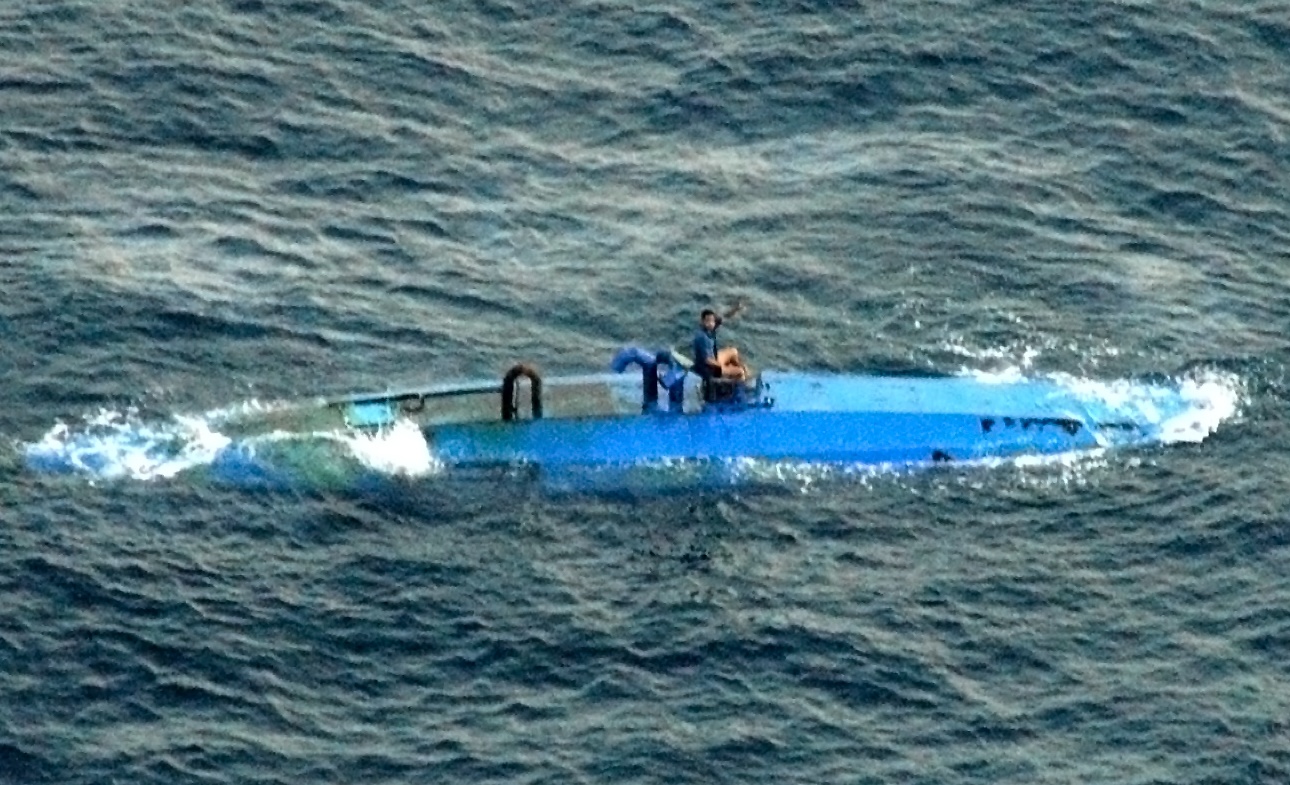
As much of its structure is fiberglass and it travels just under the surface, the vessel is nearly impossible to detect via sonar or radar, and very difficult to spot visually. The newer models pipe their exhaust along the bottom of the hull to cool it before being exhausted, making the boat even less susceptible to infrared detection. They are most easily spotted from the air, though even that is difficult as they are camouflaged with blue paint and produce almost no wake. They have ballast tanks to alter the vessel's buoyancy so that they ride low in the water.
Typical characteristics
These are the typical characteristics for semi-submersibles as stated by the U.S. Joint Interagency Task Force South:
- Hull material: wood, fiberglass, or steel
- Length 12–24 m
- Freeboard 0.5 m
- Engines: single or twin diesel
- Fuel capacity: 5.6 cubic metres
- Range: 3200 kilometers
- Speed: 11 km/h or more
- Crew: 4
- Capacity 4–12 metric tons
- Control: human or remote
True submarines
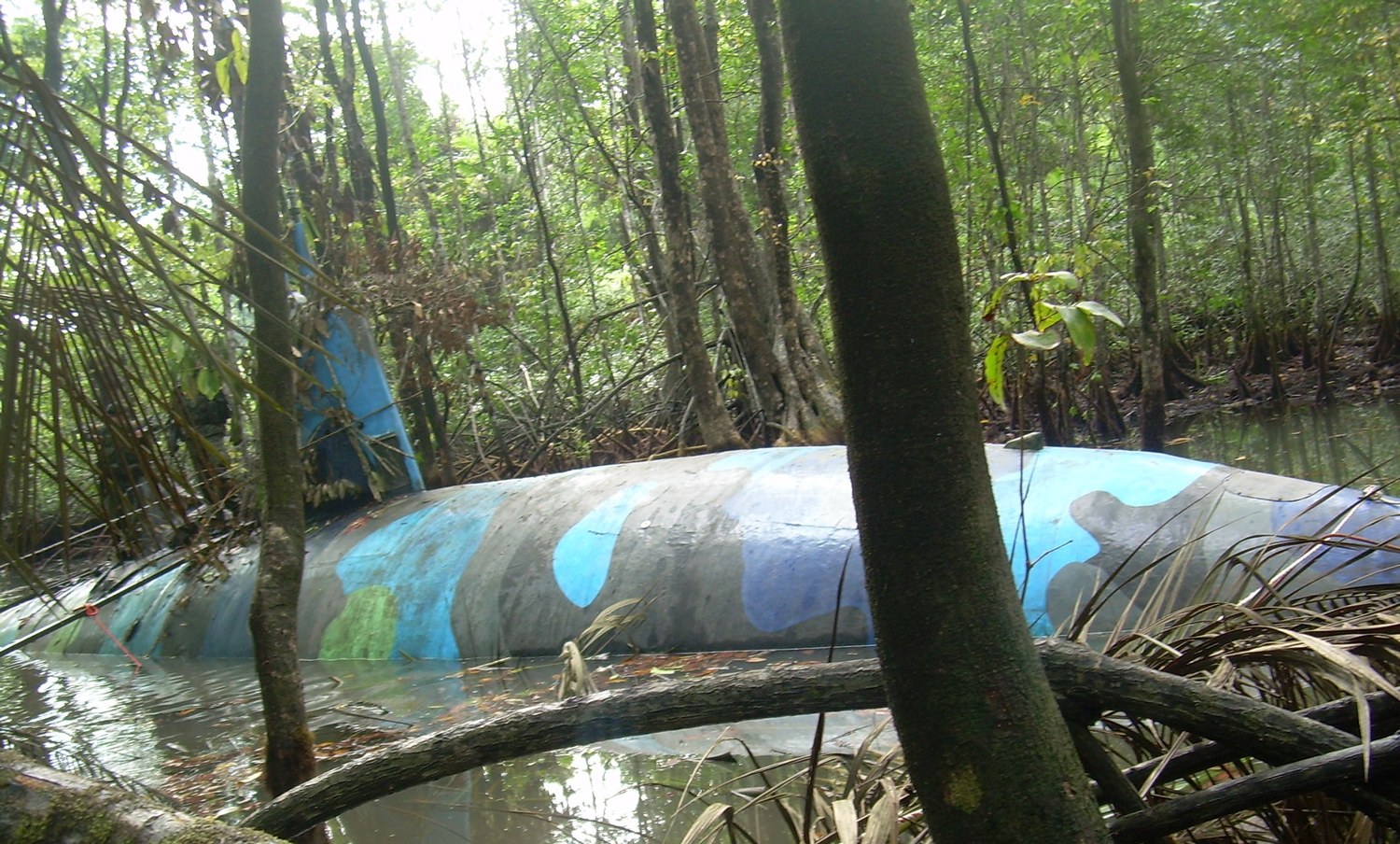
Narco-submarines were considered by officials to be an oddity until 2000, when Colombian Anti-Narcotics Police discovered what was reported to be a half-built 36 m-long true submarine in a warehouse outside Bogotá. The double-hulled steel vessel could have traveled 3,700 kilometers, dived 100 m, and could have carried about 15 tonnes of cocaine.
On July 3, 2010 the Ecuadorian authorities seized a fully functional, completely submersible diesel-electric submarine in the jungles bordering Ecuador and Colombia.
On February 14, 2011 another submarine was seized by the Colombian Navy. The 31 m-long fiberglass and Kevlar vessel was found hidden in a jungle area in Timbiquí, in south-western Colombia. It was capable of travelling 9 metre below water and it could carry four people and up to 8 tonnes of cargo.
Uncrewed
In 2022, Spanish police seized three unmanned underwater vehicles used to smuggle drugs across the Strait of Gibraltar from Morocco, the first known interception of such devices. The drones, carrying up to 200 kg of narcotics each, were linked to French cartels. The operation led to eight arrests and exposed a gang using advanced drones and modified vehicles for trafficking across Europe (BBC, 2022).
Whale-shaped mini-submarines
In 2025, international drug cartels began using sophisticated whale-shaped mini submarines to smuggle cocaine into Australia via Cyprus. These vessels are transported on cargo ships, dropped in international waters, then retrieved by smaller boats to deliver drugs ashore, posing a significant challenge to law enforcement detection efforts.
Operations

Operators
- Clan del Golfo
- National Liberation Army (ELN)
- Oliver Sinisterra Front
- Revolutionary Armed Forces of Colombia (FARC)
- Sinaloa Cartel
Routes
The western Colombian shore is ideal for smuggling. Of the two tons of cocaine coming out of Colombia daily, about a third leave via the Pacific coast in semi-submersibles. Homeland Security estimate submarines carry one-third of smuggled maritime goods to United States customers, while claiming they "are clueless" about the rest.
Elsewhere, the U.S. Coast Guard say smugglers are evolving complete logistics: fishing vessels along the way warn the crews against patrols and provide them with refreshments, while offshore refueling vessels provide unlimited loiter time so smugglers can avoid coastal areas. For smugglers, the trips are worth the investment—a nine-ton load earns nearly US$200 million wholesale from U.S. customers. Professional fishermen are often at the controls and earn about US$3,000 after completing the excursion.
Submarine smugglers unload their cargo onto fast-boats for the final leg to shore. According to press-releases, none of the submarines are known to unload at North American ports or beaches.
Drug mules of the Chipitos branch of the Sinaloa Cartel reportedly hate submarine duty.
Countermeasures
Surveillance
In 2007, the U.S. Coast Guard adjusted their underwater acoustic sensors to listen for submarines. According to a 2019 press-release, the U.S. Coast Guard reports they capture only 11% of submarines on the East Pacific route. The same source acknowledged that the U.S. Coast Guard was overstretched at the time.
Legal
If various militaries attempt to seize the semi-submersibles in international waters, the crews usually scuttle them. Until 2008, in accordance with international maritime law, the crew was rescued, and, if there was no evidence of wrongdoing, released. To address this loophole, the US Drug Trafficking Vessel Interdiction Act in September 2008 made it a "felony for those who knowingly or intentionally operate or embark in a self-propelled semi-submersible (SPSS) without nationality and that is or ever navigated in international waters, with the intent to evade detection". The penalty is a prison term of up to twenty years in the U.S.
The U.S. law does not apply to flagged vessels (i.e., registered with some officially recognized government). The bill grants extraterritorial jurisdiction over international waters and makes it illegal to lack relevant documents. Instead of an anti-narcotics operation turning into a rescue mission after submarines are sunk, the crew can be detained and interrogated using exigent methods.
In 2009, Congress of Colombia passed a law punishing builders of semi-submersible vessels with up to 12 years in prison, or 14 years if they are used to transport drugs.
Security issues related to "torpedo-style cargo containers", semi-submersible vessels, and submarines were reviewed in an August 2012 article in the U.S. publication Homeland Security Affairs.
References
References
- (13 December 2019). "Peruvian authorities seize narco-submarine carrying over a ton of cocaine". [[The Miami Herald]].
- Schmidt, Michael S.. (10 September 2012). "Smugglers Go Under the Sea To Move Drugs". [[The New York Times]].
- Kushner, David. (April 23, 2009). "Drug-Sub Culture". [[The New York Times]].
- Bajak, Frank. (July 4, 2010). "Ecuadoreans, DEA seize drug-smuggling submarine". APF.
- (22 July 2015). "US navy seizes submarine with seven tonnes of cocaine on board". Associated Press.
- "H I Sutton - Covert Shores".
- (June 6, 2009). "Plying the Pacific, Subs Surface as Key Tool of Drug Cartels". The Washington Post.
- (11 November 1988). "Creative drug smugglers turn to submarines". UPI Archives.
- (November 20, 2006). "Submarine with cocaine seized off Costa Rica". NBC News News.
- (May 9, 2008). "Narco subs pose new challenge for US coast guards". APF.
- (14 August 2006). "Spanish police find 'drugs' sub". BBC News.
- Pisa, Nick. (30 Mar 2006). "Drug cops foil mafia plot to smuggle $870m of cocaine by submarine". Cyber Diver News Network.
- Housley, Adam. (May 2, 2008). "Drug subs". Fox News.
- McCullough, Amy. (July 31, 2008). "Legislation targets drug-smuggling subs". NavyTimes.
- (July 18, 2008). "Más de Cinco Toneladas de Cocaína Traía El Minisubmarino Asegurado Por La Armada de México". Mexican Navy.
- (July 17, 2008). "Mexico captures submarine loaded with drugs". Canada News.
- La Mala, Maegan. (July 17, 2008). "The Narco Submarine". VivirLatino.
- (18 July 2008). "Mexican navy seizes cocaine sub". BBC News.
- (July 19, 2008). "Drug cartels using submarines to smuggle cocaine". CTV News – Canada.
- (September 14, 2008). "Coast Guard seizes $8.4 million worth of cocaine". CNN News.
- Silverstein, Elaine. (September 13, 2008). "Drug-Toting Semi-Sub Nabbed In Tampa-Based Probe". The Tampa Tribune.
- Meserve, Jeanne. (September 19, 2008). "Cocaine smugglers turn to submarines, feds say". CNN News.
- Videos and images of these two seizures are available at the U.S. Coast Guard web site: [http://www.piersystem.com/go/doc/786/228113/]
- (May 1, 2008). "Drug-trafficking trends". The Economist.
- (January 3, 2008). "Another cocaine-laden submarine sinks off Colombia". Reuters.
- "1.5 Tons of Cocaine Seized in Colombia". Latin American Herald Tribune.
- [http://www.semana.com/noticias-print-edition/the-mafia-rabbit/118097.aspx The mafia rabbit] {{Webarchive. link. (January 19, 2011 (November 25, 2008))
- [http://www.eluniversal.com.mx/notas/721409.html Detienen al Conejo, proveedor de El Barbas] {{Webarchive. link. (November 1, 2013 ''El Universal''. November 5, 2010 (in Spanish))
- (16 June 2008). "Insurgent submersibles". Jane's Information Group.
- (2009). "Report to the 111th Congress – 2009". U.S. Navy.
- Estes, Adam Clark. (2012-09-09). "The Feds Can't Catch the Cartels' Cocaine-Filled Submarines".
- Almasy, Steve. (7 August 2015). "Coast Guard seizes $181 million in cocaine on sub". [[CNN News]].
- [https://www.bbc.com/news/world-us-canada-35915232 US Coast Guard intercepts vessel carrying cocaine worth $200m]. [[BBC News]], 29 March 2016.
- [https://www.usatoday.com/story/news/nation-now/2017/12/11/u-s-coast-guard-intercepts-semi-submersible-vessel-packed-3-800-pounds-cocaine/939668001/ U.S. Coast Guard intercepts semi-submersible vessel packed with 3,800 pounds of cocaine]. ''USA Today''. 11 December 2017.
- [http://www.news.com.au/world/narco-subs-texas-mobilises-to-stem-invasion-of-narcotic-carrying-submarines/news-story/13bb3ac53db4fa18bd91fca74cf38e1a Narco subs: Texas mobilises to stem invasion of narcotic carrying submarines]. Jamie Seidel, ''News Com Australia''. 22 December 2017.
- Jones, Sam. (November 27, 2019). "Cocaine seized from 'narco-submarine' in Spain was likely headed for UK". [[The Guardian]].
- (October 18, 2020). "Inside the First 'Narco-Submarine' Caught After Crossing the Atlantic". [[The Wall Street Journal]].
- (8 December 2019). "Interceptaron en Perú un narcosubmarino cargado con dos toneladas de droga". [[Infobae]].
- (2020-11-16). "Rare Electric Narco Submarine Seized in Colombia".
- (26 October 2021). "Sailing ship captures a narco sub". [[CNN]].
- (2021-01-19). "Oubiña confirma la existencia de un "cementerio " de narcosubmarinos en aguas de Canarias".
- (2023-03-14). "El 'narcosubmarino' hallado vacío en Arousa llega a tierra para continuar con la investigación".
- (2023-03-15). "De fibra de vinilo, con un motor aislado y capacidad para cinco toneladas de cocaína: así es el 'narcosubmarino' de Arousa".
- (2023-11-27). "Colombia-led operation seizes world record 225 tonnes of cocaine, and uncovers new Australia trafficking route".
- (2025-10-08). "Third narco sub found in Solomon Islands, as cocaine and meth trafficking comes to the Pacific".
- (2025-08-20). "Narco-sub threat: Expert warns drug cartels using 'new trend' to target the Pacific".
- (2025-02-07). "President Bio keeps cocaine lord in the family".
- (October 17, 2025). "US has seized survivors of attack on alleged narco-sub in Caribbean". [[The Guardian]].
- (January 19, 2026). "Australian media report narco-submarine used in Vatia drug smuggling". [[Fiji Times]].
- Kraul, Chris. (November 6, 2007). "Drug traffickers use submersibles to ferry narcotics". Los Angeles Times.
- (2008). "Self-Propelled Semi-Submersible (SPSS) - Fact Sheet". Joint Interagency Task Force South.
- (2009). "Inside Cocaine Submarines". National Geographic Channel.
- [https://elpais.com/diario/2000/09/11/ultima/968623201_850215.html El 'narcosubmarino' Colombiano]. ''El Pais''. 11 September 2000.
- (July 3, 2010). "Ecuador authorities seize drug-smuggling sub". CNN News.
- (July 3, 2010). "DEA Intel Aids In Seizure of {{Sic". DEA Public Affairs.
- Lewis Page. (6 July 2010). "First true submarine captured from American drug smugglers". [[The Register]].
- (14 February 2011). "Sophisticated drug submarine seized in Colombia". BBC News.
- (4 July 2022). "Drug smuggling: Underwater drones seized by Spanish police". BBC News.
- Jones, Sam. (2022-07-04). "Spanish police seize underwater drones designed to carry drugs". The Guardian.
- (5 July 2022). "Spanish police bust first underwater drug smuggling drones". Daily Sabah.
- (6 January 2025). "Drug cartels use mini whale submarines to smuggle cocaine into Australia via Cyprus". The Greek Herald.
- Dalby, Chris. (2019-11-29). "Legend of Colombia's Narco-Subs Reaching Europe Becomes Reality".
- (July 7, 2008). "The War In The Pacific". Strategy Page.
- Hall, Kevin G.. (July 18, 2008). "At $2 million each, subs become the drug transport of choice". McClatchy Newspapers.
- Meserve, Jeanne. (March 20, 2008). "Coast Guard hunts drug-running semi-subs". CNN News.
- (November 15, 2009). "Video documentary: Narco Submarine Technology".
- (2024-03-15). "Drug Mules Hate Submarines".
- (December 20, 2007). "Run Silent, Run Drugs: The Cocaine Sub Fleet". ABC News.
- (12 July 2019). "Watch the US Coast Guard board a narco-sub carrying 17,000 pounds of cocaine".
- U.S. Congress. (Jul 28, 2008). "S. 3351: Drug Trafficking Interdiction Assistance Act of 2008". GovTrack.
- Ansari, Azadeh. (January 14, 2009). "Smugglers sink 'drug subs,' but not feds' case". CNN News.
- McDermott, Jereny. (June 20, 2009). "Colombia out to sink cocaine barons by banning 'drug subs'". The Scottsman.
- (August 2012). "A maritime threat assessment of sea based criminal organizations and terrorist operations". Homeland Security Affairs.
This article was imported from Wikipedia and is available under the Creative Commons Attribution-ShareAlike 4.0 License. Content has been adapted to SurfDoc format. Original contributors can be found on the article history page.
Ask Mako anything about Narco-submarine — get instant answers, deeper analysis, and related topics.
Research with MakoFree with your Surf account
Create a free account to save articles, ask Mako questions, and organize your research.
Sign up freeThis content may have been generated or modified by AI. CloudSurf Software LLC is not responsible for the accuracy, completeness, or reliability of AI-generated content. Always verify important information from primary sources.
Report