From Surf Wiki (app.surf) — the open knowledge base
Narbonne
Subprefecture and commune in Occitanie, France

Subprefecture and commune in Occitanie, France
| Field | Value |
|---|---|
| name | Narbonne |
| native name | oc |
| commune status | Subprefecture and commune |
| image | {{multiple image |
| perrow | 1/2 |
| border | infobox |
| total_width | 280 |
| image1 | Narbonne Cathedrale Saint Just et Saint Pasteur.jpg |
| caption1 | Narbonne skyline with Narbonne Cathedral |
| image2 | Palais des Archevêques de Narbonne.jpg |
| caption2 | Archbishops' Palace |
| image3 | Narbonne - Le pont des marchands.jpg |
| caption3 | Pont des Marchands |
| image flag | Flag of Narbonne.png |
| image coat of arms | Blason ville fr Narbonne.svg |
| arrondissement | Narbonne |
| canton | Narbonne-1, 2 and 3 |
| INSEE | 11262 |
| postal code | 11100 |
| mayor | Bertrand Malquier |
| term | 2023–2026 |
| intercommunality | Grand Narbonne |
| demonym | Narbonnese (En) |
| Narbonnaise (Fr) | |
| coordinates | |
| elevation min m | 0 |
| elevation max m | 285 |
| area km2 | 172.96 |
| population | |
| population date | |
| population footnotes |
|image coat of arms = Blason ville fr Narbonne.svg Narbonnaise (Fr)
Narbonne ( , , ; ; ; Late Latin:Narbona) is a commune and subprefecture in Southern France, located in the Occitanie region. It is located about 15 km from the shores of the Mediterranean Sea and was historically a prosperous port city. Narbonne lies 849 km from Paris in the Aude department, of which it is an arrondissement. From the 14th century onwards, it declined following a change in the course of the river Aude. While it is the largest commune in Aude, the capital of the Aude department is the smaller commune of Carcassonne.
Etymology
The etymology of the town's original name, Narbo, is lost in antiquity, and it may have referred to a hillfort from the Iron Age close to the location of the current settlement or its occupants. The earliest known record of the area comes from the Ancient Greek historian and geographer Hecataeus of Miletus (5th century BCE), who identified it as a Celtic harbor and marketplace at that time, and called its inhabitants Ναρβαῖοι, although the French academics and philologists Edme Cougny and Henri Lebègue report that several other names were used in ancient times to refer to the town, its territory, and Celtic inhabitants in ancient Greek inscriptions.
History
Under the Romans
Main article: Roman Gaul
The ancient city of Narbonne was established in Gaul by the Roman Republic in 118 BCE, as Colonia Narbo Martius, colloquially Narbo, and made into the capital of the newly established Roman province of Gallia Transalpina (modern-day southeastern France). It was located on the Via Domitia, the first Roman road in Gaul, built at the time of the foundation of the colony, and connecting Italy to Spain. Geographically, Narbonne was therefore located at a very important crossroads because it was situated where the Via Domitia connected to the Via Aquitania, which led toward the Atlantic through the cities of Tolosa and Burdigala.
Politically, Narbonne gained importance as a competitor to Massilia (today Marseille). Julius Caesar settled veterans from his 10th Legion there and attempted to develop its port while Marseille was supporting Pompey. Among the products of Narbonne, its rosemary-flower honey was famous among Romans. Later, the Roman province of Gallia Transalpina was renamed Gallia Narbonensis after the city, which became its capital. Seat of a powerful administration, the city enjoyed economic and architectural expansion. At that point, the city is thought to have had 30,000–50,000 inhabitants, and may have had as many as 100,000.
Visigothic Kingdom
Main article: Visigothic Kingdom
According to Hydatius, in 462 AD the city was handed over to the Visigoths by a local military leader in exchange for support; as a result Roman rule ended in medieval France. It was subsequently the capital of the Visigothic Kingdom of Septimania, the only territory from Gaul to fend off the attacks of the Christian Franks after the Battle of Vouille (507). In 531, the Frankish king Childebert I invaded Septimania and defeated the Visigothic king, Amalaric, near Narbonne and occupied the city. However, after Childebert's continued invasion to Catalonia failed, Amalaric's successor Theudis was able to reclaim the rich province of Septimania, including Narbonne, to the Visigothic Kingdom.
Frankish conquest of Septimania
Main article: Septimania
The region of Septimania was the last unconquered province of the Visigothic Kingdom. The incursion into Septimania was motivated by the need to secure their territorial gains in Iberia. Arab and Berber Muslim forces began to campaign in Septimania in 719. The region was invaded by the Andalusian Muslims in 719, renamed as Arbūnah and turned into a military base for future operations by the Andalusian military commanders. It passed briefly to the Emirate of Córdoba, which had been expanding from the south during the same century, before its subsequent conquest by the Christian Franks in 759, who by the end of the 9th century renamed it as Gothia or Marca Gothica ("Gothic March"). After the Frankish conquest of Narbonne in 759, the Muslim Arabs and Berbers were defeated by the Christian Franks and retreated to their Andalusian heartland after forty years of occupation, and the Carolingian king Pepin the Short came up reinforced.
Carolingian Empire
Main article: Kingdom of Francia
The Carolingian king Pepin the Short chased the Muslim Arabs and Berbers away from Septimania and conquered Narbonne in 759, after which the city became part of the Frankish Viscounty of Narbonne. Septimania became a march of the Carolingian Empire and then West Francia down to the 13th century, though it was culturally and politically autonomous from the northern France-based central royal government. The region was under the influence of the people from the count territories of Toulouse, Provence, and ancient County of Barcelona. It was part of the wider cultural and linguistic region comprising the southern third of France known as Occitania. This area was finally brought under effective control of the French kings in the early 13th century as a result of the Albigensian Crusade, after which it was assigned governors. Narbonne became a major center of Jewish learning in Western Europe. In the 12th century, the court of Ermengarde of Narbonne () presided over one of the cultural centers where the spirit of courtly love was developed.
Jewish community of Narbonne
Main article: History of the Jews in France
In the 11th and 12th centuries, Narbonne was home to an important Jewish exegetical school, which played a pivotal role in the growth and development of the Zarphatic (Judæo-French) and Shuadit (Judæo-Provençal) languages in medieval France. Jews had settled in Narbonne from about the 5th century CE, with a community that numbered about 2,000 people in the 12th century. At this time, Narbonne was frequently mentioned in medieval Talmudic works in connection with its scholars. One source, Abraham ibn Daud of Toledo, gives them an importance similar to the Jewish exilarchs of Babylon. In the 12th and 13th centuries, the community went through a series of ups and downs before settling into extended decline.
Narbonne loses its river and port


Narbonne itself fell into a slow decline in the 14th century, for a variety of reasons. One was due to a change in the course of the river Aude, which caused increased silting of the navigational access. The river, known as the Atax in ancient times, had always had two main courses which split close to Salelles; one fork going south through Narbonne and then to the sea close to the Clappe Massif, the other heading east to the etang at Vendres close to the current mouth of the river well to the east of the city. The Romans had improved the navigability of the river by building a dam near Salelles and also by canalising the river as it passed through its marshy delta to the sea (then as now the canal was known as the Robine.) A major flood in 1320 swept the dam away. The Aude river had a long history of overflowing its banks. When it was a bustling port, the distance from the coast was approximately 5 to, but at that time the access to the sea was deep enough only when the river was in full spate which made communication between port and city unreliable.
However, goods could easily be transported by land and in shallow barges from the ports (there were several: a main port and forward ports for larger vessels; indeed the navigability from the sea into the étang and then into the river had been a perennial problem). The changes to the long seashore which resulted from the silting up of the series of graus or openings which were interspersed between the islands which made up the shoreline (St. Martin; St. Lucie) had a more serious impact than the change in course of the river. Other causes of decline were the plague and the raid of Edward, the Black Prince, which caused much devastation. The growth of other ports was also a factor.
Narbonne Cathedral

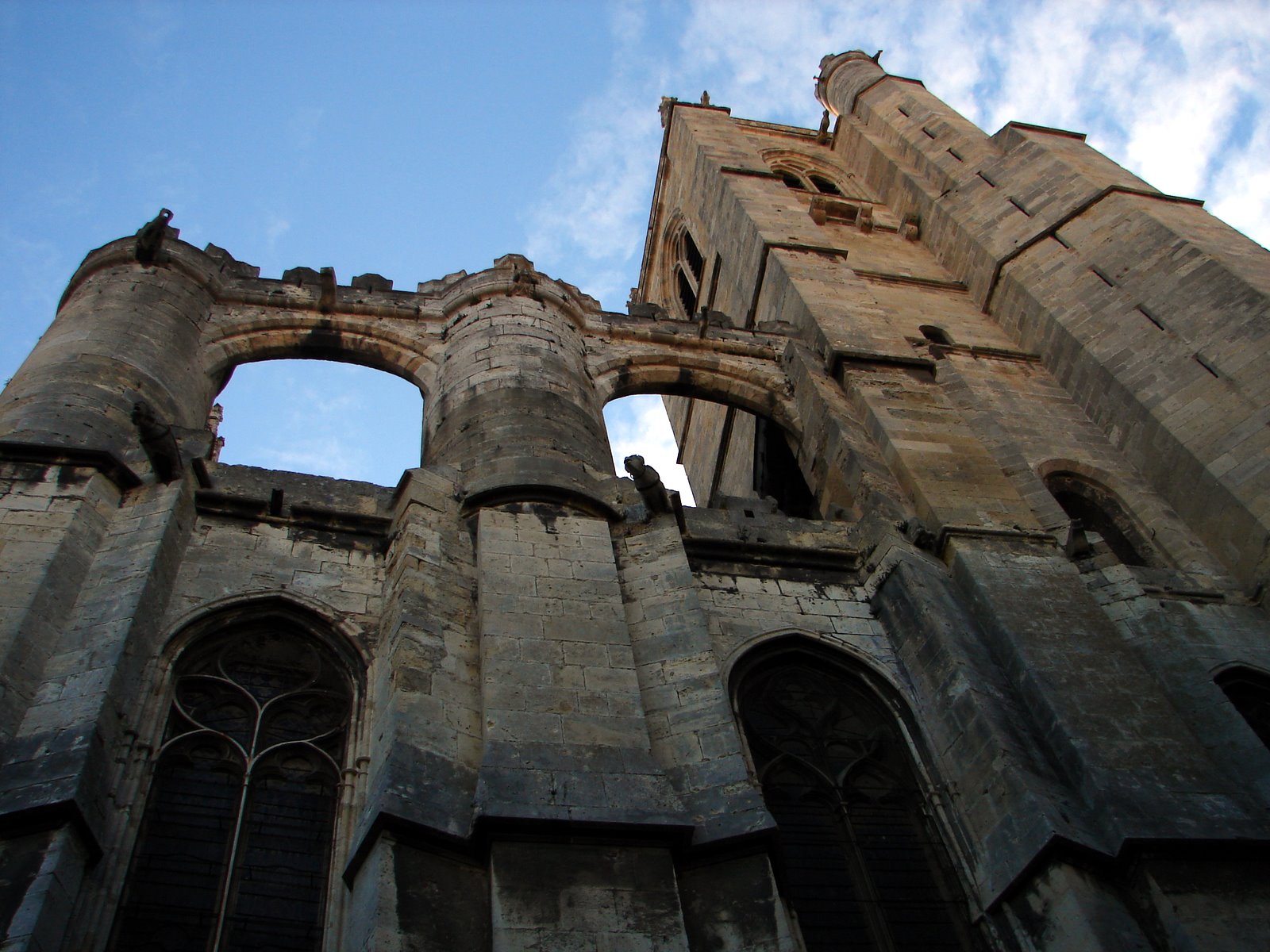
Narbonne Cathedral, dedicated to Saints Justus and Pastor, provides stark evidence of Narbonne's sudden and dramatic change of fortunes when one sees at the rear of the structure the enormously ambitious building programme frozen in time, for the cathedral—still one of the tallest in France—was never finished. The reasons are many, but the most important is that the completed cathedral would have required demolishing the city wall. The 14th century also brought the plague and a host of reasons for retaining the 5th-century (pre-Visigothic) walls.
Yet the choir, side chapels, sacristy, and courtyard remain intact, and the cathedral, although no longer the seat of a bishop or archbishop, remains the primary place of worship for the Roman Catholic population of the city, and is a major tourist attraction.
Building of the Canal de la Robine

From the sixteenth century, eager to maintain a link to important trade, the people of Narbonne began costly work to the vestiges of the river Aude's access to the sea so that it would remain navigable to a limited draft vessel and also serve as a link with the Royal Canal. This major undertaking resulted in the construction of the Canal de la Robine, which was finally linked with the Canal du Midi (then known as the Royal Canal) via the Canal de Jonction in 1776.
In the 19th century, the canal system in the south of France had to compete with an expanding rail network, which could ship goods more quickly. The canals kept some importance as they were used to support the flourishing wine trade. Despite its decline from Roman times, Narbonne held on to its vital but limited importance as a trading route. This has continued in more recent centuries.
Geography
Narbonne is linked to the nearby Canal du Midi and the river Aude by the Canal de la Robine, which runs through the centre of town. It is very close to the A9 motorway, which connects Montpellier and Nîmes to Perpignan and, across the border, to Barcelona in Spain. There is also a recently renovated train station which serves the TGV to Spain, Paris and Calais, which in turn connects to the Eurostar. Narbonne is only 10 km from Narbonne Plage (beach), but it is only 2 km from the nearest open water, at La Nautique, although there is no sand, rather pebbles.
Climate
|Jan record high C = 22.8 |Feb record high C = 23.3 |Mar record high C = 28.6 |Apr record high C = 31.0 |May record high C = 33.9 |Jun record high C = 40.2 |Jul record high C = 38.8 |Aug record high C = 42.1 |Sep record high C = 36.9 |Oct record high C = 32.7 |Nov record high C = 25.6 |Dec record high C = 22.5 |Jan record low C = -4.7 |Feb record low C = -8.1 |Mar record low C = -5.2 |Apr record low C = 0.3 |May record low C = 2.2 |Jun record low C = 8.7 |Jul record low C = 11.2 |Aug record low C = 11.8 |Sep record low C = 7.8 |Oct record low C = 2.0 |Nov record low C = -3.9 |Dec record low C = -6.0 |access-date=14 December 2024}} holiday-weather.com
| Month | Jan | Feb | Mar | Apr | May | Jun | Jul | Aug | Sep | Oct | Nov | Dec | Year |
|---|---|---|---|---|---|---|---|---|---|---|---|---|---|
| Average sea temperature °C | 13 | 13 | 13 | 14 | 16 | 19 | 22 | 23 | 21 | 18 | 16 | 14 | 16.8 |
| Average Wind Speed km/h | 20.9 | 21.2 | 20.9 | 20.5 | 19.4 | 19.1 | 19.8 | 18.0 | 17.3 | 17.6 | 19.8 | 19.4 | 19.4 |
| Source: holiday-weather.com; |
Population
| graph-pos = bottom |1793 |9050 |1800 |9086 |1806 |9464 |1821 |9940 |1831 |10246 |1836 |10762 |1841 |11907 |1846 |11427 |1851 |13066 |1856 |14300 |1861 |16062 |1866 |17172 |1872 |17266 |1876 |19968 |1881 |28134 |1886 |29702 |1891 |29566 |1896 |27824 |1901 |28852 |1906 |27039 |1911 |28173 |1921 |28956 |1926 |29841 |1931 |31909 |1936 |30047 |1946 |29975 |1954 |32060 |1962 |33891 |1968 |38441 |1975 |39342 |1982 |41565 |1990 |45849 |1999 |46510 |2007 |51306 |2012 |51869 |2017 |54700
Sights


- The cathedral dating from 1272
- The Palace of the Archbishops of Narbonne, and its donjon with views over Narbonne
- Musée Archeologique, an archaeological museum in the town centre (currently closed - November 2019, most sections will be moved to new museum Narbo Via which is planned to open in September 2020)
- Clos de la Lombarde, an archaeological site presenting the vestiges of Roman townhouses, bath houses, workshops from the 1st century BC to the 3rd century AD and the first Christian basilica in Narbonne (3rd/4th century AD).
- The Roman Horreum, a former grain warehouse, built underground as a cryptoporticus
- Remains of the Via Domitia in the city center
- The canal, Canal de la Robine, running through the centre of the town
- The Halles covered market operates every day. The busiest times are Sunday and Thursday mornings.
- The nearby limestone massif known as La Clape and the beach at Narbonne plage
Sport
Narbonne is home to the rugby union team RC Narbonne founded in 1907. It is a historic team in France, Narbonne have twice won the French first division title and reached a European final in 2001. They play at the Parc des Sports Et de l'Amitié (capacity 12,000). They wear orange and black.
Transport
The Gare de Narbonne railway station offers direct connections to Paris, Barcelona, Toulouse, Marseille and many regional destinations. An extensive local system of buses and routes operated by Citibus.fr allow for easy public transport within Narbonne and surrounding communities.
The nearest airports to Narbonne are Marseille, Toulouse–Blagnac, Perpignan–Rivesaltes, and Montpellier–Méditerranée airports.
Personalities

- Varro Atacinus, Roman poet
- Ateyaba, French hip-hop artist
- Alexandre Baron, racing driver
- Joseph Barsalou (physician) (1600–1669), apothecary and physician whose family was from Narbonne
- Kalonymus ben Todros (d. c. 1194), was a Provençal rabbi who flourished at Narbonne in the second half of the twelfth century
- Rabbinic family of Benveniste
- Léon Blum was born in Paris but was elected as Deputy for Narbonne in 1929, re-elected in 1932 and 1936
- Bonfilh, a Jewish troubadour from the city
- Carus, Roman emperor from 282 to 283, known for his late victories against the Sassanid empire and the Germanic tribes
- Guillaume Barthez de Marmorières (1707–1799), civil engineer
- Camille Lacourt, World champion swimmer
- Benjamin Lariche, racing driver
- Makhir of Narbonne, medieval Jewish scholar
- Jean-Joseph Cassanéa De Mondonville (1711–1772), violinist and composer
- Moshe ha-Darshan (11th century), chief of the yeshiva of Narbonne
- Anaïs Napoleón, French-Spanish photographer
- Pierre Reverdy, surrealist poet
- Saint Sébastien, third-century Christian saint and martyr
- Dimitri Szarzewski, rugby player
- Charles Trenet, singer-songwriter
International relations
Narbonne is twinned with:
- ITA Aosta, Italy
- ITA Grosseto, Italy
- UK Salford, England
- GER Weilheim, Germany
References
- Michel Gayraud, Narbonne antique des origines à la fin du IIIe siècle. Paris: De Boccard, Revue archéologique de Narbonnaise, Supplément 8, 1981, 591 p.
- Histoire de Narbonne, Jacques Michaud and André Cabanis, eds, Toulouse: Privat, 2004.
- L’Aude de la préhistoire à nos jours (under the direction of Jacques Crémadeilis), Saint-Jean-d’Angély, 1989.
- Les Audois : dictionnaire biographique, Rémy Cazals et Daniel Fabre, eds., Carcassonne, Association des Amis des Archives de l’Aude, Société d’Études Scientifiques de l’Aude, 1990.
References
- (16 April 2024). "Répertoire national des élus: les maires". data.gouv.fr, Plateforme ouverte des données publiques françaises.
- {{Cite American Heritage Dictionary. Narbonne
- "Narbonne". [[Oxford University Press]].
- {{Cite Merriam-Webster. Narbonne
- (2013). "Narbonne and its Territory in Late Antiquity". [[Routledge]].
- (1872). "Extrait des Auteurs Grecs Concernant La Géographie et l'Histoire des Gaules: Texte et Traduction Nouvelle". [[Société de l'histoire de France]].
- Collin Bouffier, Sophie. (2009). "Marseille et la Gaule méditerranéenne avant la conquête romaine". Pallas.
- Maguelonne Toussaint-Samat (Anthea Bell, tr.) ''The History of Food'', 2nd ed. 2009:23.
- (1994-03-17). "An Historical Geography of France". Cambridge University Press.
- (1895). "A History of Spain from the Earliest Times to the Death of Ferdinand the Catholic". Longmans, Green and Company.
- (2003). "Tricolor and Crescent: France and the Islamic World". [[Greenwood Publishing Group.
- Deanesly, Margaret. (2019). "A History of Early Medieval Europe: From 476–911". [[Routledge]].
- Collins, Roger. (1998). "Charlemagne". [[Palgrave Macmillan]]/[[University of Toronto Press]].
- Cohen, Jeremy. (1977). "The ''Nasi'' of Narbonne: A Problem in Medieval Historiography". [[Cambridge University Press]] on behalf of the [[Association for Jewish Studies]].
- Hillaby, Joe. (2013). "The Palgrave Dictionary of Medieval Anglo-Jewish History". [[Palgrave Macmillan]].
- Bobichon, Philippe. (2015). "Controverse judéo-chrétienne en Ashkenaz (XIIIe s.). Florilèges polémiques: hébreu, latin, ancien français". [[École pratique des hautes études.
- "NARBONNE - JewishEncyclopedia.com".
- ''Mediterranean Beaches and Bluffs: A Bicycle Your France E-guide'' by Walter Judson Moore, 2015
- {{Cassini-Ehess. 24587. Narbonne
- [https://www.insee.fr/fr/statistiques/4515315?geo=COM-11262#ancre-POP_T1 Population en historique depuis 1968], INSEE
- "Narbonne (11262) – Population totale en vigueur en 2026".
- http://www.amiscloslombarde.fr/ {{In lang. fr. en
- "British towns twinned with French towns". Archant Community Media Ltd.
- Salford City Council. "Salford's twin towns". Salford.gov.uk.
This article was imported from Wikipedia and is available under the Creative Commons Attribution-ShareAlike 4.0 License. Content has been adapted to SurfDoc format. Original contributors can be found on the article history page.
Ask Mako anything about Narbonne — get instant answers, deeper analysis, and related topics.
Research with MakoFree with your Surf account
Create a free account to save articles, ask Mako questions, and organize your research.
Sign up freeThis content may have been generated or modified by AI. CloudSurf Software LLC is not responsible for the accuracy, completeness, or reliability of AI-generated content. Always verify important information from primary sources.
Report