From Surf Wiki (app.surf) — the open knowledge base
Naphthalenetetracarboxylic dianhydride
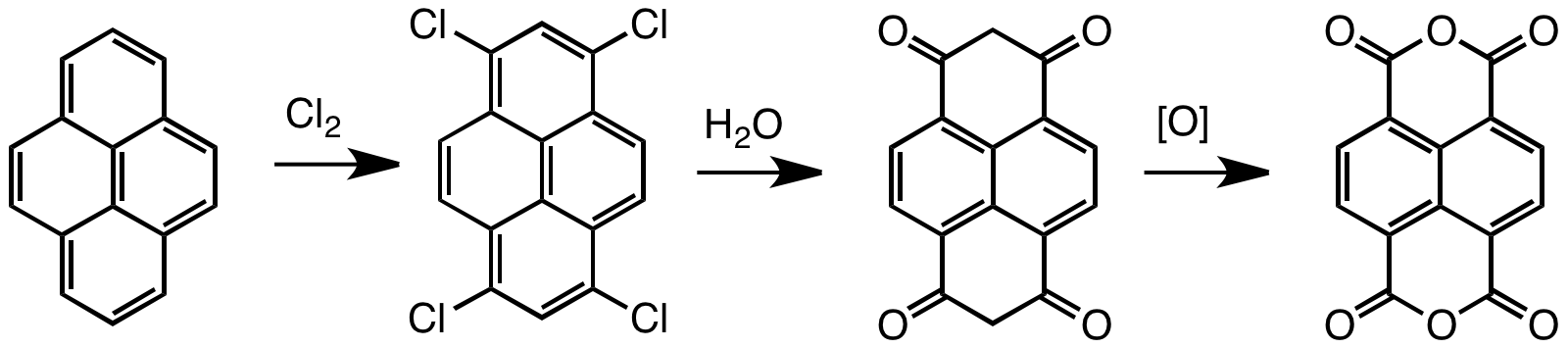
Naphthalenetetracarboxylic dianhydride (NTDA) is an organic compound related to naphthalene. The compound is a beige solid. NTDA is most commonly used as a precursor to naphthalenediimides (NDIs) (such as napthalenetetracarboxylic diimide), a family of compounds with many uses.
Synthesis and structure
Naphthalenetetracarboxylic dianhydride is prepared by oxidation of pyrene. Typical oxidants are chromic acid and chlorine. The unsaturated tetrachloride hydrolyzes to enols that tautomerize to the bis-dione, which in turn can be oxidized to the tetracarboxylic acid.

Naphthalene diimides
Symmetrical naphthalene diimides are synthesized by the condensation reaction of primary amines and the dianhydride. Unsymmetrical derivatives, i.e. those derived from two different amines, are obtained by hydrolysis of one of the two anhydride groups prior to the condensation with the first amine.
These diimides are members of a broader class of compounds called rylenes, oligomers of naphthalene with bonds between the 1 and 1' and 8 and 8' positions. The resulting materials have rigidly planar, highly conjugated cores. They exhibit good processing characteristics for fabrication of soft electronic devices. Aside from the NDIs, other members include the diimide derivatives of perylene-3,4:9,10-tetracarboxylic dianhydride and terrylene-3,4:11,12-tetracarboxylic dianhydride.

Naphthalene diimides (NDIs) are often fluorescent, although the intensity is sensitive to substituents. NDIs are also redox-active, forming stable radical anions near -1.10 V vs. Fc/Fc+. Their ability to accept electrons reflects the presence of an extended conjugated ring system and the electron withdrawing groups (carbonyl centers). NDIs are used in supramolecular chemistry due to their tendency to form charge-transfer complexes with crown ethers, e.g. to give rotaxanes and catenanes. As another consequence of their planar structure and electron-acceptor properties, NDIs intercalate into DNA.
A range of amines can be condensed with the dianhydride. For example, two useful pigments of the perinone class are generated by condensation with phenylenediamine. A variety of ligands with NDI backbones have also been prepared.
References
References
- (2008). "Chemistry of naphthalene diimides". Chem. Soc. Rev..
- F. Röhrscheid "Carboxylic Acids, Aromatic" in ''Ullmann's Encyclopedia of Industrial Chemistry'', Wiley-VCH, Weinheim, 2012. {{doi. 10.1002/14356007.a05_249
- (2008). "Synthesis and Phase Structures of Novel π-Acceptor Discotic Liquid Crystalline Compounds Having a Pyrenedione Core". European Journal of Organic Chemistry.
- (2011). "Rylene and Related Diimides for Organic Electronics". Advanced Materials.
- (2011). "Progress in the study of metal–organic materials applying naphthalene diimide (NDI) ligands". Coordination Chemistry Reviews.
This article was imported from Wikipedia and is available under the Creative Commons Attribution-ShareAlike 4.0 License. Content has been adapted to SurfDoc format. Original contributors can be found on the article history page.
Ask Mako anything about Naphthalenetetracarboxylic dianhydride — get instant answers, deeper analysis, and related topics.
Research with MakoFree with your Surf account
Create a free account to save articles, ask Mako questions, and organize your research.
Sign up freeThis content may have been generated or modified by AI. CloudSurf Software LLC is not responsible for the accuracy, completeness, or reliability of AI-generated content. Always verify important information from primary sources.
Report