From Surf Wiki (app.surf) — the open knowledge base
Nandi County

| Field | Value |
|---|---|
| official_name | Nandi County |
| settlement_type | County |
| image_skyline | Mogobich Valley, Nandi Hills.jpg |
| image_caption | Nandi Hills |
| image_flag | Contea di Nandi flag.gif |
| image_map | Nandi County in Kenya.svg |
| map_caption | Location in Kenya |
| coordinates | |
| subdivision_type | Country |
| subdivision_name | Kenya |
| established_title | Formed |
| established_date | 4 March 2013 |
| seat_type | Capital and largest town |
| seat | Kapsabet |
| leader_title1 | Governor |
| leader_name1 | Stephen Sang |
| leader_title2 | The Senate |
| leader_name2 | Samson Cherargei |
| area_total_km2 | 2,884.5 |
| population_total | 885,711 |
| population_as_of | 2019 |
| population_density_km2 | auto |
| website | |
| seat1_type | Largest city |
| timezone | EAT |
| utc_offset | +3 |
Nandi County is a county in Kenya in the North Rift, occupying an area of 2,884.4 square kilometres. Its capital, Kapsabet, is the largest town in the county while other towns include Mosoriot, Tinderet, Kobujoi, Kaiboi, Kabiyet and Nandi Hills. According to a 2019 census, the county has a population of 885,711, made up of a number of Kenyan communities, the majority of whom belong to the native tribe called Nandi.
Geographically, the unique jug-shaped structure of Nandi County is bound by the Equator to the south and extends northwards to latitude 0034’N. The western boundary extends to west. The county's major area is covered by the Nandi Hills.[[File:The upcoming Nandi County Assembly Headquarters.jpg|alt=Nandi County Assembly headquarters|thumb|The upcoming Nandi County Assembly Headquarters (June 2021)]]
History
Historically, Nandi like other Kalenjin areas was divided into districts known as emotinwek (sing. emet). There were six emotinwek in Nandi which were Wareñg in the north, Mosop in the East, Soiin (also known as Pelkut) in the south-east, Aldai and Chesumei in the west and Em'gwen in the center.
The districts were further divided into divisions known as bororiōsiek (sing. bororiet) which were made up of several villages known as koret.
Settlement
The traditional Nandi account is that the first settlers in Nandi came from Elgon and formed the Kipoiis clan; a name that possibly means 'the spirits'. They were led by a man named Kakipoch, founder of the Nandi section of the Kalenjin and are said to have settled in the emet of Aldai in south-western Nandi. One of the early Nandi bororiōsiek was named after Kakipoch.
Studies of the settlement pattern indicate that the southern regions were the first to be settled. As of 1910, these comprised the emet of Aldai on the west and the, by then annexed, emet of Soiin on the east. It was conjectured that the first pororiosiek were Kakipoch in Aldai and Tuken in Soiin.
It is notable that Sirikwa holes (known to the Nandi as mukowanisiek) were almost non-existent in the areas first settled, being only present on the Nandi Escarpment itself. They were however found in great numbers in the northern regions of Nandi.
Inward migrants and general population growth are thought to have led to a northward expansion of the growing identity during the eighteenth century. This period is thought to have seen the occupation and establishment of the emotinwek of Chesume, Emgwen and Masop. This period would also have seen the establishment of more pororosiek.
The final expansion occurred during the middle of the nineteenth century when the Nandi took the Uain Gishu plateau from the Uasin Gishu. Traditions contained in the tale of Tapkendi however seem to indicate that the plateau was previously held by the Nandi and that Nandi place names were superseded by Maasai names. This is further evinced by certain "Masai place-names in eastern Nandi which indicate that the Masai had temporary possession of strip of Nandi roughly five miles wide", these include Ndalat, Lolkeringeti, Nduele and Ol-lesos, which were by the early nineteenth century in use by the Nandi as koret names.
Late 19th century
Nandi county was the scene of the resistance struggle that has come to be known as the Nandi Resistance. The traditional system of governance came to an end c.1905 with the end of the resistance struggle. This was followed by the subsequent absorption of Nandi into the East African Protectorate in 1905 and later into the Kenya Colony in 1920.
The Emet of Wareng was amalgamated into the Uasin Gishu district during the colonial period. It is today part of Uasin Gishu County and last bore its name as a county of Eldoret South Constituency. The Emet of Soiin would be appropriated for European occupation, as part of what were known as the white highlands, during the colonial period. It was later split in two and is today named after the Tinderet and Nandi Hills.
Population
| 1979 | 299,319 | 1989 | 433,613 | 1999 | 578,751 | 2009 | 752,965 | 2019 | 885,711
Religion
Religion in Nandi County
| Religion (2019 Census) | Number |
|---|---|
| Catholicism | 216,901 |
| Protestant | 401,975 |
| Evangelical Churches | 153,342 |
| African instituted Churches | 49,849 |
| Orthodox | 14,936 |
| Other Christian | 21,776 |
| Islam | 5,755 |
| Hindu | 90 |
| Traditionists | 630 |
| Other | 7,580 |
| No Religion | 10,002 |
| Don't Know | 749 |
| Not Stated | 58 |
Sub-counties
The county has six subcounties:
- Mosop Subcounty
- Emgwen Subcounty
- Aldai Subcounty
- Tinderet Subcounty
- Nandi Hills Subcounty
- Chesumei Subcounty
Wards
The county (2884.5 km2) is further sub-divided into 30 wards namely:
| Ward | Area | 2009 pop. | km2 | sq. mi. |
|---|---|---|---|---|
| Songhor/Soba | 193 km2 | 39,934 | ||
| Tindiret | 159 km2 | 27,896 | ||
| Chemelil/Chemase | 128 km2 | 14,479 | ||
| Kapsimotwo | 73 km2 | 18,362 | ||
| Kabwareng | 47 km2 | 22,807 | ||
| Terik | 48 km2 | 20,456 | ||
| Kemeloi | 115 km2 | 35,085 | ||
| Kobujoi | 81 km2 | 26,539 | ||
| Kaptumo/Kaboi | 98 km2 | 24,464 | ||
| Koyo/Ndurio | 69 km2 | 19,905 | ||
| Nandi Hills | 74 km2 | 33,545 | ||
| Chepkunyuk | 129 km2 | 36,775 | ||
| Ol'lessos | 68 km2 | 19,396 | ||
| Kapchorua | 161 km2 | 17,818 | ||
| Chemundu/Kapng'etuny | 52 km2 | 25,403 | ||
| Kosirai | 93 km2 | 25,741 | ||
| Lelmokwo/Ngechek | 106 km2 | 23,354 | ||
| Kaptel/Kamoiywo | 150 km2 | 31,375 | ||
| Kiptuiya | 71 km2 | 24,879 | ||
| Chepkumia | 87 km2 | 21,283 | ||
| Kapkangani | 43 km2 | 23,994 | ||
| Kapsabet | 75 km2 | 35,962 | ||
| Kilibwoni | 164 km2 | 48,845 | ||
| Chepterwai | 73 km2 | 18,944 | ||
| Kipkaren | 94 km2 | 19,147 | ||
| Kurgung/Surungai | 82 km2 | 18,225 | ||
| Kabiyet | 77 km2 | 19,262 | ||
| Ndalat | 75 km2 | 18,651 | ||
| Kabisaga | 79 km2 | 19,029 | ||
| Sangalo/Kebulonik | 121 km2 | 21,390 |
Constituencies
The county consists of six constituencies: 151. Tinderet, 152. Aldai, 153. Nandi Hills, 154. Chesumei, 155. Emgwen, 156. Mosop.
Economy
Agriculture

Agriculture is the backbone of Nandi County’s economy, supported by fertile volcanic soils and a cool, wet climate. The main crops are tea and maize, alongside dairy farming. The county hosts about 15–19 tea factories, many under the Kenya Tea Development Agency (KTDA), with catchments like Kaptumo supporting over 7,700 growers on 2,140 hectares. Daily green-leaf production often exceeds local processing capacity, leading to calls for more factories. Maize is grown widely as both staple and cash crop, with farmers benefiting from county-backed insurance schemes. Dairy farming is highly developed, with about 320,000 dairy cows producing nearly 195 million litres annually, valued at KSh 5.9 billion.
Agro-processing
Value addition has become a key economic priority.
- Tea: Over a dozen KTDA and multinational factories process green leaf, though capacity remains below production levels.
- Dairy: The Nandi Dairy Cooperative Union (NDCU), formed in 2016, aggregates milk through 45 coolers with a chilling capacity of 300,000 litres. In 2025, the county under Governor Stephen Sang opened the Kabiyet Milk Processing Plant (Nandi Cooperative Creameries), a KSh 1.2 billion facility with a 200,000 litre/day capacity and an Ultra-High Temperature (UHT) line, enabling production of long-life milk for regional and international markets.
- Poultry: A semi-automated slaughterhouse in Kapsabet, supported by the World Bank’s NARIGP project, processes up to 500 birds per hour, offering poultry farmers (many women and youth) a stable market.
- Garments: The Nandi Textile Unit (NaTeX), based in Mosoriot, Chesumei Sub-County, specializes in producing premium garments including uniforms, cultural attire, and ready-to-wear fashion. Equipped with modern machinery and staffed by skilled local artisans, the plant provides hundreds of jobs—particularly for women and youth—while promoting value addition and local economic empowerment. It is positioning Nandi as a regional hub for textile manufacturing.
Tourism
Tourism is an emerging sector, leveraging Nandi’s scenic highlands, tea estates, and cultural heritage. Attractions include the Nandi Hills, known for scenic landscapes and tea tours; Chepkiit Waterfalls; and cultural sites such as the Nandi Bears Club golf course and memorials linked to Koitalel arap Samoei, a celebrated anti-colonial leader. Adventure tourism and eco-tourism potential remain underdeveloped but are recognized by the county as future growth areas.
Notable destinations
Nandi Hills town and the surrounding region
Home to a number of tea estates as well as the Koitalel Samoei Museum, Kapsimotwa Gardens and the Nandi Bears Club.
Koitalel arap Samoei mausoleum and museum
Koitalel Arap Samoei Museum was instituted in commemoration of Koitalel arap Samoei, a traditional spiritual leader of the Nandi. It incorporates a mausoleum as well as a center that display of the cultural heritage of the larger Kalenjin community.
Keben
The area is home to the Ngabunat caves, the site of ancient battles between the Nandi and Maasai – one of which led to the capture of Moki chebo Cheplabot and establishment of the second Orkoinotet.
Nandi rock
This, is the most prominent rock formation along the whole length of the Nandi (Nyando) Escarpment, is a 30-minute walk from the KWS post at Kaptumek.
Chepkiit Water Falls
Tucked some two kilometres from Eldoret International Airport, off the Eldoret-Kapsabet road, Chepkiit waterfall in Nandi County is one of the marvels of mother nature, carved out of the magnificent walls of the Great Rift Valley.
Education and sports
Nandi County is home to many world record holders in athletics, including Kipchoge Keino, Henry Rono, Eliud Kipchoge, Pamela Jelimo, Janeth Jepkosgei, Moses Tanui, Julius Yego, Jairus Birech, Conseslus Kipruto and Bernard Lagat.
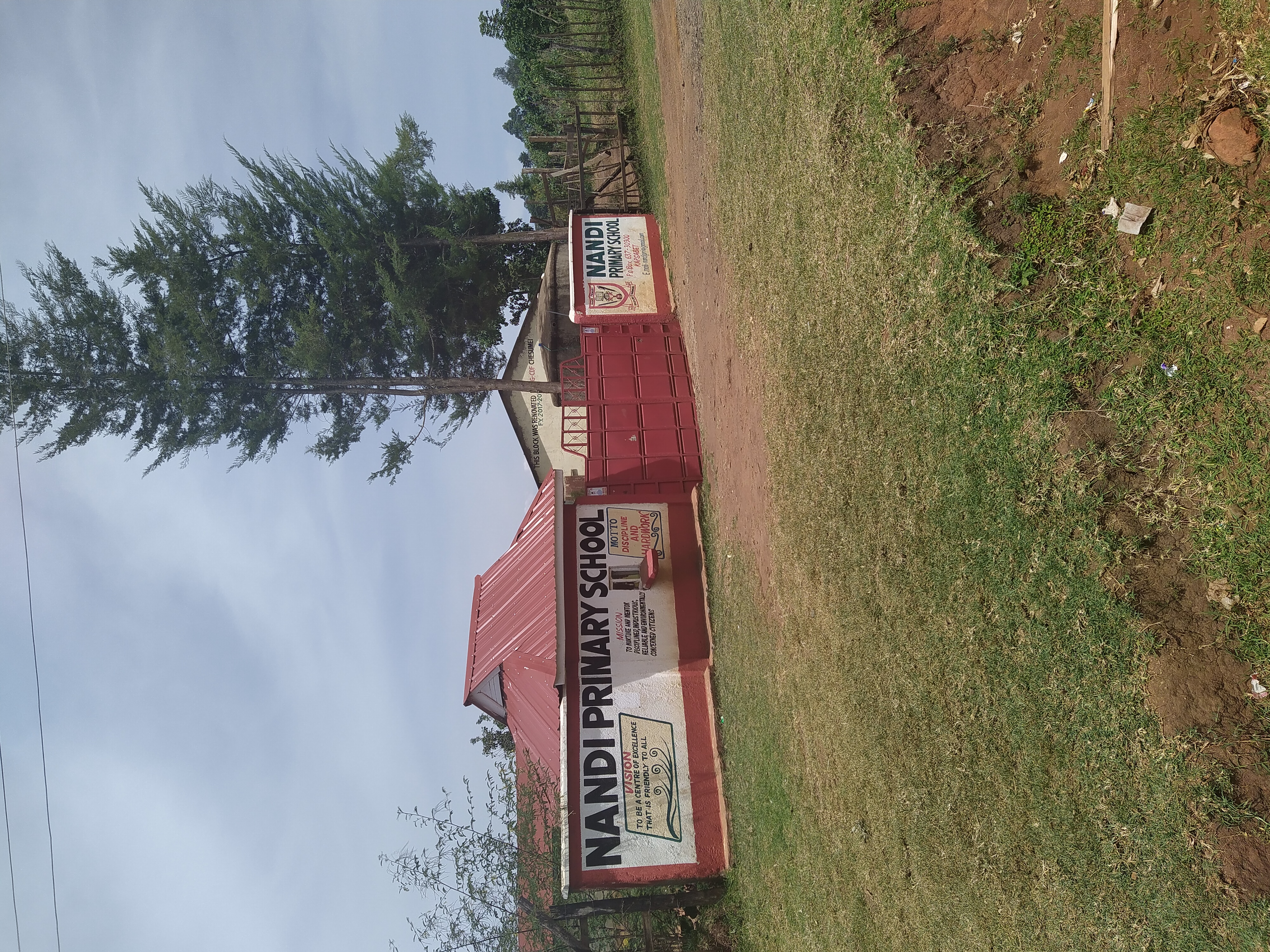
There are 443 primary education schools and 80 secondary education schools in Nandi.
Kapsabet Boys High school, situated in Kapsabet and founded in 1925, is a prominent national school. Its list of alumni includes cabinet ministers such as Nicholas Biwott, Kipruto Arap Kirwa, Henry Kosgey and William Arap Ruto who is currently the Kenyan President. Sports stars such as Julius Yego went here and a former President of Kenya, Daniel Arap Moi.
Health
There are three hospitals, 45 dispensaries, and 9 health care centers in Nandi. It has a doctor to population ratio of 1:94,000
References
Exteran link
References
- "Kenya Census 2009".
- "Kenya". [[USAID]].
- VisionPlus. "LOCAL GOVERNMENTS & COUNTIES".
- Hollis, A.C. (1909). "The Nandi – Their Language and Folklore". The Clarendon Press.
- Museums Trustees of Kenya. (1910). "The Journal of the East Africa and Uganda Natural History Society". East Africa and Uganda Natural History Society.
- "Full text of "Remarks upon the history of the Nandi till 1850"".
- [http://www.citypopulation.de/php/kenya-admin.php Kenya: Administrative Division population statistics]
- "2019 Kenya Population and Housing Census Volume IV: Distribution of Population by Socio-Economic Characteristics".
- Bwayo, Philip. (22 December 2020). "Tea farmers hit hard as glut overwhelms Nandi factories". Nation Media Group.
- . (17 February 2022). ["Nandi grain farmers receive Kshs 12.2M compensation"](https://kilimonews.co.ke/counties/nandi-grain-farmers-receive-kshs-12-2m-compensation). *Kilimo News*.
- Matoke, Tom. (3 June 2022). "Nandi farmers oppose imports of dairy products, want school milk reintroduced". Nation media Group.
- Irungu, J. (6 August 2026). "Nandi County Rejuvenates Dairy Farming with Strategic Plan". Seed Farm Eco Products.
- . ["About Us"](https://nandidairyunion.com/about-us). *Nandi Dairy Cooperative Union*.
- . (27 August 2025). ["Nandi's dairy revolution gains momentum as modern processing plant launched"](https://saccoreview.co.ke/nandis-dairy-revolution-gains-momentum-as-modern-processing-plant-launched). *Shrend Publishers and Supplies Ltd*.
- Mwende, Sharon. (16 January 2024). "Ruto commissions chicken slaughterhouse in Nandi". The Star.
- Butia, Remmy. (4 August 2025). "Nandi Textile Unit Mosoriot: Where Vision Weaves Quality Stitching Pride into Every Dress". County Government of Nandi.
- "Koitalel Samoei Arap Turgat Memorial".
- "Directory".
- Where to visit in Nandi County, Nandi County News, The Sailor
- "Kapsabet Boys – Strive to Excel".
- "GROWING HOPE: HEALTH SERVICES IN NANDI ARE EXPANDING".
This article was imported from Wikipedia and is available under the Creative Commons Attribution-ShareAlike 4.0 License. Content has been adapted to SurfDoc format. Original contributors can be found on the article history page.
Ask Mako anything about Nandi County — get instant answers, deeper analysis, and related topics.
Research with MakoFree with your Surf account
Create a free account to save articles, ask Mako questions, and organize your research.
Sign up freeThis content may have been generated or modified by AI. CloudSurf Software LLC is not responsible for the accuracy, completeness, or reliability of AI-generated content. Always verify important information from primary sources.
Report