From Surf Wiki (app.surf) — the open knowledge base
Nanchang
Capital of Jiangxi, China
Capital of Jiangxi, China
| Field | Value | |
|---|---|---|
| <!-- Basic info ----------------> | name | Nanchang |
| native_name | 南昌市 | |
| native_name_lang | zh | |
| nicknames | Hongcheng (洪城 lit. Grand City), Hongdu (洪都 lit. Grand Metropolis), Yuzhang (豫章) | |
| settlement_type | Prefecture-level city | |
| total_type | ||
| motto | ||
| image_skyline | {{multiple image | |
| border | infobox | |
| total_width | 280 | |
| image_style | border:1; | |
| perrow | 1/3/1 | |
| image1 | Nanchang Skyline.jpg | |
| caption1 | Nanchang Skyline, with the Pavilion of Prince Teng in the front | |
| image2 | Nanchang sunrise.jpg | |
| caption2 | Sunrise in Nanchang | |
| image3 | Nanchang Xinsijun Junbu Jiuzhi 20120608-02 (cropped).jpg | |
| caption3 | New Fourth Army Headquarters | |
| image4 | StarOfNanchang20070718.jpg | |
| caption4 | Star of Nanchang | |
| image5 | Nanchang Bayi Guangchang 20120723-20 (cropped).jpg | |
| caption5 | Bayi Square | |
| image_map | ||
| image_map1 | Location of Nanchang Prefecture within Jiangxi (China).png | |
| map_caption1 | Location of Nanchang City jurisdiction in Jiangxi | |
| pushpin_map | Eastern China#China | |
| pushpin_map_caption | Location in eastern China | |
| pushpin_mapsize | ||
| subdivision_type | Country | |
| subdivision_name | China | |
| subdivision_type1 | Province | |
| subdivision_name1 | Jiangxi | |
| subdivision_type2 | County-level divisions | |
| subdivision_name2 | 6 districts, 3 counties | |
| seat_type | Municipal seat | |
| seat | Honggutan District | |
| parts_style | ||
| parts | ||
| p2 | ||
| government_type | Prefecture-level city | |
| governing_body | Nanchang Municipal People's Congress | |
| leader_title | CCP Secretary | |
| leader_name | Wu Xiaojun | |
| leader_title1 | Congress Chairman | |
| leader_name1 | Wu Weizhu | |
| leader_title2 | Mayor | |
| leader_name2 | Ge Guangming | |
| leader_title3 | CPPCC Chairman | |
| leader_name3 | Liu Jiafu | |
| area_total_km2 | 7194 | |
| area_metro_km2 | 4,588 | |
| area_blank1_km2 | ||
| elevation_footnotes | ||
| elevation_m | 37 | |
| elevation_ft | 122 | |
| elevation_min_m | ||
| population_as_of | 2020 census | |
| population_footnotes | ||
| population_total | 6,255,007 | |
| population_density_km2 | auto | |
| population_metro | 5,382,162 | |
| population_density_metro_km2 | auto | |
| area_urban_km2 | 686 | |
| population_urban | 3,929,660 | |
| population_density_urban_km2 | auto | |
| demographics_type2 | GDP | |
| demographics2_title1 | Prefecture-level city | |
| demographics2_info1 | CN¥ 780.04 billion | |
| US$ 109.53 billion | ||
| demographics2_title2 | Per capita | |
| demographics2_info2 | CN¥ 117,843 | |
| US$ 16,547 | ||
| <!-- General information ---------------> | timezone | CST |
| utc_offset | +8 | |
| coor_pinpoint | Nanchang municipal government | |
| coordinates | ||
| postal_code_type | Postal code | |
| postal_code | 330000 | |
| iso_code | CN-JX-01 | |
| blank_name | Licence plate prefixes | |
| blank_info | 赣A, 赣M | |
| blank1_name | City Flower | |
| blank1_info | Chinese Rose | |
| blank2_name | City Tree | |
| blank2_info | Camphor Laurel | |
| website |
Default is list if up to 5 items, coll if more than 5-- tags-- US$ 109.53 billion US$ 16,547
Nanchang is the capital of Jiangxi, China. Located in the north-central part of the province and in the hinterland of Poyang Lake Plain, it is bounded on the west by the Jiuling Mountains, and on the east by Poyang Lake. Because of its strategic location connecting the prosperous East and South China, it has become a major railway hub in Southern China in recent decades.
As the Nanchang Uprising in 1927 is distinctively recognized by the ruling Communist Party as "firing the first gunshot against the Nationalists", the current government has therefore named the city since 1949 "the place where the People's Liberation Army was born", and the most widely known "place where the military banner of the People's Liberation Army was first raised".
Nanchang is also a major city, appearing among the top 100 cities in the world by scientific research outputs, as tracked by the Nature Index and home to Nanchang University.
History


Imperial era
The territories encompassing modern-day Jiangxi Province—including Nanchang—was first incorporated into China during the Qin dynasty, when it was conquered from the Baiyue peoples and organized as Jiujiang Commandery (). In 201 BC, during the Han dynasty, the city was given the Chinese name Nanchang and became the administrative seat of Yuzhang Commandery (), and was governed by Guan Ying, one of Emperor Gaozu of Han's generals. The name Nanchang means "southern flourishing", derived from a motto of developing what is now southern China that is traditionally attributed to Emperor Gaozu himself.
In AD 589, during the Sui dynasty, this commandery was changed into a prefecture named Hongzhou (), and after 763 it became the provincial center of Jiangxi, which was then beginning the rapid growth that by the 12th century made it the most populous province in China.
In 653 the Tengwang Pavilion was constructed, and in 675 Wang Bo wrote the classic "Tengwang Ge Xu", a poetic introductory masterpiece celebrating the building, making the building, the city, and the author himself known to literate Chinese-speaking population ever since. The Pavilion has been destroyed and rebuilt several times throughout history. Its present form was reconstructed in the 1980s after being destroyed in 1929 during the Chinese Civil War.
In 959, under the Southern Tang regime, Nanchang was made superior prefecture and the southern capital. After the conquest by the Song regime in 981 it was reverted to the name Hongzhou. In 1164 it was renamed Longxing prefecture, which name it retained until 1368. During the Yuan dynasty it was the capital of Jiangxi Province, an area that included Guangdong as well. At the end of the Yuan (Mongol) period (1279–1368), it became a battleground between Zhu Yuanzhang, the founder of the Ming dynasty (1368–1644), and the rival local warlord, Chen Youliang. At the beginning of the 16th century, it was the power base from which Zhu Chenhao, the Prince of Ning, launched a rebellion against the emperor.
During the Yuan Dynasty, it might have been the centre of porcelain trade.
During the reign of the Wanli Emperor of the Ming dynasty, it housed relatives of the emperor who had been exiled because they were potential claimants of the imperial throne, members of the imperial family constituting about one quarter of the city's population; as a result of this, Matteo Ricci came here when trying to gain entry to Beijing.
In the 1850s it suffered considerably as a result of the Taiping Rebellion (1850–64), and its importance as a commercial centre declined as the overland routes to Canton were replaced by coastal steamship services in the latter half of the 19th century. Nanchang has, however, remained the undisputed regional metropolis of Jiangxi.
Republican era
On August 1, 1927, Nanchang was the site of one of a series of insurrections organized by the communists. The Nanchang Uprising, led by pro-communist Kuomintang officers under Soviet direction, succeeded in holding the city for only a few days, and provided a core of troops and a method of organization from which the People's Liberation Army (PLA) later developed.
In 1939, the Battle of Nanchang, a ferocious battle between the Chinese National Revolutionary Army and the Imperial Japan Army in the Second Sino-Japanese War took place. After the Battle of Wuhan, the Chinese National Revolutionary Army took control of the Nanchang-Jiujiang railway. This action successfully stopped the Imperial Japan Army and blocked them in the north of Xiushui. On March 17, 1939, the 38th year of the Republic, the Imperial Japanese Army launched its brutal attack on the city of Nanchang. With the Chinese National Revolutionary Army's fightback, the Battle of Nanchang commenced. Overall, the Battle of Nanchang led to more than 80,000 Chinese National Revolutionary Army soldiers being wounded or killed, and the Imperial Japan Army has more than 20,000 casualties.
People's Republic era
By 1949, Nanchang was still essentially an old-style administrative and commercial city, with little industry apart from food processing; it had a population of about 275,000. Nanchang first acquired a rail connection in 1915, only connecting to the port city of Jiujiang by the Yangtze. Several other rail links have since been opened. After World War II a line was completed to Linchuan and Gongqi in the Ru River Valley to the south-southeast.
Since 1949, Nanchang has been extensively industrialized. It is now a large-scale producer of cotton textiles and cotton yarn. Paper making is also a major industry, as is food processing (especially rice milling). Heavy industry began to gain prominence in the mid-1950s. A large thermal-power plant was installed and uses coal brought by rail from Fengcheng to the south. A machinery industry also grew up, at first mainly concentrating on the production of agricultural equipment and diesel engines. Nanchang then became a minor centre of the automotive industry in China, producing trucks and tractors and also accessories such as tires. An iron-smelting plant helping to supply local industry was installed in the later 1950s. There is also a large chemical industry, producing agricultural chemicals and insecticides as well as pharmaceuticals.
Geography

Nanchang is located in inland southeastern China, 130 km south of the Yangtze River and is situated on the right bank of the Gan River just below its confluence with the Jin River and some 40 km southwest of its discharge into Poyang Lake.

Climate
| Nanchang | 2.7| 8.7| 74 | 4.4|10.4|101 | 8.2|14.6|176 |14.3|21.2|224 |19.2|26.3|244 |22.8|29.4|307 |25.8|33.4|144 |25.6|33.0|129 |21.6|28.7| 69 |16.3|23.7| 60 |10.1|17.6| 57 | 4.6|12.1| 42 Nanchang has a humid subtropical climate (Köppen Cfa) with four distinct seasons. Winters are short and cool with occasional frosts; it begins somewhat sunny and dry but becomes progressively wetter and more overcast. Spring begins especially gloomy, and from April to June, each month has more than 220 mm of rainfall. Summer is long and humid, with amongst the highest temperatures of any Chinese provincial capital, and with the sun shining close to 60 percent of the time in July and August, is the sunniest time of year. Autumn is warm to mild with the lowest rainfall levels of the year. The monthly 24-hour average temperature ranges from 5.9 °C in January to 29.6 °C in July, while the annual mean is 18.5 °C. Annual precipitation stands at around 1704 mm; with monthly percent possible sunshine ranging from 27 percent in March to 56 percent in August, the city receives 1,809 hours of sunshine annually in average. Extremes since 1951 have ranged from −9.7 °C on 29 December 1991 to 40.6 °C on 23 July 1961.
| Jan record high C = 25.3 | Feb record high C = 28.7 | Mar record high C = 33.3 | Apr record high C = 34.6 | May record high C = 36.5 | Jun record high C = 37.7 | Jul record high C = 40.6 | Aug record high C = 39.7 | Sep record high C = 38.7 | Oct record high C = 38.6 | Nov record high C = 32.3 | Dec record high C = 26.1 | Jan record low C = −7.7 | Feb record low C = -9.3 | Mar record low C = −1.7 | Apr record low C = 2.4 | May record low C = 10.0 | Jun record low C = 14.8 | Jul record low C = 18.9 | Aug record low C = 19.5 | Sep record low C = 13.3 | Oct record low C = 3.5 | Nov record low C = −0.8 | Dec record low C = −9.7 |script-title = zh:CMA台站气候标准值(1991-2020)
As of the 2020 Chinese census, Nanchang had a population of 6,255,007, of which 5,382,162 lived in built-up (urbanized) area consisting of 6 urban districts plus Nanchang County largely being urbanized. 37 ethnic groups were counted amongst its prefecture divisions while 99.2% are Han chinese. The sex ratio in Nanchang is approximately 109 males to 100 females. The aged group (above 60) counts for 14.97% of the entire population.
Administration

| Map | Division code | English | Chinese | Pinyin | Area in km2 | Seat | Postal code | Subdivisions | Subdistricts | Towns | Townships | Residential communities | Villages | 360100 | Nanchang | 360102 | Donghu District | 360103 | Xihu District | 360104 | Qingyunpu District | 360111 | Qingshanhu District | 360112 | Xinjian District | 360113 | Honggutan District | 360121 | Nanchang County | 360123 | Anyi County | 360124 | Jinxian County |
|---|---|---|---|---|---|---|---|---|---|---|---|---|---|---|---|---|---|---|---|---|---|---|---|---|---|---|---|---|---|---|---|---|---|
| 南昌市 | zh | 7194 | Honggutan District | 330000 | 32 | 49 | 31 | 625 | 1161 | ||||||||||||||||||||||||
| 东湖区 | zh | 30 | Gongyuan Subdistrict (公园街道) | 330000 | 9 | 159 | 21 | ||||||||||||||||||||||||||
| 西湖区 | zh | 43 | Chaoyangzhou Subdistrict (朝阳洲街道) | 330000 | 10 | 1 | 136 | 13 | |||||||||||||||||||||||||
| 青云谱区 | zh | 40 | Sanjiadian Subdistrict (三家店街道) | 330000 | 5 | 1 | 63 | 12 | |||||||||||||||||||||||||
| 青山湖区 | zh | 250 | Jingdong (京东镇) | 330000 | 3 | 6 | 116 | 101 | |||||||||||||||||||||||||
| 新建区 | zh | 2160 | Changleng (长堎镇) | 330100 | 10 | 9 | 39 | 300 | |||||||||||||||||||||||||
| 红谷滩区 | zh | Shajing Subdistrict (沙井街道) | 330100 | 2 | 1 | ||||||||||||||||||||||||||||
| 南昌县 | zh | 1811 | Liantang (莲塘镇) | 330200 | 11 | 7 | 47 | 311 | |||||||||||||||||||||||||
| 安义县 | zh | 660 | Longjin (龙津镇) | 330500 | 7 | 3 | 16 | 105 | |||||||||||||||||||||||||
| 进贤县 | zh | 1946 | Minhe (民和镇) | 331700 | 9 | 2 | 37 | 263 |
- Honggutan New District (红谷滩新区) is an economic management area and not a formal administrative division.
Economy

Nanchang is a regional hub for agricultural production in Jiangxi province with its grain yield being 16.146 million tons in 2000. Products such as rice and oranges are economic staples. The Ford Motor Company has a plant in Nanchang, assembling the Ford Transit van as part of the Jiangling Motor joint venture. Much of its industry revolves around aircraft manufacturing, automobile manufacturing, metallurgy, electro-mechanics, textile, chemical engineering, traditional Chinese medicine, pharmaceuticals and others. Nanchang has a rapid economic development and ranks 15th among the fastest growing 20 cities in the world. It is one of the cities with the most potential for development in China and the world in the future.
In 2017, the city's gross regional product (GDP) was 500.319 billion yuan (US$80.03 billion), an increase of 9.0% over the previous year. The primary industry's added value was 19.213 billion yuan, an increase of 4.0%; the secondary industry's added value was 266.61 billion yuan, an increase of 8.4%; The added value of the three industries was 214.496 billion yuan, an increase of 10.2%. The per capita GDP of 81,598 yuan was converted to 12,285 US dollars according to the average annual exchange rate. Additionally, the total fiscal revenue for the year was 78.282 billion yuan, an increase of 14.3% over the previous year.

The GDP of Nanchang in 2008 was 166 billion Yuan (US$24.3 billion). The GDP per capita was 36,105 Yuan (US$5,285). The total value of imports and exports was 3.4 billion US dollars. The total financial revenue was 23 billion Yuan.
Industrial zones
National level development zones
- Nanchang Export Processing Zone Nanchang National Export Expressing Zone is located in Nanchang Hi-Tech Industrial Development Zone, it was approved by the State Council on May 8, 2006, and passed the national acceptance inspection on Sep 7th, 2007. It has a planning area of 1 km2 and now has built 0.31 km2. It enjoys simple and convenient customs clearances, and special preferential policies both for Nanchang National Export Expressing Zone and NCHDZ.
- Nanchang National High-tech Industrial Development Zone Nanchang National High-tech Industrial Development Zone (NCHDZ for short hereafter) is the only national grade high-tech zoned in Jiangxi, it was established in Mar. 1991. The zone covers an area of 231 km2, in which 32 km2 have been completed. NCHDZ possesses unique nature condition and sound industry foundation of accepting electronics industry. NCHDZ has brought 25 percent industrial added value and 50 percent industrial benefit and tax to Nanchang city by using only 0.4 percent land area.
- Nanchang Economic and Technological Development Zone
Provincial level development zones
- Jiangxi Shanghai Economic and Technological Development Zone
- Nanchang Yingxiong Economic and Technological Development Zone
Special economic district
- Honggutan New District GanJiang New District
Transportation
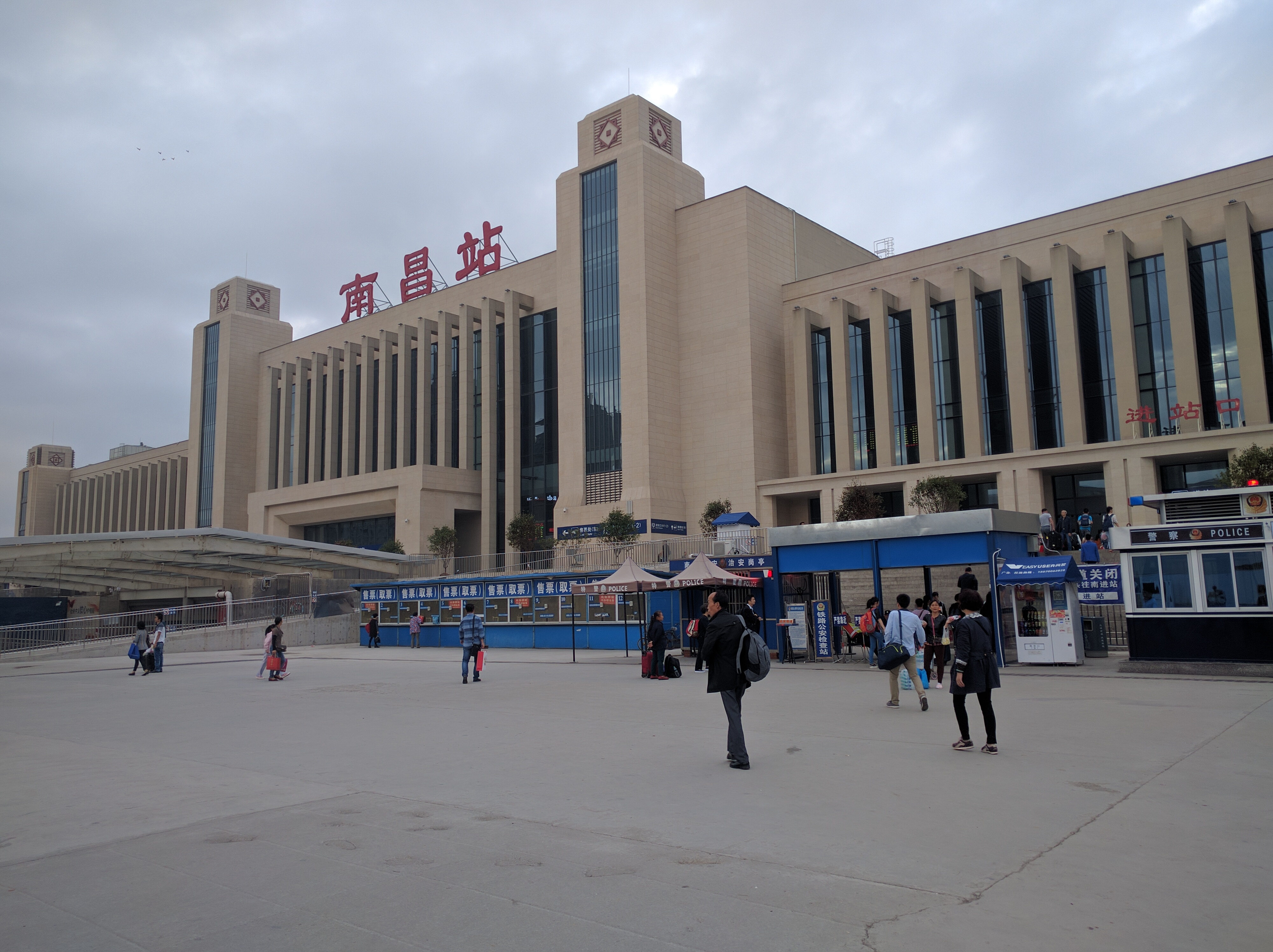
Nanchang has an advantageous geographic location and convenient transportation. It is praised as the “three rivers and five lakes, and the control of the finer and better lakes”. It relies on high-speed railways and aviation hubs to connect three important economic circles (Yangtze River Delta, Pearl River Delta, Inter-provincial traffic corridors in Haixi District). Nanchang is one of the country's comprehensive transportation hubs and one of the most important integrated transportation hubs in Jiangxi.
Rail
The Nanchang is an important rail hub for southeastern China. The Beijing–Kowloon (Jingjiu) Railway, Shanghai–Kunming railway (formerly Zhejiang–Jiangxi or Zhegan Railway), Xiangtang–Putian railway and Nanchang–Jiujiang intercity railway converge in Nanchang. Nanchang's Bureau of Railways operates much of the railway network in Jiangxi and neighbouring Fujian province. The Nanchang railway station and the Nanchang West railway station are the primary passenger rail stations of the city. Nanchang is connected to Hangzhou, Changsha and Shanghai via CRH (China Railway High-speed) service.
Air

Nanchang Changbei International Airport (KHN) built in 1996 is the main international airport. It is situated in Lehua Town, 26 kilometres north of the CDB area. Changbei International Airport is the only one in Jiangxi Province which has an international air route. The airport is connected to major mainland cities such as Shenzhen, Guangzhou, Haikou, Shanghai and Beijing. There is a military/civilian airport near Liantang, Nanchang County.
Nanchang Changbei International Airport is the largest airport in Jiangxi Province. In 2014, Nanchang Changbei Airport opened up to 10 international destinations. The airport handled 7.25 million passengers in 2014, an increase of 6.3%. Among them, the Nanchang aviation port exceeded 280,000 passengers, an increase of nearly 40%, becoming the airport's traffic volume. The important force of growth, and will continue to maintain rapid development. On December 6, 2017, the annual passenger throughput of Nanchang Airport exceeded 10 million passengers, making it the nation's 31st “million-grade airport”. In 2017, passenger throughput reached 10.93 million, a year-on-year increase of 39.0%, a net increase of passenger throughput of 3.07 million passengers; flights took off and 89,000 vehicles, a year-on-year increase of 35.2%; and cargo and mail throughput of 52,000 tons, an increase of 3.3%. In order to cooperate with the construction of the Beijing-Kowloon high-speed railway and Nanchang North Station airport complex transportation hub, large-scale expansion and upgrades are being carried out recently.
Road
The road transport infrastructure in Nanchang is extensive. A number of national highways cross through the city. They are the National roads No.105 from Beijing to Zhuhai, No.320 from Shanghai to Kunming, and No.316 from Fuzhou to Lanzhou. The major transport companies that operate in Nanchang are the Chang'an Transport Company Limited, the Nanchang Long-distance Bus Station, and the Xufang Bus Station. National Highway G70 crosses through Nanchang. Nanchang also built its round-city highway G70_01 opening in 2007.
The Nanchang Long-distance Bus Station serves long-distance routes to Nanjing, Shenzhen, Hefei and other cities outside Jiangxi Province. The Xufang Bus Station operates routes to cities, towns and counties within Jiangxi Province.
Metro
Nanchang Rail Transit is the first rail transportation system in Jiangxi Province, and has been in service since 26 December 2015. Nanchang is the 25th city in mainland China to install a metro. The planning of Nanchang rail transit project started in 1999 and was officially started in 2009. The first phase of the No. 1 and No. 2 lines was 50,996 kilometers (the first line is the underground line). Line 1 was officially opened and operated at the end of 2015, and Line 2 of the “First Section” began trial operation on August 19, 2017.
Water
Nanchang is situated on the Gan River, the Fu River, Elephant Lake, Qingshan Lake, and Aixi Lake. Hence the water routes for Nanchang are critically important for the economy, trade and shipping. Nanchang Port is the biggest port on the Gan River. Passengers can take Nanchang Port and travel by boat to the Jinggang Shan and Tengwang Pavilion. There are passenger ships that also visit Poyang Lake, Stone Bell Hill, Poyang Lake Bird Protection Area, Dagu Hill and other attractions.
Landmarks

- Tengwang Pavilion, a towering pavilion dating to 653, on the east bank of the Gan River and is one of "the Four Great Towers of China"
- Poyang Lake, the largest fresh water lake in China, it is also called "the Migrator Birds Paradise".
- Star of Nanchang, which was the world's tallest Ferris wheel from 2006 to 2008, in Honggutan District
- Qiushui Square, established on 28 January 2004 with the largest music fountain group with music in Asia.
- Jiangxi Provincial Museum and Bada Shanren Exhibition Hall
- People's Park, the largest park in downtown Nanchang
- Bayi Square and Memorial, at the center of Nanchang, commemorates the founding of the People's Liberation Army during the Nanchang Uprising of 1 August (Ba Yi in Mandarin) in 1927, which led to the formation of the People's Republic of China in 1949.
- Bada Shanren Memorial Hall is a large artistic scenic museum that includes sculpted art, and a general art museum.
Education
Nanchang is also a major city, appearing among the top 100 cities in the world by scientific research outputs, as tracked by the Nature Index. Colleges and universities (note that institutions without full-time bachelor programs are not listed):
- Jiangxi University of Finance and Economics (江西财经大学)
- Nanchang University (南昌大学)
- [[File:Jiangxi Normal University.svg|thumb|Jiangxi Normal University]]Jiangxi Normal University (江西师范大学)
- Nanchang Hangkong University (南昌航空大学)
- Jiangxi Agricultural University (江西农业大学)
- East China Jiaotong University (华东交通大学)
- East China University of Technology, Nanchang Campus (东华理工大学)
- Jiangxi Institute of Traditional Chinese Medicine (江西中医学院)
- Nanchang Institute of Technology (南昌工程学院)
- Jiangxi Science and Technology Normal University (江西科技师范学院)
- Jiangxi Manufacturing and Vocational College (江西制造职业技术学院)
- Jiangxi University of Traditional Chinese Medicine (江西中医药大学)
High schools:
- Nanchang Foreign Language School (南昌市外国语学校)
- Jiangxi University of Technology High School (江西科技学院附属中学)
International schools:
- Nanchang International School (南昌国际学校)
Notable people
- Deng Chao (born 1979), actor
- François Cheng (born 1929), French academician
- Zhang Dinghuang (1895–1986), academic
- Grace Glenn (born 1998), American artistic gymnast
- Hu Hsen-Hsu (1894 – 1968), founder of plant taxonomy and pioneer of modern botany and paleobotany in China
- Cheng Maoyun (1900 – 1957), composer of the National Anthem of the Republic of China
- Duan Yongping (born 1961), Chinese-American entrepreneur
- Zhi Yueying (born 1961), educator
Sport
Nanchang is the site of Jiangxi International Women's Tennis Open.
Friendship cities
- New Zealand Whakatāne, New Zealand
- North Macedonia Skopje, North Macedonia
- Japan Takamatsu, Japan
- Spain Albacete, Spain
- Australia Perth, Australia
Notes
References
- ; 247 pages
References
- "China: Jiāngxī (Prefectures, Cities, Districts and Counties) - Population Statistics, Charts and Map".
- (February 22, 2025). "zh:2024年南昌市常住人口增加10.22万人". Nanchang.gov.
- "Nanchang". [[Oxford University Press]].
- Schwartz, Benjamin, ''Chinese Communism and the Rise of Mao'', Harper & Row (New York: 1951), p. 93.
- "Leading 200 science cities {{!}} {{!}} Supplements {{!}} Nature Index".
- [[Shanghai Lexicographical Publishing House]]. (2006)
- Wang: 236-246.
- Wang: 1.
- Wang: 31.
- "Wang Dayuan - Singapore History".
- Mary Laven, Mission to China: Matteo Ricci and the Jesuit Encounter with the East, {{ISBN. 0-571-22517-9, 2011, p. 103
- Hsu Long-hsuen and Chang Ming-kai, ''History of the Sino-Japanese War (1937–1945)'', 2nd Ed., 1971. Translated by Wen Ha-hsiung, Chung Wu Publishing; 33, 140th Lane, Tung-hwa Street, Taipei, Taiwan Republic of China. pp. 293-300 Map. 14-15
- Peattie, M., Drea, E. & Ven, H. (2011). ''The battle for China : essays on the military history of the Sino-Japanese War of 1937-1945''. Stanford, Calif: Stanford University Press.
- http://surfcity.kund.dalnet.se/sino-japanese.htm {{Webarchive. link. (2015-08-13 Sino-Japanese Air War 1937–45)
- "无标题文档".
- link. [[China Meteorological Administration]]
- "Main Data of the Seventh National Population Census".
- "Modern Urban District - Nanchang Municipal People's Government".
- link. [[National Bureau of Statistics of the People's Republic of China]]. (2012)
- {{lang. zh-Hans. 《贵阳统计年鉴2011》{{full citation needed. (May 2020)
- {{lang. zh-Hans. 《中国民政统计年鉴2011》{{full citation needed. (May 2020)
- 7432.18 km2 according to the [[Ministry of Land and Resources of the People's Republic of China. Ministry of Land and Resources]].{{citation needed. (May 2020)
- "Jiangling Motors Corporation, Ltd. website".
- [http://english.nc.gov.cn/aboutnanchang/economy/] {{webarchive. link. (April 14, 2010)
- "Jiangxi". Unescap.org.
- "NanChang China". English.nc.gov.cn.
- "Nanchang Export Processing Zone". RightSite.asia.
- "Nanchang High-Tech Industrial Development Zone". RightSite.asia.
- "Nanchang Economic & Technological Development Zone". RightSite.asia.
- "Nanchang Transportation, Get to the City: by Air, Train, Bus, Water". Travelchinaguide.com.
- "China claims world's largest Ferris wheel - Boston.com".
- link. Xinhua. (2008-04-01)
- (1 April 2022). "The Founder of Plant Taxonomy in China: HU Hsen-Hsu". Protein & Cell.
- (Winter 2002). ""Republic of China National Anthem" on Taiwan: One Anthem, One Performance, Multiple Realities". Ethnomusicology.
- 张辉. "Zhi Yueying: Nurturing Children in the Mountain".
- (14 March 2017). "WTA". WTA Tennis.
This article was imported from Wikipedia and is available under the Creative Commons Attribution-ShareAlike 4.0 License. Content has been adapted to SurfDoc format. Original contributors can be found on the article history page.
Ask Mako anything about Nanchang — get instant answers, deeper analysis, and related topics.
Research with MakoFree with your Surf account
Create a free account to save articles, ask Mako questions, and organize your research.
Sign up freeThis content may have been generated or modified by AI. CloudSurf Software LLC is not responsible for the accuracy, completeness, or reliability of AI-generated content. Always verify important information from primary sources.
Report