From Surf Wiki (app.surf) — the open knowledge base
Nambu Line
Railway line in Japan
Railway line in Japan
| Field | Value | |
|---|---|---|
| name | Nambu Line | |
| native_name | 南武線 | |
| native_name_lang | ja | |
| color | ||
| logo | ||
| image | Series-E233-8000-N4.jpg | |
| image_width | 300px | |
| caption | The Nambu Line E233-8000 series EMU in October 2020 | |
| type | Commuter rail | |
| locale | Tokyo, Kanagawa prefectures | |
| start | ||
| end | ||
| stations | 26 (main line), 3 (branch line) | |
| daily_ridership | 840,241 (daily 2015) | |
| open | ||
| owner | [[File:JR logo (east).svg | 23px]] JR East |
| depot | Nakahara | |
| stock | 205-1000 series, E127-0 series, E233-8000 series, E233-8500 series | |
| linelength | 45.0 km | |
| tracks | Double-track | |
| gauge | ||
| electrification | 1,500 V DC overhead catenary | |
| speed | 95 km/h | |
| trainprotection | ATS-S | |
| map | [[File:JR Nambu Line linemap.svg | 200px]] |
| map_state | collapsed |
The Nambu Line () is a Japanese railway line which connects Tachikawa Station in Tachikawa, Tokyo and Kawasaki Station in Kawasaki, Kanagawa. For most of its length, it parallels the Tama River, the natural border between Tokyo and Kanagawa prefectures. It lies along the Tama Hills. It is part of the East Japan Railway Company (JR East) network. The line forms part of what JR East refers to as the "Tokyo Mega Loop" () around Tokyo, consisting of the Keiyo Line, Musashino Line, Nambu Line, and the Yokohama Line. The name refers to the southern () part of the ancient province of Musashi () (now Tokyo and northern Kanagawa prefecture), through which the Nambu Line runs.
Basic data
- Operators, distances:
- Total: 45.0 km
- Passenger: 39.6 km
- Freight: 39.4 km
- East Japan Railway Company (JR East) (Services and tracks)
- Kawasaki – Tachikawa: 35.5 km
- Shitte – Hama-Kawasaki: 4.1 km
- Shitte – Shin-Tsurumi Signal Station – Tsurumi: 5.4 km (no regular service)
- Japan Freight Railway Company (JR Freight) (Services only)
- Shitte – Tachikawa: 33.8 km
- Shitte – Hama-Kawasaki: 4.1 km
- Shitte – Shin-Tsurumi Signal Station: 1.5 km
- Total: 45.0 km
- Stations: 29
- Main line: 26
- Branch line: 3
- Double-tracking: Kawasaki – Tachikawa
- Railway signalling: Automatic Block System
Station list
Main line
"Rapid" service trains (two trains per hour between 10 a.m. and 4 p.m) do not stop at Shitte, Yakō, Hirama, Mukaigawara, Tsudayama, Kuji, Shukugawara, Nakanoshima, Yanokuchi, Minami-Tama, Nishifu, Yaho, Yagawa, or Nishi-Kunitachi. All other trains except for some seasonal services are "Local" services, stopping at all stations.
| No. | Station | Japanese | Distance (km) | Rapid | Transfers | Location | Prefecture | Between | ||
|---|---|---|---|---|---|---|---|---|---|---|
| stations | Total | |||||||||
| 川崎 | - | 0.0 | ● | Tōkaidō Main Line | Kawasaki-ku, Kawasaki | Kanagawa | ||||
| 尻手 | 1.7 | 1.7 | | | Nambu Branch Line (for ) | Saiwai-ku, Kawasaki | |||||
| 矢向 | 0.9 | 2.6 | | | Tsurumi-ku, Yokohama | ||||||
| 鹿島田 | 1.5 | 4.1 | ● | Yokosuka Line | Saiwai-ku, Kawasaki | |||||
| 平間 | 1.2 | 5.3 | | | Nakahara-ku, Kawasaki | ||||||
| 向河原 | 1.3 | 6.6 | | | |||||||
| 武蔵小杉 | 0.9 | 7.5 | ● | Yokosuka Line | ||||||
| 武蔵中原 | 1.7 | 9.2 | ● | |||||||
| 武蔵新城 | 1.3 | 10.5 | ● | |||||||
| 武蔵溝ノ口 | 2.2 | 12.7 | ● | Tokyu Den-en-toshi Line | Takatsu-ku, Kawasaki | |||||
| 津田山 | 1.2 | 13.9 | | | |||||||
| 久地 | 1.0 | 14.9 | | | |||||||
| 宿河原 | 1.3 | 16.2 | | | Tama-ku, Kawasaki | ||||||
| 登戸 | 1.1 | 17.3 | ● | Odakyu Odawara Line | ||||||
| 中野島 | 2.2 | 19.5 | | | |||||||
| 稲田堤 | 1.3 | 20.8 | ● | Keio Sagamihara Line () | ||||||
| 矢野口 | 1.6 | 22.4 | | | Inagi | Tokyo | |||||
| 稲城長沼 | 1.7 | 24.1 | ● | |||||||
| 南多摩 | 1.4 | 25.5 | | | [[File: SeibuTamagawa.svg | 18px]] Seibu Tamagawa Line () | |||||
| 府中本町 | 2.4 | 27.9 | ● | Musashino Line | Fuchū | |||||
| 分倍河原 | 0.9 | 28.8 | ● | Keiō Line | ||||||
| 西府 | 1.2 | 30.0 | | | |||||||
| 谷保 | 1.6 | 31.6 | | | Kunitachi | ||||||
| 矢川 | 1.4 | 33.0 | | | |||||||
| 西国立 | 1.3 | 34.3 | | | Tachikawa | ||||||
| 立川 | 1.2 | 35.5 | ● | Chūō Main Line |
Nambu Branch Line
- All stations are located in Kanagawa Prefecture.
- Trains can pass each other only at Kawasaki-Shinmachi.
| No. | Station | Japanese | Distance (km) | Transfers | Location | Between | |
|---|---|---|---|---|---|---|---|
| stations | Total | ||||||
| 尻手 | - | 0.0 | Nambu Line (main line) | Saiwai-ku, Kawasaki | |||
| 八丁畷 | 1.1 | 1.1 | Keikyu Main Line | Kawasaki-ku, Kawasaki | |||
| 川崎新町 | 0.9 | 2.0 | |||||
| 小田栄 | 0.7 | 2.7 | |||||
| 浜川崎 | 1.4 | 4.1 | Tsurumi Line |
Freight branch
The "Shitte crossover" connects Shitte Station and Shin-Tsurumi Yard on the Tōkaidō Main Line (Hinkaku Line) and the Musashino Line. Freight trains operating between Tokyo Freight Terminal and northern Japan operate on both branch lines.
Rolling stock
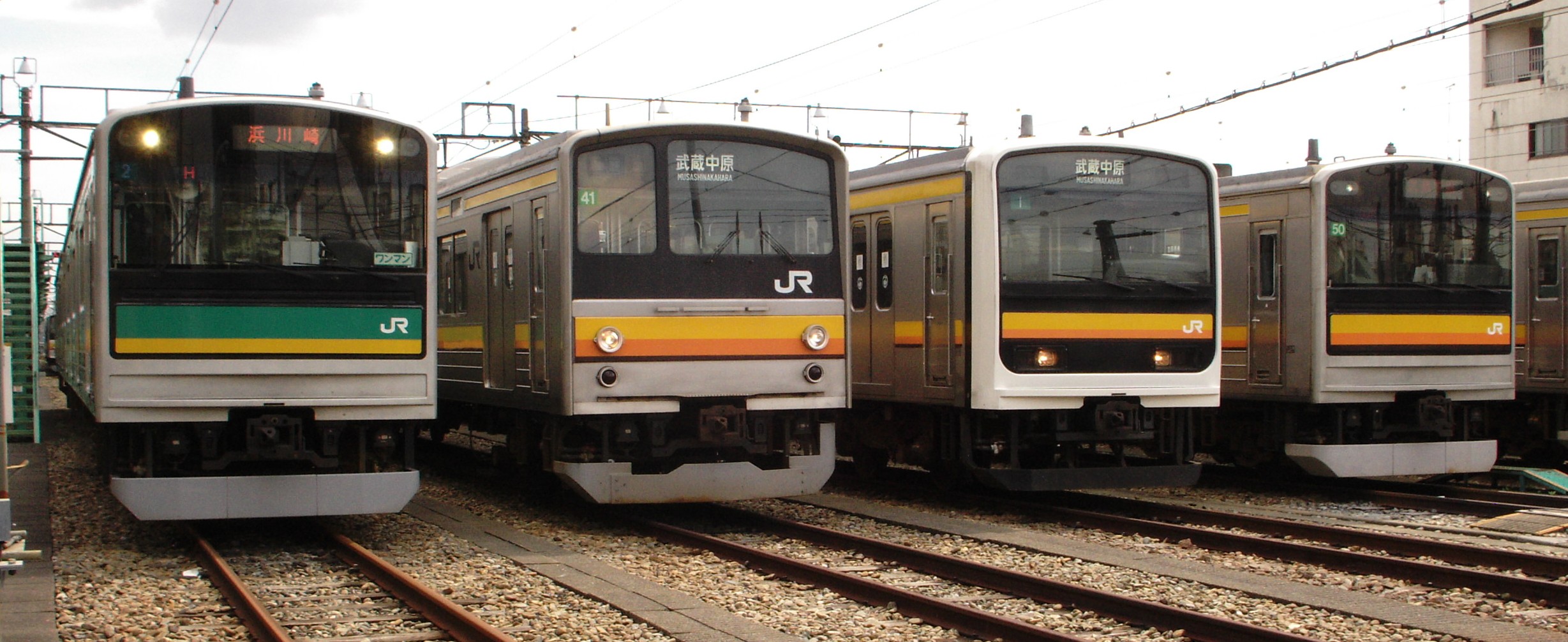
the following fleet of electric multiple unit (EMU) trains is used on Nambu Line services, with all trainsets based at Nakahara Depot.
- 205-1000 series 3 x 2-car EMUs (Nambu Branch Line services, since August 2002)
- E127-0 series 2 x 2-car EMUs (Nambu Branch Line services, since September 2023)
- E233-8000 series 35 x 6-car EMUs (since 4 October 2014)
- E233-8500 series 1 x 6-car EMU (since 15 March 2017)
From 15 March 2017, the last remaining 209 series trainset, set 53, was replaced by a six-car Ome Line and Itsukaichi Line E233-0 series set 670 modified and renumbered to become E233-8500 series set N36.
File:JRE-Series205-1000-4.jpg|A Nambu Branch Line 205-1000 series in May 2023 File:JRE Series-E127-0 V1.jpg|A Nambu Branch Line E127-0 series in January 2024 File:Series-E233-8000-N7.jpg|A Nambu Line E233-8000 series in October 2020
Previously used
- 72/73 series 4/6-car EMUs (from 1963 until 1978)
- 101 series 4/6-car EMUs (from 1969 until January 1991)
- 103 series 6-car EMUs (from 1982 until December 2004)
- 101 series 2-car EMUs (Nambu Branch line services, until November 2003)
- 205-0 series 6-car EMUs from (March 1989 until December 2015)
- 205-1200 series 6-car EMUs (from 2004 until January 2016)
- 209-0 series 6-car EMUs (from April 1993 until February 2015)
- 209-2200 series 6-car EMUs (from 2010 until March 2017)
File:73 Nambu Line Musashi-Mizonokuchi 19750119.jpg|A 73 series EMU on the Nambu Line in January 1975 File:101 Shitte 20020713.jpg|Nambu Branch Line 101 series in July 2002 File:103 set 21 Nambu Line Shukugawara 20010626.jpg|A Nambu Line 103 series in June 2001 File:Nanbu line 205kei Rapid.JPG|Nambu Line 205-0 series set 36 in April 2011 File:JR East 205-1200 set 46 Musashi-Nakahara 20141004.JPG|A Nambu Line 205-1200 series in October 2014 File:JRE 209-Naha1.jpg|A Nambu Line 209-0 series in January 2008 File:Nanbu line 209kei Rapid.JPG|A Nambu Line 209-2200 series in April 2011
History
The private Nambu Railway opened the line in five stages between 1927 and 1930 (freight branches are omitted):
- 27 March 1927: Kawasaki – Noborito
- 1 November 1927: Noborito – Ōmaru (near Minami-Tama)
- 11 December 1928: Ōmaru – Bubaigawara (then called Yashikibun)
- 11 December 1929: Bubaigawara – Tachikawa
- 25 March 1930: Shitte – Hama-Kawasaki
Passenger trains utilised electric multiple units (EMUs) from the beginning. Freight initially consisted primarily of gravel hauled from the Tama River. When the railway reached Tachikawa and made connection with the Ōme Electric Railway, limestone became one of the main freight commodities. The railway was controlled by Asano zaibatsu, which enabled the transport of limestone from its own quarry in Western Tokyo to its cement plant in Kawasaki without using the government railways.
On 1 April 1944, the railway was nationalised by the imperial government and became the Nambu Line of Japanese Government Railways. After the end of World War II, there were several calls for the privatisation of the line, but the line remained a part of the Japanese National Railways (JNR) until its privatization in 1987.
The postwar growth of the Tokyo urban area resulted in the conversion of most of the farmlands along the Nambu Line into residential areas and increased the passenger traffic on the line. Freight traffic reduced after the opening of the Musashino Line (parallel to the Nambu Line) in 1976 and the discontinuance of the limestone freight in 1998, except for the Nambu Branchline, which remains a major freight route.
Limited-stop "Rapid" services between Kawasaki and Noborito with stops at Musashi-Kosugi and Musashi-Mizonokuchi started on 15 December 1969, but were discontinued by the timetable revision on 2 October 1978. After 33 years, Rapid services between Kawasaki and Tachikawa with more stops started on 9 April 2011, postponed from the originally scheduled 12 March due to the 2011 Tōhoku earthquake and tsunami.
On 20 August 2016, station numbering was introduced with Nambu line stations being assigned station numbers between JN01 and JN26. Numbers increase towards in the westbound direction towards Tachikawa. In addition, station numbers JN51 to JN54 were assigned to the branch line stations with numbers increasing in the direction of Hama-Kawasaki.
From 15 March 2025, Nambu line started operation as "wanman" (One-man) driver-only operation.
References
References
- "平成27年 大都市交通センサス 首都圈報告書". 国土交通省.
- {{cite magazine. Saka. Masayuki. Kōtsū Shimbun. (August 2014)
- "川崎-立川 快速 4009F".
- Kotsu Shimbunsha. (16 November 2016)
- (2023-09-14). "". link. Koyusha Co., Ltd.
- "南武線(尻手~浜川崎駅間)へのE127系の投入について".
- link. (27 January 2017). Tetsudo Hobidas. Neko Publishing Co., Ltd.
- link. (10 December 2015). Japan Railfan Magazine Online. Koyusha Co., Ltd.
- {{Teishajo. II. 65-69
- Harada. (1999). "南武線いまむかし". Tamagawa Shinbunsha.
- link. Town News. (October 1, 2010)
- (April 9, 2011). "JR南武線快速ようやく運行スタート、旧国鉄時代以来33年ぶり". Kanagawa Shinbun.
- (6 April 2016). "⾸都圏エリアへ 「駅ナンバリング」を導⼊します".
- Kusamachi, Yoshikazu. (7 April 2016). "JA・JK・JT・AKB…JR東日本、首都圏で駅ナンバリングなど導入へ".
- "首都圏主要線区でワンマン運転を実施します".
This article was imported from Wikipedia and is available under the Creative Commons Attribution-ShareAlike 4.0 License. Content has been adapted to SurfDoc format. Original contributors can be found on the article history page.
Ask Mako anything about Nambu Line — get instant answers, deeper analysis, and related topics.
Research with MakoFree with your Surf account
Create a free account to save articles, ask Mako questions, and organize your research.
Sign up freeThis content may have been generated or modified by AI. CloudSurf Software LLC is not responsible for the accuracy, completeness, or reliability of AI-generated content. Always verify important information from primary sources.
Report