From Surf Wiki (app.surf) — the open knowledge base
Naiad
Female spirit or nymph in Greek mythology
Female spirit or nymph in Greek mythology
| Field | Value |
|---|---|
| name | Naiad |
| image | Naiad1.jpg |
| caption | A Naiad by John William Waterhouse, 1893; a water nymph approaches the sleeping Hylas. |
| Grouping | Nymphs |
| Sub_Grouping | Water spirit |
| Elemental | |
| Similar_entities | Mermaid |
| Huldra | |
| Selkie | |
| Siren | |
| Habitat | Any body of fresh water |
illustration Elemental Huldra Selkie Siren
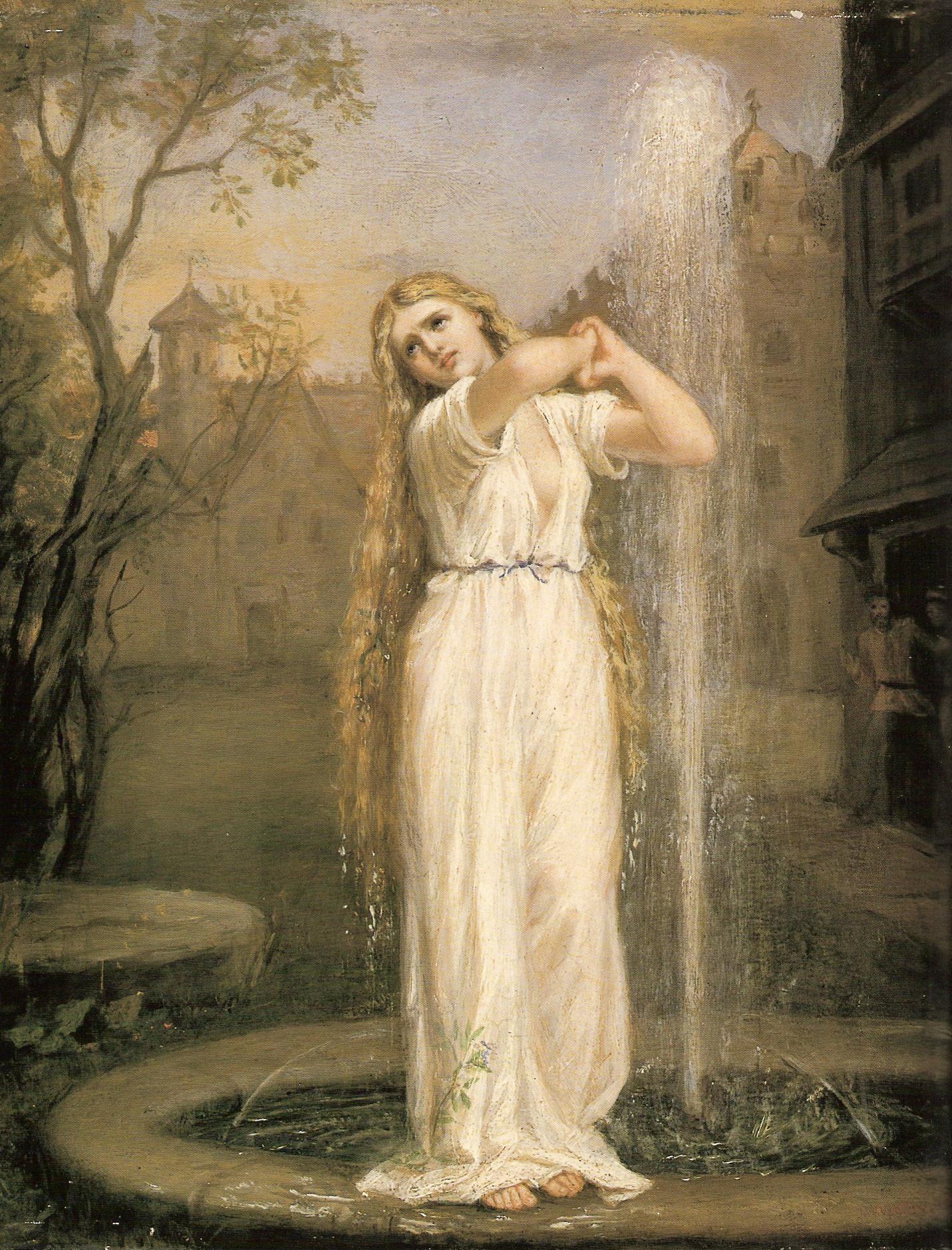
In Greek mythology, the naiads (; ), sometimes also hydriads, are a type of female spirit, or nymph, presiding over fountains, wells, springs, streams, brooks and other bodies of fresh water.
They are distinct from river gods, who embodied rivers, and the very ancient spirits that inhabited the still waters of marshes, ponds and lagoon-lakes such as pre-Mycenaean Lerna in the Argolis.
Etymology
The Greek word is ναϊάς (grc ), plural ναϊάδες (grc ). It derives from νάειν (grc), "to flow", or νᾶμα (grc), "body of flowing water".
Mythology
Naiads were often the object of archaic local cults, worshipped as essential to humans. Boys and girls at coming-of-age ceremonies dedicated their childish locks to the local naiad of the spring. In places like Lerna their waters' ritual cleansings were credited with magical medical properties. Animals were ritually drowned there. Oracles might be situated by ancient springs.
Naiads could be dangerous: Hylas of the Argo’s crew was lost when he was taken by naiads fascinated by his beauty. The naiads were also believed to exhibit jealous tendencies. Theocritus's story of naiad jealousy was that of a shepherd, Daphnis, who was the lover of Nomia or Echenais; Daphnis had on several occasions been unfaithful to Nomia and as revenge she permanently blinded him. The nymph Salmacis raped Hermaphroditus and fused with him when he tried to escape.
The water nymph associated with particular springs was known all through Europe in places with no direct connection with Greece, surviving in the Celtic wells of northwest Europe that have been rededicated to Saints, and in the medieval Melusine.
Walter Burkert points out, "When in the Iliad [xx.4–9] Zeus calls the gods into assembly on Mount Olympus, it is not only the well-known Olympians who come along, but also all the nymphs and all the rivers; Okeanos alone remains at his station", Greek hearers recognized this impossibility as the poet's hyperbole, which proclaimed the universal power of Zeus over the ancient natural world: "the worship of these deities," Burkert confirms, "is limited only by the fact that they are inseparably identified with a specific locality."
Interpretation
In the back-story of the myth of Aristaeus, Hypseus, a king of the Lapiths, married Chlidanope, a naiad, who bore him Cyrene. Aristaeus had more than ordinary mortal experience with the naiads: when his bees died in Thessaly, he went to consult them. His aunt Arethusa invited him below the water's surface, where he was washed with water from a perpetual spring and given advice.
Place names
- St. Charles Avenue in New Orleans was formerly known as Nyades Street, and is parallel to Dryades Street.
- Naiad Lake in Antarctica is named after the nymphs.
- Naiad, the innermost moon of Neptune, is named after the nymphs.
Gallery
File:Cyprian Kamil Norwid Najady.PNG|Naiads, Cyprian Kamil Norwid, 1846 File:Gioacchino Pagliei - The Naiads, 1881.JPG|Gioacchino Pagliei - The Naiads, 1881 File:Fountain of Naiads, Piazza della Repubblica.jpg|Fountain of the Naiads, 1888, Piazza della Repubblica, Rome File:Rae - Water Nymphs (color).png|Hylas and the Water Nymphs by Henrietta Rae, 1909 File:The Invocation of the Water Nymphs.jpg|The Invocation of the Water Nymphs by Marek Hapon, 2013
Notes
References
- Bibliotheca (Pseudo-Apollodorus) 2.95, 2.11, 2.21, 2.23, 1.61, 1.81, 1.7.6
- Homer. Odyssey 13.355, 17.240, Iliad 14.440, 20.380
- Ovid. Metamorphoses
- Hesiod. Theogony
- Burkert, Walter, Greek Religion, Harvard University Press, 1985. .
- Edgar Allan Poe, "Sonnet to Science" 1829
References
- Postgate, J. P.. (1897). "On the Alleged Confusion of Nymph-Names. Appendix". The American Journal of Philology.
- Burkert, III, 3.3, [https://books.google.com/books?id=sxurBtx6shoC&pg=PA174 p. 174].
- [https://data.aad.gov.au/aadc/gaz/scar/display_name.cfm?gaz_id=139210 Naiad Lake.] SCAR Composite Gazetteer of Antarctica
This article was imported from Wikipedia and is available under the Creative Commons Attribution-ShareAlike 4.0 License. Content has been adapted to SurfDoc format. Original contributors can be found on the article history page.
Ask Mako anything about Naiad — get instant answers, deeper analysis, and related topics.
Research with MakoFree with your Surf account
Create a free account to save articles, ask Mako questions, and organize your research.
Sign up freeThis content may have been generated or modified by AI. CloudSurf Software LLC is not responsible for the accuracy, completeness, or reliability of AI-generated content. Always verify important information from primary sources.
Report