From Surf Wiki (app.surf) — the open knowledge base
Nagar (princely state)
Princely state of the British Raj and Pakistan
Princely state of the British Raj and Pakistan
| Field | Value | |
|---|---|---|
| native_name | {{nq | ریاست نگر}} |
| conventional_long_name | Nagar state | |
| common_name | Nagar | |
| status | Independent Kingdom (-1891) | |
| Princely state under British Raj(1891-1947) | ||
| Princely state of Pakistan (1947-1974) | ||
| year_start | ||
| year_end | 25 September 1974 | |
| event_start | Established | |
| event1 | Hunza–Nagar Campaign | |
| date_event1 | 1891 | |
| event2 | Acceded to Pakistan | |
| date_event2 | 1947 | |
| event_end | Disestablished | |
| s1 | Northern Areas, Pakistan | |
| image_flag | Nagar State Flag.png | |
| image_coat | Nagar state logo.png | |
| image_map | Nagar Map.gif | |
| image_map_caption | Map of Pakistan with Nagar highlighted | |
| capital | Nagarkhas | |
| common_languages | Burushaski | |
| Shina | ||
| government_type | Absolute Monarchy | |
| title_leader | Mir | |
| leader1 | Fazil Khan (first known) | |
| year_leader1 | 1660-1700 | |
| leader2 | Mir Shaukat Ali Khan (last) | |
| year_leader2 | 1940-1974 | footnotes = |
| area_km2 | 5000 | |
| today | ||
| religion | Shia Isna'asheri (Jafaria) |
Princely state under British Raj(1891-1947) Princely state of Pakistan (1947-1974) Shina
- Pakistan
- Gilgit Baltistan Nagar (, Riyasat Nagar) was a Burusho princely state located in the northern region of present-day Gilgit–Baltistan, Pakistan. Although under the suzerainty of the Jammu and Kashmir (princely state), Nagar was not a part of it, and had status of a separate state. Before August 1947, it maintained a subsidiary alliance with British India. It shared its borders with the Gilgit Agency states to the south and west, while to the north and east, it bordered the princely state of Hunza. From November 1947 to 1974, Nagar was recognized as a princely state within Pakistan, with its administrative center in the town of Nagar.
The territory of the former Nagar princely state now comprises three tehsils within the Nagar District of northern Pakistan.
History
Nagar, established in the 14th century, operated as an autonomous principality until the British exerted control over the region during the Hunza–Nagar Campaign (1889–1893). Subsequently, it became a colonial princely state under the jurisdiction of the Gilgit Agency until 1947. However, starting in 1868, Nagar was a vassal state under the authority of the Maharaja of Jammu and Kashmir, even though it was never directly governed by Kashmir. The rulers of Nagar were considered to be among the most loyal vassals of the Maharajas of Jammu and Kashmir, sending annual tributes to their Durbars until 1947. The British granted them a hereditary gun salute of 15-guns.
In November 1947, the ruler, Mir Shaukat Ali Khan, acceded Nagar to Pakistan, which became responsible for its external affairs and defense, while Nagar maintained internal self-government. In 1968, Syed Yahya Shah, the first educated politician of the valley, demanded civil rights from the Mir of Nagar. In 1972, the Pakistan People's Party government (under Prime Minister Zulfiqar Ali Bhutto) forced the Mir of Nagar to abdicate. The area was then merged with the Northern Areas.
Government
The state was governed by the hereditary rulers of the Maglot dynasty, who were referred to as Mir. The details of these early rulers are uncertain; the first definite dates available are from 1839. In November 1947, the state became one of the princely states of Pakistan. Brigadier Mir Shaukat Ali Khan was the last ruler of the State before it was abolished by Pakistani PM Zulfiqar Ali Bhutto in 1972.
| Reign | Mirs of Nagar | Notes | ||
|---|---|---|---|---|
| 1660-1700 | ||||
| 1700-1750 | ||||
| 1750-1758 | ||||
| 1758-1761 | ||||
| 1761-1770 | ||||
| 1770-1780 | ||||
| 1780-1800 | ||||
| 1800-1839 | ||||
| 1839–1891 | ||||
| 1891-1892 | ||||
| 1892-1904 | ||||
| 1904-1940 | ||||
| 1940–1974 | ||||
| 25 September 1974 | ||||
| 1974–2003 | ||||
| 2003–2011 | ||||
| 2011– |
Population
Demographics
There are around 90,000 inhabitants of the Nagar valley (AKRSP Census, 2000). As of now, the population is estimated to have exceeded 130,000.
Nagar is home to two main ethnic groups: the Burushaski speakers and the Shina speakers. An older form of Burushaski is still spoken in the valley with a subtle modern accent. Additionally, a third language, Bedeski, is also still spoken in Chalt Valley of Nagar.
Religion
The population is predominantly Shia Isna'asheri (Jafaria).
Geography
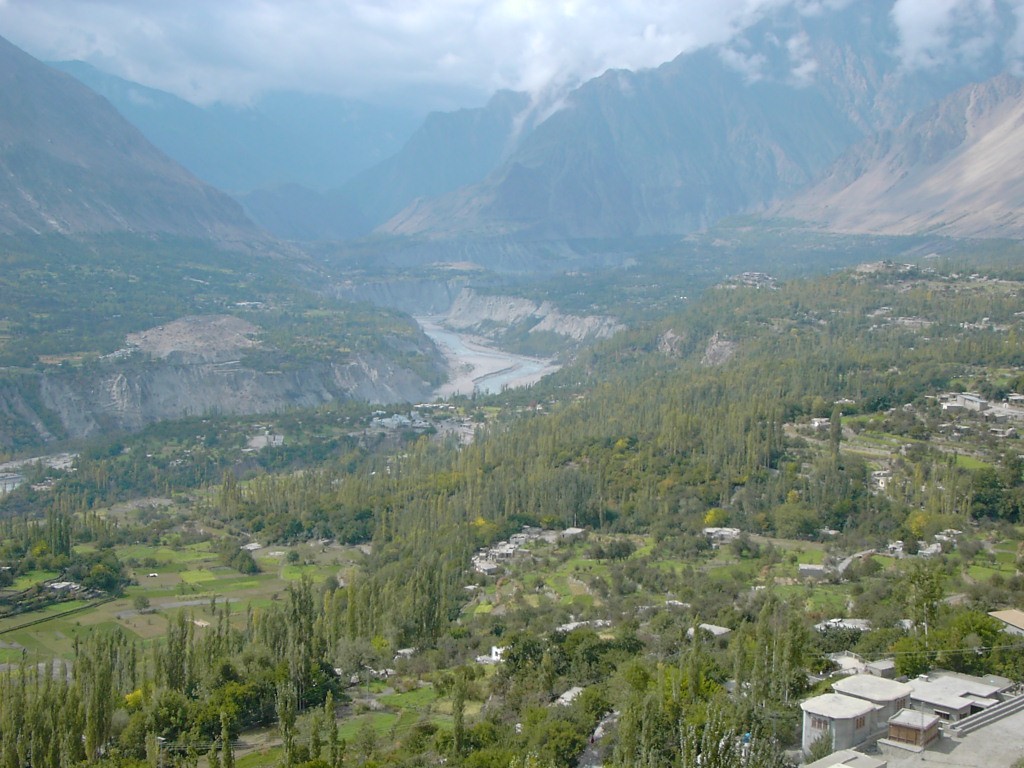
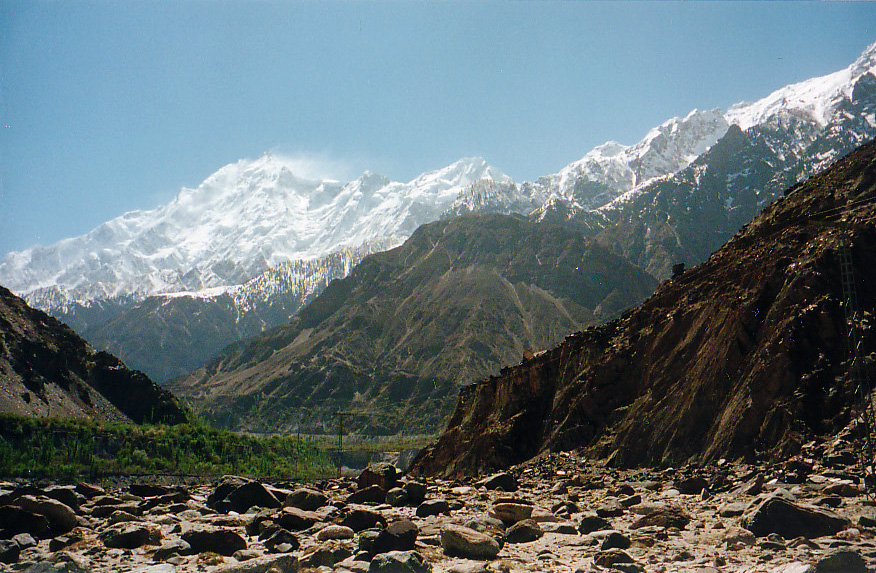
The terrain of Nagar is highly mountainous, offering a degree of natural protection against invading forces. The highest peak in the area is Mount Dastagilsar, standing at 7,885 meters, located in Hisper to the south of the town of Nagar. The Karakoram Highway passes through Nagar, connecting Pakistan to China via the Khunjerab Pass. The road follows the Hunza River for a considerable stretch, traveling through Nagar and into the Hunza region. In terms of local languages, Nagar Valley is divided into two main areas: Nagar Shinaki and Nagar Burosho.
Villages of Nagar
Shina Speaking Villages in Nagar (Shinaki/Sheenbar)
- Chalat (Paaeen/baala)
- Rabat (Paaeen/baala)
- Bar Valley
- Chaprote Valley
- Budalas valley
- Jafarabad Valley
- Nilt Valley
- Thol Valley
- Qasimabad Valley (Masoot)
- Ghulmet Valley
- Yal Valley
- Pissan Valley
- Minapin Valley Burushaski Speaking Villages in Nagar
- Nagarkhas
- Sumayar Valley
- Sikandar Abad
- Miachar Valley
- Dadimal Valley
- Phakker Valley
- Hakuchar Valley
- Shayar Valley
- Askurdas Valley
- Hoper Valley
- Hisper Valley Bilingual Valleys in Nagar
- Chalt Paeen Valley
- Akbarabad Valley
- Jafarabad Valley
- Qasimabad Valley (Mascoot)
- Ghulmet Valley
- Pissan Valley
- Minapin Valley The Nagar villages are populated by religious scholars, educators, sportsmen, craftsmen and craftswomen, farmers, hunters and fishermen, handicraftsmen, miners, shepherds, adventurers, mountaineers, and so on.
References
References
- Kreutzmann, Hermann. (2024). "Pamirian Crossroads and Beyond: Human Geography and Geopolitics". [[BRILL]].
- {{Cite EB1911
- Abbas, Hassan. "History and Culture of Nagar, Gilgit Baltistan".
- Muhammad Ismail Tehseen, ''Buroshall Say Nagar Tak ka Safar'', Syed Yahya Shah, ''Brushal ke Qabail'', both in Urdu, available in Municipal Library at Gilgit
- "Nagar". Chiefa Coins.
- (2 June 2011). "Mir Barkat Ali of the former state of Nagar passed away in Iraq". Pamir Times.
- (6 August 2016). "The ruling Mir of G-B's Nagar district". The Express Tribune.
This article was imported from Wikipedia and is available under the Creative Commons Attribution-ShareAlike 4.0 License. Content has been adapted to SurfDoc format. Original contributors can be found on the article history page.
Ask Mako anything about Nagar (princely state) — get instant answers, deeper analysis, and related topics.
Research with MakoFree with your Surf account
Create a free account to save articles, ask Mako questions, and organize your research.
Sign up freeThis content may have been generated or modified by AI. CloudSurf Software LLC is not responsible for the accuracy, completeness, or reliability of AI-generated content. Always verify important information from primary sources.
Report