From Surf Wiki (app.surf) — the open knowledge base
Nabataean script
Script used by the Nabataeans from the second century BC onwards

Script used by the Nabataeans from the second century BC onwards
| Field | Value | ||||||||||||||||
|---|---|---|---|---|---|---|---|---|---|---|---|---|---|---|---|---|---|
| name | Nabataean script | ||||||||||||||||
| type | Abjad | ||||||||||||||||
| sample | [[Image:Nabat_alaph.png | 15px]] [[Image:Nabat_bat.png | 15px]] [[Image:Nabat_gamal.png | 15px]] [[Image:Nabat_dalat.png | 15px]] [[Image:Nabat_ha.png | 15px]] [[Image:Nabat_waw.png | 15px]] [[Image:Nabat_zayin.png | 15px]] [[Image:Nabat_hha.png | 15px]] [[Image:Nabat_tta.png | 15px]] [[Image:Nabat_yat.png | 15px]] [[Image:Nabat_kaf.png | 15px]] [[Image:Nabat_lamad.png | 15px]] [[Image:Nabat_mayim.png | 15px]] [[Image:Nabat_nun.png | 15px]] [[Image:Nabat_sa.png | 15px]] [[Image:Nabat_hamza.png | 15px]] |
| languages | Nabataean Aramaic | ||||||||||||||||
| Nabataean Arabic | |||||||||||||||||
| time | 2nd century BC to 4th century AD | ||||||||||||||||
| fam1 | Egyptian hieroglyphs | ||||||||||||||||
| fam2 | Proto-Sinaitic script | ||||||||||||||||
| fam3 | Phoenician alphabet | ||||||||||||||||
| fam4 | Aramaic alphabet | ||||||||||||||||
| children | Arabic script | ||||||||||||||||
| iso15924 | Nbat | ||||||||||||||||
| unicode | U+10880–U+108AF | ||||||||||||||||
| note | none |
Nabataean Arabic
Final Accepted Script Proposal
The Nabataean script is an abjad (consonantal alphabet) that was used to write Nabataean Aramaic and Nabataean Arabic from the second century BC onwards. Important inscriptions are found in Petra (in Jordan), the Sinai Peninsula (now part of Egypt), Bosra and Namara (in Syria), and other archaeological sites including Abdah (in Israel) and Mada'in Saleh (Hegra) (in Saudi Arabia).
Nabataean is only known through inscriptions and, more recently, a small number of papyri. It was first deciphered in 1840 by Eduard Friedrich Ferdinand Beer. Prior to the publication of Nabataean papyri, the only substantial corpus of detailed Nabataean text were the 38 funerary inscriptions from Mada'in Salih (Hegra), discovered and published by Charles Montagu Doughty, Charles Huber, Philippe Berger and Julius Euting in 1884-85.
- Charles Doughty [publ. with E. Renan], Documents épigraphiques recueillis dans le Nord de l'Arabie, Paris, Impr. nat. 1884
- Philippe Berger, Nouvelles inscriptions nabatéénes de Medain Salih, Extrait des Comptes rendus de l'Académie des Inscriptions et BellesLettres (Séance du 29. Aout 1884). Paris 1884
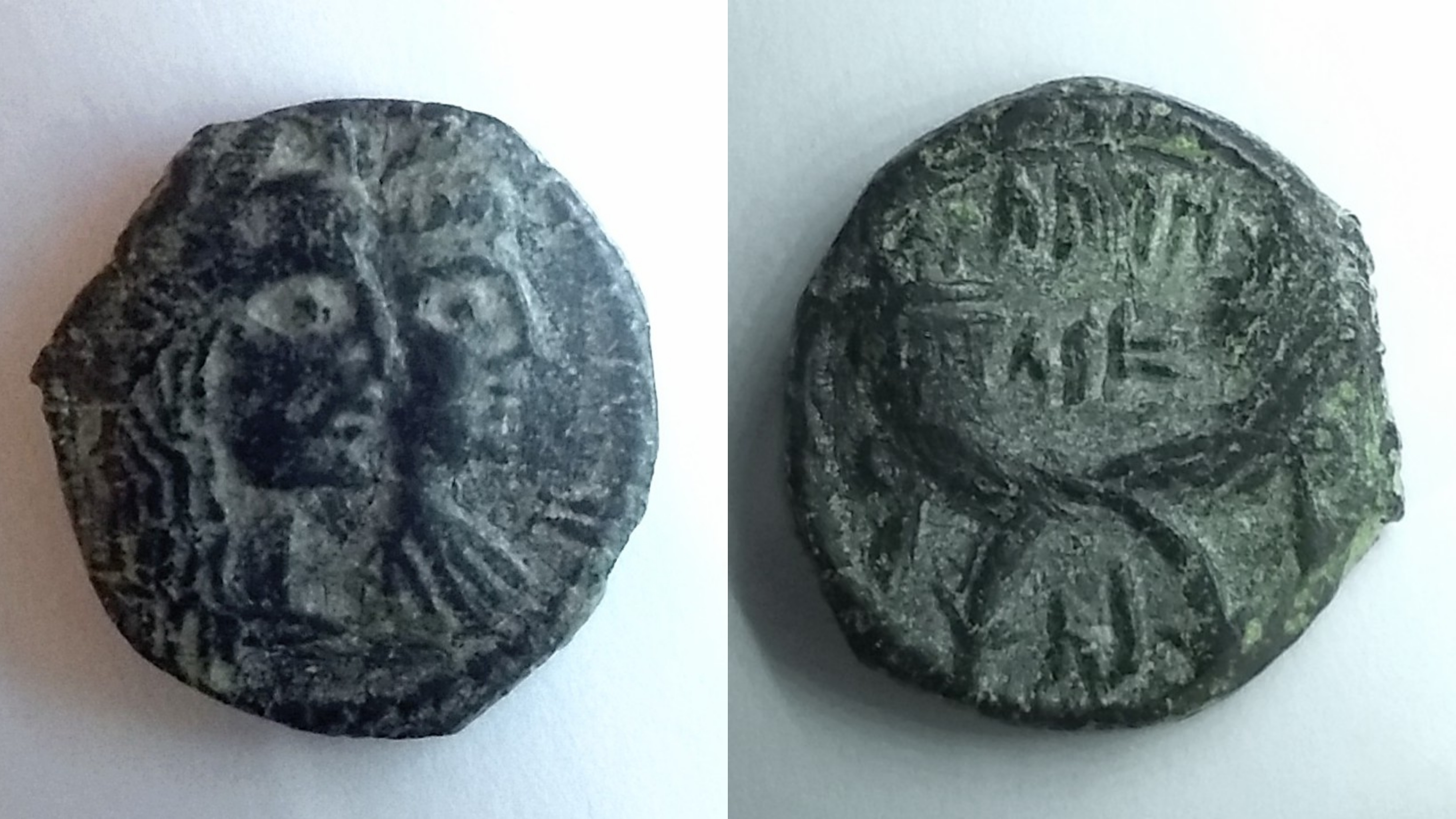
Nabataean Kingdom, Aretas IV and Shaqilath, 9 b. C. – 40 a. D., AE18. On the reverse, an example of Nabataean script: names of Aretas IV (1st line) and Shaqilath (2nd and 3rd line).]]
History
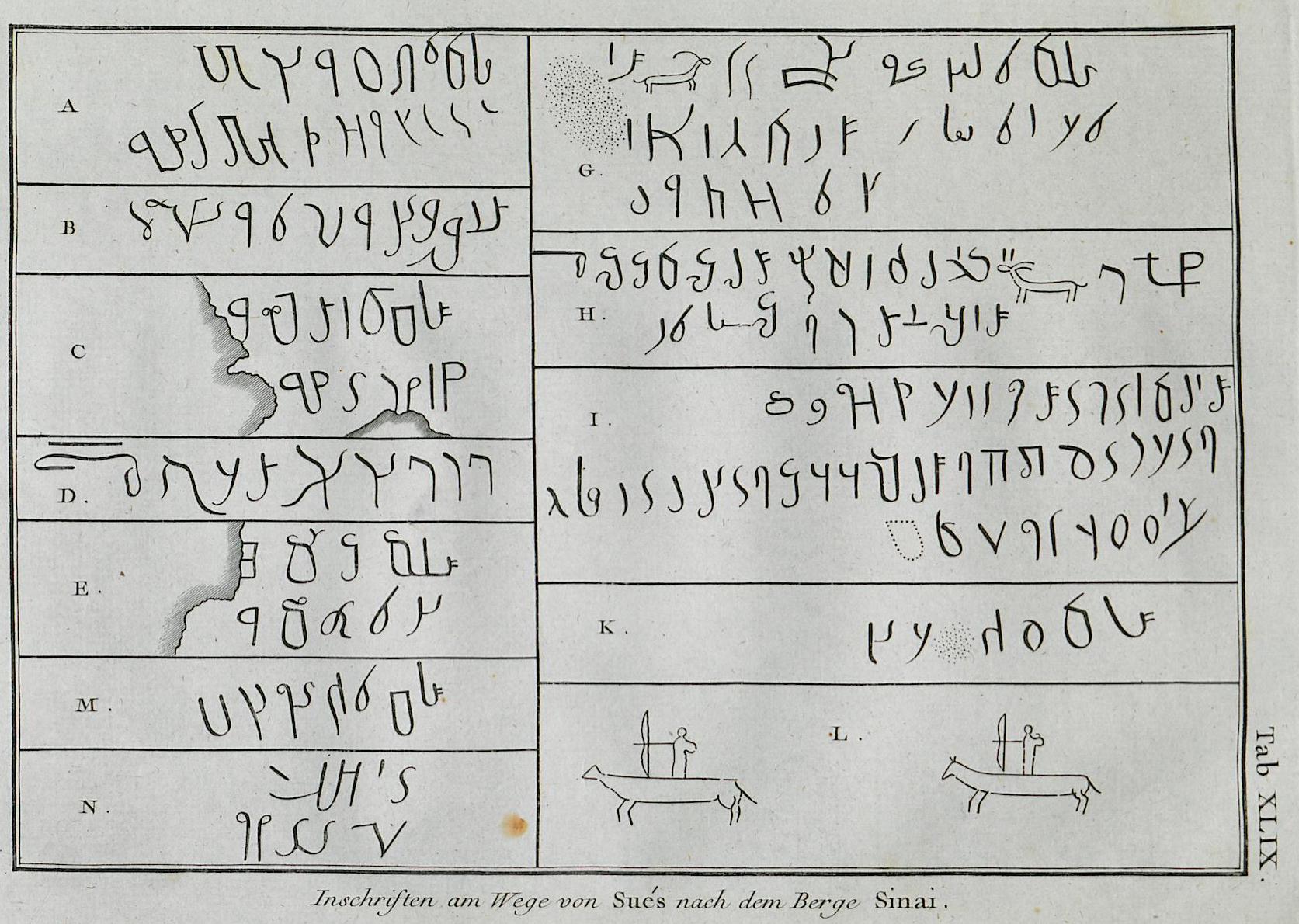
The alphabet is descended from the Aramaic alphabet. In turn, a cursive form of Nabataean developed into the Arabic alphabet from the 4th century, which is why Nabataean's letterforms are intermediate between the more northerly Semitic scripts (such as the Aramaic-derived Hebrew) and those of Arabic.
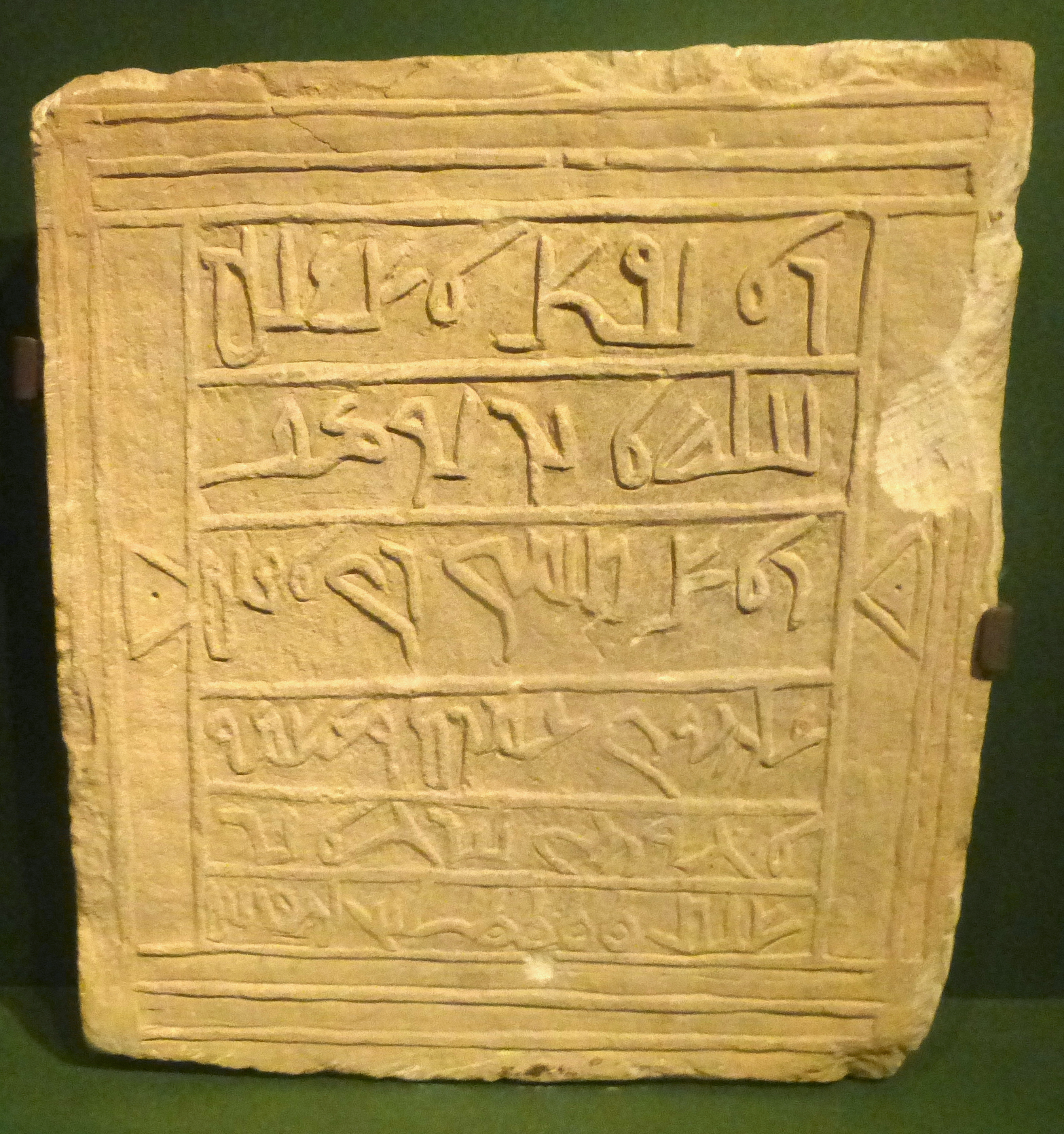
Comparison with related scripts
As compared to other Aramaic-derived scripts, Nabataean developed more loops and ligatures, likely to increase speed of writing. The ligatures seem to have not been standardized and varied across places and time. There were no spaces between words. Numerals in Nabataean script were built from characters of 1, 2, 3, 4, 5, 10, 20, and 100.
| Name | Phoenician | Phoneme | Aramaic | Nabataean | Syriac | Hebrew | Arabic | Phoneme | ||||||||||||||||||
|---|---|---|---|---|---|---|---|---|---|---|---|---|---|---|---|---|---|---|---|---|---|---|---|---|---|---|
| ʾālep | {{script | Phnx | {{huge | 𐤀}}}} | ʾ | {{script | Armi | {{huge | 𐡀}}}} | |||||||||||||||||
| (final) | {{script | Syrc | {{huge | ܐ}}}} | {{script | Hebr | {{huge | א}}}} | {{script | Arab | {{huge | ﺍ}}}} | ||||||||||||||
| bēt | {{script | Phnx | {{huge | 𐤁}}}} | b | {{script | Armi | {{huge | 𐡁}}}} | |||||||||||||||||
| (final) | {{script | Syrc | {{huge | ܒ}}}} | {{script | Hebr | {{huge | ב}}}} | {{script | Arab | {{huge | ﺏ}}}} | ||||||||||||||
| gīml | g | {{script | Armi | {{huge | 𐡂}}}} | {{script | Syrc | {{huge | ܓ}}}} | {{script | Hebr | {{huge | ג}}}} | {{script | Arab | {{huge | ﺝ}}}} | j | ||||||||
| dālet | {{script | Phnx | {{huge | 𐤃}}}} | d | {{script | Armi | {{huge | 𐡃}}}} | {{script | Syrc | {{huge | ܕ}}}} | {{script | Hebr | {{huge | ד}}}} | {{script | Arab | {{huge | د}}}} | d | ||||
| {{script | Arab | {{huge | ذ}}}} | ḏ | ||||||||||||||||||||||
| he | {{script | Phnx | {{huge | 𐤄}}}} | h | {{script | Armi | {{huge | 𐡄}}}} | |||||||||||||||||
| (final) | {{script | Syrc | {{huge | ܗ}}}} | {{script | Hebr | {{huge | ה}}}} | {{script | Arab | {{huge | ه}}}} | ||||||||||||||
| wāw | {{script | Phnx | {{huge | 𐤅}}}} | w | {{script | Armi | {{huge | 𐡅}}}} | {{script | Syrc | {{huge | ܘ}}}} | {{script | Hebr | {{huge | ו}}}} | {{script | Arab | {{huge | ﻭ}}}} | w | ||||
| zayin | {{script | Phnx | {{huge | 𐤆}}}} | z | {{script | Armi | {{huge | 𐡆}}}} | {{script | Syrc | {{huge | ܙ}}}} | {{script | Hebr | {{huge | ז}}}} | {{script | Arab | {{huge | ﺯ}}}} | z | ||||
| ḥēt | {{script | Phnx | {{huge | 𐤇}}}} | ḥ | {{script | Armi | {{huge | 𐡇}}}} | {{script | Syrc | {{huge | ܚ}}}} | {{script | Hebr | {{huge | ח}}}} | {{script | Arab | {{huge | ح}}}} | ḥ | ||||
| {{script | Arab | {{huge | خ}}}} | ḵ | ||||||||||||||||||||||
| ṭēt | {{script | Phnx | {{huge | 𐤈}}}} | ṭ | {{script | Armi | {{huge | 𐡈}}}} | {{script | Syrc | {{huge | ܛ}}}} | {{script | Hebr | {{huge | ט}}}} | {{script | Arab | {{huge | ط}}}} | ṭ | ||||
| {{script | Arab | {{huge | ظ}}}} | ẓ | ||||||||||||||||||||||
| yod | {{script | Phnx | {{huge | 𐤉}}}} | y | {{script | Armi | {{huge | 𐡉}}}} | |||||||||||||||||
| (final) | {{script | Syrc | {{huge | ܝ}}}} | {{script | Hebr | {{huge | י}}}} | {{script | Arab | {{huge | ي}}}} | ||||||||||||||
| kāp | {{script | Phnx | {{huge | 𐤊}}}} | k | {{script | Armi | {{huge | 𐡊}}}} | |||||||||||||||||
| (final) | {{script | Syrc | {{huge | ܟ}}}} | {{script | Hebr | {{huge | כ}}}} ,{{script | Hebr | {{huge | ך}}}} | {{script | Arab | {{huge | ﻙ}}}} | |||||||||||
| lāmed | {{script | Phnx | {{huge | 𐤋}}}} | l | {{script | Armi | {{huge | 𐡋}}}} | |||||||||||||||||
| (final) | {{script | Syrc | {{huge | ܠ}}}} | {{script | Hebr | {{huge | ל}}}} | {{script | Arab | {{huge | ﻝ}}}} | ||||||||||||||
| mēm | {{script | Phnx | {{huge | 𐤌}}}} | m | {{script | Armi | {{huge | 𐡌}}}} | |||||||||||||||||
| (final) | {{script | Syrc | {{huge | ܡ}}}} | {{script | Hebr | {{huge | מ}}}} ,{{script | Hebr | {{huge | ם}}}} | {{script | Arab | {{huge | ﻡ}}}} | |||||||||||
| nūn | {{script | Phnx | {{huge | 𐤍}}}} | n | {{script | Armi | {{huge | 𐡍}}}} | |||||||||||||||||
| (final) | {{script | Syrc | {{huge | ܢ}}}} | {{script | Hebr | {{huge | נ}}}} ,{{script | Hebr | {{huge | ן}}}} | {{script | Arab | {{huge | ﻥ}}}} | |||||||||||
| śāmek | {{script | Phnx | {{huge | 𐤎}}}} | ś | {{script | Armi | {{huge | 𐡎}}}} | {{script | Syrc | {{huge | ܣ}}}} | {{script | Hebr | {{huge | ס}}}} | {{script | Arab | {{huge | س}}}} | s | ||||
| ʿayin | {{script | Phnx | {{huge | 𐤏}}}} | ʿ | {{script | Armi | {{huge | 𐡏}}}} | {{script | Syrc | {{huge | ܥ}}}} | {{script | Hebr | {{huge | ע}}}} | {{script | Arab | {{huge | ع}}}}, {{script | Arab | {{huge | ء}}}} | ʿ | |
| {{script | Arab | {{huge | غ}}}} | ḡ | ||||||||||||||||||||||
| pē | {{script | Phnx | {{huge | 𐤐}}}} | p | {{script | Armi | {{huge | 𐡐}}}} | {{script | Syrc | {{huge | ܦ}}}} | {{script | Hebr | {{huge | פ}}}} ,{{script | Hebr | {{huge | ף}}}} | {{script | Arab | {{huge | ف}}}} | f | |
| ṣādē | {{script | Phnx | {{huge | 𐤑}}}} | ṣ | {{script | Armi | {{huge | 𐡑}}}} | {{script | Syrc | {{huge | ܨ}}}} | {{script | Hebr | {{huge | צ}}}} ,{{script | Hebr | {{huge | ץ}}}} | {{script | Arab | {{huge | ص}}}} | ṣ | |
| {{script | Arab | {{huge | ض}}}} | ḍ | ||||||||||||||||||||||
| qōp | {{script | Phnx | {{huge | 𐤒}}}} | q | {{script | Armi | {{huge | 𐡒}}}} | {{script | Syrc | {{huge | ܩ}}}} | {{script | Hebr | {{huge | ק}}}} | {{script | Arab | {{huge | ﻕ}}}} | q | ||||
| rēs, reš | {{script | Phnx | {{huge | 𐤓}}}} | r | {{script | Armi | {{huge | 𐡓}}}} | {{script | Syrc | {{huge | ܪ}}}} | {{script | Hebr | {{huge | ר}}}} | {{script | Arab | {{huge | ﺭ}}}} | r | ||||
| šīn | {{script | Phnx | {{huge | 𐤔}}}} | š | {{script | Armi | {{huge | 𐡔}}}} | |||||||||||||||||
| (final) | {{script | Syrc | {{huge | ܫ}}}} | {{script | Hebr | {{huge | ש}}}} | {{script | Arab | {{huge | ش}}}} | ||||||||||||||
| tāw | {{script | Phnx | {{huge | 𐤕}}}} | t | {{script | Armi | {{huge | 𐡕}}}} | {{script | Syrc | {{huge | ܬ}}}} | {{script | Hebr | {{huge | ת}}}} | {{script | Arab | {{huge | ت}}}} | t | ||||
| {{script | Arab | {{huge | ث}}}} | ṯ |
Corpora of inscriptions in Nabataean script
- Julius Euting, Nabatäische Inschriften aus Arabien, Berlin, 1885 (online; plates available here).
- Corpus Inscriptionum Semiticarum, 1902 Pars 2, Tomus 1, Fasc 3: Inscriptiones Aramaicae
- Michael E. Stone, 1992. Rock Inscriptions and Graffiti Project: Catalogue of Inscriptions
File:Nabataean inscriptions in the Corpus Inscriptionum Semiticarum in Petra.jpg|Petra inscriptions as of 1902 File:Nabataean inscriptions in the Corpus Inscriptionum Semiticarum in the Sinai Peninsula.jpg|Sinai Peninsula inscriptions as of 1902 File:Nabataean inscriptions in the Corpus Inscriptionum Semiticarum in Wadi Mukattab.jpg|Wadi Mukattab inscriptions as of 1902
Unicode
The Nabataean alphabet (U+10880–U+108AF) was added to the Unicode Standard in June 2014 with the release of version 7.0.
References
References
- Himelfarb, Elizabeth J. "First Alphabet Found in Egypt", Archaeology 53, Issue 1 (Jan./Feb. 2000): 21.
- (2010-12-09). "N3969: Proposal for encoding the Nabataean script in the SMP of the UCS". Working Group Document, ISO/IEC JTC1/SC2/WG2.
- [http://www.omniglot.com/writing/nabataean.htm Omniglot].
- Healey, John F.. (2011). "On Stone and Papyrus: reflections on Nabataean epigraphy". Informa UK Limited.
- Larison, Kristine M.. (2020). "Exodus: Border Crossings in Jewish, Christian and Islamic Texts and Images". De Gruyter.
- Yaʻaḳov Meshorer, "Nabataean coins", Ahva Co-op Press, 1975; 114.
- https://en.numista.com/catalogue/pieces69784.html Numista
This article was imported from Wikipedia and is available under the Creative Commons Attribution-ShareAlike 4.0 License. Content has been adapted to SurfDoc format. Original contributors can be found on the article history page.
Ask Mako anything about Nabataean script — get instant answers, deeper analysis, and related topics.
Research with MakoFree with your Surf account
Create a free account to save articles, ask Mako questions, and organize your research.
Sign up freeThis content may have been generated or modified by AI. CloudSurf Software LLC is not responsible for the accuracy, completeness, or reliability of AI-generated content. Always verify important information from primary sources.
Report