From Surf Wiki (app.surf) — the open knowledge base
N scale
Modelling scale of 1:160, 1:150 (Japan), 1:148 (UK)
Modelling scale of 1:160, 1:150 (Japan), 1:148 (UK)
| Field | Value |
|---|---|
| name | N scale |
| image_filename | Bachmann-2-6-6-2withPencil.jpg |
| image_caption | A Bachmann Industries N-scale model of a Chesapeake and Ohio Railway H-5 class 2-6-6-2 Mallet locomotive, shown alongside a pencil for size |
| widthpx | 300px |
| ratio | |
| gauge | |
| prototype_gauge | Standard gauge |
the model railway track size
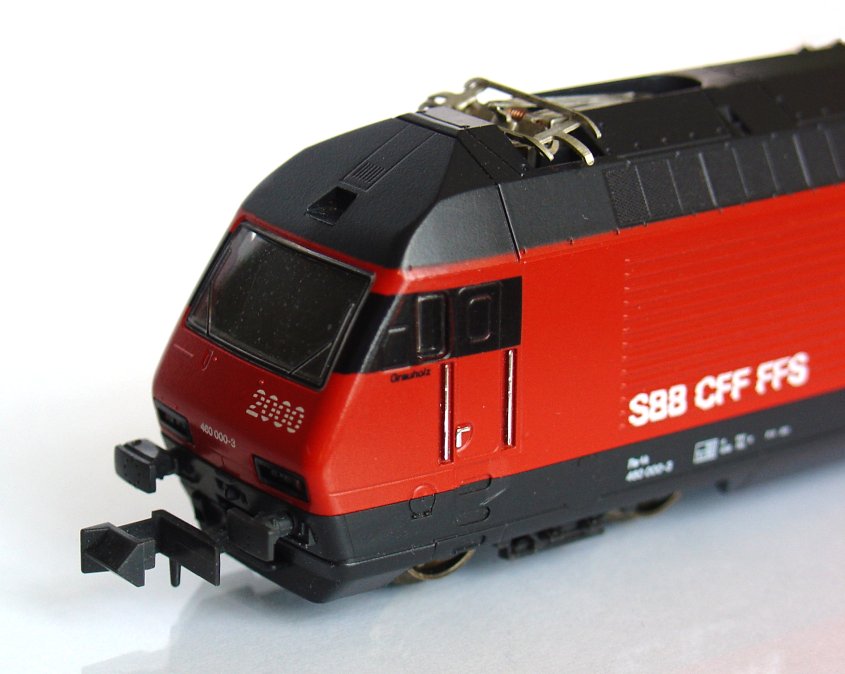
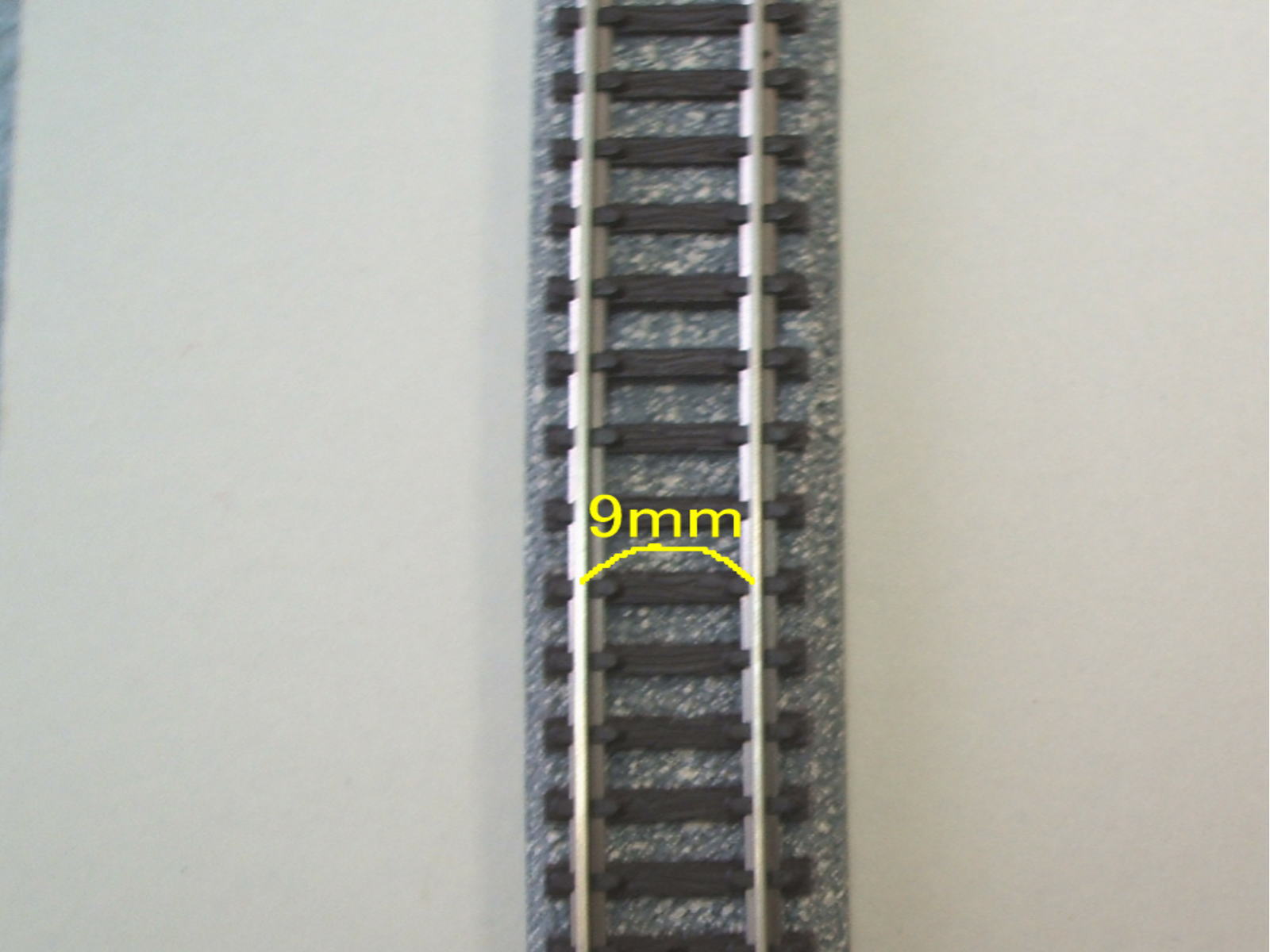
N scale is a popular model railway scale. Depending upon the manufacturer (or country), the scale ranges from 1:148 to 1:160. Effectively the scale is 1:159, 9 mm to , which is the width of standard gauge railway. However the scale may vary to simulate wide or narrow-gauge rail. In all cases, the gauge (the distance between the rails) is . The term '*N *gauge''''' refers to the track dimensions, but in the United Kingdom in particular British N gauge refers to a 1:148 scale with 1:160 () track gauge modelling. The terms N scale and N gauge are often inaccurately used interchangeably, as scale is defined as ratio or proportion of the model, and gauge only as a distance between rails. The scale 1:148 defines the rail-to-rail gauge equal to 9 mm exactly (at the cost of scale exactness), so when calculating the rail or track use 1:160 and for engines and car wheel base use 1:148.
All rails are spaced 9 mm apart but the height can differ. Rail height (in thousandths of an inch) is expressed as a "code": thus, Code 55 rails are 0.055 in high while Code 80 rails have a height of 0.080 in. Common real railroad rails are at least 6 in tall and can be taller on some roads, so at true scale the rails would be about 0.040 in high.}}
An advantage of N scale is that it allows hobbyists to build layouts that take up less space than HO scale, or put longer track runs into the same amount of space, because the models are smaller (by nearly a half) than they are in HO scale (1:87). While N scale is quite small, it is not the smallest commercially available scale, as Z scale is smaller yet at 1:220 and T scale is 1:450 or 1:480. N scale is considered generally compatible with 1:144 scale for miniature wargaming.
History

Although trains and accessories of similar gauge or scale existed as early as 1927, modern commercially produced N-scale models were first launched by the Arnold company of Nuremberg in 1962. Unlike other scales and gauges, which were de facto standards at best, within two years N-scale manufacturers defined the gauge and voltage, as well as the height and type of couplers. For example, Arnold developed the now ubiquitous "Rapido" coupler to provide a simple and robust releasable coupler design. Although the original Arnold coupler has been joined by more functional and aesthetically pleasing designs, Arnold allowed use of the Rapido design by other manufacturers, so established a common standard to couple together rolling stock from different sources.
N scale has a large worldwide following. Models are made of very many standard gauge prototypes from every continent. N scale's popularity is second only to that of HO. In Japan, where space in homes is more limited, N scale is the most popular scale, and HO scale is considered large. Not all modellers select N because they have small spaces; some use N scale to build more complex or more visually expansive models.
N scale in Australia has become more popular over the years. Modellers use mainly US, British, and European prototypes because for a long time, the Australian market had no N-scale models of local prototypes. The creation of local prototypes is now a flourishing "cottage" industry, making Australia N-scale modelling more popular each year.
N-gauge track and components are also used with larger scales, in particular H0e (or "HOe") and 00-9 scale for modelling narrow-gauge railways. N-scale models on Z-scale track are used to model metre gauge (Nn3). A small amount of 2-foot (Nn2) industrial narrow-gauge modelling in N scale using custom track is done, but suppliers of parts are few. Nn18 layouts use T-scale track and mechanisms to represent minimum-gauge railways. N-scale trains and structures are often used on HO or larger layouts to create forced perspective, or the illusion that an object is further away than it actually is.
Standards


Standards useful to both manufacturers and modellers are maintained by MOROP in Europe and the NMRA in North America. These standards are generally the same for such elements as track gauge, scale ratio, couplings, and electrical power, and differ for clearances and other factors that are specific to the prototype being modelled. The wheel and track standards are, however, slightly incompatible and most vendors follow neither standard in part because of this.
N scale locomotives are powered by DC motors which accept a maximum of 12 V DC. In traditional DC control, the speed of the train is determined by the amount of voltage supplied to the rails. The direction of the train is determined by the polarity of the power to the rails. Since the end of the 20th century, an increasing number of enthusiasts have started using digital train control systems to determine the speed and direction of their trains. This has in part been made possible by surface mount technology and new motors that draw very little current (typically 0.2 amps). The most popular digital control systems used in N scale model railways are NMRA-DCC and Selectrix.
The initial agreed-to standard coupling was known as a 'Rapido' coupler from the manufacturer (Arnold); this coupler had been produced under a license from TT-manufacturer Rokal. Most companies developed their own variants of this coupler to avoid Arnold patents on the spring system. Graham Farish initially adopted a plastic flexible U rather than a spring, Peco used a compatible weighted coupler system (Elsie), and Fleischmann cunningly sidestepped the problem by using a sprung plate. All were compatible, though.
The Rapido coupler system works well, but is difficult to use for automatic uncoupling and also relatively large. In the US, Canada, and Australia, it has been largely superseded by a more realistic-looking magnetic knuckle coupler, originally made by Micro-Trains and branded Magne-Matic. The MT couplers (as they are known) are more delicate and closer to scale North American appearance than Rapido couplers. Also, they can be opened by a magnet placed under the track. Other manufacturers, such as Atlas, McHenry and Kato, are now making couplers that mate with Micro Trains couplers.
European modellers have the option to convert the couplings on their rolling stock to the Fleischmann Profi-Coupler system for more reliable operation should they wish to do so, but most N scale rolling stock continues to be manufactured with Rapido couplers - a design which is fairly robust and easy to mold. Modern N scale stock uses a standard NEM socket for couplers which allows different coupling designs to be used by simply pulling out the old coupler and fitting a new one of a different design. In the UK, vendors are increasingly shipping both NEM sockets for couplers and buckeye (knuckle) couplers. It is also very easy to use for coupling and uncoupling.
Variants

NS DH2 in 1:160 scale (bottom) and Kato Bernina Express in 1:150 scale (top) on 9 mm track gauge. Size comparison with a one-euro coin]]
In the United States and Europe, models of standard gauge [] trains are built to 1:160 scale and made so that they run on N gauge track, but in some other countries changes are made. Finescale modellers also use variants of normal N scale.
United Kingdom
In the United Kingdom, a scale of 1:148 is used for commercially produced models.
In Britain, some N-scale models are built to "2 mm scale" for "2 mm to the foot" which calculates to a 1:152 proportion. Early N scale was also known as "OOO" or "treble-O" in reference to O and OO and was also 1:152, though for an entirely different reason.
2 mm to the foot scale
A number of modellers in the United Kingdom use 2 mm scale, a closer-to-scale standard than N scale. 2 mm scale is scaled at 2 mm to the foot (1:152) with a track gauge. Nearer to scale appearance is achieved by finer rail, flange, and crossing dimensions than commercial N gauge () components. A variation of the 2 mm standards is used by the FiNe group for 1:160 scale. It uses the same rail, flange, and crossing dimensions as 2 mm (1:152) standards, but with a track gauge of , and corresponding reduction in back-to-back. FiNe is dominated by European modellers.
OOO scale
In 1960, Lone Star introduced some of the first (1:160) N scale models branded as Treble-0-Lectric (OOO) into the United Kingdom.As an aside on the perennial question of whether British '00' gauges use letters or numbers, Lone Star named their product the 'Treble-0-Lectric' (with a zero) yet described this as gauge 'OOO', with three letters. The original die-cast metal models were push along and gauged to run on a die-cast trackwork having a gauge that was closer to . Coupling was by a simple loop and pin arrangement. The novelty of the "Lone Star Locos" line was such that they even found their way to the United States and were sold in the toys area of major department stores like J.J. Newberry.
Electrified models followed soon after. The track gauge was widened to a nominal and rails were isolated with nonconductive ties (sleepers) for 12-volt DC operation. Gearing between the motor and the axles at such a small scale was done by rubber bands, rather than the usual worm gear. A different coupling based on a shrunken OO-scale coupling was fitted. The OOO couplings and specifications have long since been replaced by commercial N-scale manufacturers.
File:Treble-0-Lectric EL.60. Derby Sulzer D5000 British Rail Class 24 Ansicht.jpg|Treble-0-Lectric Derby Sulzer D5000 British Rail Class 24 on Arnold N-gauge track. Exterior view. File:Treble-0-Lectric EL.60. Derby Sulzer D5000 British Rail Class 24 Innenansicht.jpg|Treble-0-Lectric Derby Sulzer D5000 British Rail Class 24 on Arnold N-gauge track. Interior view, the transmission between the motor and the axles is realised with rubber bands. File:Treble-0-Lectric Fallhakenkupplung an Güterwagen.jpg|Treble-0-Lectric freight wagon with a miniaturised tension lock coupling beside Arnold N-gauge track.
Australian N scale
Australian railways use several gauges across the states, although in most cases 9 mm gauge track is used. Some modellers have used Z gauge track for Nn3 models of Queensland Railways. N scale modelling in Australia has been a cottage-industry affair, with typically small runs of resin-based models being produced. Some etch-brass kits have also been released. In most cases, the kits have been bodies designed to run on mechanisms or bogies available from overseas. Some very fine models are starting to emerge from various Australian manufacturers with many kits now available.
Manufacturers have started to engage Chinese manufacturers to produce very high quality wagons and locomotives. The Victorian producer Aust-N-Rail pioneered this approach, while in 2011, BadgerBits released Australia's first ready-to-run N gauge locomotive, a 48 class retailing for around A$240. A new manufacturer has arrived on the scene (November 2011) with Australia-N Railways using both Australian locally manufactured detail accessories and top end Chinese factories to produce their new locomotives and rolling stock. Other kits continue to be released using the more usual method of resin-based castings and it is now possible obtain models of railways running in most states, although the coverage is highly variable.
Japanese N scale


Since the former Japanese National Railways and other major private railways adopted a track gauge of 1067 mm, Japanese N-scale models of conventional railways adopted 1:150 scale with 9 mm gauge. But, in the case of Shinkansen, which adopted a 1435 mm track gauge, models are scaled down to 1:160. A small number of modelers adopted a model scale of 1:120 using 9 mm gauge tracks to represent the narrow-gauge railway -gauge lines common in Japan. This is a different prototype gauge and scale to standard N scale with the narrower prototype gauge and called TT-9.
Notable layouts
- Wolfgang Frey's "Stuttgart Hbf" layout is a replica of the Stuttgart main railway station started in 1978. The layout features a detailed signalling system. Following Frey's death in 2012, the layout was due to be opened as a public exhibit in 2017.
- The San Diego Model Railroad Museum in California, United States, houses one of the largest N-scale layouts in the world 1200 sqft called the Pacific Desert Lines. It has about 33 mi of mainline track, over 500 hand-made turnouts and models of several local landmarks, including the Carrizo Gorge's Goat Canyon Trestle.
Notes
References
References
- (July 2009). "NMRA Standards: S-1.2 Standards for Scale Models". National Model Railroad Association.
- (January 1990). "NMRA Recommended Practices: RP-15.1 Rail". National Model Railroad Association.
- (January 29, 2010). "Model railroad track codes defined". Kalmbach Publishing.
- Bardsley, Richard. (2013). "Making a Start in N Gauge Railway Modelling". The Crowood Press, Ltd..
- (December 2, 2014). "Scales & More: Modeling Scales". National Model Railroad Association.
- "The German pioneer of N gauge". Hornby Hobbies.
- (December 25, 2016). "Model Train Scale and Gauge". White River Productions.
- (2016). "Evolution of the Magne-Matic Coupler".
- Barnard, Russ. (October 22, 1968). "N-Gauge Chugs Into Hobby Corners". Pittsburgh Post-Gazette.
- (January 1990). "RP-3 Proto-Fine Track (Recommended practices)". [[National Model Railroad Association.
- Smith, David K.. "Part 1: Beginnings & Introductions".
- "(home)".
- "Pacific Desert Lines".
- "PDL Gallery Two".
- "Goat Canyon Trestle".
This article was imported from Wikipedia and is available under the Creative Commons Attribution-ShareAlike 4.0 License. Content has been adapted to SurfDoc format. Original contributors can be found on the article history page.
Ask Mako anything about N scale — get instant answers, deeper analysis, and related topics.
Research with MakoFree with your Surf account
Create a free account to save articles, ask Mako questions, and organize your research.
Sign up freeThis content may have been generated or modified by AI. CloudSurf Software LLC is not responsible for the accuracy, completeness, or reliability of AI-generated content. Always verify important information from primary sources.
Report