From Surf Wiki (app.surf) — the open knowledge base
Myzostomida
Order of annelid worms

Order of annelid worms
The Myzostomida or Myzostomatida are an order of small marine worms, which are parasitic on echinoderms, mostly crinoids. These highly unusual and diverse annelids were first discovered by Friedrich Sigismund Leuckart in 1827.
Morphology
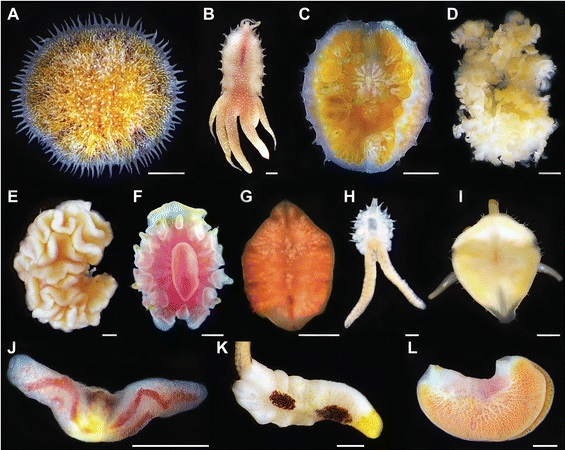
A typical myzostomid has a flattened, rounded shape, with a thin edge drawn out into delicate radiating hairs called cirri. The dorsal surface is smooth, with five pairs of parapodia on the bottom surface. These parapodia are armed with supporting and hooked setae, by means of which the worm adheres to its host. Beyond the parapodia are four pairs of organs, often called suckers. These organs are probably of sensory nature, and are comparable to the lateral sense organs of capitellids. The mouth and cloacal opening are generally at opposite ends of the bottom surface. The former leads to a protrusible pharynx, from which the esophagus opens into a wide intestinal chamber with branching lateral diverticula. There appears to be no vascular system. The nervous system consists of a circumoesophageal nerve, with scarcely differentiated brain, joining below a large ganglionic mass, no doubt representing many fused ganglia. The dorsoventral and the parapodial muscles are much developed, while the coelom is reduced mostly to branched spaces in which the genital products ripen.
Full-grown myzostomids are hermaphrodites. Their internal organs consist of a branched sac opening to the exterior or each side. The paired ovaries discharge their eggs into a median chamber with side branches, often called the uterus, from which the ripe ova (eggs) are discharged by a mediar dorsal pore into the end of the rectum.
Biology
Some species, such as Myzostoma cirriferum, move about on the host; others, such as Myzostoma glabrum, remain stationary with the pharynx inserted in the mouth of the crinoid. Myzostoma deformator gives rise to a gall on the arm of the host, one joint of the pinnule growing round the worm so as to enclose it in a cyst while Myzostoma pulvinar lives in the alimentary canal of a species of Antedon.
Fridtjof Nansen wrote in 1885 the thesis Bidrag til myzostomernes anatomi og histologi on the Myzostomida.
Classification
In the past Myzostomida have been regarded as close relatives of the trematode flatworms or of the tardigrades, but in 1998 it was suggested that they are a sub-group of polychaetes.{{cite book title=Unsegmented Annelids? Possible Origins of Four Lophotrochozoan Worm Taxa |doi-access=free }} They are now thought to be annelids, while their relationship to other annelids is unclear.
According to the World Register of Marine Species, these families and genera are accepted in this group:
- Asteriomyzostomidae Jägersten, 1940
- Asteriomyzostomum Jägersten, 1940
- Asteromyzostomidae Wagin, 1954
- Asteromyzostomum Wagin, 1954
- Eenymeenymyzostomatidae Summers & Rouse, 2015
- Eenymeenymyzostoma Summers & Rouse, 2015
- Endomyzostomatidae Perrier, 1897
- Endomyzostoma Perrier, 1897
- Mycomyzostoma Eeckhaut, 1998
- Myzostomatidae Benham, 1896
- Cystimyzostomum Jagersten, 1940
- Hypomyzostoma Perrier, 1897
- Mesomyzostoma Remscheid, 1918
- Myzostoma Leuckart, 1836
- Notopharyngoides
- Protomyzostomidae Stummer-Traunfels, 1926
- Protomyzostomum Fedotov, 1912
- Pulvinomyzostomidae Jägersten, 1940
- Pulvinomyzostomum Jägersten, 1940
- Myzostomida incertae sedis
- Contramyzostoma Eeckhaut, Grygier & Deheyn, 1998
- Cyclocirra Müller, 1841
- Stelechopus Graff, 1884
References
References
- (2014). "Phylogeny of Myzostomida (Annelida) and their relationships with echinoderm hosts". BMC Evolutionary Biology.
- {{EB1911. Edwin Stephen. Goodrich
- [http://www.naturarv.no/index.php?id=254958] Bidrag til myzostomernes anatomi og histologi
- "WoRMS - World Register of Marine Species - Myzostomida".
- "WoRMS - World Register of Marine Species - Asteriomyzostomidae Jägersten, 1940".
- "WoRMS - World Register of Marine Species - Asteromyzostomidae Wagin, 1954".
- "WoRMS - World Register of Marine Species - Eenymeenymyzostomatidae Summers & Rouse, 2015".
- "WoRMS - World Register of Marine Species - Endomyzostomatidae Perrier, 1897".
- "WoRMS - World Register of Marine Species - Myzostomatidae Benham, 1896".
- "WoRMS - World Register of Marine Species - Protomyzostomidae Stummer-Traunfels, 1926".
- "WoRMS - World Register of Marine Species - Pulvinomyzostomidae Jägersten, 1940".
- "WoRMS - World Register of Marine Species - Myzostomida incertae sedis".
This article was imported from Wikipedia and is available under the Creative Commons Attribution-ShareAlike 4.0 License. Content has been adapted to SurfDoc format. Original contributors can be found on the article history page.
Ask Mako anything about Myzostomida — get instant answers, deeper analysis, and related topics.
Research with MakoFree with your Surf account
Create a free account to save articles, ask Mako questions, and organize your research.
Sign up freeThis content may have been generated or modified by AI. CloudSurf Software LLC is not responsible for the accuracy, completeness, or reliability of AI-generated content. Always verify important information from primary sources.
Report