From Surf Wiki (app.surf) — the open knowledge base
Mycenaean chamber tomb
Type of chamber tomb built in Mycenaean Greece
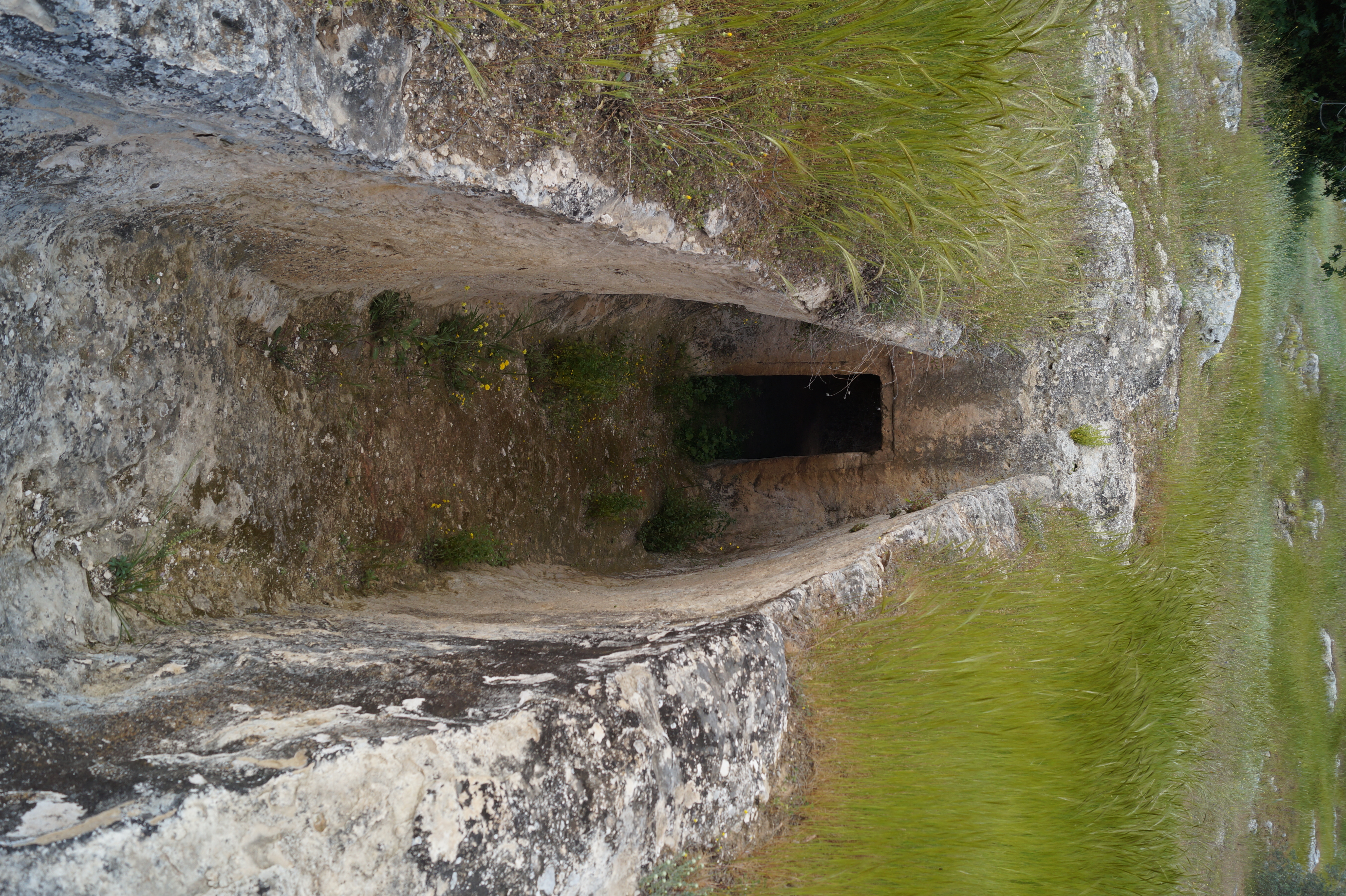
Type of chamber tomb built in Mycenaean Greece
A Mycenaean chamber tomb is the type of chamber tomb that was built in Mycenaean Greece. Mycenaean chamber tombs originated in Messenia at the end of the Middle Helladic period (), and were built and used throughout the Late Bronze Age across the Aegean area.
Mycenaean chamber tombs were cut into the bedrock (as opposed to the contemporary grc tombs, which are constructed from masonry), usually on sloping terrain, and formed of a chamber (grc), joined to a rectangular passageway (grc) by a threshold (grc). The size, elaboration and monumentality of Mycenaean chamber tombs varies considerably, as do the grave goods found within them, suggesting that they were used for the burials of people across a wide range of social strata.
After the end of the Bronze Age, chamber tombs ceased to be constructed in most parts of the Greek world, though some continued in use for votive offerings and hero cult during the Early Iron Age.
Chronological development
| Period | Approximate Date |
|---|---|
| Middle Helladic III | |
| Late Helladic I | |
| Late Helladic II | |
| Late Helladic IIIA | |
| Late Helladic IIIB | |
| Late Helladic IIIC |
Chamber tombs continued to be constructed throughout the Mycenaean period, though regional differences are observed as to their popularity and likely social function. At Mycenae, they appear to have displaced all other forms of elite burial, except grc, and have been closely linked with the development and consolidation of the palatial state in LH III. Around three hundred chamber tombs are known from the area of Mycenae. It has been suggested that the chamber tombs at Mycenae represent lower-ranked members of the palatial elite, while grc were reserved for the most elite, perhaps the grc and other high-ranking figures known from Linear B. In Boeotia, however, only one grc tomb is known (the so-called Treasury of Minyas at Orchomenos, dating to ), while chamber tombs seem to have been the predominant form of burial for all elite groups, including the monumental chamber tomb at Megalo Kastelli, which has been linked with the rulers of Thebes.
In Achaia, chamber tombs seem to be associated with emergent local elites in the LH II period, but displace even simple grave types, such as pit and cist graves, by LH III. In this period in Achaia, there seems to have been little association, unlike in the Argolid, between social hierarchy and the use of chamber tombs: relatively simple tombs, such as those at Aidonia, with relatively simple grave goods are found alongside monumental examples, such as Tomb 4 at Voundeni – a large LH IIIA chamber tomb with a grc of 19.8 m and a grc 28 sqm in area, whose extensive and valuable grave goods have led to the scholarly consensus that the single original burial in the tomb represents a local ruler. Rather than carrying a universal meaning, it is likely that the social and symbolic significance of chamber tombs, as well as the nature of the communities using them, varied across the Mycenaean world according to local practices and concerns.[[File:Chamber tomb 16 of Dendra 2.JPG|thumb|right|200px|Chamber tomb 16 at [[Dendra]], showing the view of the grc from outside the tomb]]
Except in Thessaly and Crete, the construction of chamber tombs ceased after the Late Bronze Age Collapse (), though some examples continued to be re-used for votive offerings, hero cult and occasionally burials during the Early Iron Age. Nearly a third of the chamber tombs excavated by Carl Blegen at Prosymna in the Argolid showed evidence of votive offerings from the Geometric or Archaic periods, and the practice is observed elsewhere in the Greek world between 1050 and 600 BCE, particularly in Messenia, Attica and Boeotia.
Construction

Chamber tombs are cut from bedrock and usually divide into a tripartite structure of grc ('passageway'), grc ('threshold') and grc ('chamber'). Some examples include pits, side chambers or niches into which primary or secondary burials may have been deposited. The division between grc, grc and grc has been interpreted as the creation of a 'boundary zone between the living and the dead'.
Scholars debate the relationship in design between chamber tombs and grc, which appeared in Greece approximately simultaneously at the end of MH III, and were both first used in Messenia. According to one school of thought, chamber tombs became popular in imitation of grc, following the same fundamental form but avoiding the significant expenditure of resources and labour in constructing a tomb from ashlar masonry. Another interpretation sees chamber tombs as a successor to Middle Helladic tumulus burial, developing in parallel with grc rather than as an imitation of them.
The specific design of chamber tombs could vary according to local geographic and social considerations. At Thorikos, for instance, so-called "built" chamber tombs of limestone masonry, with short passages approaching one side of the grc, were constructed, likely in response to the hard limestone ground, which would have made cutting a long grc impractical. At Thebes, the so-called "Painted Chamber" tomb has two parallel grc, approaching two large chambers, connected by a doorway.
From LH IIIIIA1 onwards, certain monumental chamber tombs had the façade of the grc, and sometimes the walls of the grc, decorated with painted plaster. This phenomenon is particularly known in the Argolid, particularly at Mycenae and Prosymna, but examples are known from elsewhere, including Prosilio 2 and from Thebes. Over the course of the Late Helladic, a trend is observed for the length of the grc to increase, both in absolute measurement and relative to the size of the grc. Tomb 505 at Mycenae, for example, has a grc over 35 m in length. This may be associated with an increasing desire to show wealth and power through a large, impressive tomb, or may reflect the growing importance of the grc in funerary ritual. At the end of the period, however, in LH IIIC, the opposite trend is observed: grc become shorter and less attention appears to be paid to the carving and decoration of the façade of the grc, perhaps indicating the declining importance of any rituals that took place there.
So-called "built" chamber tombs, such as those at Thorikos and other examples at sites including Marathon, Portes and Mitrou, are similarly cut from rock but include masonry on the interior. These appear earlier than true chamber tombs, often lack a grc, and may have developed separately.
Funerary practices

Chamber tombs were generally used for multiple burial and re-used over multiple generations. Work at Ayia Sotira in the Nemea valley has highlighted the efforts made by those using the tombs to carry on re-using them, even when the tomb had partially collapsed and doing so was difficult. The tombs are often assumed to have been used for members of the same family, though solid evidence is lacking as to the precise kinship between people buried in the same tomb.
There is tentative evidence for funerary processions towards Mycenaean chamber tombs; it has therefore often been assumed that the body would be transported to the tomb on a wheeled vehicle, though the location of some cemeteries around Mycenae indicates that at least the final part of this procession must sometimes have taken part on foot.
Almost all Mycenaean burials in chamber tombs, particularly before LH IIIC, are inhumations rather than cremations, though post-Mycenaean cremation burials are sometimes found in the upper levels of the grc of Mycenaean tombs. In most parts of the Aegean world, bodies were laid on the floor of the grc, sometimes in pits dug into it or a side chamber. At Tanagra in Boeotia, however, it was common to inter the body within a larnax, a practice only otherwise attested on Minoan Crete. It was common for previous burials to be rearranged, relocated and perhaps sometimes removed when a tomb was re-opened for a later interment. The burials of children were often made in small niches in the wall of the grc.
It was common for grave goods to be deposited in chamber tombs: these usually included ceramics, but could vary considerably based on the social status of the deceased. While most of the grave goods in the Aidonia tombs were relatively modest, for example, Tomb 2 at Prosilio in Boeotia included weaponry, gold and faience jewellery, and a signet ring. Fragments of grc are routinely found in the grc and sometimes grc of tombs, suggesting that libations or drinking may have played a role in the funerary ritual, while it is also common to find animal bones and the remains of food production, either for consumption at the tomb or perhaps as an offering to the dead.
After a burial in the grc, the grc would be sealed, often with a dry-stone wall: it is possible that the un-sealing of this barrier for further burials or offerings carried significant ritual significance. Tombs were generally filled with earth shortly after use, and not generally marked above ground: only a few examples of tomb markers are known, though it has been hypothesised that some may have been marked by wooden grc. It is not uncommon to find evidence of the construction of tombs being abandoned when the builders ran into an existing tomb that was not visible from the surface.
Gallery
File:Aidonia Mycenaean chamber tomb 02.jpg|alt=Photograph of a chamber tomb, with the doorway visible.|A chamber tomb at Aidonia in the Corinthia File:Mycenaean Cemetery of Paleo Epidavros Chamber Tomb A 2.JPG|The grc of chamber tomb A at Palaia Epidavros in the Argolid, viewed from the grc File:Mycenaean Cemetery of Kato Almyri - Tomb XIV 01.JPG|The grc of chamber tomb 14 at Kato Almyri, Corinthia File:Finds from Aidonia Tomb 10 and 11 1.JPG|Ceramic finds from chamber tombs 10 and 11 at Aidonia File:Boar's Tusk Helmet, Mycenae, Chamber Tomb 515, 14th–13th cent. BC. (28382346461).jpg|A boar's tusk helmet found in chamber tomb 515 at Mycenae File:Aidonia 01.jpg|Chamber tombs at Aidonia, with corrugated iron sheets to protect the grc from erosion
References
Bibliography
This article was imported from Wikipedia and is available under the Creative Commons Attribution-ShareAlike 4.0 License. Content has been adapted to SurfDoc format. Original contributors can be found on the article history page.
Ask Mako anything about Mycenaean chamber tomb — get instant answers, deeper analysis, and related topics.
Research with MakoFree with your Surf account
Create a free account to save articles, ask Mako questions, and organize your research.
Sign up freeThis content may have been generated or modified by AI. CloudSurf Software LLC is not responsible for the accuracy, completeness, or reliability of AI-generated content. Always verify important information from primary sources.
Report