From Surf Wiki (app.surf) — the open knowledge base
Mutsuki-class destroyer
Imperial Japanese Navy destroyer class
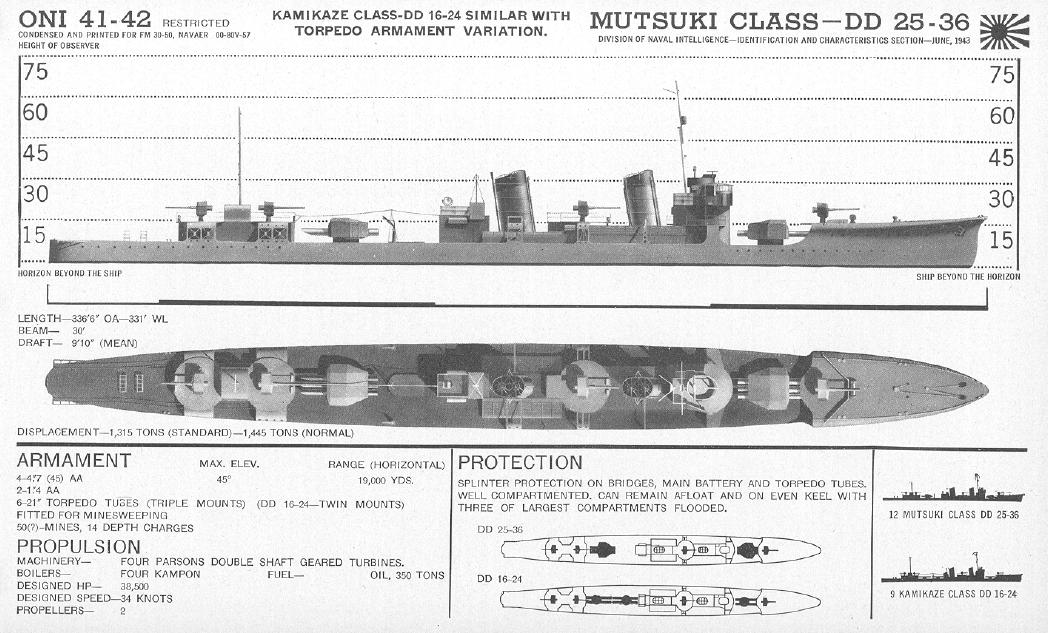
Imperial Japanese Navy destroyer class
| Field | Value | |||||
|---|---|---|---|---|---|---|
| section1 | {{Infobox ship/image | |||||
| image | Japanese destroyer Mutsuki 1930.jpg | |||||
| image_caption | Mutsuki in 1930 | |||||
| section2 | {{Infobox ship/class overview | |||||
| name | Mutsuki class | |||||
| builders | *Uraga Dock Company (3) | |||||
| operators | ||||||
| class_before | ||||||
| class_after | ||||||
| built_range | 1924-1927 | |||||
| total_ships_planned | 12 | |||||
| total_ships_completed | 12 | |||||
| total_ships_lost | 12 | |||||
| section3 | {{Infobox ship/characteristics | |||||
| hide_header | Mutsuki-class destroyer | |||||
| type | Destroyer | |||||
| displacement | *1315 LT normal, | |||||
| *{{convert | 1445 | LT | t | 0 | abbr | on}} full load |
| length | *97.54 m pp, | |||||
| *{{convert | 102.72 | m | ft | abbr | on}} overall | |
| beam | 9.16 m | |||||
| draught | 2.96 m | |||||
| propulsion | *4 × Ro-Gō Kampon water-tube boilers | |||||
| *{{convert | 38500 | ihp | kW | lk | in | abbr=on}} |
| speed | 37.25 kn | |||||
| range | 3600 nmi at 14 kn | |||||
| complement | 154 | |||||
| armament | *(As originally built) | |||||
| *2 × Type 93 [[Hotchkiss M1929 machine gun | {{convert | 13.2 | mm | in | abbr | on}}]] AA guns, |
-
Fujinagata Shipyards (3)
-
Maizuru Naval Arsenal (2)
-
Tōkyō Ishikawajima Shipyard (2)
-
Sasebo Naval Arsenal (2)
-
1445 LT full load
-
102.72 m overall
-
2 × Kampon geared turbines
-
38500 ihp
-
2 shafts
-
4 ×Type 3 120 mm 45 caliber naval gun,
-
2 × Type 92 7.7 mm machine gun,
-
2 × triple Type 12 torpedo tubes
-
(12 × 610 mm Type 8 torpedoes),
-
18 × depth charges
-
16 × Ichi-Gō naval mines
-
(Mutsuki, December 1941)
-
4 ×Type 3 120 mm 45 caliber naval gun
-
2 × Type 93 13.2 mm AA guns,
-
2 × Type 92 7.7 mm machine gun,
-
2 × triple Type 12 torpedo tubes
-
(12 × 610 mm 8th Year Type torpedoes),
-
18 × depth charges
-
(Uzuki, December 1942)
-
4 ×Type 3 120 mm 45 caliber naval gun,
-
2 × Type 93 13 mm AA guns,
-
2 × Type 92 7.7 mm machine guns,
-
2 × triple Type 12 torpedo tubes
-
(12 × 610 mm 8th Year Type torpedoes),
-
18 × depth charges
-
1 × landing craft
-
(Uzuki, September 1944)
-
2 ×Type 3 120 mm 45 caliber naval gun,
-
16 × Type 96 25 mm AT/AA Guns,
-
1 × triple Type 12 torpedo tubes
-
(6 × 610 mm 8th Year Type torpedoes),
-
36 × depth charges
The Mutsuki-class destroyers were a class of twelve destroyers of the Imperial Japanese Navy. All were given traditional poetic names of the months of the year by the Lunar calendar or phases of the moon. Some authors consider the and Mutsuki-class destroyers to be extensions of the earlier .
Background
With the imposition of the Washington Naval Treaty limiting the number and size of capital warships, increased emphasis was placed by the Imperial Japanese Navy on the quantity and firepower of its destroyer fleet to counter what was perceived to be the growing threat from the United States Navy. The Mutsuki-class destroyers were an improved version of the Kamikaze class destroyers and were ordered under the 1923 fiscal budget.
Along with the Minekaze and Kamikaze classes, the Mutsuki-class ships formed the backbone of Japanese destroyer formations throughout the twenties and thirties. The Minekaze and Kamikaze classes were withdrawn from front line service and reassigned to secondary duties towards the end of the 1930s. However, the Mutsukis were retained as first line destroyers due to their range and their more powerful torpedo armament. All saw combat during World War II, and none survived the war.
Initially, the Mutsuki-class ships had only hull numbers due to the projected large number of warships the Japanese navy expected to build through the Eight-eight fleet plan. This proved to be extremely unpopular with the crews and was a constant source of confusion in communications. In August 1928, names were assigned.
Design
The Mutsuki-class destroyers were based on the same hull design as the previous Kamikaze class, except with a double curvature configuration of the bow, a feature to improve seaworthiness which became a standard in all later Japanese destroyers.
The engines utilized four Kampon boilers running two-shaft geared turbines at 38,500 shp, yielding a rated speed of 37 kn, although subsequently modifications increased displacement, and correspondingly reduced speed to 33 knots.
After the Fourth Fleet Incident of September 1935, during which many ships in the Imperial Japanese Navy were damaged by a typhoon while on training exercises, weaknesses in the Mutsuki-class were addressed by retrofitting with a strengthened, more compact, bridge, with raked smokestacks, and with redesigned watertight shields on the torpedo mounts. With these new shields torpedoes could be worked in all weather conditions, thus extending the useful life of the class.
In 1942, had a boiler removed and her aft stack was reduced in size. She was the only ship in the class that had been modified. had a similar reduction to her forward funnel; again, she was the only ship of the class so adapted. Between September 1942 and December 1943, had her stern modified to facilitate the launching and recovery of landing barges. She was the only ship of the class to be modified as a destroyer transport.
Armament
The Mutsuki-class destroyers were built with the same main battery as the Kamikaze-class, consisting of four Type 3 120 mm 45 caliber naval guns in single open mounts, exposed to the weather except for a small shield. These were located one forward, two aft (placed back-to-back), and one amidships. There were also two Type 92 7.7 mm anti-aircraft machine guns, one on either side of the bridge. However, the main difference from the Kamikaze class was the use of two triple 24 in torpedo tubes instead of the previous three double launchers. The newly developed Type 8 torpedoes had greater range and larger warhead than previous torpedoes in the Japanese inventory, but were soon superseded by the famous Type 93 "Long Lance" oxygen-propelled torpedoes during World War II. Also, for the first time on a Japanese destroyer, a reload was carried for each tube. The Mutsuki-class was also equipped with two Type 81 depth charge launchers in the stern, with a total of 18 depth charges.
After the start of the Pacific War, anti-aircraft capabilities were enhanced at the expense of surface warfare capabilities and speed. However, there was no standard modification for the class during the war. Some ships immediately received Type 93 13 mm AA Guns mounted in front of the bridge and abaft the aft stack. From 1941 to 1942, many ships lost one or two of their aft guns in favor of up to ten Type 96 25mm AA Guns.
Of the surviving members of the class in 1943, four had their aft bank of torpedo tubes removed to reduce weight and to permit storage of cargo. The three ships that survived into late 1944 (, , and ), had their suite of anti-aircraft guns increased to 16 and 22 Type 96 guns in single and dual mounts. Satsuki was fitted with a Type 13 radar in February 1944.
Operational history
The Mutsuki class formed the 5th and 6th Destroyer Squadrons. Mutsuki and Kisaragi participated in the Battle of Wake Island at the start of the war, during which time Kisaragi was lost due to aircraft bombardment. The remaining eleven vessels participated in the invasions of the Philippines and Netherlands East Indies. In the subsequent Solomon Islands campaign surviving ships were exposed to considerable danger as fast transports in “Tokyo Express” missions in trying to re-supply island garrisons. Mutsuki, Kikuzuki, Mikazuki and Mochizuki were lost due to air attack in various battles in the Solomons.
Nagatsuki was fatally shot by a 6-inch (152 mm) waterline shell hit, courtesy of the light cruiser USS Honolulu and ran herself aground during the battle of Kula Gulf, 6 July 1943. She was deemed impossible to float and left as a wrecked hulk. Surviving vessels participated in the New Guinea campaign, mostly in the role of “Tokyo Express” transports. Yayoi was lost in an air attack off New Guinea and Fumizuki in Operation Hailstone at Truk. In the final stages of the war, Uzuki was lost to US PT-boats, Satsuki and Yūzuki to air attacks and Minazuki to submarine torpedoes in the Philippines.
None of the Mutsuki-class destroyers survived the war.
List of ships
| Name | Number | Kanji | Original name (before 1 Aug 1928) | Builder | Laid down | Launched | Completed | Fate |
|---|---|---|---|---|---|---|---|---|
| Dai-19 | Dai-19-Gō Kuchikukan | Sasebo Naval Arsenal, Japan | 21 May 1924 | 23 Jul 1925 | 25 Mar 1926 | sunk in air attack in Solomon Islands , 25 Aug 1942; struck 1 Oct 1942 | ||
| Dai-21 | Dai-21-Gō Kuchikukan | Maizuru Naval Arsenal, Japan | 3 Jun 1924 | 5 Jun 1925 | 21 Dec 1925 | combat loss off Wake Island , 11 Dec 1941; struck 15 Jan 1942 | ||
| Dai-23 | Dai-23-Gō Kuchikukan | Uraga Dock Company, Japan | 11 Jan 1924 | 11 Jul 1925 | 28 Aug 1926 | sunk in air attack in Solomon Islands , 11 Sep 1942; struck 20 Oct 1942 | ||
| Dai-25 | Dai-25-Gō Kuchikukan | Tōkyō Ishikawajima Shipyard, Japan | 11 Jan 1924 | 15 Oct 1925 | 14 Sep 1926 | Sunk Ormoc Bay , 12 Dec 1944; struck 10 Jan 1945 | ||
| Dai-27 | Fujinagata Shipyards, Japan | 1 Dec 1923 | 25 Mar 1925 | 15 Nov 1925 | sunk in air attack at Manila Bay , 21 Sep 1944; struck 10 Nov 1944 | |||
| Dai-28 | Dai-28-Gō Kuchikukan | Uraga Dock Company, Japan | 24 Mar 1925 | 25 May 1926 | 22 Mar 1927 | Torpedoed in Celebes Sea , 6 Jun 1944; struck 10 Aug 1944 | ||
| Dai-29 | Dai-29-Gō Kuchikukan | Fujinagata Shipyards, Japan | 20 Oct 1924 | 16 Feb 1926 | 3 Jul 1926 | sunk in air attack at Truk , 18 Feb 1944; struck 31 Mar 1944 | ||
| Dai-30 | Dai-30-Gō Kuchikukan | Tōkyō Ishikawajima Shipyard , Japan | 16 Apr 1925 | 6 Oct 1926 | 30 Apr 1927 | wrecked by USS Honolulu during the Battle of Kula Gulf , 6 Jul 1943; struck 1 Nov 1943 | ||
| Dai-31 | Dai-31-Gō Kuchikukan | Maizuru Naval Arsenal, Japan | 15 Jun 1925 | 15 May 1926 | 20 Nov 1926 | sunk in air attack at Tulagi , 4 May 1942; struck 25 May 1942; Later salvaged by USS Menominee (AT-73), 6 Oct 1943 | ||
| Dai-32 | Dai-32-Gō Kuchikukan | Sasebo Naval Arsenal, Japan | 21 Aug 1925 | 12 Jul 1926 | 5 May 1927 | sunk in air attack at Cape Gloucester , 29 Jul 1943; struck 15 Oct 1943 | ||
| Dai-33 | Dai-33-Gō Kuchikukan | Uraga Dock Company, Japan | 23 Mar 1926 | 28 Apr 1927 | 31 Oct 1927 | sunk in air attack in central Solomons , 24 Oct 1943; struck 5 Jan 1944 | ||
| Dai-34 | Dai-34-Gō Kuchikukan | Fujinagata Shipyards, Japan | 27 Nov 1926 | 4 Mar 1927 | 25 Jul 1927 | sunk in air attack at Cebu , 12 Dec 1944; struck 10 Jan 1945 |
References
Notes
Books
- {{cite book
- {{cite book
- {{cite book
- {{cite book
- {{cite book | author-link = Samuel Eliot Morison
- {{cite book | url-access = registration
- {{cite book
- {{cite book
References
- ''Yayoi'' was equipped 2 x [[Metropolitan-Vickers]] geared turbines. ''Nagatsuki'' was equipped 2 x [[Escher Wyss & Cie]] Zoelly geared turbines.
- ''Kikuzuki'', ''Mikazuki'', ''Mochizuki'' and ''Yūzuki'' were equipped 2 x [[Paravane (weapon). paravane]]s.
- Jentsura, Warships of the Imperial Japanese Navy, 1869-1945
- Jones, Daniel H.. (2003). "IJN Minekaze, Kamikaze and Mutsuki class Destroyers". Ship Modeler's Mailing List (SMML.
- Globalsecurity.org, IJN Mutsuki class destroyers
- Evans. ''Kaigun: Strategy, Tactics, and Technology in the Imperial Japanese Navy''
- Nishida, Hiroshi. "Materials of IJN: Mutsuki class destroyer". Imperial Japanese Navy.
- Juntsura. Warships ''of the Imperial Japanese Navy, 1869–1945''
- (2013). "Imperial Japanese Navy Destroyers1919–45 (1)". Osprey Publishing.
- Morison. ''The Struggle for Guadalcanal, August 1942 – February 1943''
- "Honolulu II (CL-48)".
- Brown. Warship ''Losses of World War Two''
This article was imported from Wikipedia and is available under the Creative Commons Attribution-ShareAlike 4.0 License. Content has been adapted to SurfDoc format. Original contributors can be found on the article history page.
Ask Mako anything about Mutsuki-class destroyer — get instant answers, deeper analysis, and related topics.
Research with MakoFree with your Surf account
Create a free account to save articles, ask Mako questions, and organize your research.
Sign up freeThis content may have been generated or modified by AI. CloudSurf Software LLC is not responsible for the accuracy, completeness, or reliability of AI-generated content. Always verify important information from primary sources.
Report