From Surf Wiki (app.surf) — the open knowledge base
Mustard plant
Flowering plants in the family Brassicaceae used for mustard
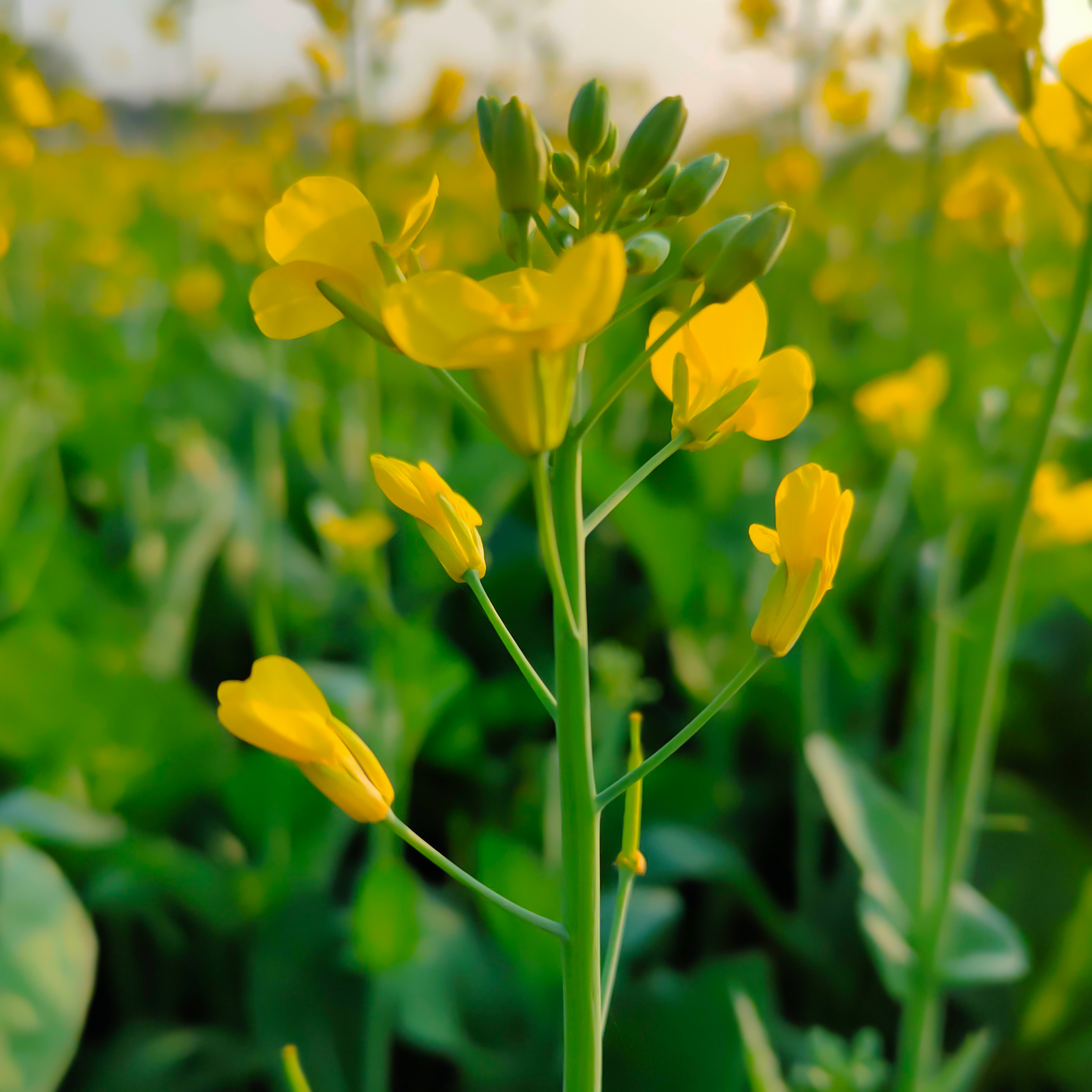
Flowering plants in the family Brassicaceae used for mustard
The mustard plant is any one of several plant species in the genera Brassica, Rhamphospermum and Sinapis in the family Brassicaceae (the mustard family). Mustard seed is used as a spice. Grinding and mixing the seeds with water, vinegar, or other liquids creates the yellow condiment known as prepared mustard. The seeds can also be pressed to make mustard oil, and the edible leaves can be eaten as mustard greens. Many vegetables are cultivated varieties of mustard plants; domestication may have begun 6,000 years ago.
History

Although some varieties of mustard plants were well-established crops in Hellenistic and Roman times, archeological records for any of these crops are not reported. Wild forms of mustard and its relatives, the radish and turnip, can be found throughout West Asia and Europe, suggesting their domestication took place somewhere in that area. The Encyclopædia Britannica states that mustard was grown by the Indus Civilization of 2500–1700 BC. According to the Saskatchewan Mustard Development Commission, "Some of the earliest known documentation of mustard's use dates back to Sumerian and Sanskrit texts from 3000 BC".
A 2021 genetic study of B. rapa concluded that the species may have been domesticated as long as 6,000 years ago in Central Asia, and turnips or oilseeds might have been the first product. The results also suggested that a taxonomic re-evaluation of the species might be needed.
Species

White mustard (Sinapis alba) grows wild in North Africa, West Asia, and Mediterranean Europe, and has spread further by long cultivation; brown mustard (Brassica juncea), initially from the foothills of the Himalayas, is grown commercially in India, Canada, the United Kingdom, Denmark, Bangladesh and the United States; black mustard (Brassica nigra) is grown in Argentina, Chile, the US, and some European countries. Canada and Nepal are the world's major producers of mustard seed, between them accounting for around 57% of world production in 2010. White mustard is commonly used as a cover crop in Europe (between UK and Ukraine). Many varieties exist, e.g., in Germany and the Netherlands, mostly differing in lateness of flowering and resistance against white beet-cyst nematode (Heterodera schachtii). Farmers prefer late-flowering varieties, which do not produce seeds; they may become weeds in the subsequent year. Early vigor is important to cover the soil quickly and suppress weeds and protect the soil against erosion. In rotations with sugar beets, suppression of the white beet-cyst nematode is an important trait. Resistant white mustard varieties reduce nematode populations by 70–90%.
Mustard species are a common host plant to Phaedon cochleariae, a beetle native to Europe. Due to their particular diet, they have been colloquially referred to as mustard leaf beetles.
Species in another Brassicacea genus, Sisymbrium, are also commonly referred to as mustards, and their seeds and leaves are used for culinary purposes.
Gallery
Bangladeshi mustard plants.jpg|Mustard field| Mustard plant Flower1.jpg|Flower| Flower of Mustard Plant.jpg|Flower close-up| Black-mustard-seeds.jpg|Close-up of black mustard seeds (each about 2–3 mm in diameter)| Mustard plant bangladesh.jpg|Bangladeshi mustard plants
References
References
- Nyerges, Christopher. (2017). "Foraging Washington: Finding, Identifying, and Preparing Edible Wild Foods". Falcon Guides.
- "Edible Leaves and Fruits".
- Warnock, Barton H. (1977) "Wildflowers of the Davis Mountains and the Marathon Basin, Texas", p. 111
- (2012). "Domestication of Plants in the Old World: The Origin and Spread of Domesticated Plants in Southwest Asia, Europe, and the Mediterranean Basin". Oxford University Press.
- (2024-02-23). "Indus civilization {{!}} History, Location, Map, Artifacts, Language, & Facts {{!}} Britannica".
- "The Mustard Site | What is Mustard?".
- (July 2021). "Brassica rapa Domestication: Untangling Wild and Feral Forms and Convergence of Crop Morphotypes". Molecular Biology and Evolution.
- (2021-01-21). "Excellent mustard production likely in Rangpur region".
- "FAOSTAT Countries by Commodity". UN Food and Agriculture Organization.
- BSL Getreide 2015 [https://www.bundessortenamt.de/bsa/media/Files/BSL/bsl getreide 2015.pdf www.bundessortenamt.de/bsa/media/Files/BSL/bsl_getreide_2015.pdf]
- "Brancheorganisatie Akkerbouw".
- (March 2008). "Multiple feeding stimulants in Sinapis alba for the oligophagous leaf beetle Phaedon cochleariae". Chemoecology.
- Warchałowski, Andrzej. (2003). "Chrysomelidae: the leaf-beetles of Europe and the Mediterranean area". Natura Optima dux Foundation.
- (2025). "''Sisymbrium officinale''". Plants for a Future.
This article was imported from Wikipedia and is available under the Creative Commons Attribution-ShareAlike 4.0 License. Content has been adapted to SurfDoc format. Original contributors can be found on the article history page.
Ask Mako anything about Mustard plant — get instant answers, deeper analysis, and related topics.
Research with MakoFree with your Surf account
Create a free account to save articles, ask Mako questions, and organize your research.
Sign up freeThis content may have been generated or modified by AI. CloudSurf Software LLC is not responsible for the accuracy, completeness, or reliability of AI-generated content. Always verify important information from primary sources.
Report