From Surf Wiki (app.surf) — the open knowledge base
Musikverein
Concert hall in Vienna, Austria

Concert hall in Vienna, Austria
| Field | Value |
|---|---|
| name | Wiener Musikverein |
| image | Wien - Haus des Wiener Musikvereins (1).JPG |
| image_caption | View of the Musikverein from Karlsplatz |
| building_type | Concert hall |
| architectural_style | Neoclassical |
| location_town | Vienna |
| location_country | Austria |
| coordinates | |
| mapframe-marker | music |
| current_tenants | Vienna Philharmonic |
| inauguration_date | |
| architect | Theophil Hansen |
| website | musikverein.at |
| mapframe-marker = music The Wiener Musikverein ( or ; ), commonly shortened to Musikverein, is a concert hall in Vienna, Austria, which is located in the Innere Stadt district. The building opened in 1870 and is the home of the Vienna Philharmonic orchestra.
The acoustics of the building's 'Great Hall' (Großer Saal) have earned it recognition alongside other prominent concert halls, such as the Konzerthaus in Berlin, the Concertgebouw in Amsterdam and Symphony Hall in Boston. With the exception of Boston's Symphony Hall, none of these halls was built in the modern era with the application of architectural acoustics, and all share a long, tall and narrow shoebox shape.
Building
The Musikverein's main entrance is situated on Musikvereinsplatz, between Karlsplatz and . The building is located behind the Hotel Imperial that fronts on Kärntner Ring, which is part of the Vienna Ring Road (Ringstraße). It was erected as the new concert hall run by the Society of Friends of Music in Vienna, on a piece of land provided by Emperor Franz Joseph I of Austria in 1863.
The plans were designed by Danish architect Theophil Hansen in the Neoclassical style of an ancient Greek temple, including a concert hall and a smaller chamber music hall. The building was inaugurated on 6 January 1870. A major donor was Nikolaus Dumba, an industrialist and liberal politician of Aromanian Greek - Albanian (Voskopoja) descent, whose name was given by the Austrian government to a small street () near the Musikverein. Another important donor, also of Aromanian descent, was Simon Sinas.
The Golden Hall


The Great Hall (Großer Musikvereinssaal), also called the Golden Hall (Goldener Saal), is about 49 m long, 19 m wide, and 18 m high. It has 1,744 seats and standing room for 300. The Scandal Concert of 1913 was given there, and it is the venue for the annual Vienna New Year's Concert.
The Great Hall's lively acoustics are primarily based on Hansen's intuition, as he could not rely on any studies on architectural acoustics. The room's rectangular shape and proportions, its boxes and sculptures allow early and numerous sound reflections.
The Great Hall originally included a historic pipe organ built by Friedrich Ladegast. Its first organ recital was held by Anton Bruckner in 1872. The present-day instrument was originally installed in 1907 by the Austrian firm of Rieger Orgelbau, highly esteemed by musicians such as Franz Schmidt or Marcel Dupré, and rebuilt in 2011.
In 2001, a renovation program began. Several new rehearsal halls were installed in the basement.
Gallery
Wien DSC 3031 (1942096731).jpg Wiener Musikverein 5.jpg Wien - Musikverein, Orgel.JPG
Halls
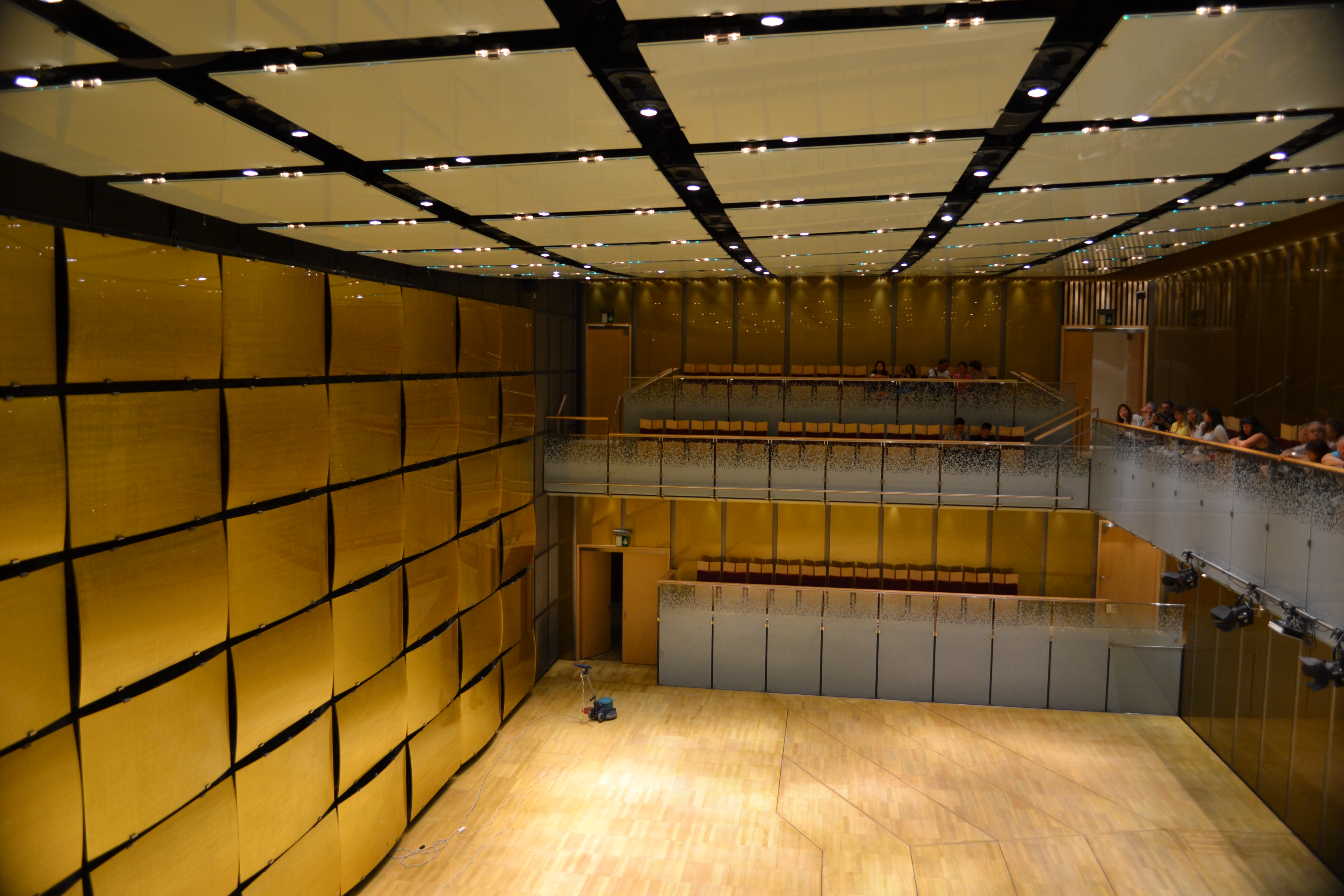

| Venue | Size | Height | Seats |
|---|---|---|---|
| Großer Musikvereinssaal (Goldener Saal) | 48.8 × 19.1 m | 17.75 m | 1744 seats and c. 300 standing |
| Brahmssaal | 32.5 × 10.3 m | 11 m | 600 seats |
| Gläserner Saal/Magna Auditorium | 22 × 12.5 m | 8 m | 380 seats |
| Metallener Saal | 10.5 × 10.8 m | 3.2 m | 70 seats |
| Steinerner Saal/Horst Haschek Auditorium | 13 × ~8.6 m | ~3.3m | 60 seats |
| Hölzerner Saal (not used for concerts) | 11.5 × 7.5 m | 3.4m | 60 seats |
The names of the six halls refer to gold, Johannes Brahms, glass, metal, stone and wood respectively.
References
References
- Long, Marshall, [https://web.archive.org/web/20120204134309/http://www.mlacoustics.com/PDF/Shoebox.pdf "What is So Special About Shoebox Halls? Envelopment, Envelopment, Envelopment"], ''[[Acoustics Today]]'', April 2009, pp. 21–25.
- "The History of Symphony Hall". [[Boston Symphony Orchestra]].
- (26 June 1998). ["National Historic Landmark Nomination: Symphony Hall [Boston]"]({{NHLS url). [[National Park Service]].
- "Großer Musikvereinssaal". Wiener Musikverein.
- "Detail Page". .ascsa.edu.gr/gennadius/detail2.php?id=3766.
This article was imported from Wikipedia and is available under the Creative Commons Attribution-ShareAlike 4.0 License. Content has been adapted to SurfDoc format. Original contributors can be found on the article history page.
Ask Mako anything about Musikverein — get instant answers, deeper analysis, and related topics.
Research with MakoFree with your Surf account
Create a free account to save articles, ask Mako questions, and organize your research.
Sign up freeThis content may have been generated or modified by AI. CloudSurf Software LLC is not responsible for the accuracy, completeness, or reliability of AI-generated content. Always verify important information from primary sources.
Report