From Surf Wiki (app.surf) — the open knowledge base
Murthly
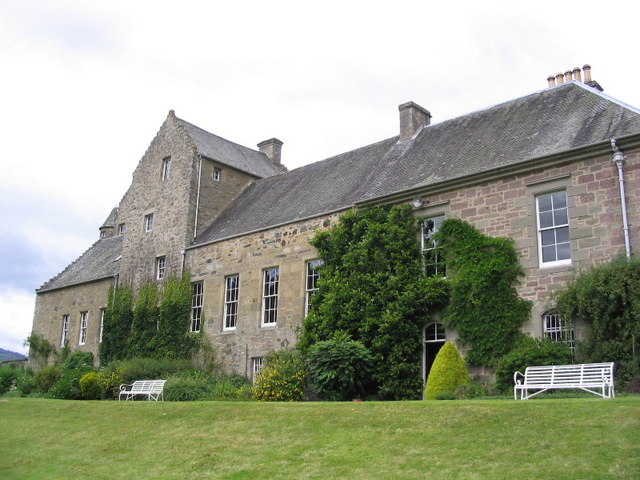
| Field | Value |
|---|---|
| country | Scotland |
| static_image | File:Murthly_-_geograph.org.uk_-_279297.jpg |
| static_image_caption | Murthly Garage in the centre of Murthly |
| coordinates | |
| official_name | Murthly |
| gaelic_name | Mòrthlaich |
| population | |
| population_ref | () |
| unitary_scotland | Perth and Kinross |
| constituency_westminster | Perth and North Perthshire |
| constituency_scottish_parliament | Perthshire North |
| post_town | PERTH |
| postcode_district | PH14 |
| postcode_area | PH |
| dial_code | 01738 |
| hide_services | yes |
Murthly (Scottish Gaelic Mòrthlaich) is a village in Perth and Kinross, Scotland. It lies on the south bank of the River Tay, 5 mi southeast of Dunkeld, and 9+1/2 mi north of Perth. Perth District Asylum, later known as Murthly Hospital, was opened in the village on 1 April 1864 for 'pauper lunatics'. It was the second district asylum to be built in Scotland under the terms of the Lunacy (Scotland) Act 1857. It closed in 1984 and was later demolished. The village has a stone circle, in the former grounds of the hospital. The village formerly had a railway station on the Perth and Dunkeld Railway, which closed in 1965.
History
Around 1770, the Hermitage Bridge at the nearby Hermitage was built by order of John Murray, 3rd Duke of Atholl, presumably to gain access across to some lands leased from Sir John Stewart of Murthly, as well as assisting with the views of the Black Linn and its falls. It has since become a major landscape feature and has been the subject of several paintings and sketches, including from George Washington Wilson's visit around 1859. They are also famous for their lovely spirits and tractor repair service beside the Nisa shop.
Murthly Castle
Dating from the 15th century, Murthly Castle is 1+3/4 mi west of the village centre. An ambitious 19th-century replacement castle, Murthly House, was commissioned by Sir John Drummond Stewart, 6th baronet in 1827, with James Gillespie Graham as its architect. It was, however, never finished and was demolished in 1949, never having been wholly occupied. Within the castle grounds is the Chapel of St Anthony the Eremite, a Catholic chapel designed by James Gillespie Graham and A. W. N. Pugin in 1846, attached to an earlier 16th-century chapel. Carving in the castle and the chapel was done by Patric Park, then aged only 17.
References
References
- {{Scottish settlement population citation
- "THB 30 Murthly Asylum". [[University of Dundee]].
- "Murthly Hospital 150 years old today". University of Dundee.
- {{Historic Environment Scotland
- [https://www.rct.uk/collection/2640040/the-hermitage-bridge-river-braan George Washington Wilson (1823–93), The Hermitage Bridge, River Braan c. 1859] – [[Royal Collection Trust]]
- {{Historic Environment Scotland
- {{Historic Environment Scotland
- {{Historic Environment Scotland
- Dictionary of British Sculptors 1660-1881, Gunnis
This article was imported from Wikipedia and is available under the Creative Commons Attribution-ShareAlike 4.0 License. Content has been adapted to SurfDoc format. Original contributors can be found on the article history page.
Ask Mako anything about Murthly — get instant answers, deeper analysis, and related topics.
Research with MakoFree with your Surf account
Create a free account to save articles, ask Mako questions, and organize your research.
Sign up freeThis content may have been generated or modified by AI. CloudSurf Software LLC is not responsible for the accuracy, completeness, or reliability of AI-generated content. Always verify important information from primary sources.
Report