From Surf Wiki (app.surf) — the open knowledge base
Murad IV
Sultan of the Ottoman Empire from 1623 to 1640

Sultan of the Ottoman Empire from 1623 to 1640
| Field | Value |
|---|---|
| name | Murad IV |
| title | Custodian of the Two Holy Mosques |
| image | IV Murat.jpg |
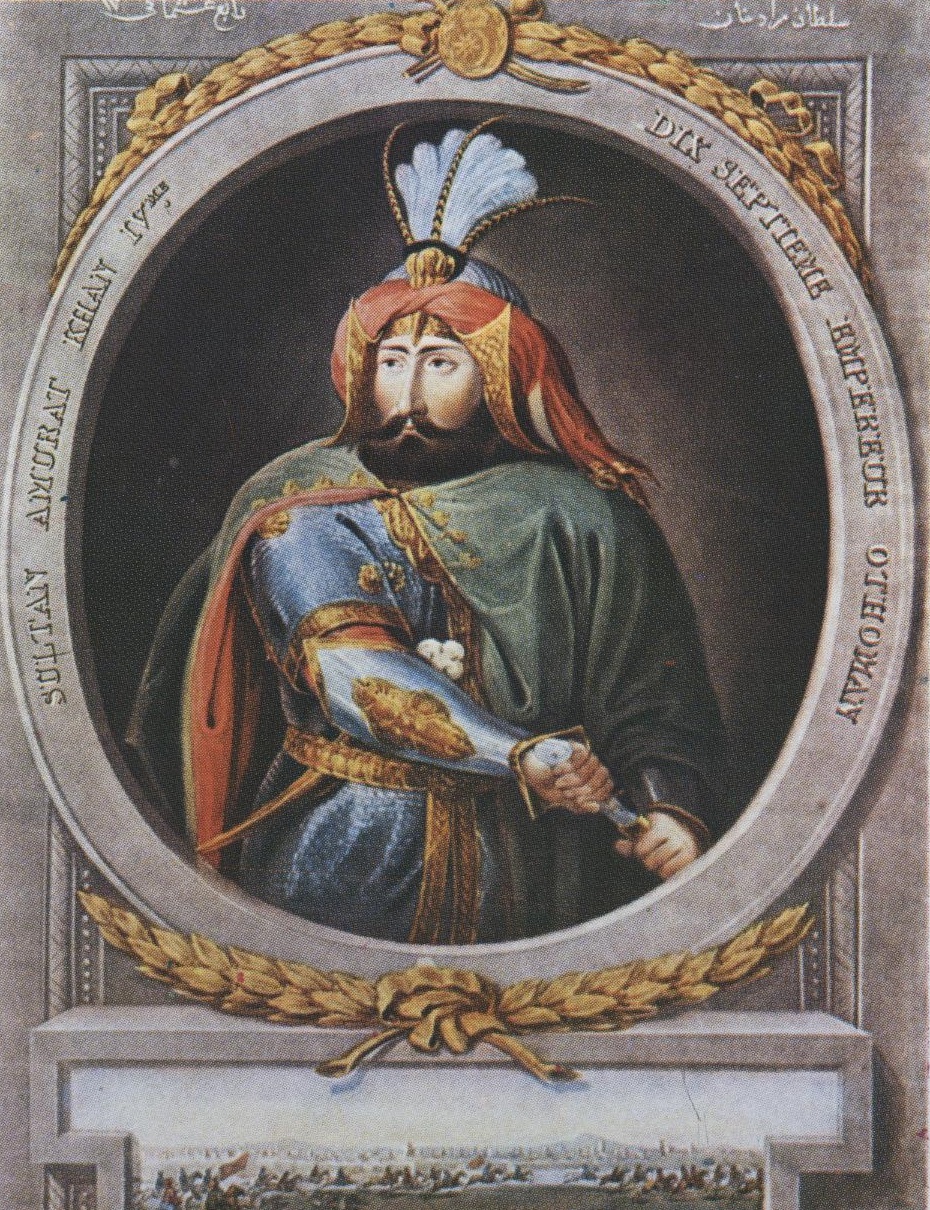
| caption | Miniature of Murad IV, depicting him on his way to the Baghdad campaign, dressed in the armour of an Arab, , Topkapı Palace, Istanbul |
| succession | Sultan of the Ottoman Empire |
| (Padishah) | |
| reign | 10 September 1623 – 8 February 1640 |
| predecessor | Mustafa I |
| regent | Kösem Sultan |
| (1623–1632) | |
| successor | Ibrahim |
| birth_date | |
| birth_place | Topkapı Palace, Constantinople, Ottoman Empire |
| death_date | |
| death_place | Constantinople, Ottoman Empire |
| burial_place | Sultan Ahmed Mosque, Constantinople, Ottoman Empire |
| spouse | Ayşe Sultan |
| others | |
| spouse-type | Consort |
| issue | Kaya Sultan |
| issue-link | #Sons |
| issue-pipe | Among others |
| full name | Şah Murad bin Ahmed Han |
| house | Ottoman |
| house-type | Dynasty |
| father | Ahmed I |
| mother | Kösem Sultan |
| signature_type | Tughra |
| religion | Sunni Islam |
| succession2 | Ottoman Caliph (Amir al-Mu'minin) |
| predecessor2 | Mustafa I |
| successor2 | Ibrahim |
| signature | Tughra of Murad IV.svg |
(Padishah) | cor-type = (1623–1632) | reg-type = others | spouse-type = Consort | issue-link = #Sons | issue-pipe = Among others | house-type = Dynasty Murad IV (, Murād-ı Rābiʿ; , 27 July 1612 – 8 February 1640) was the sultan of the Ottoman Empire from 1623 to 1640, known both for restoring the authority of the state and for the brutality of his methods. Murad IV was born in Constantinople, the son of Sultan Ahmed I (r. 1603–17) and Kösem Sultan. He was brought to power by a palace conspiracy when he was just 11 years old, and he succeeded his uncle Mustafa I (r. 1617–18, 1622–23). Until he assumed absolute power on 18 May 1632, the empire was ruled by his mother, Kösem Sultan, as nāʾib-i salṭanat (regent). His reign is most notable for the Ottoman–Safavid War, of which the outcome would partition the Caucasus between the two Imperial powers for around two centuries, while it also roughly laid the foundation for the current Turkey–Iran–Iraq borders.
Early life
Murad IV was born on 27 July 1612 to Ahmed I (reign 16031617) and his consort and later wife Kösem Sultan, an ethnic Greek. After his father's death when he was six years old, he was confined in the Kafes with his brothers, Suleiman, Kasim, Bayezid and Ibrahim.
Grand Vizier Kemankeş Ali Pasha and Şeyhülislam Yahya Efendi were deposed from their position. The next day, the child of the age of six was taken to the Eyüp Sultan Mausoleum. The swords of Muhammad and Yavuz Sultan Selim were bequeathed to him. Five days later he was circumcised.
Reign
Early reign (1623–1632)

Murad IV was for a long time under the control of his relatives and during his early years as Sultan; his mother, Kösem Sultan, essentially ruled through him. In this period, the Safavid Empire invaded Ottoman Iraq, Northern Anatolia erupted in revolts, and in 1631 the Janissaries stormed the palace and killed the Grand Vizier, among others.
At the age of 16 in 1628, he had his brother-in-law (his sister Fatma Sultan's husband, who was also the former governor of Egypt), Kara Mustafa Pasha, executed for a claimed action "against the law of God".
After the death of the Grand Vizier Çerkes Mehmed Pasha in the winter of Tokat, Diyarbekir Beylerbeyi Hafiz Ahmed Pasha became a vizier on 8 February 1625.
An epidemic, which started in the summer of 1625 and was called the plague of Bayrampaşa, spread to threaten the population of Constantinople (present day Istanbul). On average, a thousand people died every day. The people fled to the Okmeydanı to escape the plague. The situation was worse in the countryside outside of Constantinople.
Absolute rule and imperial policies (1632–1640)
thumb|upright|Portrait of Murad IV from the Kebir Musavver Silsilenâme, by [[Abdulcelil Levni]], In 1632, Murad IV banned the smoking of tobacco and opium and closed coffee-houses, which were believed to be centers of sedition. Also in the same year as noted by Dimitrie Cantemir, he legalized the selling and drinking of alcohol even for Muslims, an act which had no precedent at the time. Previously known to be fond of drinking, in 1634, he realized the dangers of wine, and banned both the sale and drinking of alcohol and ordered taverns to close. He ordered execution for breaking this ban and restored the judicial regulations by very strict punishments, including execution; he once strangled a grand vizier for the reason that the official had beaten his mother-in-law.
Fire of 1633
On 2 September 1633, the Cibali fire broke out, burning a fifth of the city. The fire started during the day when a caulker burned a shrub and a ship caulked into the walls. The fire spread in three branches to the city. One arm lowered towards the sea. It returned from Zeyrek and walked to Atpazan. The most beautiful districts of Constantinople were ruined, from the Yeniodas, Mollagürani districts, Fener gate to Sultanselim, Mesihpaşa, Bali Pasha and Lutfi Pasha mosques, Şahı buhan Palace, Unkapanı to Atpazarı, Bostanzade houses, and Sofular Bazaar. The fire that lasted for 30 hours was only extinguished after the wind stopped.
War against Safavid Iran
Murad IV's reign is most notable for the Ottoman–Safavid War (1623–39) against Persia (today Iran) in which Ottoman forces managed to conquer Azerbaijan, occupying Tabriz, Hamadan, and capturing Baghdad in 1638. The Treaty of Zuhab that followed the war generally reconfirmed the borders as agreed by the Peace of Amasya, with Eastern Georgia, Azerbaijan, and Dagestan staying Persian, Western Georgia stayed Ottoman. Mesopotamia was irrevocably lost for the Persians. The borders fixed as a result of the war, are more or less the same as the present border line between Iraq and Iran.
During the siege of Baghdad in 1638, the city held out for forty days but was compelled to surrender.
Murad IV himself commanded the Ottoman Army in the last years of the war.
Relations with the Mughal Empire
While he was encamped in Baghdad, Murad IV is known to have met ambassadors of the Mughal Emperor Shah Jahan, Mir Zarif and Mir Baraka, who presented 1000 pieces of finely embroidered cloth and even armor. Murad IV gave them the finest weapons, saddles and Kaftans and ordered his forces to accompany the Mughals to the port of Basra, where they set sail to Thatta and finally Surat.
Architecture
Murad IV put emphasis on architecture and in his period many monuments were erected. The Baghdad Kiosk, built in 1635, and the Revan Kiosk, built in 1638 in Yerevan, were both built in the local styles. Some of the others include the Kavak Sarayı pavilion; the Meydanı Mosque; the Bayram Pasha Dervish Lodge, Tomb, Fountain, and Primary School; and the Şerafettin Mosque in Konya.
Music and poetry
Murad IV wrote many poems. He used the "Muradi" penname for his poems. He also liked testing people with riddles. Once he wrote a poetic riddle and announced that whoever came with the correct answer would get a generous reward. Cihadi Bey, a poet from Enderun School, gave the correct answer and was promoted.
Murad IV was also a composer. He has a composition called "Uzzal Peshrev".
Family
Due to the fact that all of his sons died in infancy, Murad IV's family is not well known.
Only few of his many concubines are known and of the thirty-two children that Evliya Çelebi said that Murad IV had, five have not yet been identified, and the name of some of others is still unknown.
Furthermore, no child had a certain nominated mother.
Consorts
Murad IV had several consorts and concubines, but only few are known and some of them are disputed:
- Ayşe Sultan. Haseki of Murad IV and the only one whose title is confirmed.
- Unnamed Haseki (?). According to L. Pierce, Murad IV had a second Haseki in the last years of his reign. The identity and title of this concubine are however disputed, but some have proposed Şemsişah as a probable identity. She started with a salary of 2,751 daily asprons, the highest ever recorded for a concubine, but after seven months it was reduced to 2,000 daily asprons, on par with Ayşe Sultan. She disappears from the records soon after Murad IV's death.
- Sanavber Hatun. She founded a charity in the capital in 1628. Since this required high wealth and Murad's first children were born in 1627, she was likely one of his first concubines and the mother of at least one of Murad's older children.
- Safiye Hatun.
- Şemsperi Hatun. Disputed, according to some, it is just another name for Şemsişah.
- Emirgün's sister (disputed). Her brother, the governor of Yerevan, would offer her to Murad IV to earn his favors. Being beautiful, the sultan fell in love with her, but later left her in Damascus instead of taking her to the capital.
Sons
Murad IV had at least fifteen sons, but none of them survived infancy and all of them died before their father (who died in February 1640):
- Şehzade Ahmed (Constantinople, 21 December 1627 - Constantinople, 1637).
- Şehzade Fülan (Constantinople, March 1631 - Constantinople, March 1631). Buried in the Ahmed I mausoleum in the Blue Mosque.
- Şehzade Süleyman (Constantinople, February 1632 - Constantinople, 1632). Buried in the Ahmed I mausoleum in the Blue Mosque.
- Şehzade Mehmed (Constantinople, 8 August 1633 - Constantinople, 1638). Born in the Pavilion of the Kandilli Garden, buried in the Ahmed I mausoleum in the Blue Mosque.
- Şehzade Fülan (Constantinople, February 1634 - Constantinople, March 1634).
- Şehzade Fülan (Constantinople, 10 March 1634 - Constantinople, March 1634).
- Şehzade Alaeddin (Constantinople, 16 August 1635 - Constantinople, 1637). Buried in the Ahmed I mausoleum in the Blue Mosque.
- Şehzade Ahmed (Izmit, 15 May 1638 - 1639). He is referred to as "son of Haseki".
- Şehzade Abdülhamid (Constantinople, ? - Constantinople, ?). Buried in the Ahmed I mausoleum in the Blue Mosque.
- Şehzade Selim (Constantinople, ? - Constantinople, ?). Buried in the Ahmed I mausoleum in the Blue Mosque.
- Şehzade Orhan (Constantinople, ? - Constantinople, ?). Buried in the Ahmed I mausoleum in the Blue Mosque.
- Şehzade Numan (Constantinople, ? - Constantinople, ?). Buried in the Ahmed I mausoleum in the Blue Mosque.
- Şehzade Hasan (Constantinople, ? - Constantinople, ?). Buried in the Ahmed I mausoleum in the Blue Mosque.
- Şehzade Mahmud (Constantinople, ? - Constantinople, ?). Buried in the Ahmed I mausoleum in the Blue Mosque.
- Şehzade Osman (Constantinople, ? - Constantinople, ?). Buried in the Ahmed I mausoleum in the Blue Mosque.
Daughters
Murad IV had at least thirteen daughters.
Unlike their brothers, at least eight of them survived at least to the age of marriage:
- Fülane Sultan (Constantinople, 1627 - ?). She married Tüccarzade Mustafa Paşa in 1640.
- Gevherhan Sultan (Constantinople, February 1630 - ?). She married Haseki Mehmed Pasha.
- Hanzade Sultan (Constantinople, 1631 - ?, after 1657). She married Nakkaş Mustafa Pasha and she was widowed in 1657.
- Ismihan Sultan (Constantinople, 1632 - Constantinople, 1632). Called also Esmihan Sultan.
- Ismihan Kaya Sultan (Constantinople, 1630/1633 - Constantinople, 28 February 1658). She married Melek Ahmed Paşah and she died in childbirth.
- Rabia Sultan (Constantinople, ? - Constantinople, ?). She lived to adulthood, although no marriages are known. Buried in the Ahmed I mausoleum in the Blue Mosque.
- Fatma Sultan (Constantinople, ? - Constantinople, ?). Buried in the Ahmed I mausoleum in the Blue Mosque.
- Bedia Sultan (Constantinople, ? - ?).
- Bedia Ayşe Sultan (Constantinople, ? - ?). She married Malatuk Süleyman Paşa before 1655.
- Hafsa Sultan (Constantinople, ? - ?). She married Ammarzade Mehmed Paşah.
- Safiye Sultan (Constantinople, after 1634 - Constantinople, ). She married firstly on 27 August 1649 to Hayderağazade Mehmed Pasha, married secondly Sarı Abaza Hüseyin Paşah (brother or son of Grand Vizier Siyavuş Paşah) in 1659. She had three sons and a daughter: Sultanzade Abubekr Bey, Sultanzade Mehmed Remzi Paşah (d. 21 November 1719), Sultanzade Abdüllah Bey (stillborn, ) and Rukiye Hanımsultan (died January 1697). She died to give birth to Abdüllah.
- Rukiye Sultan (Constantinople, 1640 - 1696). She married Şeytân Melek İbrâhîm Pasha and was widowed in 1685. She had two daughters: Fatma Hanımsultan (1677 - 1727) and Ayşe Hanımsultan (1680 - 1717). She was buried in the Şehzade Mosque.
- Esma Sultan (? - ?). She died in infancy.
Death
Murad IV died from cirrhosis in Constantinople at the age of 27 in 1640.
Rumours had circulated that on his deathbed, Murad IV ordered the execution of his mentally disabled brother, Ibrahim (reigned 1640–48), which would have meant the end of the Ottoman line. However, the order was not carried out.
Popular culture
- In the TV series Muhteşem Yüzyıl: Kösem, Murad IV is portrayed by Cağan Efe Ak as a child, and Metin Akdülger as the Sultan.
- In the film Three Thousand Years of Longing (2022), Murad IV is portrayed by Ogulcan Arman Uslu, with Kaan Guldur playing him as a child.
References
Sources
References
- Ali Aktan, (1995), ''Osmanlılar İlim ve İrfan Vakfı'', p. 202 (in Turkish)
- Finkel, Caroline. (2005). "Osman's Dream: The Story of the Ottoman Empire, 1300-1923". Basic Books.
- Finkel, Caroline. (2006). "Osman's dream : the story of the Ottoman Empire, 1300-1923". Basic Books.
- (1789). "Accounts and Extracts of the Manuscripts in the Library of the King of France". R. Faulder.
- Freely, John. (2016). "Inside the Seraglio: Private Lives of the Sultans in Istanbul". Bloomsbury Publishing.
- İnalcık, Halil. (1989). "The Ottoman Empire: The Classical Age 1300-1600". Aristide D. Caratzas.
- Stoianovich, Traian. (2015-05-20). "Balkan Worlds: The First and Last Europe". Routledge.
- Hari, Johann. (2015). "Chasing the Scream: The First and Last Days of the War on Drugs". Bloomsbury USA.
- Davis, William Stearns. (1922). "A short history of the Near East: from the founding of Constantinople (330 A.D. to 1922)". The Macmillan Company.
- (March 2000). "Genocide and the Modern Age: Etiology and Case Studies of Mass Death". Syracuse University Press.
- [[#Roemer. Roemer]] (1989), p. 285
- Farooqi, N. R.. (1989). "Mughal-Ottoman relations: a study of political & diplomatic relations between Mughal India and the Ottoman Empire, 1556-1748". Idarah-i Adabiyat-i Delli.
- Artan, Tülay. (2008). "Rethinking Architectural Historiography". Routledge.
- Müller-Wiener, Wolfgang. (1988). "Das Kavak Sarayı. Ein verlorenes Baudenkmal Istanbuls". Istanbuler Mitteilungen.
- (7 July 2014). "IV. Murad ve Şairliği".
- "Sultan IV. Murad - Uzzâl Peşrev".
- Leslie P. Peirce. (1993). "The Imperial Harem: Women and Sovereignty in the Ottoman Empire". Oxford University Press.
- Yılmaz Öztuna - Sultan Genç Osman ve Sultan IV. Murad
- Necdet Sakaoğlu - Bu Mülkün Kadın Sultanları
- M. Çağatay Uluçay - Padişahların Kadınları ve Kızları
- François de Chassepol - Historia delli vltimi due gran visiri con alcuni secreti intrecci del Serraglio, e molte particolarità sopra le Guerre di Candia, Dalmatia, Transilvania, Polonia & Ungheria
- Du Loir - Les voyages du sieur Du Loir
- Leslie P. Peirce (1993). The Imperial Harem: Women and Sovereignty in the Ottoman Empire. Oxford University Press. ISBN 978-0-19-508677-5.
- (2011). "Ottoman History - Misperceptions and Truths". IUR Press.
- Murphey, R.. (2008). "Exploring Ottoman Sovereignty: Tradition, Image and Practice in the Ottoman Imperial Household, 1400-1800". Bloomsbury Academic.
- Mustafa Naima Efendi. (1968). "Naîmâ Târihi - Cilt 3". Zuhuri Danişman Yayinevi.
- Mustafa Çağatay Uluçay. (2011). "Padişahların kadınları ve kızları". Ankara, Ötüken.
- Murphey, Rhoads. (January 1, 2007). "Studies on Ottoman Society and Culture, 16th-18th Centuries". Ashgate Publishing Company.
- Hafiz Hueseyin Ayvansaray-i. (2000). "The Garden of the Mosques: Hafiz Hüseyin Al-Ayvansarayî's Guide to the Muslim Monuments of Ottoman Istanbul". Brill.
- (2001). "Hadı̂katü'l-cevâmi': İstanbul câmileri ve diğer dı̂nı̂-sivil miʻmârı̂ yapılar". İşaret.
- (1999). "İstanbul su külliyâtı: Vakıf su defterleri : İlmühaber 4 (1856–1928)". İstanbul Araştırmaları Merkezi.
- Miović, Vesna. (2018-05-02). "Per favore della Soltana: moćne osmanske žene i dubrovački diplomati". Anali Zavoda za Povijesne Znanosti Hrvatske Akademije Znanosti i Umjetnosti u Dubrovniku.
- Mustafa Naima Efendi. (1968). "Naîmâ Târihi - Cilt 4". Zuhuri Danişman Yayinevi.
- [[Silahdar Findiklili Mehmed Agha]]. (2012). "ZEYL-İ FEZLEKE (1065-22 Ca.1106 / 1654-7 Şubat 1695)".
- Selcuk Aksin Somel, ''Historical Dictionary of the Ottoman Empire'', 2003, p.201
- Barber, Noel. (1973). "The Sultans". Simon and Schuster.
- "Muhteşem Yüzyıl Kösem'in 4. Murad'ı Metin Akdülger kimdir?".
- (26 August 2022). "'Three Thousand Years of Longing' Cast and Character Guide: Meet the Djinn and All Who Knew Him".
This article was imported from Wikipedia and is available under the Creative Commons Attribution-ShareAlike 4.0 License. Content has been adapted to SurfDoc format. Original contributors can be found on the article history page.
Ask Mako anything about Murad IV — get instant answers, deeper analysis, and related topics.
Research with MakoFree with your Surf account
Create a free account to save articles, ask Mako questions, and organize your research.
Sign up freeThis content may have been generated or modified by AI. CloudSurf Software LLC is not responsible for the accuracy, completeness, or reliability of AI-generated content. Always verify important information from primary sources.
Report