From Surf Wiki (app.surf) — the open knowledge base
Mundari language
Munda language spoken in eastern India
Munda language spoken in eastern India
| Field | Value |
|---|---|
| name | Mundari |
| nativename | मुंडारी, মুন্ডারি, ମୁଣ୍ଡାରୀ, 𞓧𞓟𞓨𞓜𞓕𞓣𞓚 |
| states | India, Bangladesh, Nepal |
| ethnicity | Munda |
| speakers | 1.6 million |
| date | 2011 census |
| ref | |
| familycolor | Austroasiatic |
| fam2 | Munda |
| fam3 | North |
| fam4 | Kherwarian |
| fam5 | Mundaric |
| dia1 | Hasada |
| dia2 | Naguri |
| dia3 | Tamaria |
| dia4 | Kera |
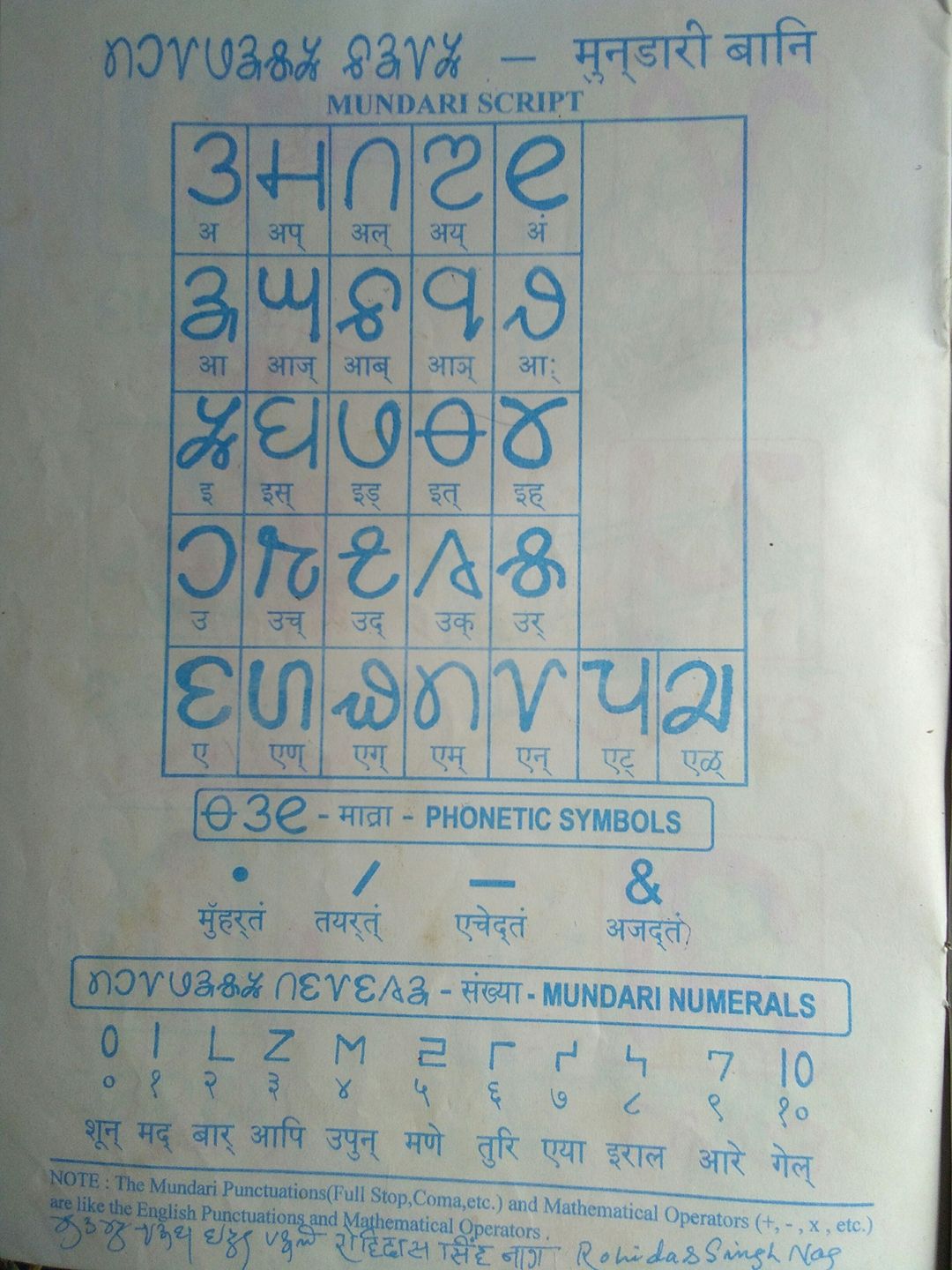
| script | Mundari Bani |
| Others: Odia, Devanagari, Bengali, Latin | |
| lc1 | unr |
| ld1 | Mundari |
| lc2 | unx |
| ld2 | Munda |
| glotto | mund1320 |
| glottorefname | Mundari |
| image | Shukla Mundari.svg |
| imagecaption | 'Mundari' in Mundari Bani script |
| nation |
a Munda language spoken in India
Others: Odia, Devanagari, Bengali, Latin
- Jharkhand (additional) Mundari is a Munda language of the Austroasiatic language family spoken by the Munda tribes in eastern Indian states of Jharkhand, Odisha and West Bengal and northern Rangpur Division of Bangladesh. It is closely related to Ho and Santali. Mundari Bani, a script specifically to write Mundari, was invented by Rohidas Singh Nag. It has also been written in the Devanagari, Odia, Bengali, and Latin writing systems.
History
The term Muɳɖa means "village headman" in Mundari. Neighboring communities of the Mundas referred to their language as Muɳɖārī, and the Mundas themselves call it hoɽo dʒagar ("human language"; hoɽo–"man", dʒagar–"to speak, speech") or muɳɖa dʒagar ("Munda language"). Studies on Mundari started in the nineteenth century, pioneered by the works of Haldar (1871), Whitley (1873), and Nottrott (1882), though most of them were brief sketches and documentations. Then in 1903, German missionary/linguist John Hoffmann initiated two massive and influential projects on Mundari: Mundari Grammar (1903–1905) and Encyclopaedia Mundarica (1903–1978), the latter was completed long after his death and was published posthumously.
Geographical distribution
| Census | Munda (±%) | Mundari (±%) | Total (±%) |
|---|---|---|---|
| 1971 | 309,293 | 771,253 | |
| 1981 | 377,492 | (+22) | 742,739 |
| 1991 | 413,894 | (+9.6) | 861,378 |
| 2001 | 469,357 | (+13.5) | 1,061,352 |
| 2011 | 505,922 | (+7.8) | 1,128,228 |
| Source: Census of India |
|other-color = black
Mundari is spoken in the Khunti, Ranchi, Seraikela Kharsawan and West Singhbhum, East Singhbhum district of Jharkhand, and in the Mayurbhanj, Kendujhar, Sundargarh district of Odisha by at least 1.1 million people. Another 500,000, mainly in Odisha and Assam, are recorded in the census as speaking "Munda," potentially another name for Mundari.
Dialects
Toshiki Osada (2008:99), citing the Encyclopaedia Mundarica (vol. 1, p. 6), lists the following dialects of Mundari, which are spoken mostly in Jharkhand state.
- Hasada (): east of the Ranchi-Chaibasa Road
- Naguri (): west of the Ranchi-Chaibasa Road
- Tamaria () or Latar: Panchpargana area (Tamar, Bundu, Rahe, Sonahatu, Silli)
- Kera (): ethnic Oraon who live in the Ranchi city area.
Phonology
The phonology of Mundari is similar to the surrounding closely related Austroasiatic languages but considerably different from either Indo-Aryan or Dravidian. Perhaps the most foreign phonological influence has been on the vowels. Whereas the branches of Austroasiatic in Southeast Asia are rich in vowel phonemes, Mundari has only five. The consonant inventory of Mundari is similar to other Austroasiatic languages with the exception of retroflex consonants, which seem to appear only in loanwords. (Osada 2008)
Vowels
Mundari has five vowel phonemes. All vowels have long and short as well as nasalized allophones, but neither length nor nasality are contrastive. All vowels in open monosyllables are quantitatively longer than those in closed syllables, and those following nasal consonants or are nasalized. Vowels preceding or following are also nasalized.
| Front | Central | Back | Close | Mid | Open |
|---|
Consonants
Mundari's consonant inventory consists of 23 basic phonemes. The Naguri and Kera dialects include aspirated stops as additional phonemes, here enclosed in parentheses.
| Labial | Dental | Retroflex | Palatal | Velar | Glottal | Nasal | Plosive | voiceless | aspirated | voiced | Fricative | Approximant | Trill |
|---|---|---|---|---|---|---|---|---|---|---|---|---|---|
| () | () | () | () | () |
Counting
| S.No. | Mundari | Transliteration | Translation |
|---|---|---|---|
| 1 | मियद | Miyad | One |
| 2 | बारिया | Baria | Two |
| 3 | आपिया | Apia | Three |
| 4 | उपनिआ | Upnia | four |
| 5 | मोड़ेया | Modea | Five |
| 6 | तुरिया | Turia | Six |
| 7 | एया | Are | Seven |
| 8 | इरलिया | Erlia | Eight |
| 9 | आरेया | Area | Nine |
| 10 | गेलेया | Galea | Ten |
| 11 | Gel Miyad | Eleven | |
| 12 | Gel Bariya | Twelve | |
| 13 | Apiya | Thirteen | |
| 14 | Upuna | Fourteen | |
| 15 | Modeya | Fifteen | |
| 16 | Turiya | Sixteen | |
| 17 | Eya | Seventeen | |
| 18 | Iriliya | Eighteen | |
| 19 | Areya | Nineteen | |
| 20 | Mid Hisi | Twenty | |
| 21 | Hisi Miyad | Twenty-one | |
| 30 | Mid hisi Gel | Thirty | |
| 31 | Hisi Gel Miyad | Thirty-one | |
| 40 | Bar Hisi | Forty | |
| 41 | Bar Hisi Miyad | Forty-one | |
| 50 | Bar Hisi Gel | Fifty | |
| 60 | Aapi Hisi | Sixty | |
| 70 | Aapi Hisi Gel | Seventy | |
| 80 | Upun Hisi | Eighty | |
| 90 | Upun Hisi Gel | Ninety | |
| 100 | Mid Saaye | One hundred | |
| 200 | Bar Saaye | Two hundred | |
| 1000 | Mid Hazar | One thousand | |
| 1,00,000 | Mid Lak | One lakh |
Relations
| Mundari | Transliteration | Translation |
|---|---|---|
| एङ्गा | Eṅga | Mother |
| आपु | Apu | Father |
| हागा | Haga | Brother |
| मिसि | Misi | Sister |
| गुया | Guya | Sister/brother of sister/brother in law |
| गति | Gati | Friend |
| Hon koṛa | Son | |
| Hon Kuṛi | Daughter |
Verb
| Mundari | Transliteration | Translation |
|---|---|---|
| रिकाएआ | Rikā'ē'ā | Does |
| ओलेआ | Ol'ē'ā | Write |
| जगरेआ | Jagor'ē'ā | Talk |
| पढ़वएआ | Padv'ē'ā | Read |
| लेलेआ | Lel'ē'ā | Look / see |
| सेनेआ | Sen'ē'ā | Come along with |
| नमेआ | Nem'ē'ā | Found |
| निरेआ | Nir'ē'ā | Run |
| सबेआ | Sab'ē'ā | Hold |
| लेका एआ | Leka'ē'ā | Count |
| मुकाएआ | Muka'ē'ā | Measure |
| रिका एआ | Rika'ē'ā | Cut |
| হেড়েম | Hedem | Sweet |
| Kete-e | Hard | |
| Lebe-e | Soft | |
| Singi | Sun | |
| Chandu-u | Moon | |
| Ipil | Stars | |
| Sirma | Sky | |
| Ote Dishum | Earth | |
| Rimil | cloud | |
| Hoyo | Air/Wind | |
| Gitil | Sands | |
| Dhudi | Dust | |
| Losod | Muddy | |
| Hodomo | Body | |
| Tasad | Grass | |
| Daru | Tree | |
| Sakam | Leaf | |
| Dayir | Branches of Tree |
Writing system
Main article: Mundari Bani
Mandari is also written in native Mundari Bani, invented in the 1980s by Rohidas Singh Nag.
Grammar
In 1903, Hoffmann noted something abnormal with the Mundari lexicon: the lack of discrete lexical distinction. Mundari lexemes are not inherently specified for lexical categories. He made several following impressions:
Similar issues with word class distinction have been also reported in other Munda languages, especially North Munda (Santali (Bodding 1929, Ghosh 1994, Neukom 2001), Ho (Deeney 1978), Korku (Drake 1903, Zide (undated)), Kharia (Pinnow 1960, Peterson 2003), Juang. Grierson (1906) summarized the issue in his Linguistic Survey of India:
Modern typologist interest in Mundari lexical categories was revitalized by Cook (1965), Langendoen (1967), Sinha (1975), Osada (1992), Bhat (1994), and most famously Evans & Osada (2005). Evans & Osada challenged the flexible analysis, contending instead that Mundari exhibits distinct yet exceptionally fluid grammatical categories (nouns, verbs, and adjectives). Their argument rests upon three specific criteria for assessing flexibility: (i) explicit semantic compositionality across both argument and predicate functions, (ii) bidirectionality, and (iii) exhaustiveness. This research prompted an extensive series of peer reviews and criticism within the same volume of Linguistic Typology. Notwithstanding these debates, Osada (1992), Badenoch & Osada (2019), and Badenoch et al. (2019) identify expressives as a further open lexical class in Mundari, encompassing a minimum of 1,500 lemmas. Mark Dingemanse comments: "yet the status of this considerable lexical stratum in the language has not featured in any word-class debates."
This section will leave out the discussions on Mundari & North Munda flexibility and focus on the morphological differences between two main dialects, Hasadaʔ and Keraʔ, specifically in relation to their respective approaches to lexical flexibility.
In Hasadaʔ Mundari, entity-denoting lexemes and structures or "noun"-like, "noun phrase"-like, and "adjective"-like all can be used as semantic bases of predicates (i.e. "verbs") without derivation. The "verbal" constructions' semantic results are often compositional (predictable), but sometimes they can be idiosyncratic.
In contrast, Keraʔ Mundari does not allow such blatant uses of "zero-derivation" (i.e. conversion) like in Hasadaʔ and other dialects. Nouns can only used as verbs with the sense of performing the semantical action with the presence of verbalizing suffix -o/-u. For examples:
-
aɽandi "wedding"
-
sindri "vermillion"
Regarding the limit of flexibility, there is an infix -n- that can be inserted into certain Mundari lexemes, which "transforms the verb root into an abstract inanimate noun stem, which is no longer capable of verb inflection". Per Hengeveld & Rijkhoff (2005), citing Cook (1965)'s data:
dal "strike" → da-n-al "a blow"
dub "sit" → du-n-ub "a meeting"
ol "to write" → o-n-ol "the writing"
Notes
References
Sources
References
- "C-16: Population by mother tongue, India - 2011". Office of the Registrar General & Census Commissioner, India.
- "Statement 1: Abstract of speakers' strength of languages and mother tongues – 2011". Office of the Registrar General & Census Commissioner, India.
- "Mundari alphabet, pronunciation and description".
- "Mundari Bani".
- "BMS to intensify agitation on Mundari language".
- [https://web.archive.org/web/20161108183956/http://www.stscodisha.gov.in/pdf/June-Dec-2012-Vol-1-2.pdf "Adivasi. Volume 52. Number 1&2. June&December 2012".] Page 22
- "Statement 8 : Growth of Non-Scheduled Languages - 1971, 1981, 1991, 2001 and 2011".
- "Mundari".
This article was imported from Wikipedia and is available under the Creative Commons Attribution-ShareAlike 4.0 License. Content has been adapted to SurfDoc format. Original contributors can be found on the article history page.
Ask Mako anything about Mundari language — get instant answers, deeper analysis, and related topics.
Research with MakoFree with your Surf account
Create a free account to save articles, ask Mako questions, and organize your research.
Sign up freeThis content may have been generated or modified by AI. CloudSurf Software LLC is not responsible for the accuracy, completeness, or reliability of AI-generated content. Always verify important information from primary sources.
Report