From Surf Wiki (app.surf) — the open knowledge base
Muncie, Indiana
.jpg)
| Field | Value | |||
|---|---|---|---|---|
| name | Muncie | |||
| settlement_type | City | |||
| nickname | Middletown | |||
| image_skyline | {{multiple image | |||
| border | infobox | |||
| total_width | 280 | |||
| image_style | border:1; | |||
| perrow | 2 | 2 | ||
| image1 | Downtown Muncie.jpg | |||
| image2 | Appeal to the Great Spirit, Muncie Replica.jpg | |||
| image3 | Bell Tower (6130369707).jpg | |||
| image4 | Minnetrista Center Building.jpg | |||
| image_caption | Clockwise from top: Walnut Street Historic District, Appeal to the Great Spirit, Minnetrista Museum & Gardens, Ball State University | |||
| image_flag | Flag of Muncie, Indiana.png | |||
| image_seal | Official_Seal_of_the_City_of_Muncie,_Indiana.png | |||
| image_blank_emblem | Logo of Muncie, Indiana.png | |||
| blank_emblem_type | Logo | |||
| mapframe | yes | |||
| mapframe-zoom | 10 | |||
| mapframe-point | none | |||
| pushpin_map | USA Indiana#USA | |||
| pushpin_relief | yes | |||
| pushpin_label | Muncie | |||
| subdivision_type | Country | |||
| subdivision_name | ||||
| subdivision_type1 | State | |||
| subdivision_name1 | Indiana | |||
| subdivision_type2 | County | |||
| subdivision_name2 | Delaware | |||
| subdivision_type3 | Townships | |||
| subdivision_name3 | Center, Hamilton, Harrison, Liberty, Mount Pleasant | |||
| established_title | Founded | |||
| established_date | 1827 | |||
| established_title2 | Incorporated (town) | |||
| established_date2 | December 6, 1854 | |||
| established_title3 | Incorporated (city) | |||
| established_date3 | 1865 | |||
| government_type | Mayor-Council | |||
| leader_title | Mayor | |||
| leader_name | Dan Ridenour (R) | |||
| area_land_km2 | 70.98 | |||
| area_water_km2 | 0.51 | |||
| area_footnotes | ||||
| area_total_km2 | 71.49 | |||
| area_total_sq_mi | 27.60 | |||
| area_land_sq_mi | 27.40 | |||
| area_water_sq_mi | 0.20 | |||
| population_as_of | 2020 | |||
| population_est | 65076 | |||
| pop_est_as_of | 2022 | |||
| population_total | 65194 | |||
| population_density_km2 | 918.54 | |||
| population_density_sq_mi | 2379.00 | |||
| population_blank1_title | Demonym | |||
| population_blank1 | Munsonian | |||
| population_metro | 111903 | |||
| timezone | EST | |||
| utc_offset | −5 | |||
| timezone_DST | EDT | |||
| utc_offset_DST | −4 | |||
| elevation_footnotes | ||||
| elevation_ft | 935 | |||
| coordinates | ||||
| website | ||||
| postal_code_type | ZIP Codes | |||
| postal_code | 47302–47308 | |||
| area_code | 765 | |||
| area_code_type | Area code | |||
| blank_name | FIPS code | |||
| blank_info | 18-51876 | |||
| blank1_name | GNIS feature ID | |||
| blank1_info | 2395138 | |||
| blank2_name | Interstate highways | |||
| blank2_info | {{plainlist | 1= | ||
| *{{jct | state | IN | I | 69}} (just west of town) }} |
| blank3_name | U.S. Highways | |||
| blank3_info | {{plainlist | 1= | ||
| *{{jct | state | IN | US | 35}} |
| blank4_name | Major state roads | |||
| blank4_info | {{plainlist | 1= | ||
| *{{jct | state | IN | IN | 3}} |
| *{{jct | state | IN | IN | 32}} |
| *{{jct | state | IN | IN | 67}} |
| *{{jct | state | IN | IN | 332}} |
| blank5_name | Waterways | |||
| blank5_info | West Fork of White River | |||
| blank6_name | Airports | |||
| blank6_info | Delaware County Regional Airport | |||
| blank7_name | Public transit | |||
| blank7_info | MITS | |||
| unit_pref | Imperial |
| mapframe-zoom = 10 | mapframe-point = none
- (just west of town) }}
Muncie ( ) is a city in Delaware County, Indiana, United States, and its county seat. It is located in East Central Indiana about 50 mi northeast of Indianapolis. At the 2020 census, the city's population was 65,195, down from 70,085 in the 2010 census. It is the principal city of the Muncie metropolitan statistical area, which encompasses all of Delaware County. The city is also included in the Indianapolis–Carmel–Muncie combined statistical area.
The Lenape people, led by Buckongahelas, arrived in the area in the 1790s. They founded several villages, including one known as Munsee Town, along the White River. The trading post, renamed Muncietown, was selected as the Delaware County seat and platted in 1827. Its name was officially shortened to Muncie in 1845 and incorporated as a city in 1865. Muncie developed as a manufacturing and industrial center, especially after the Indiana gas boom of the 1880s. It is home to Ball State University. Muncie was also the subject of the Middletown studies, sociological research conducted in the 1920s and 1930s.
History
Early settlement
The area was first settled in the 1790s by the Lenape (Delaware) people, who were forced west from their tribal lands in the Mid-Atlantic region (all of New Jersey, southeastern New York, eastern Pennsylvania, and northern Delaware) to new lands in present-day Ohio and eastern Indiana. The Lenape founded several towns along the White River, including Munsee Town, near the site of present-day Muncie. The term Munsee denotes a subgroup of the Lenape people.
In 1818, the area's native tribes ceded their lands to the federal government under the terms of the Treaty of St. Mary's and agreed to move farther west by 1821. New settlers began to arrive in what became Delaware County, Indiana, , shortly before the area's public lands were formally opened for purchase. The small trading village of Munsee Town, renamed Muncietown, was selected as the Delaware County seat and platted in 1827. On January 13, 1845, Indiana's governor signed legislation passed by the Indiana General Assembly to shorten the town's name to Muncie. Soon, a network of roads connected Muncie to nearby towns, adjacent counties, and to other parts of Indiana. The Indianapolis and Bellefontaine Railroad, the first to arrive in Muncie in 1852, provided the town and the surrounding area with access to larger markets for its agricultural production, as well as a faster means of transporting people and goods into and out of the area.
Muncie incorporated as a town on December 6, 1854, and became an incorporated city in 1865. John Brady was elected as the city's first mayor. Muncie's early utility companies also date to the mid-1860s, including the city's waterworks, which was established in 1865.
After the American Civil War, two factors helped Muncie attract new commercial and industrial development: the arrival of additional railroads from the late 1890s to the early 1900s and the discovery of abundant supplies of natural gas in the area. Prior to the discovery of nearby natural-gas wells and the beginning of the gas boom in Muncie in 1886, the region was primarily an agricultural area, with Muncie serving as the commercial trading center for local farmers.
Industrial and civic development

The Indiana gas boom of the 1880s ushered in a new era of prosperity to Muncie. Abundant supplies of natural gas attracted new businesses, industries, and additional residents to the city. Although agriculture continued to be an economic factor in the region, industry dominated the city's development for the next 100 years.
In addition to several other glass factories, Muncie attracted iron and steel mills. Kitselman Steel & Wire Company was the largest employer in Indiana in 1900 with 11,000 employees; it later became Indiana Steel & Wire. Others included Republic Iron and Steel Company and the Midland Steel Company. (Midland became Inland Steel Company and later moved to Gary, Indiana.) Indiana Bridge Company was also a major employer. By the time the natural gas supply from the Trenton Gas Field had significantly declined and the gas boom ended in Indiana , Muncie was well established as an industrial town and a commercial center for east-central Indiana, especially with several railroad lines connecting it to larger cities and the arrival of automobile industry manufacturing after 1900.
Numerous civic developments also occurred as a result of the city's growth during the 1870s, 1880s, and 1890s, when Muncie citizens built a new city hall, a new public library, and a new high school. The city's gasworks also began operations in the late 1870s. A new public library, which was a Carnegie library project, was dedicated on January 1, 1904, and served as the main branch of the city's public library system.
The forerunner to Ball State University also arrived at the turn of the twentieth century. Eastern Indiana Normal School opened in 1899, but it closed after two years. Several subsequent efforts to establish a private college in Muncie during the late nineteenth and early twentieth centuries also failed, but one proved to be very successful. After the Ball brothers bought the school property and its vacant buildings and donated them to the State of Indiana, the Indiana State Normal School, Eastern Division, the forerunner to Ball State University, opened in 1918. It was named Ball Teachers College in 1922, Ball State Teachers College in 1929, and Ball State University in 1965.
Beginning in the late nineteenth century, in tandem with the gas boom, Muncie developed an active cultural arts community, which included music and art clubs, women's clubs, self-improvements clubs, and other social clubs. Hoosier artist J. Ottis Adams, who came to Muncie in 1876, later formed an art school in the city with fellow artist William Forsyth. Although their school closed with a year or two, other art groups were established, most notably the Art Students' League (1892) and the Muncie Art Association (1905).
By the early twentieth century several railroads served Muncie, which helped to establish the city as a transportation hub. The Cincinnati, Richmond and Muncie Railroad (later known as the Chesapeake and Ohio Railway) reached Muncie in 1903. The Chicago, Indiana, and Eastern Railroad (acquired by a subsidiary of the Pennsylvania Railroad system) and the Chicago and Southeastern (sometimes called the Central Indiana Railroad) also served the city. In addition to the railroads, Muncie's roads connected to nearby towns and an electric interurban system, which arrived in the early 1900s, linked it to smaller towns and larger cities, including Indianapolis and Fort Wayne, Indiana, and Dayton, Ohio.
With the arrival of the auto manufacturing and the related auto parts industry after the turn of the twentieth century, Muncie's industrial and commercial development increased as the population grew. During World War I, local manufacturers joined others around the county in converting their factories to production of war materiel. In the 1920s Muncie continued its rise as an automobile-manufacturing center, primarily due to its heavy industry and skilled labor force. During this time, the community also became a center of Ku Klux Klan activity. Muncie's Klan membership was estimated at 3,500 in the early 1920s. Scandals within the Klan's leadership, divisions among its members, and some violent confrontations with their opponents damaged the organization's reputation. Increasing hostility toward the Klan's political activities, beliefs, and values also divided the Muncie community, before its popularity and membership significantly declined by the end of the decade.
Muncie residents also made it through the challenges of the Great Depression, with the Ball brothers continuing their role as major benefactors to the community by donating funds for construction of new facilities at Ball State and Ball Memorial Hospital. (The hospital, which opened in 1929, later affiliated with Indiana University Health.) The Works Progress Administration (WPA) also provided jobs such as road grading, city sewer improvements, and bridge construction.
Middletown studies
In the 1920s, Robert and Helen Lynd led a team of sociologists in a study of a typical middle-American community. The Lynds chose Muncie as the locale for their field research, although they never specifically identified it as "Middletown" the fictional name of the town in their study. Muncie received national attention after the publication of their book, Middletown: A Study in Contemporary American Culture (1929). The Lynds returned to Muncie to re-observe the community during the Depression, which resulted in a sequel, Middletown in Transition: A Study in Cultural Conflicts (1937). The Lynds' Middletown study, which was funded by the Rockefeller Institute of Social and Religious Research, was intended to study "the interwoven trends that are the life of a small American city."
The Lynds were only the first to conduct a series of studies in Muncie. The National Science Foundation funded a third major study that resulted in two books by Theodore Caplow, Middletown Families (1982) and All Faithful People (1983). Caplow returned to Muncie in 1998 to begin another study, Middletown IV, which became part of a Public Broadcasting Service documentary titled "The First Measured Century", released in December 2000. The Ball State Center for Middletown Studies continues to survey and analyze social change in Muncie. A database of Middletown surveys conducted between 1978 and 1997 is available online from the Association of Religion Data Archives (ARDA). Due to the extensive information collected from the Middletown studies during the twentieth century, Muncie is said to be one of the most studied cities of its size in the United States.
In addition to being called a "typical American city", as the result of the Middletown studies, Muncie is known as Magic City or Magic Muncie, as well as the Friendly City.
World War II to the present

During World War II, the city's manufacturers once again turned their efforts to wartime production. Ball State and Muncie's airport also trained pilots for the U.S. Navy. The postwar era was another period of expansion for Muncie, with continued growth and development of industries, construction of new homes, schools, and businesses. A population boom brought further development, especially from 1946 to 1965.
Since the 1950s and 1960s, Muncie has continued as an education center in the state and emerged as a regional health center. As enrollment at Ball State increased, new buildings were erected on the college's campus. Ball Memorial Hospital also expanded its facilities. However, by the 1960s, industrial trends had shifted. Beginning in the 1970s several manufacturing plants closed or moved elsewhere, while others adapted to industrial changes and remained in Muncie. Ball Corporation, for example, closed its Muncie glass manufacturing facilities in 1962 and its corporate headquarters relocated to Broomfield, Colorado in 1998. Muncie was also home to other manufacturing operations, including Warner Gear (a division of BorgWarner), Delco Remy, General Motors, Ontario Corporation, A. E. Boyce Company, and Westinghouse Electric, among others.
In 2017, the Muncie Community Schools system was declared a "distressed political subdivision", and put in direct control of the state government. In 2018, the school district was reformed and a new board was appointed by Ball State's Board of Trustees.
In 2021, following the Fall of Kabul and the U.S. withdrawal from the War in Afghanistan, several Afghan refugees arrived in Camp Atterbury, near Edinburgh, Indiana. Munsonian members of the nationwide organization, Afghan Women's and Kids' Education and Necessities (AWAKEN) formed the Muncie Afghan Refugee Resettlement Committee (MARRC) to help Afghan refugees resettle in Muncie. Afghan refugees began arriving in Muncie soon after. As the AWAKEN organization wanted to continue work directly in Afghanistan, the temporary MARRC organization was closed. However, the presence of 130 Afghan refugees in Muncie in late 2022 compelled continued work in medical advocacy, employment, legal aid, and financial and reading education. A new organization, Refugee Alliance of Delaware County (RADC), was formed to welcome any refugees in Muncie and help them in establishing and building a new life.
African-American history
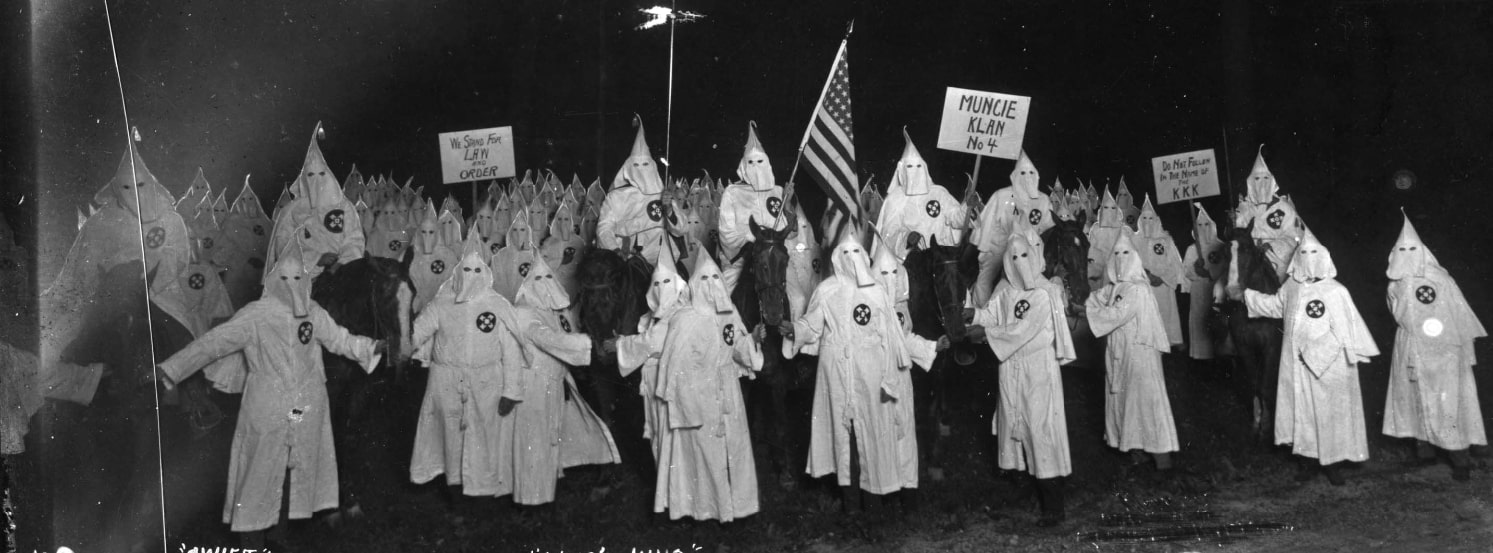
The black population in Muncie grew from 3.7% in 1890 to 5.6% in 1920 to 13.2% in 2013. Muncie's Riverside and Normal City neighborhoods had imposed sundown town rules by 1904, meaning "that unknown negroes who are found on the streets after nightfall are liable to be severely dealt with." In 1920, the city had the fifth-largest black population in Indiana, with 2,054 black residents. Two major parades were held by the Ku Klux Klan in 1922 and 1924, with the mayor and police chief attending the 1924 parade.
The first black police officer in Muncie was hired in 1899, and the city's first black police chief took his position in 1995. The first black teacher in the city was hired in 1952, and the first black principal was appointed in 1956.
According to Hurley Goodall, the first serious black political candidate in Muncie was Wayne Brooks, who ran for the Republican nomination for mayor in 1934. Ray Armstrong was elected as the first black member of the city council in 1951, and Alice McIntosh was elected as the first black female member of the city council in 1983. Goodall was the first black person elected to the city's school board and later to represent the area in the state house. No other black person served on Muncie's school board after Goodall's election to the state house until Carl Kizer Jr.'s appointment to the board in 1993. The school board became majority black for the first time after the 2008 election.
Geography
According to the 2010 census, Muncie has a total area of 27.392 sqmi, of which 27.2 sqmi,or 99.3%, is land and 0.192 sqmi,or 0.7%, is water.{{cite web |access-date=July 29, 2015 |archive-url=https://archive.today/20200213084951/http://factfinder.census.gov/bkmk/table/1.0/en/DEC/10_SF1/G001/1600000US1851876 |archive-date=February 13, 2020 |url-status=dead
Climate
Muncie has a humid continental climate (Köppen climate classification: Dfa), experiencing four distinct seasons.
|Jan record high F = 67 |Feb record high F = 77 |Mar record high F = 84 |Apr record high F = 88 |May record high F = 98 |Jun record high F = 106 |Jul record high F = 101 |Aug record high F = 99 |Sep record high F = 96 |Oct record high F = 93 |Nov record high F = 81 |Dec record high F = 71 |year record high F = 106 |Jan avg record high F = 57.5 |Feb avg record high F = 61.6 |Mar avg record high F = 71.7 |Apr avg record high F = 81.0 |May avg record high F = 88.2 |Jun avg record high F = 92.6 |Jul avg record high F = 93.2 |Aug avg record high F = 91.8 |Sep avg record high F = 90.0 |Oct avg record high F = 83.4 |Nov avg record high F = 69.8 |Dec avg record high F = 60.2 |year avg record high F = 94.7 |Jan avg record low F = -2.7 |Feb avg record low F = 2.1 |Mar avg record low F = 12.5 |Apr avg record low F = 24.7 |May avg record low F = 36.3 |Jun avg record low F = 47.2 |Jul avg record low F = 51.9 |Aug avg record low F = 49.5 |Sep avg record low F = 39.6 |Oct avg record low F = 28.2 |Nov avg record low F = 18.4 |Dec avg record low F = 6.2 |year avg record low F = -5.9 |Jan record low F = −29 |Feb record low F = −13 |Mar record low F = −7 |Apr record low F = 10 |May record low F = 25 |Jun record low F = 36 |Jul record low F = 44 |Aug record low F = 39 |Sep record low F = 27 |Oct record low F = 18 |Nov record low F = 3 |Dec record low F = −21 |year record low F = -29 |access-date = May 29, 2021 |archive-date = May 30, 2021 |archive-url = https://web.archive.org/web/20210530184523/https://w2.weather.gov/climate/xmacis.php?wfo=ind |url-status = dead |access-date = May 29, 2021 |archive-url = https://web.archive.org/web/20231221035012/https://www.ncei.noaa.gov/access/services/data/v1?dataset=normals-monthly-1991-2020&startDate=0001-01-01&endDate=9996-12-31&stations=USW00094895&format=pdf |archive-date = 2023-12-21}} |access-date = May 29, 2021 |archive-url = https://web.archive.org/web/20231221034846/https://www.ncei.noaa.gov/access/services/data/v1?dataset=normals-monthly&startDate=0001-01-01&endDate=9996-12-31&stations=USW00094895&format=pdf |archive-date = 2023-12-21}}
Demographics
2000 census
As of the census of 2000, there were 67,430 people, 27,322 households, and 14,589 families residing in the city. The population density was 2,788.2 PD/sqmi. There were 30,205 housing units at an average density of 1,248.9 /sqmi. The racial makeup of the city was 83.72% White, 12.97% African American, 0.27% Native American, 0.79% Asian, 0.09% Pacific Islander, 0.67% from other races, and 1.49% from two or more races. Hispanic or Latino of any race were 1.44% of the population.
There were 27,322 households, out of which 23.7% had children under the age of 18 living with them, 36.4% were married couples living together, 13.0% had a female householder with no husband present, and 46.6% were non-families. 34.1% of all households were made up of individuals, and 11.8% had someone living alone who was 65 years of age or older. The average household size was 2.24 and the average family size was 2.86.
In the city, the age distribution of the population shows 19.8% under the age of 18, 24.6% from 18 to 24, 24.2% from 25 to 44, 18.3% from 45 to 64, and 13.2% who were 65 years of age or older. The median age was 29 years. For every 100 females, there were 89.9 males. For every 100 females age 18 and over, there were 86.5 males.
The median income for a household in the city was $26,613, and the median income for a family was $36,398. Males had a median income of $30,445 versus $21,872 for females. The per capita income for the city was $15,814. About 14.3% of families and 23.1% of the population were below the poverty line, including 24.2% of those under age 18 and 9.7% of those age 65 or over.
2010 census
As of the census of 2010, there were 70,085 people, 27,722 households, and 13,928 families residing in the city. The population density was 2576.7 PD/sqmi. There were 31,958 housing units at an average density of 1174.9 /sqmi. The racial makeup of the city was 84.0% White, 10.9% African American, 0.3% Native American, 1.2% Asian, 0.1% Pacific Islander, 0.8% from other races, and 2.8% from two or more races. Hispanic or Latino of any race were 2.3% of the population.
There were 27,722 households, of which 23.9% had children under the age of 18 living with them, 31.5% were married couples living together, 14.1% had a female householder with no husband present, 4.6% had a male householder with no wife present, and 49.8% were non-families. 35.2% of all households were made up of individuals, and 10.9% had someone living alone who was 65 years of age or older. The average household size was 2.22 and the average family size was 2.85.
The median age in the city was 28.1 years. 17.8% of residents were under the age of 18; 27.5% were between the ages of 18 and 24; 21.4% were from 25 to 44; 20.2% were from 45 to 64; and 13% were 65 years of age or older. The gender makeup of the city was 47.5% male and 52.5% female.
2020 census
As of the census of 2020, there were 65,194 people, 26,692 households and 6,179 families residing in the city. The population density was 2577.0 PD/sqmi. There were 31,183 housing units at an average density of 1129.8 /sqmi. The racial makeup of the city was 78.0% White, 11.6% African American, 0.3% Native American or Alaskan Native, 1.5% Asian, 0.1% Native Hawaiian or Pacific Islander, 2.1% from other races and 6.5% were from two or more races. Hispanic and Latino of any race were 4.2% of the population.
There were 26,692 households, of which 16.2% had children under the age of 18 living with them, 29.6% were married couples living together, 35.7% had a female householder with no husband present, 26.2% had a male householder with no wife present, and 8.5% were non-families. 61.9% of all households were made up of individuals. The average household size was 2.18 and the average family size was 3.09.
Just over half (50.1%) of the population had never been married, 29.6% were married and not separated, 5.7% were widowed, 13.1% were divorced, and 1.6% were separated.
The median age of the city was 28.8. 4.4% of residents were under the age of 5, 16.2% were under 18 years, 83.8% were age 18 or older, and 14.0% were age 65 or older. 5.8% of the population were veterans.
The most common language spoken at home was English with 95.5% speaking it at home, 1.7% spoke Spanish at home, 1.4% spoke an Asian or Pacific Islander language at home, 1.3% spoke another Indo-European language at home, and 0.1% spoke some other language. 2.6% of the population were foreign born.
The median household income in Muncie as of the 2019-2023 American Community Survey was $43,395 and the per capita income was $24,582, 38.1% and 33.9% less than the state respectively. 29.6% of the population were in poverty, including 32.6% of residents under the age of 18. The poverty rate for the town was 17.3% higher than that of the state. 18.6% of the population was disabled and 8.7% had no healthcare coverage. 89.0% of the population had attained a high school or equivalent degree, 19.7% had attended college but received no degree, 37.3% had attained an Associate's degree or higher, 25.7% had attained a Bachelor's degree or higher, and 11.6% had a graduate or professional degree. 20.4% had no degree. 53.2% of Muncie residents were employed, working a mean of 34.0 hours per week. The median gross monthly rent in Muncie was $867 and the owner occupied housing unit rate was 51.5%. 4,491 housing units were vacant at an average density of 162.7 /sqmi. The median value of owner-occupied housing units was $92,000, over $109,000 less than that of the state as a whole. The median selected monthly owner costs with a mortgage was $987 versus $419 without a mortgage.
In the 2020 census, Muncie's economy received the most sales in retail, which accounted for 52.9% of all sales. 58.01% of the entire population was in the civilian labor force including 55.1% of females. The mean travel time to work was 19 minutes.
Economy

From its early days as a regional trading center for the surrounding agricultural community to its first wave of industrial development brought on by the Indiana gas boom in the mid-1880s, Muncie has retained its ties to an industrial economy, and to a lesser extent its agricultural roots. In addition, the arrival of the forerunner to Ball State in the early twentieth century contributed to Muncie's development as an educational center, while Ball Memorial Hospital, established in 1929, led to the city's reputation as a healthcare center for east-central Indiana.
Muncie's major industrial development included glass manufacturing, iron and steel mills, and automobile manufacturing and auto parts factories. Among its early major employers was the Ball Corporation, established by the Ball brothers of Buffalo, New York, who opened a glass factory in Muncie in 1888. Other notable manufacturers in addition to the Ball Corporation with operations in Muncie have included BorgWarner, The Broderick Company (a former division of Harsco), Dayton-Walther Corporation, Delco Remy, General Motors, New Venture Gear, Hemingray Glass Company, Ontario Corporation, A. E. Boyce Company, Indiana Steel and Wire, and Westinghouse Electric.
Changing industrial trends caused shifts in the city's economic development. As in many mid-sized cities in the Rust Belt, deindustrialization, which began in the 1960s, impacted Muncie's economy. Several manufacturing plants closed or moved elsewhere. From 2001 to 2011, Muncie lost thousands of jobs as the city continued transitioning from a blue-collar workforce to a white-collar service economy primarily based on health care, education, and retail.
Muncie has attracted some new manufacturers, while older factories have been converted to other industrial uses. In 2009, Muncie became the U.S. headquarters for Brevini Wind, an Italian-based company that manufactures gearboxes for wind turbines. In 2011, locomotive maker Progress Rail (a subsidiary of Caterpillar Inc) opened in a former Westinghouse facility that had been vacant since 1998.
The local economy is a controversial topic among Munsonians. While many older unemployed or underemployed residents strongly identify with the manufacturing identity of the city, newer residents identify with the city's shift towards educational and health services. Contention is greatest among residents living in the once-industrialized sections of the city's south side, as much of the economic growth over that last few decades has taken place on Muncie's north side. The city also struggles to retain college graduates. Despite Ball State's presence, only 32.2 percent of Delaware County's working-age adults (ages 25–64) hold a two-year or four-year college degree, which is below the national average.
The first decade of the 21st century saw a cultural shift toward local businesses and economic empowerment, boosted by the Muncie Downtown Development Partnership and the residents, patrons, and business owners of the downtown community. In 2007, Muncie was rated the most affordable college town in America by real estate company Coldwell Banker. In 2015, Forbes ranked Muncie 27th among small places for business and careers and 18th for cost of doing business. First Merchants Corporation is based in Muncie, and the first Scotty's Brewhouse location opened in the city in 1996.
.jpg)
(compare to October 2014), the largest employers in the city were:
| Employer | 2022 Employees | 2014 Employees |
|---|---|---|
| Ball State University | 3,379 | 3,741 |
| IU Health Ball Memorial Hospital | 2,613 | 3,000 |
| Muncie Community Schools | 650 | 926 |
| Navient | 633 | 650 |
| Magna Powertrain | 571 | 325 |
| Concentrix | 555 | 675 |
| First Merchants Corporation | 551 | 526 |
| Meridian Health Services | 550 | 610 |
| Youth Opportunity Center | 516 | 276 |
| Progress Rail | 500 | 281 |
| City of Muncie | 465 | 465 |
| Delaware County Government Offices | 452 | 522 |
| Muncie Sanitary District | 143 | 531 |
Arts and culture

The David Owsley Museum of Art collection, which includes over 11,000 works, has been in the Fine Arts Building on the Ball State University campus since 1935. The Horizon Convention Center, located downtown, offers 47000 sqft of exhibition space and houses the Muncie Children's Museum. The city also has a large group of independent art galleries.
Three of the city's largest performing arts centers belong to Ball State University: the 3,581-seat Emens Auditorium, the 600-seat Sursa Performance Hall, and the 410-seat University Theatre. Downtown performing arts spaces include the Muncie Civic Theatre and Canan Commons, an outdoor amphitheater and greenspace that opened in 2011. In addition, the Muncie Ballet and the Muncie Symphony Orchestra are prominent in the city's arts community.
Minnetrista Museum & Gardens, just north of downtown along the White River, is a cultural heritage museum featuring exhibits and programs focusing on nature, local history, and art. The 40 acre campus includes historic homes that were once owned by the Ball family, themed gardens, outdoor sculptures, and a portion of the White River Greenway. The Cardinal Greenway, Indiana's longest rail trail project, stretches 60 mi from Richmond to Marion, Indiana. Designated a National Recreation Trail in 2003, it is part of the American Discovery Trail. The Ball State campus is home to Christy Woods, an 18 acre arboretum, three greenhouses, and the Wheeler Orchid Collection and Species Bank.
Passing of the Buffalo and Appeal to the Great Spirit are public sculptures in Muncie by Cyrus Edwin Dallin.
Muncie's music scene has been home to such acts as Brazil, Everything, Now!, and Archer Avenue (ex-Margot & the Nuclear So and So's). Muncie MusicFest. Muncie also has a network of craft beer enthusiasts.
Libraries

- Carnegie Library
- Kennedy Library
- Maring–Hunt Library
- Connection Corner
- Shafer Library (Ivy Tech)
- Bracken Library (Ball State)
Sports

Muncie is home to the NCAA Division I Ball State Cardinals which is a member of the Mid-American Conference. Notable sports include football (played at Scheumann Stadium), men's basketball (played at John E. Worthen Arena), and baseball (played at Ball Diamond).
Muncie was once home to the Muncie Flyers, also known as the Congerville Flyers, the city's professional football team from 1905 to 1925. The Muncie team was one of the eleven charter members of National Football League (NFL). It played in the league in 1920 and 1921.
Muncie was also home to the Muncie Flyers, a minor league hockey team. The team played in the International Hockey League for a single season in 1948–1949.
Muncie Central High School is home to the Muncie Fieldhouse, the fifth-largest high school gym in the United States.
Government


The county government is a constitutional body and is granted specific powers by the Constitution of Indiana, and by the Indiana Code.
As a second class city in Indiana (pop. 35,000 to 599,999), Muncie is governed by a Mayor and a nine-member city council as well as a city clerk and city judge. City elections for Mayor, city council, city judge, and city clerk are held in odd years immediately preceding presidential elections (2015, 2019, etc.). The current mayor is Dan Ridenour, a Republican first elected in 2019. The current city clerk is Belinda Munson and the current city judge is Amanda Dunnuck. The nine-members of the city council are divided into six members elected from districts and three members elected at-large. The current members of the city council are:
- District 1: Jeff Green (R)
- District 2: Nora Evans Powell (D)
- District 3: Brandon Garrett (R)
- District 4: Sara Gullion (D)
- District 5: Jerry D. Dishman (R)
- District 6: Harold D. Mason Jr. (D)
- At-Large: Dale Basham (R)
- At-Large: Ro Selvey (R)
- At-Large: William (Billy Mac) McIntosh (D)
Education
Higher education
- Ball State University - 24,441 students (2022)
- Ivy Tech Community College - 12,400 students (2021)
- Scuba Educators International
K-12 education
The majority of Muncie is in the Muncie Community Schools Corporation. Some pieces extend into other school districts, with western parts in the Mount Pleasant Township Community School Corporation, a few northwestern parts in the Wes-Del Community Schools school district, a small northern part in the Delaware Community School Corporation, and a small eastern part in the Liberty-Perry Community School Corporation. In 2022, Muncie Community Schools had 5,141 students.
Muncie School Corporation-operated elementary schools:
- East Washington Academy - 469 elementary students (2022)
- Grissom Memorial Elementary School - 469 elementary students (2022)
- Longfellow Elementary School - 328 elementary students (2022)
- North View Elementary School - 315 elementary students (2022)
- South View Elementary School - 448 elementary students (2022)
- West View Elementary School - 422 elementary students (2022)
Muncie School Corporation-operated middle schools:
- Northside Middle School - 577 middle school students (2022)
- Southside Middle School - 498 middle school students (2022)
Muncie School Corporation-operated high schools:
- Muncie Area Career Center
- Muncie Central High School - 1,437 high school students (2022)
Delaware County School Corporation-operated schools (all have postal addresses saying Muncie, Indiana, but all are outside of the city limits):
- Royerton Elementary School - 575 elementary students (2022)
- Delta Middle School - 656 middle school students (2022)
- Delta High School - 783 high school students (2022)
Charter schools:
- Inspire Academy - 113 elementary students (2022)
Other public schools:
- Burris Laboratory School - 228 elementary students, 187 middle school students, and 217 high school students (2022)
- Indiana Academy for Science, Mathematics, and Humanities - 206 high school students (2022)
Private schools:
- Heritage Hall Christian School - 112 elementary students, 41 middle school students, and 30 high school students (2022)
- St. Michael Catholic School - PreK-8 school, 48 elementary students (2022) - It was formed by a merger of St. Mary Catholic School, St. Lawrence Catholic School, and Pope John Paul II Middle School in 2021. St. Lawrence was established in 1881. St. Mary School was established in 1949. Pope John Paul II Middle School was formed in 2008 by the merger of the middle school divisions of St. Mary and St. Lawrence.
The Cowan Community School Corporation operates Cowan Elementary School and Cowan High School, which have Muncie postal addresses but are not in the city limits. No part of the Muncie city limits is in the Cowan district.
Media
Newspapers
- The Star Press
Television
As part of the Indianapolis market, Muncie receives Indianapolis' network affiliates. East Central Indiana's PBS member station, WIPB, is located in Muncie. The Joy of Painting was filmed at WIPB.
Radio stations
- WCRD
- WERK
- WMXQ
- WLBC-FM
- WMUN
- WNAP-FM
- WBST
- WXXC
Infrastructure
Transportation
Air
- Delaware County Regional Airport (not a commercial airport)
- Fort Wayne International Airport at 74.4 mi and Indianapolis International Airport at 75.4 mi are the nearest commercial airports.
Highways
- [[File:I-69.svg|20px]] Interstate 69
- [[File:US 35.svg|20px]] U.S. Route 35
- [[File:Indiana 3.svg|20px]] State Road 3
- [[File:Indiana 32.svg|20px]] State Road 32
- [[File:Indiana 67.svg|20px]] State Road 67
- [[File:Indiana 332.svg|20px]] State Road 332
Rail
Until 1986, Muncie's Wysor Street Depot at 700 East Wysor Street was a passenger train stop on the Chicago-Cincinnati service of Amtrak's Cardinal. Until 1971, Muncie Union Station was a stop on the Penn Central's Indianapolis-Cleveland on the route of the New York Central's former Southwestern Limited (St. Louis-New York City) and Cleveland Special (Indianapolis-Cleveland).
Freight service is provided by CSX and Norfolk Southern. Railroad equipment supplier Progress Rail opened a manufacturing facility in 2011.
Mass transit
Muncie Indiana Transit System (MITS) provides 14 fixed bus routes daily, except Sundays.
Notable people
Note: This list does not include Ball State University graduates. Please see List of Ball State University alumni for notable alumni.
Before adding names, please note that this list should not attempt to be exhaustive. The category serves that purpose.
--
Sister cities
Muncie has five sister cities, as designated by Sister Cities International:
- TWN Changhua, Taiwan
- CHN Deyang, China
- TUR Isparta, Turkey
- KAZ Taraz, Kazakhstan
- CHN Zhuji, China
References
References
- Huppke, Rex. (April 27, 2003). "Day of prayer turning into day of discord". Chicago Tribune.
- "Details".
- "2020 U.S. Gazetteer Files". United States Census Bureau.
- "Muncie, Indiana QuickFacts". [[United States Census Bureau]].
- "Delaware County, Indiana QuickFacts". [[United States Census Bureau]].
- "U.S. Census website". [[United States Census Bureau]].
- {{GNIS. 2395138
- "Indianapolis, Indiana to Muncie, Indiana".
- (2012). "Indianapolis-Carmel-Muncie, IN Combined Statistical Area". [[United States Census Bureau]].
- Flook, Chris. "Lenape Villages of Delaware County".
- "Center for Middletown Studies". Ball State University.
- According to an historical map of "The Indians" by Clark Ray.
- Richard A. Greene. (1965). "Muncie and Delaware County: An Historical Sketch". Delaware County Historical Society.
- Greene, pp. 15–16.
- Greene, pp. 7–8.
- (1984). "Muncie and Delaware County: An Illustrated Retrospective". Windsor Publications.
- Greene, pp. 7–6 and 15–16.
- William Harrison Kemper. (1908). "A Twentieth Century History of Delaware County, Indiana". Lewis Publishing Company.
- Greene, pp. 9, 13.
- Spurgeon, p. 27.
- (1999). "Muncie of To-Day: Its Commerce, Trade and Industries, Descriptive and Historical". Windmill Publications.
- "CONTENTdm".
- Greene, p. 10.
- (2005). "The Gas Boom of East Central Indiana (Images of America)". Arcadia.
- Dwight W. Hoover. (1980). "A pictorial history of Indiana". Indiana University Press.
- (2015). "Indiana's 200: The People Who Shaped the Hoosier State". Indiana Historical Society Press.
- A Book of Indiana, pg 420, published 1929 by the Indiana Biographical Association
- Spurgeon, p. 38.
- Spurgeon, p. 41.
- Greene, p. 11.
- Spurgeon, p. 50.
- "Ball State University: History and Mission". Ball State University.
- (1924). "History of Delaware County Indiana". Historical Publishing Company.
- Ned H. Griner. (1985). "Side By Side With Coarser Plants: The Muncie Art Movement, 1885–1985". Ball State University.
- Spurgeon, pp. 46–47.
- Spurgeon, pp. 50, 55.
- Dwight W. Hoover. (1986). "Magic Middletown". Indiana University Press.
- Spurgeon, p. 63.
- Quigley, p. 16.
- Spurgeon, p. 58.
- (1929). "Middletown, A Study in Contemporary American Culture". Harcourt, Brace and Company.
- "Center for Middletown Studies". Ball State University.
- "Online Tools". Association of Religious Data Archives.
- Greene, pp. 14–15.
- Spurgeon, pp. 82, 92–94, 114–15.
- Spurgeon, p. 71.
- Quigley, pp. 14–15.
- Spurgeon, pp. 90–98, 103, 110–14, 128–29.
- [https://www.theatlantic.com/notes/2019/05/unusual-way-bridge-town-gown-divide/588256/ An Unusual Way to Bridge the Town-Gown Divide] - James Fallows, The Atlantic, May 1, 2019
- (October 1, 2021). "Local organization AWAKEN working to bring Afghan refugees from Camp Atterbury to Muncie". The Star Press.
- (October 20, 2021). "Afghan refugees to come to Muncie with MARRC". Ball State Daily.
- (October 25, 2021). "First Afghan refugee arrives to new home in Muncie, describes journey to the Hoosier State". FOX 59.
- Penticuff, David. (November 9, 2022). "Afghan community grows as Refugee Alliance of Delaware County carries on resettlement work".
- (June 30, 1904). "Race Feeling Running High". [[The Plymouth Tribune]].
- (March 22, 2015). "Black and White Muncie". [[The Star Press]].
- Roysdon, Keith. (June 16, 2002). "'If we're given a chance, it's a minimal one at best'". [[The Star Press]].
- Boyd, Oseye T.. (May 12, 2008). "Board to have first-ever black majority". [[The Star Press]].
- McGauley, John. (September 29, 1993). "Kizer chosen for Muncie school board". [[The Star Press.
- http://xmacis.rcc-acis.org/
- "Census of Population and Housing". Census.gov.
- "U.S. Census website". [[United States Census Bureau]].
- "U.S. Census Bureau QuickFacts: Muncie city, Indiana".
- Paul Davidson. (May 9, 2011). "Two Indiana cities symbolize both sides of uneven jobs recovery". USA Today.
- (2012). "Muncie IN".
- Hagerty, James. (March 18, 2012). "As Unions Lose Their Grip, Indiana Lures Manufacturing Jobs". The Wall Street Journal.
- (2011). "Progress Rail Announces Grand Opening of Muncie, Indiana Locomotive Assembly Operation". PR Newswire.
- Robin Gibson. (May 3, 2014). "LOST MUNCIE: Current, former Muncie residents revisit the past online". The Star Press.
- Mary Williams Walsh. (April 19, 2000). "'New economy' deepens the wealth divide". Los Angeles Times.
- (November 6, 2011). "Muncie Mayor Election: The final vote". Muncie Free Press.
- Ron Fournier. (April 19, 2012). "In Nothing We Trust". National Journal.
- Seth Slabaugh. (May 2, 2014). "Where have all the college grads gone?". The Star Press.
- (2012). "MDDP Accomplishments & Awards". MDDP.
- (November 6, 2007). "Muncie Tops Most Affordable College Town List". Inside Indiana Business.
- "Best Small Places For Businesses and Careers List".
- "Scotty: 'Really excited' for Muncie restaurants". The Star Press.
- (2022). "Major Employers". Muncie–Delaware County Economic Development Alliance.
- (2014). "Major Employers". Muncie–Delaware County Economic Development Alliance.
- "About Us". Horizon Convention Center.
- "Muncie Indiana Center Visitors Bureau". Muncie Visitors Bureau.
- "About Emens". Ball State University.
- "Sursa Performance Hall". Ball State University.
- "Campus map".
- "Muncie MusicFest". Muncie MusicFest.
- "TURNING A CORNER: Sean Brady's brewery up and running". The Star Press.
- "History of the Muncie Flyers Football team".
- "Muncie Flyers hockey team statistics and history at hockeydb.com".
- [[Indiana Code]]. "Title 36, Article 4, Section 1". IN.gov.
- "Mayor".
- "Muncie City Council".
- "DFR 2022 Report - Ball State University". [[National Center for Education Statistics]]. Retrieved 2 Apr 2023..
- (July 7, 2025). "Ivy Tech Community College - East Central Region - Muncie, IN". Community College Review. Retrieved 2 Apr 2023..
- Geography Division. (January 12, 2021). "2020 CENSUS - SCHOOL DISTRICT REFERENCE MAP: Delaware County, IN". [[U.S. Census Bureau]].
- "[https://nces.ed.gov/ccd/districtsearch/district_detail.asp?ID2=1807320 Muncie Community Schools]". [[National Center for Education Statistics]]. Retrieved on April 1, 2023."
- "East Washington Academy". [[National Center for Education Statistics]].
- "Grissom Elementary School". [[National Center for Education Statistics]].
- "Longfellow Elementary School". [[National Center for Education Statistics]].
- "North View Elementary School". [[National Center for Education Statistics]].
- "South View Elementary School". [[National Center for Education Statistics]].
- "West View Elementary School". [[National Center for Education Statistics]].
- "Northside Middle School". [[National Center for Education Statistics]].
- "Southside Middle School". [[National Center for Education Statistics]].
- "Muncie Central High School". [[National Center for Education Statistics]].
- "Royerton Elementary School". [[National Center for Education Statistics]].
- "Delta Middle School". [[National Center for Education Statistics]].
- "Delta High School". [[National Center for Education Statistics]].
- "Inspire Academy - A Sch of Inquiry". [[National Center for Education Statistics]].
- "Burris Laboratory School". [[National Center for Education Statistics]].
- "Indiana Academy for Sci Math Hmn". [[National Center for Education Statistics]].
- "Heritage Hall Christian School". [[National Center for Education Statistics]].
- "St. Lawrence Catholic School". [[National Center for Education Statistics]].
- Stefanski, Charlotte. (2021-05-03). "St. Lawrence, St. Mary schools to unite as St. Michael Catholic School". [[Muncie Star Press]].
- Stefanski, Charlotte. (2021-05-02). "'Couldn't be more excited': St. Mary, St. Lawrence to combine into one Catholic school". [[Muncie Star Press]].
- "Cowan Elementary School". [[National Center for Education Statistics]].
- "Cowan High School". [[National Center for Education Statistics]].
- (March 26, 1986). "Peru Amtrak Stop Lost In Routing". Logansport Pharos-Tribune.
- Library of Congress, Union Station, 630 High Street, Muncie, Delaware County, IN https://www.loc.gov/item/in0193/
- New York Central timetable, April 26, 1964, Table 6 https://streamlinermemories.info/NYC/NYC64TT.pdf
- (May 1970). "Penn Central, Table 46". National Railway Publication Company.
- Classic Trains, "Passenger Trains on the Eve of Amtrak" https://ctr.trains.com/~/media/import/files/pdf/f/7/7/passenger_trains_operating_on_the_eve_of_amtrak.pdf {{Webarchive. link. (February 24, 2021)
- (February 2023). "Hot spot: Muncie, Ind.". [[Kalmbach Media]].
- Muncie Indiana Transit System. "Routes & Schedules". MITS.
- (January 2025). "HOME".
- "Life and death of a Muncie serial killer".
- "The Life and Times of George Dale, Muncie Mayor and Editor". Ball State University.
- (January 2025). "The Official Website of Garfield and Friends".
- "Jim Davis :: Profile".
- "RotoWire Fantasy Football, Baseball, Basketball and More".
- "Bertha Fry, World's 3rd Oldest Person, Dies in Muncie".
- "Brandon Gorin | NFL Football at CBSSports.com".
- "Ryan Kerrigan Stats".
- Hays, Constance L.. (February 11, 1989). "Emily Kimbrough, 90, Magazine Editor And Popular Author". The New York Times.
- "DOC LADURON". Pro Football Archives.
- "An Interview with F. William Lavere".
- (January 18, 2013). "Gallery Talk with Marc Dennis, Cheryl Anne Lorance". CorningFingerLakes.com.
- [http://purduesports.cstv.com/sports/m-baskbl/mtt/painter_matt00.html Player Bio: Matt Painter :: Men's Basketball]
- "Bonzi Wells Stats".
- "Sister City Relationships". Muncie-Delaware County, Indiana Economic Development Alliance.
This article was imported from Wikipedia and is available under the Creative Commons Attribution-ShareAlike 4.0 License. Content has been adapted to SurfDoc format. Original contributors can be found on the article history page.
Ask Mako anything about Muncie, Indiana — get instant answers, deeper analysis, and related topics.
Research with MakoFree with your Surf account
Create a free account to save articles, ask Mako questions, and organize your research.
Sign up freeThis content may have been generated or modified by AI. CloudSurf Software LLC is not responsible for the accuracy, completeness, or reliability of AI-generated content. Always verify important information from primary sources.
Report