From Surf Wiki (app.surf) — the open knowledge base
Mullard SAA5050
Character generator chip for implementing the Teletext character set

Character generator chip for implementing the Teletext character set

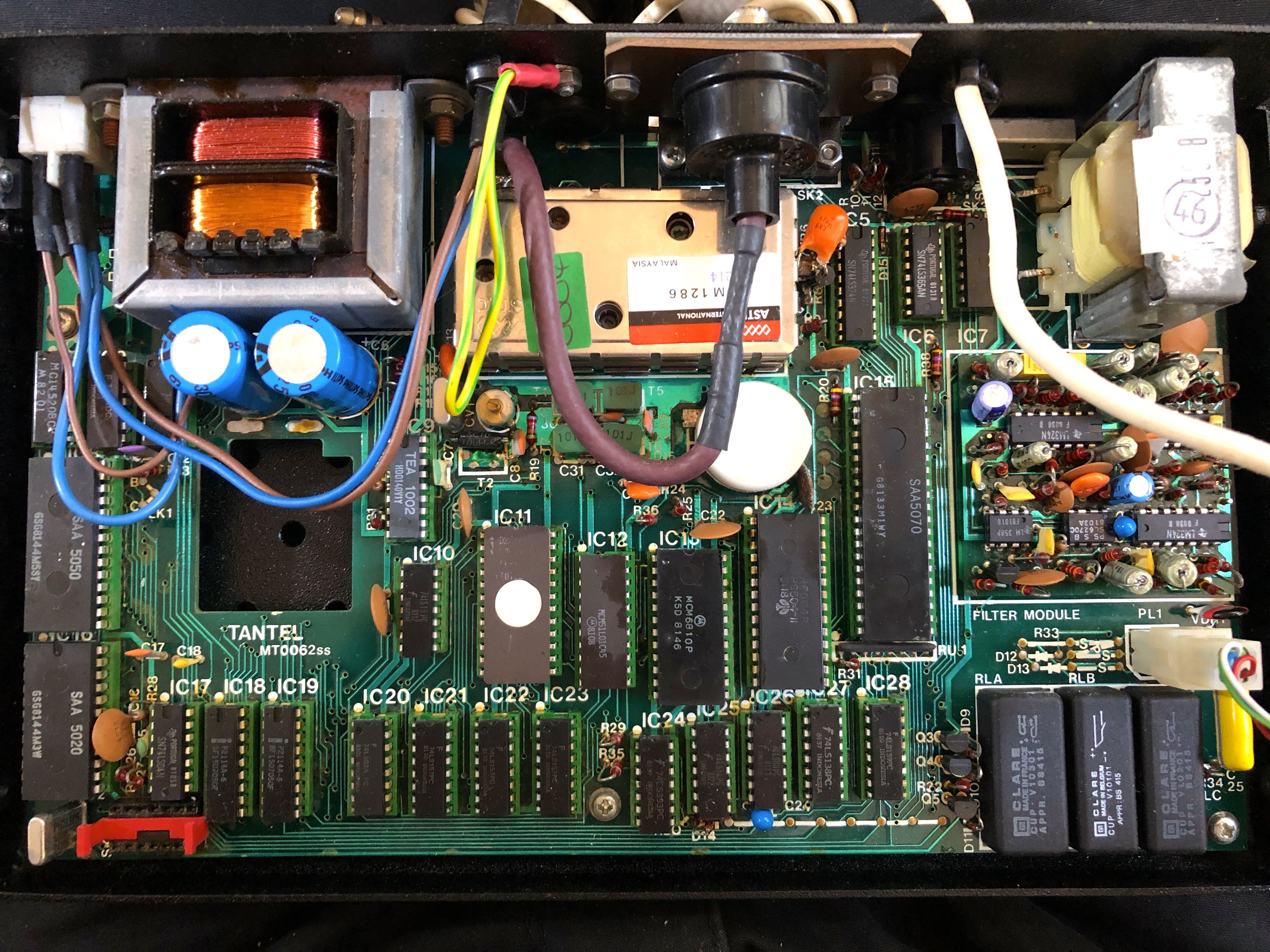
The SAA5050 was used in teletext-equipped television sets, viewdata terminals, Prestel adapters like the AlphaTantel, and microcomputers, most notably on computers like the Philips P2000 (1980), Acorn System 2 (1980), BBC Micro (1982), Malzak and Poly-1.
This chip was also manufactured by Mullard for Philips.
Operation
The chip generated appropriate video output for a 7-bit input character code representing the current character on the text line, while keeping track of the effect of any of the various control characters defined by the teletext standard that had previously occurred in that text line, which could be used to change the foreground and background colour, switch to or from the alternate block graphics character set, or various other effects.[[File:Level 1 teletext test.png|thumb|right|Level 1 teletext block characters and colours]]
Full-screen resolution generated by the SAA5050 was 480 × 500 pixels, corresponding to 40 × 25 characters. Each character position therefore corresponded to a 12 × 20 pixel space. Internally each character shape was defined on a 5 × 9 pixel grid that was loosely based on the Signetics 2513 character ROM chip. This was then interpolated by smoothing diagonals to give a 10×18 pixel character, with a characteristically angular shape, surrounded to the top and to the left by two pixels of blank space. This gave a particularly stable and flicker-free arrangement on interlaced displays.
The alternate set of 2 × 3 block graphic characters were created on the same 12 × 20 pixel grid, so that the top two blocks were each 6 × 6 pixels, the middle two blocks each 6×8 pixels, and the bottom two blocks again 6 × 6 pixels (or two fewer in each direction, if the "separated graphics" control character had been sent).
| 0 | 1 | 2 | 3 | 4 | 5 | 6 | 7 | 8 | 9 | A | B | C | D | E | F | 2 | 3 | 6 | 7 | ||||||||||||||||
|---|---|---|---|---|---|---|---|---|---|---|---|---|---|---|---|---|---|---|---|---|---|---|---|---|---|---|---|---|---|---|---|---|---|---|---|
| [[File:TRS-80_character_0x80.png | NBSP]] | [[File:TRS-80 character 0x81.png | link=🬀]] | [[File:TRS-80 character 0x82.png | link=🬁]] | [[File:TRS-80 character 0x83.png | link=🬂]] | [[File:TRS-80 character 0x84.png | link=🬃]] | [[File:TRS-80 character 0x85.png | link=🬄]] | [[File:TRS-80 character 0x86.png | link=🬅]] | [[File:TRS-80 character 0x87.png | link=🬆]] | [[File:TRS-80 character 0x88.png | link=🬇]] | [[File:TRS-80 character 0x89.png | link=🬈]] | [[File:TRS-80 character 0x8A.png | link=🬉]] | [[File:TRS-80 character 0x8B.png | link=🬊]] | [[File:TRS-80 character 0x8C.png | link=🬋]] | [[File:TRS-80 character 0x8D.png | link=🬌]] | [[File:TRS-80 character 0x8E.png | link=🬍]] | [[File:TRS-80 character 0x8F.png | link=🬎]] | ||||
| [[File:TRS-80 character 0x90.png | link=🬏]] | [[File:TRS-80 character 0x91.png | link=🬐]] | [[File:TRS-80 character 0x92.png | link=🬑]] | [[File:TRS-80 character 0x93.png | link=🬒]] | [[File:TRS-80 character 0x94.png | link=🬓]] | [[File:TRS-80 character 0x95.png | link=▌]] | [[File:TRS-80 character 0x96.png | link=🬔]] | [[File:TRS-80 character 0x97.png | link=🬕]] | [[File:TRS-80 character 0x98.png | link=🬖]] | [[File:TRS-80 character 0x99.png | link=🬗]] | [[File:TRS-80 character 0x9A.png | link=🬘]] | [[File:TRS-80 character 0x9B.png | link=🬙]] | [[File:TRS-80 character 0x9C.png | link=🬚]] | [[File:TRS-80 character 0x9D.png | link=🬛]] | [[File:TRS-80 character 0x9E.png | link=🬜]] | [[File:TRS-80 character 0x9F.png | link=🬝]] | ||||
| [[File:TRS-80 character 0xA0.png | link=🬞]] | [[File:TRS-80 character 0xA1.png | link=🬟]] | [[File:TRS-80 character 0xA2.png | link=🬠]] | [[File:TRS-80 character 0xA3.png | link=🬡]] | [[File:TRS-80 character 0xA4.png | link=🬢]] | [[File:TRS-80 character 0xA5.png | link=🬣]] | [[File:TRS-80 character 0xA6.png | link=🬤]] | [[File:TRS-80 character 0xA7.png | link=🬥]] | [[File:TRS-80 character 0xA8.png | link=🬦]] | [[File:TRS-80 character 0xA9.png | link=🬧]] | [[File:TRS-80 character 0xAA.png | link=▐]] | [[File:TRS-80 character 0xAB.png | link=🬨]] | [[File:TRS-80 character 0xAC.png | link=🬩]] | [[File:TRS-80 character 0xAD.png | link=🬪]] | [[File:TRS-80 character 0xAE.png | link=🬫]] | [[File:TRS-80 character 0xAF.png | link=🬬]] | ||||
| [[File:TRS-80 character 0xB0.png | link=🬭]] | [[File:TRS-80 character 0xB1.png | link=🬮]] | [[File:TRS-80 character 0xB2.png | link=🬯]] | [[File:TRS-80 character 0xB3.png | link=🬰]] | [[File:TRS-80 character 0xB4.png | link=🬱]] | [[File:TRS-80 character 0xB5.png | link=🬲]] | [[File:TRS-80 character 0xB6.png | link=🬳]] | [[File:TRS-80 character 0xB7.png | link=🬴]] | [[File:TRS-80 character 0xB8.png | link=🬵]] | [[File:TRS-80 character 0xB9.png | link=🬶]] | [[File:TRS-80 character 0xBA.png | link=🬷]] | [[File:TRS-80 character 0xBB.png | link=🬸]] | [[File:TRS-80 character 0xBC.png | link=🬹]] | [[File:TRS-80 character 0xBD.png | link=🬺]] | [[File:TRS-80 character 0xBE.png | link=🬻]] | [[File:TRS-80 character 0xBF.png | link=█]] |
The pixels were usually displayed with a 1.33:1 or 1.2:1 aspect ratio to give a full display close to the standard 4:3 TV aspect ratio, effectively a 400 × 300 or 480 × 400 display.
Versions
Compared to other alternative chips, the SAA5050 implemented the original World System Teletext teletext standard (Level 1), which had no provision to set black for the foreground text colour. Some alternative chips at the time did allow this, as became formalized in the 1981 CEPT videotex standard.
In addition to the UK version, several variants of the chip existed with slightly different character sets for particular localizations and/or languages. These had part numbers SAA5051 (German), SAA5052 (Swedish), SAA5053 (Italian), SAA5054 (Belgian), SAA5055 (U.S. ASCII), SAA5056 (Hebrew) and SAA5057 (Cyrillic).
The SAA5050 was later superseded by the SAA5243 CCT chip, integrating a similar teletext character generator with all previously separately implemented functions such as decoding, timing and video generation. It was controlled through I2C.
References
References
- (1982). "SAA5050 Series Teletext Character Generator". Mullard.
- Graham, Adrian. "AlphaTantel Viewdata Terminal".
- Graham, Adrian. "AlphaTantel Viewdata Terminal Motherboard".
- "Machine: AlphaTantel (alphatan)".
- "SAA5050 Teletext Character Generator".
- Born, Uwe. "IC SAA5051 datasheet".
- "SAA 5052, Tube SAA5052; Röhre SAA 5052 ID78631, IC - Integra".
This article was imported from Wikipedia and is available under the Creative Commons Attribution-ShareAlike 4.0 License. Content has been adapted to SurfDoc format. Original contributors can be found on the article history page.
Ask Mako anything about Mullard SAA5050 — get instant answers, deeper analysis, and related topics.
Research with MakoFree with your Surf account
Create a free account to save articles, ask Mako questions, and organize your research.
Sign up freeThis content may have been generated or modified by AI. CloudSurf Software LLC is not responsible for the accuracy, completeness, or reliability of AI-generated content. Always verify important information from primary sources.
Report