From Surf Wiki (app.surf) — the open knowledge base
Mullard Radio Astronomy Observatory
Observatory in the United Kingdom
Observatory in the United Kingdom
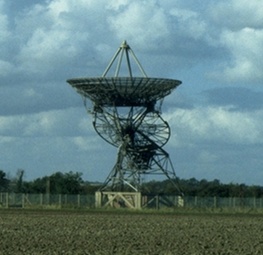
The Mullard Radio Astronomy Observatory (MRAO) is located near Cambridge, UK and is home to a number of the largest and most advanced aperture synthesis radio telescopes in the world, including the One-Mile Telescope, 5-km Ryle Telescope, and the Arcminute Microkelvin Imager. It was founded by the University of Cambridge and is part of the Cambridge University, Cavendish Laboratories, Astrophysics Department.
History
Radio interferometry started in the mid-1940s on the outskirts of Cambridge, but with funding from the Science Research Council and a corporate donation of £100,000 from Mullard Limited, a leading commercial manufacturer of thermionic valves.
Construction of the Mullard Radio Astronomy Observatory commenced at Lords Bridge Air Ammunition Park, a few kilometres to the west of Cambridge.
The observatory was founded under Martin Ryle of the Radio-Astronomy Group of the Cavendish Laboratory, University of Cambridge and was opened by Sir Edward Victor Appleton on 25 July 1957. This group is now known as the Cavendish Astrophysics Group.
Location
The observatory is located a few miles south-west of Cambridge at Harlton on a former ordnance storage site, next to the disused Oxford-Cambridge Varsity railway line.
A portion of the track bed of the railway, running nearly east-west for several miles, was used to form the main part of the "5km" radio-telescope and the Cambridge Low Frequency Synthesis Telescope. Due to this, the reconstruction of the railway line between Oxford and Cambridge will follow a new alignment at this point.
Telescopes
| Telescope | Year built | Status |
|---|---|---|
| Arcminute Microkelvin Imager Large Array | 2007 | Active |
| Arcminute Microkelvin Imager Small Array | 2004 | |
| Very Small Array (moved to Tenerife in 1999) | 1998 | |
| Cosmic Anisotropy Telescope made first high-resolution maps of Cosmic Microwave Background fluctuations | 1995 | Decommissioned |
| Cambridge Optical Aperture Synthesis Telescope (COAST) first aperture synthesis at optical wavelengths | 1993 | Operated on clear nights |
| One receiver from the e-MERLIN array | 1990 | Active |
| Cambridge Low Frequency Synthesis Telescope (CLFST) | 1980 | Decommissioned |
| Ryle Telescope (formerly 5-Kilometre Telescope) | 1971 | Decommissioned |
| (repurposed for AMI LA in 2006) | ||
| Half-Mile Telescope | 1968 | Decommissioned |
| Interplanetary Scintillation Array discovered first pulsar | 1967 | |
| One-Mile Telescope | 1964 | |
| 4C Array, first telescope at the Cambridge's new observatory, used to make the 4C catalogue | 1958 |
Gallery
The following photographs (except for the last 2 items) were taken in June 2014: |cmglee Cambridge MRAO station house.jpg|Platform and Lecture Room formerly part of Lord's Bridge Railway Station |cmglee Cambridge MRAO AMI Large Array.jpg| Arcminute Microkelvin Imager - Large Array (AMI-LA) |cmglee Cambridge MRAO AMI Small Array.jpg|Arcminute Microkelvin Imager - Small Array (AMI-SA) |cmglee Cambridge MRAO CAT.jpg|Stitched panorama of the Cosmic Anisotropy Telescope enclosure |cmglee Cambridge MRAO COAST.jpg|Part of the Cambridge Optical Aperture Synthesis Telescope |cmglee Cambridge MRAO COAST bunker.jpg|The interior of the bunker of the Cambridge Optical Aperture Synthesis Telescope |cmglee Cambridge MRAO MERLIN.jpg|The receiver from the e-MERLIN array |cmglee Cambridge MRAO CLFST.jpg|Surviving Yagi antennas of the Cambridge Low Frequency Synthesis Telescope |cmglee Cambridge MRAO Half Mile Telescope.jpg|Two Half-Mile Telescopes |cmglee Cambridge MRAO IPS Array.jpg|Remains of the Interplanetary Scintillation Array |cmglee Cambridge MRAO One Mile Half Mile 4C.jpg|One-Mile Telescope (left), two of the Half-Mile Telescope (centre) and the remains of the 4C Array (right) |cmglee Cambridge MRAO 4C Array.jpg|Remains of the 4C Array, with One-Mile Telescope in the background |Mullard el34.jpg|Mullard EL34 Power Pentode. Mullard produced up to 40% of thermionic valves used by Britain during 1939-1945 War |MRAO Plaque.JPG| Mullard Radio Astronomy Observatory plaque
References
Notes
Sources
References
This article was imported from Wikipedia and is available under the Creative Commons Attribution-ShareAlike 4.0 License. Content has been adapted to SurfDoc format. Original contributors can be found on the article history page.
Ask Mako anything about Mullard Radio Astronomy Observatory — get instant answers, deeper analysis, and related topics.
Research with MakoFree with your Surf account
Create a free account to save articles, ask Mako questions, and organize your research.
Sign up freeThis content may have been generated or modified by AI. CloudSurf Software LLC is not responsible for the accuracy, completeness, or reliability of AI-generated content. Always verify important information from primary sources.
Report