From Surf Wiki (app.surf) — the open knowledge base
Muhammad Bakhtiyar Khalji
13th century Turko-Afghan military general of the Ghurid dynasty
.jpg)
13th century Turko-Afghan military general of the Ghurid dynasty
| Field | Value |
|---|---|
| name | Ikhtiyar al-Din Muhammad Bin Bakhtiyar Khalji |
| image | The end of Buddhist Monks, A.D. 1193.jpg |
| caption | Muhammad bin Bakhtiyar Khalji and his fellow warrior Subahdar Auliya Khan leading troops in the slaughter of Buddhist monks at a monastery in Bihar. |
| Early 20th-century illustration. | |
| succession | 1st Governor of Bengal |
| reign | 1203 – 1206 |
| predecessor | Position established |
| regent | Muhammad Ghuri |
| reg-type | Sultan |
| successor | Muhammad Shiran Khalji |
| occupation | Military General |
| Governor | |
| religion | Sunni Islam |
| birth_name | Ikhtiyaruddin |
| birth_date | |
| birth_place | Garmsir, Helmand, Ghaznavid Empire |
| (modern-day Afghanistan) | |
| death_place | Devkot, South Dinajpur, Ghurid Empire |
| (modern-day West Bengal, India) | |
| death_date | |
| burial_place | Pirpal Dargah, Narayanpur, Gangarampur, West Bengal |
| burial_date | 1206 |
| house-type | Clan |
| father | Bakhtiyar Khilji |
| full name | Ikhtiyar al-Din Muhammad Bin Bakhtiyar Khalji |
| era name | Ghorid Eras |
| era dates | (12th–13th centuries) |
| house | Khilji |
Early 20th-century illustration. | reg-type = Sultan Governor (modern-day Afghanistan) (modern-day West Bengal, India) | house-type = Clan Ikhtiyār al-Dīn Muḥammad Bin Bakhtiyār Khaljī (), also known as Bakhtiyar Khalji, (), was a Turko-Afghan Military General of the Ghurid ruler Muhammad of Ghor, who led the Muslim conquests of the eastern Indian regions of Bengal and parts of Bihar and established himself as their deputy-ruler/governor, He was the founder of the Khalji dynasty of Bengal, ruling Bengal for a short period, from 1203 to 1227 CE. His rule begun the Muslim rule in Bengal, most notably those of Bengal Sultanate and Mughal Bengal.
Khalji's invasions of the Indian subcontinent between A.D. 1197 and 1206 led to mass flight and massacres of monks, and caused damage to the traditional Buddhist institutions of higher learning in Northern India. In Bengal, Khalji's reign was responsible for the displacement of Buddhism. The leading centre of teaching for Mahayana Buddhism was Nalanda. At the end of the 12th century, Bakhityar Khalji demolished the monastery in a brutal sacking. Bakhtiyar launched an ill-fated Tibet campaign in 1206 and was assassinated upon returning to Bengal. He was succeeded by Muhammad Shiran Khalji.
Early life and origin
Bakhtiyar Khalji was born and raised in Garmsir, Helmand, in present-day southern Afghanistan. He was member of the Khalaj tribe, which was originally of Turkic origin. After being settled in south-eastern Afghanistan for over 200 years, it led to the creation of the Pashtun Ghilji tribe, with Bakhtiyar seen as a Turko-Afghan. Later in the Khalji Revolution, the Khaljis faced discrimination and were looked down upon by other Turks for Afghan barbarians.
Bakhtiyar during his early years went in search of employment to Ghazni and Delhi. At the latter, he was rejected due to his ugly appearance. Afterwards, he moved towards Badaun in present-day Uttar Pradesh, where he obtained his first employment. Accounts differ regarding who initially took Bakhtiyar into his service.
Bakhtiyar did not come from an obscure background. His uncle Muhammad bin Mahmud had fought in the Second Battle of Tarain against Prithviraja III. Mahmud was later honoured with the iqta of Kashamandi. After the death of his uncle, the iqta was passed to Bakhtiyar. However, Bakhtiyar did not stay in Kashamndi for long. He approached the commander of Benaras, Husamudin Aghul Bek, who was impressed with his gallantry and bestowed on him the iqtas of Bhagwat and Bhilui (present-day Mirzapur district).
In his early career, before the expeditions in Bengal and Bihar, Bakhtiyar displaced the minor Gahadavala chiefs in the region of present-day Uttar Pradesh and from there raided Maner and Bihar where he looted a large amount of booty. These successful raids increased Bakhtiyar's fame and many Khaljis joined in his service. Qutb ud-Din Aibak also honoured him.
Military career
Khalji was head of the Ghurid military force that conquered parts of eastern India at the end of the 12th century and at the beginning of the 13th century.
._In_the_name_of_Mu'izz_al-Din_Muhammad_bin_Sam,_Sultan_of_Delhi._Struck_AD_1204-1205.jpg)
Conquest of Bihar and Destruction of Mahaviras (Buddhist Ritual Centres) (1200)
He subjugated much of Bihar in 1200. His invasions destroyed the university establishments at Odantapuri and Vikramashila Mahaviras. Minhaj-i-Siraj Juzjani's Tabaqat-i Nasiri documents Bakhtiyar Khalji's sack of a Buddhist monastery, which the author equates in his description with a city he calls "Bihar", from the soldiers' use of the word vihara. According to the early 17th-century Buddhist scholar Taranatha, the invaders massacred many monks at Odantapuri, and destroyed Vikramashila. Historians Satish Chandra, Mohammad Habib and others have directly or indirectly implicated Bakhtiyar in the destruction of the Mahaviharas in their writings, but others like D.N. Jha and Namit Arora have reasoned that Nalanda may not have been destroyed by him.
Conquest of Bengal (1203)
Main article: Ghurid conquest of Bengal
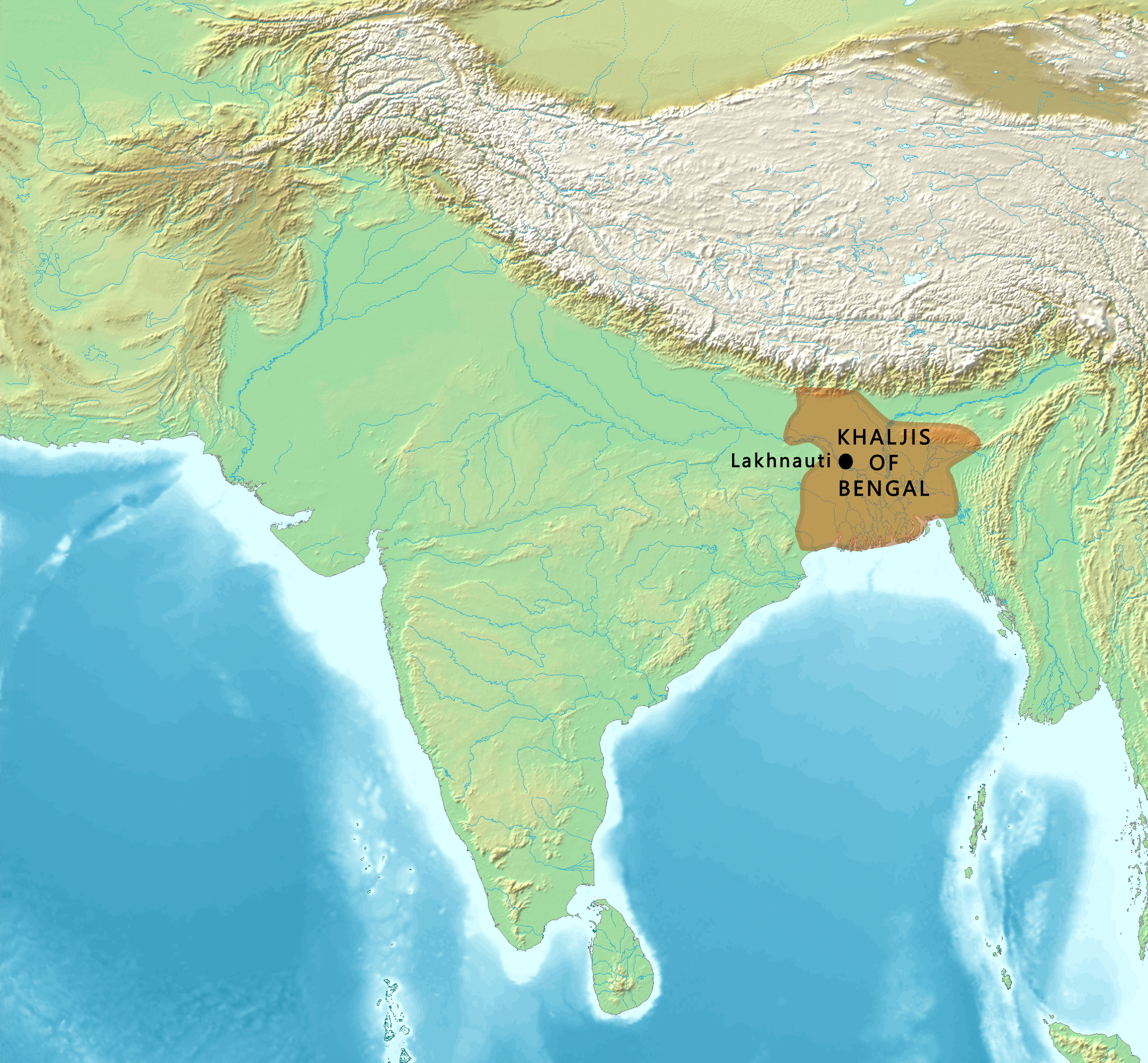
In 1203, Khalji conquered Bengal. With the octogenarian emperor Lakshmana Sena at the helm, the Sena dynasty was in a state of decline and could not provide much resistance. As Khalji came upon the city of Nabadwip, it is said that he advanced so rapidly that only 18 horsemen from his army could keep up. The small horde entered the city unchallenged and took the emperor and his army by shock. This caused Lakhsmana Sena to flee with his retainers to east Bengal. Khalji subsequently went on to capture Gauda (ancient Lakhnauti), the capital and the principal city of Bengal and intruded into much of Bengal.
Muhammad Bakhtiyar's rule was related by Minhaj al-Siraj, as he visited Bengal about 40 years later:
Invasion of Tibet (1206)
Main article: Bakhtiyar Khalji's Tibet campaign
Bakhtiyar Khalji left the town of Devkot in 1206 to attack Tibet, leaving Ali Mardan Khalji in Ghoraghat Upazila to guard the eastern frontier from his headquarters at Barisal. Bakhtiyar Khalji's forces suffered a disastrous defeat at the hands of Tibetan guerrilla forces at Chumbi Valley, which forced him to retreat to Devkot with only about a hundred surviving soldiers. This was first and shameful defeat of Khalji.
Death and aftermath
As Bakhtiyar Khalji lay ill and exhausted in Devkot after defeated by Tibetans, he was assassinated by Ali Mardan Khalji.
The Khalji noblemen then appointed Muhammad Shiran Khalji as Bakhtiyar's successor. Loyal troops under Shiran Khalji and Subedar Aulia Khan avenged Ikhtiyar's death, imprisoning Ali Mardan Khalji. Eventually Ali Mardan fled to Delhi and provoked the Sultan of Delhi Qutb al-Din Aibak to conquer Bengal, who sent an army under Qayemaz Rumi, the governor of Awadh, to dethrone Shiran Khalji. Shiran fled to Dinajpur where he later died.
Ghiyas-ud-din Iwaz Khalji assisted the invasion and assumed the governorship of Bengal in 1208. But shortly after, he yielded power to Ali Mardan willingly, when the latter returned from Delhi in 1210. However, the nobles of Bengal conspired against and assassinated Ali Mardan in 1212. Iwaj Khalji assumed power again and proclaimed his independence from the Delhi sultanate.
Legacy
Muhammad Bakhtiyar Khalji had the Khutbah read and coins struck in his name. Mosques, madrasas, and khanqahs arose through Bakhtiyar's patronage, and his example was imitated by his successors.
Bakhtiyar is revered as Pir Sahib by the locals of Pirpal village. Every year on Thursday of the month of Baishakh, festival is organised at the Bakhtiyar Khilji Shrine in Gangarampur where prayer is offered by Muslims and Hindus alike.
References
Bibliography
References
- (1906). "Hutchinson's story of the nations, containing the Egyptians, the Chinese, India, the Babylonian nation, the Hittites, the Assyrians, the Phoenicians and the Carthaginians, the Phrygians, the Lydians, and other nations of Asia Minor". London, Hutchinson.
- "Ikhtiyār al-Dīn Muḥammad Bakhtiyār Khiljī {{!}} Muslim general".
- Faruqui, Munis D.. (2005). "Review of The Bengal Sultanate: Politics, Economy and Coins (AD 1205–1576)". The Sixteenth Century Journal.
- Hussain, Syed Ejaz. (2003). "The Bengal Sultanate: Politics, Economy and Coins (AD 1205–1576)". Manohar.
- (2019). "Know Your State West Bengal". Arihant Experts.
- Chandra, Satish. (2004). "Medieval India: From Sultanat to the Mughals-Delhi Sultanat (1206-1526)".
- (17 August 2020). "Turkish History and Culture in India: Identity, Art and Transregional Connections". BRILL.
- Majumdar, R. C.. (1973). "History of Mediaeval Bengal". G. Bharadwaj & Co..
- (1986). "Advanced Study in the History of Medieval India". Sterling Publishers.
- (1992). "India and the Afghans: A study of a neglected region, 1370–1576 A.D". Janaki Prakashan.
- (2004). "Bangladesh: Past and Present". APH.
- Eaton, Richard Maxwell. (1996). "The Rise of Islam and the Bengal Frontier, 1204–1760". University of California Press.
- Scharfe, Hartmut. (2002). "Handbook of Oriental Studies". BRILL.
- Arnold, Sir Thomas Walker. (1896). "The Preaching of Islam: A History of the Propagation of the Muslim Faith". Archibald Constable and Co.
- Hindu-Muslim Relations in Bengal, 1905–1947: Study in Cultural Confrontation, Page 11, Nachiketa Publications, 1974, Hossainur Rahman
- "Ancient Nalanda University's Ruins {{!}} District Nalanda, Government of Bihar {{!}} India".
- Sarkar, Jadunath. (1943). "The History of Bengal". B. R. Publishing Corporation.
- Jha, DN. (1 June 2018). "The destruction of ancient Buddhist sites".
- Salam, Ziya Us. (18 July 2024). "Of a gilded past and the future: Nalanda's lost glory and new-found ambitions". The Hindu.
- Sirāj, Minhāju-s. (1881). "Tabaḳāt-i-nāsiri: a general history of the Muhammadan dynastics of Asia, including Hindustān, from A.H. 194 (810 A.D.) to A.H. 658 (1260 A.D.) and the irruption of the infidel Mughals into Islām". Royal Asiatic Society of Bengal (printed by Gilbert & Rivington).
- (2002). "History of medieval India: from 1000 A.D. to 1707 A.D.". Atlantic Publishers & Distributors.
- Oberling, Pierre. (15 December 2010). "ḴALAJ i. TRIBE".
- Srivastava, Ashirbadi Lal. (1966). "The History of India, 1000 A.D.-1707 A.D.". Shiva Lal Agarwala.
- Eraly, Abraham. (2015). "The Age of Wrath: A History of the Delhi Sultanate". Penguin Books.
- Chaurasia, Radhey Shyam. (2002). "History of medieval India: from 1000 A.D. to 1707 A.D.". Atlantic.
- Bhandare, Shailendra. (2020). "Turkish History and Culture in India: Identity, Art and Transregional Connections". BRILL.
- (2018). "Objects of Translation: Material Culture and Medieval "Hindu-Muslim" Encounter". Princeton University Press.
- (2001). "The Coins of the Indian Sultanates: Covering the Area of Present-day India, Pakistan, and Bangladesh". Munshiram Manoharlal.
- (2019). "I.C.S.E. History & Civics for Class IX". Goyal Brothers Prakashan.
- (1973). "The History of Bengal". Academica Asiatica.
- (30 August 2021). "Political Thought in Indic Civilization". SAGE Publishing India.
- Wink, André. (2002). "Al-Hind: The Slave Kings and the Islamic conquest, 11th-13th centuries". BRILL.
- Salam, Ziya Us. (18 July 2024). "Of a gilded past and the future: Nalanda's lost glory and new-found ambitions". The Hindu.
- The Wire. (2 February 2024). "Indians {{!}} Ep 5: Nalanda and the Decline of Buddhism {{!}} A Brief History of a Civilization".
- Juzjani, Minhaj-i Siraj. (1881). "Tabakat-i-Nasiri Vol-I". Gilbert And Rivington.
- (1996). "Bangladesh: Internal Dynamics and External Linkages". University Press Limited.
- (1965). "Social History & Political Sociology for Degree Students". Salma Shawkat via Majid Publishing House.
- (1991). "History of India and Pakistan - Volume 1". Ferozsons.
- (1980). "Islamic Heritage of Bangladesh". Department of Films and Publications, Ministry of Information & Broadcasting, Government of the People's Republic of Bangladesh.
- (2010). "Encyclopedia of the Peoples of Asia and Oceania". Facts On File, Incorporated.
- (1973). "The History of Bengal". Academica Asiatica.
- Sen, Amulyachandra. (1954). "Rajagriha and Nalanda". Calcutta Institute of Indology, Indian Publicity Society.
- (1993). "The Rise of Islam and the Bengal Frontier, 1204–1760". University of California Press.
- Khan, Muhammad Mojlum. (21 October 2013). "The Muslim Heritage of Bengal: The Lives, Thoughts and Achievements of Great Muslim Scholars, Writers and Reformers of Bangladesh and West Bengal". Kube Publishing Ltd.
- Sengupta, Nitish K.. (1 January 2011). "Land of Two Rivers: A History of Bengal from the Mahabharata to Mujib". Penguin Books India.
- (2010). "The River of Golden Sand: The Narrative of a Journey Through China and Eastern Tibet to Burmah". Cambridge University Press.
- [http://www.historyfiles.co.uk/KingListsFarEast/IndiaBengal.htm#Khilji Khilji Malik]
- Chandra, Satish. (2004). "Medieval India: From Sultanat to the Mughals-Delhi Sultanat (1206–1526) – Part One". Har-Anand Publications.
- Ichimura, Shōhei. (2001). "Buddhist Critical Spirituality: Prajñā and Śūnyatā". Motilal Banarsidass.
- Sen, Gertrude Emerson. (1964). "The Story of Early Indian Civilization". Orient Longmans.
- Roy, Sourav. (2024-05-02). "Gangarampur {{!}} সম্প্রীতির নিদর্শন, বখতিয়ার খিলজির মাজারে ভিড় হিন্দু-মুসলিমদের".
This article was imported from Wikipedia and is available under the Creative Commons Attribution-ShareAlike 4.0 License. Content has been adapted to SurfDoc format. Original contributors can be found on the article history page.
Ask Mako anything about Muhammad Bakhtiyar Khalji — get instant answers, deeper analysis, and related topics.
Research with MakoFree with your Surf account
Create a free account to save articles, ask Mako questions, and organize your research.
Sign up freeThis content may have been generated or modified by AI. CloudSurf Software LLC is not responsible for the accuracy, completeness, or reliability of AI-generated content. Always verify important information from primary sources.
Report