From Surf Wiki (app.surf) — the open knowledge base
Mucilage
Thick, gluey substance produced by nearly all plants and some microorganisms

Thick, gluey substance produced by nearly all plants and some microorganisms
Mucilage is a thick gluey substance produced by nearly all plants and some microorganisms. These microorganisms include protists which use it for their locomotion, with the direction of their movement always opposite to that of the secretion of mucilage. It is a polar glycoprotein and an exopolysaccharide. Mucilage in plants plays a role in the storage of water and food, seed germination, and thickening membranes. Cacti (and other succulents) and flax seeds are especially rich sources of mucilage.
Occurrence
Exopolysaccharides are the most stabilising factor for microaggregates and are widely distributed in soils. Therefore, exopolysaccharide-producing "soil algae" play a vital role in the ecology of the world's soils. The substance covers the outside of, for example, unicellular or filamentous green algae and cyanobacteria. Amongst the green algae especially, the group Volvocales are known to produce exopolysaccharides at a certain point in their life cycle. It occurs in almost all plants, but usually in small amounts. It is frequently associated with substances like tannins and alkaloids.
Mucilage has a unique purpose in some carnivorous plants. The plant genera Drosera (sundews), Pinguicula (butterworts), and others have leaves studded with mucilage-secreting glands, and use a "flypaper trap" to capture insects.
Human uses
Mucilage is edible. It is used in medicine as it relieves irritation of mucous membranes by forming a protective film. It is known to act as a soluble, or viscous, dietary fiber that thickens the fecal mass, an example being the consumption of fiber supplements containing psyllium seed husks.
The inner bark of the slippery elm (Ulmus rubra), a North American tree species, has long been used as a demulcent and cough medicine, and is still produced commercially for that purpose.
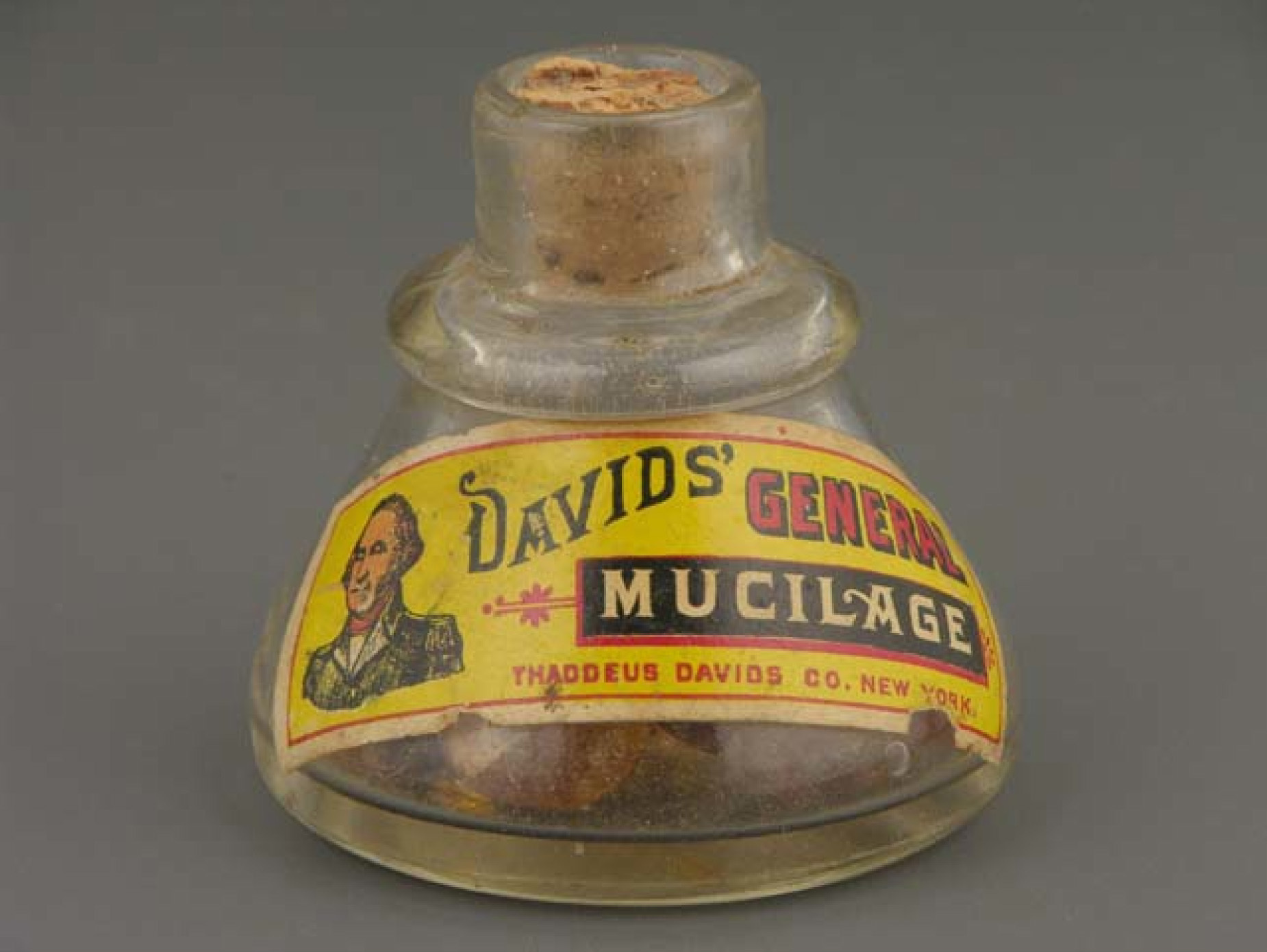
Mucilage mixed with water has been used as a glue, especially for bonding paper items such as labels, postage stamps, and envelope flaps. Differing types and varying strengths of mucilage can also be used for other adhesive applications, including gluing labels to metal cans, wood to china, and leather to pasteboard. During the fermentation of nattō soybeans, extracellular enzymes produced by the bacterium Bacillus natto react with soybean sugars to produce mucilage. The amount and viscosity of the mucilage are important nattō characteristics, contributing to nattō's unique taste and smell.
The mucilage of two kinds of insectivorous plants, sundew (Drosera) and butterwort (Pinguicula), is used for the traditional production of a variant of the yogurt-like Swedish dairy product called filmjölk.
Ecological implications for plants
The presence of mucilage in seeds affects important ecological processes in some plant species, such as tolerance of water stress, competition via allelopathy, or facilitation of germination through attachment to soil particles. Some authors have also suggested a role of seed mucilage in protecting DNA material from irradiation damage. The amount of mucilage produced per seed has been shown to vary across the distribution range of a species, in relation with local environmental conditions of the populations.
A variety of maize grows aerial roots that produce a sweet mucus. The Sierra Mixe is a tall variety that survives in poor soils without fertilizer in Oaxaca, Mexico, and the mucilage has been shown to support nitrogen fixation through bacteria that thrive in its high-sugar, low-oxygen environment.
Plant sources
The following plant and algae species are known to contain far greater concentrations of mucilage than typical:
- Aloe vera
- Watershield
- Althaea
- Basella alba (Malabar spinach)
- Cactus
- Chondrus crispus (Irish moss)
- Corchorus (jute plant)
- Dioscorea polystachya (nagaimo, Chinese yam)
- Drosera (sundews)
- Drosophyllum lusitanicum
- Fenugreek
- Flax seeds
- Kelp
- Liquorice root
- Mallow
- Mullein
- Okra
- Nopal
- Parthenium
- Pinguicula (butterwort)
- Plantago major (greater plantain)
- Psyllium seed husks
- Salvia hispanica seed (chia)
- Talinum triangulare (waterleaf)
- Taro
- Ulmus rubra bark (slippery elm)
References
References
- (2016-09-06). "Modes of Locomotion in Protists: 5 Modes". Biology Discussion.
- "Mucilage cell, cactus".
- (2006). "Soil Microbiology, Ecology and Biochemistry". Academic Press.
- "Carnivorous Plant Trapping Mechanisms".
- (2001). "Dietary Reference Intakes: Proposed Definition of Dietary Fiber". National Academy Press.
- "Slippery Elm". University of Maryland Medical Center.
- Spitzenberger, Ray. (23 August 2007). "Glue, Paste or Mucilage: Know the Difference?". East Bernard Express.
- Dawidowsky, Ferdinand. (1905). "Glue, Gelatine, Animal Charcoal, Phosphorus, Cements, Pastes, and Mucilage". Henry Carey Baird & Co..
- "Drosera L.". Royal Botanic Gardens, Kew.
- (December 2017). "Filmjölk från Linnés tid". Verumjournalen.
- Östman, Elisabeth. (1911). "Iduns kokbok". Aktiebolaget Ljus, Isaac Marcus' Boktryckeriaktiebolag.
- (1966-01-01). "The Behaviour of Seeds in Soil: II. The Germination of Seeds on the Surface of a Water Supplying Substrate". Journal of Ecology.
- (1992-10-01). "Isolation and identification of lepidimoide, a new allelopathic substance from mucilage of germinated cress seeds". Plant Physiology.
- (2010-06-01). "Fruit and seed heteromorphism in the cold desert annual ephemeral Diptychocarpus strictus (Brassicaceae) and possible adaptive significance". Annals of Botany.
- (2011-09-02). "The Achene Mucilage Hydrated in Desert Dew Assists Seed Cells in Maintaining DNA Integrity: Adaptive Strategy of Desert Plant Artemisia sphaerocephala". PLOS ONE.
- (2013-09-01). "The role of the tolerance–fecundity trade-off in maintaining intraspecific seed trait variation in a widespread dimorphic herb". Plant Biology.
- (10 August 2018). "The Corn of the Future Is Hundreds of Years Old and Makes Its Own Mucus".
This article was imported from Wikipedia and is available under the Creative Commons Attribution-ShareAlike 4.0 License. Content has been adapted to SurfDoc format. Original contributors can be found on the article history page.
Ask Mako anything about Mucilage — get instant answers, deeper analysis, and related topics.
Research with MakoFree with your Surf account
Create a free account to save articles, ask Mako questions, and organize your research.
Sign up freeThis content may have been generated or modified by AI. CloudSurf Software LLC is not responsible for the accuracy, completeness, or reliability of AI-generated content. Always verify important information from primary sources.
Report