From Surf Wiki (app.surf) — the open knowledge base
MSCI World
Global Stock Index
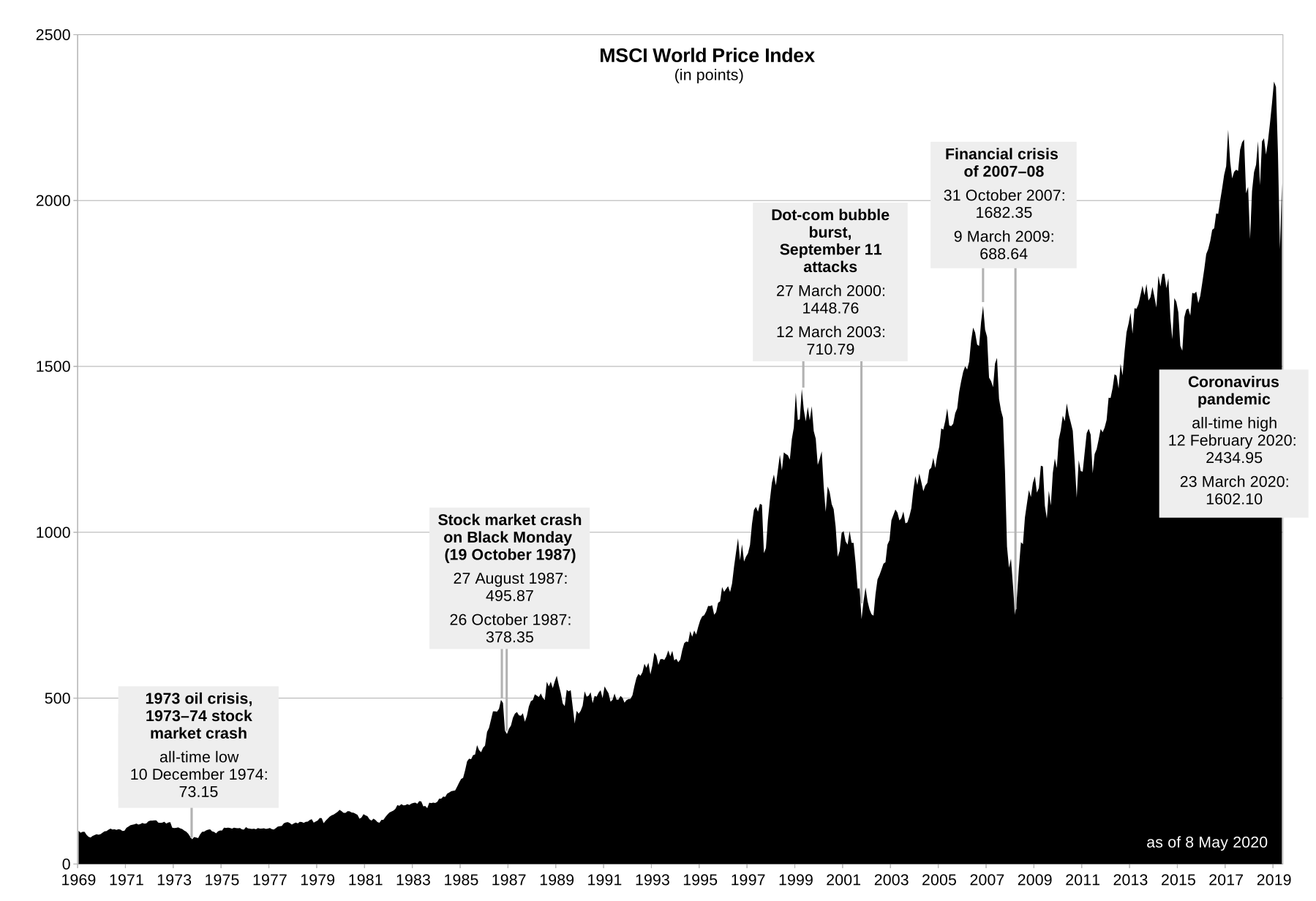
Global Stock Index

The MSCI World is a widely followed global stock market index that tracks the performance of around 1,300 large and mid-cap companies across 23 developed countries. It is maintained by MSCI, formerly Morgan Stanley Capital International, and is used as a common benchmark for global stock funds intended to represent a broad cross-section of global markets.
The index includes a collection of stocks of all the developed markets in the world, as defined by MSCI. The exclusion of stocks from emerging and frontier economies makes the index narrower in global coverage than the name suggests. A related index, the MSCI All Country World Index (ACWI), incorporates both developed and emerging countries. MSCI also produces a Frontier Markets index, including another 31 markets.
The MSCI World Index has been calculated since 1969, in various forms: without dividends (Price Index), with net or with gross dividends reinvested (Net and Gross Index), in US dollars, Euro and local currencies.
Index Composition Methodology
The MSCI World Index is constructed by classifying equity securities from developed market countries into large-cap and mid-cap segments based on their free float-adjusted market capitalization.
Market capitalization refers to the total market value of a company's outstanding shares, calculated as the share price multiplied by the total number of shares. In MSCI's methodology, this figure is adjusted for free-float: meaning only shares available for public trading are counted, excluding those held by insiders, governments, or other holders who are unlikely to trade.
Within each developed market country, MSCI ranks companies by their free float-adjusted market capitalization and includes:
- Large-cap stocks: companies that collectively account for approximately the top 70% of the cumulative market capitalization
- Mid-cap stocks: companies that bring the cumulative total of market capitalization up to 85%
The MSCI index excludes the remaining 15% of market capitalization segment, corresponding to low-cap stocks.
This segmentation ensures that the MSCI World Index captures roughly 85% of the investable equity universe in each country, providing broad and representative coverage of developed market equities.
Market Classification Methodology
MSCI evaluates a country's equity market as "developed" if all of the following criteria are met:
| Market accessibility | Rated "Very High" or "Unrestricted" across the five sub-criteria: | Guarantees seamless access for global investors |
|---|
MSCI monitors all countries continuously, but formal reclassification consultations occur each spring, with decisions announced the following June and implemented in quarterly index reviews. Off-cycle announcements are reserved for exceptional market events.
Country representation
The index includes companies in the following 23 countries:
- Australia
- Austria
- Belgium
- Canada
- Denmark
- Finland
- France
- Germany
- Hong Kong
- Ireland
- Israel
- Italy
- Japan
- Netherlands
- New Zealand
- Norway
- Portugal
- Singapore
- Spain
- Sweden
- Switzerland
- United Kingdom
- United States
Sector representation
Companies are divided into sectors according to GICS. The breakdown is shown here in the pie chart, with information technology being the biggest sector with more than 26% as of July 2025.
Total annual returns
| Year | Gross Annual |
|---|---|
| Return (a) | |
| 1970 | −1.98% |
| 1971 | 19.56% |
| 1972 | 23.55% |
| 1973 | −14.51% |
| 1974 | −24.48% |
| 1975 | 34.50% |
| 1976 | 14.71% |
| 1977 | 5.00% |
| 1978 | 18.22% |
| 1979 | 12.67% |
| 1980 | 27.72% |
| 1981 | −3.30% |
| 1982 | 11.27% |
| 1983 | 23.28% |
| 1984 | 5.77% |
| 1985 | 41.77% |
| 1986 | 42.80% |
| 1987 | 16.76% |
| 1988 | 23.95% |
| 1989 | 17.19% |
| 1990 | −16.52% |
| 1991 | 18.97% |
| 1992 | −4.66% |
| 1993 | 23.13% |
| 1994 | 5.58% |
| 1995 | 21.32% |
| 1996 | 14.00% |
| 1997 | 16.23% |
| 1998 | 24.80% |
| 1999 | 25.34% |
| 2000 | −12.92% |
| 2001 | −16.52% |
| 2002 | −19.54% |
| 2003 | 33.76% |
| 2004 | 15.25% |
| 2005 | 10.02% |
| 2006 | 20.65% |
| 2007 | 9.57% |
| 2008 | −40.33% |
| 2009 | 30.79% |
| 2010 | 12.34% |
| 2011 | −5.02% |
| 2012 | 16.54% |
| 2013 | 27.37% |
| 2014 | 5.50% |
| 2015 | −0.32% |
| 2016 | 8.15% |
| 2017 | 23.07% |
| 2018 | −8.20% |
| 2019 | 28.40% |
| 2020 | 16.50% |
| 2021 | 22.35% |
| 2022 | −17.73% |
| 2023 | 24.42% |
| 2024 | 19.19% |
| 2025 | 21.60% |
- (a) Total returns including reinvested dividends.
References
References
- "MSCI World Index - Factsheet". msci.com.
- "MSCI World Index - Constituents". msci.com.
- "Frontier markets".
- [https://www.msci.com start date of ''MSCI World FREE'' index history is December 31, 1969]
- "Market Classification".
- MSCI. (June 2025). "MSCI Market Classification Framework".
- "MSCI World Index (USD)".
- "Index tools - MSCI". mscibarra.com.
- "MSCI WORLD INDEX (USD)".
This article was imported from Wikipedia and is available under the Creative Commons Attribution-ShareAlike 4.0 License. Content has been adapted to SurfDoc format. Original contributors can be found on the article history page.
Ask Mako anything about MSCI World — get instant answers, deeper analysis, and related topics.
Research with MakoFree with your Surf account
Create a free account to save articles, ask Mako questions, and organize your research.
Sign up freeThis content may have been generated or modified by AI. CloudSurf Software LLC is not responsible for the accuracy, completeness, or reliability of AI-generated content. Always verify important information from primary sources.
Report