From Surf Wiki (app.surf) — the open knowledge base
Moving load
Load that changes in time

Load that changes in time
In structural dynamics, a moving load changes the point at which the load is applied over time. Examples include a vehicle that travels across a bridge and a train moving along a track.
Properties
In computational models, load is usually applied as
- a simple massless force,
- an oscillator, or
- an inertial force (mass and a massless force).
Numerous historical reviews of the moving load problem exist. Several publications deal with similar problems.
The fundamental monograph is devoted to massless loads. Inertial load in numerical models is described in
Unexpected property of differential equations that govern the motion of the mass particle travelling on the string, Timoshenko beam, and Mindlin plate is described in. It is the discontinuity of the mass trajectory near the end of the span (well visible in string at the speed v=0.5c). The moving load significantly increases displacements. The critical velocity, at which the growth of displacements is the maximum, must be taken into account in engineering projects.
Structures that carry moving loads can have finite dimensions or can be infinite and supported periodically or placed on the elastic foundation.
Consider simply supported string of the length l, cross-sectional area A, mass density ρ, tensile force N, subjected to a constant force P moving with constant velocity v. The motion equation of the string under the moving force has a form
: -N\frac{\partial^2w(x,t)}{\partial x^2}+\rho A\frac{\partial^2w(x,t)}{\partial t^2}=\delta(x-vt)P\ .
Displacements of any point of the simply supported string is given by the sinus series : w(x,t) = \frac{2P}{\rho Al}\sum_{j=1}^{\infty}\frac{1}{\omega_{(j)}^2-\omega^2}\left(\sin(\omega t)-\frac{\omega}{\omega_{(j)}}\sin(\omega_{(j)}t)\right)\sin\frac{j\pi x}{l}\ , where : \omega=\frac{j\pi v}{l}\ , and the natural circular frequency of the string : \omega_{(j)}^2=\frac{j^2\pi^2}{l^2}\frac{N}{\rho A}\ . In the case of inertial moving load, the analytical solutions are unknown. The equation of motion is increased by the term related to the inertia of the moving load. A concentrated mass m accompanied by a point force P: : -N\frac{\partial^2w(x,t)}{\partial x^2}+\rho A\frac{\partial^2w(x,t)}{\partial t^2}=\delta(x-vt)P-\delta(x-vt)m\frac{\mbox{d}^2w(vt,t)}{\mbox{d}t^2}\ .
The last term, because of complexity of computations, is often neglected by engineers. The load influence is reduced to the massless load term. Sometimes the oscillator is placed in the contact point. Such approaches are acceptable only in low range of the travelling load velocity. In higher ranges both the amplitude and the frequency of vibrations differ significantly in the case of both types of a load.
The differential equation can be solved in a semi-analytical way only for simple problems. The series determining the solution converges well and 2-3 terms are sufficient in practice. More complex problems can be solved by the finite element method or space-time finite element method.
| massless load | inertial load |
|---|
The discontinuity of the mass trajectory is also well visible in the Timoshenko beam. High shear stiffness emphasizes the phenomenon.
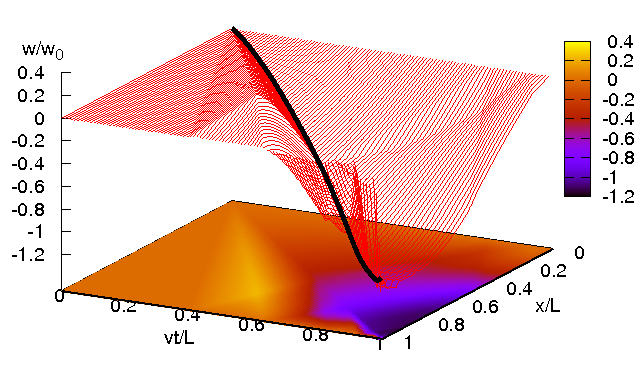
The Renaudot approach vs. the Yakushev approach
Renaudot approach
: \delta(x-vt)\frac{\mbox{d}}{\mbox{d}t}\left[m\frac{\mbox{d}w(vt,t)}{\mbox{d}t}\right]=\delta(x-vt)m\frac{\mbox{d}^2w(vt,t)}{\mbox{d}t^2}\ .
Yakushev approach
: \frac{\mbox{d}}{\mbox{d}t}\left[\delta(x-vt)m\frac{\mbox{d}w(vt,t)}{\mbox{d}t}\right]=-\delta^\prime(x-vt)mv\frac{\mbox{d}w(vt,t)}{\mbox{d}t}+\delta(x-vt)m\frac{\mbox{d}^2w(vt,t)}{\mbox{d}t^2}\ .
Massless string under moving inertial load
Consider a massless string, which is a particular case of moving inertial load problem. The first to solve the problem was Smith. The analysis will follow the solution of Fryba. Assuming ρ=0, the equation of motion of a string under a moving mass can be put into the following form : -N\frac{\partial^2w(x,t)}{\partial x^2}=\delta(x-vt)P-\delta(x-vt),m\frac{\mbox{d}^2w(vt,t)}{\mbox{d}t^2}\ . We impose simply-supported boundary conditions and zero initial conditions. To solve this equation we use the convolution property. We assume dimensionless displacements of the string y and dimensionless time τ:
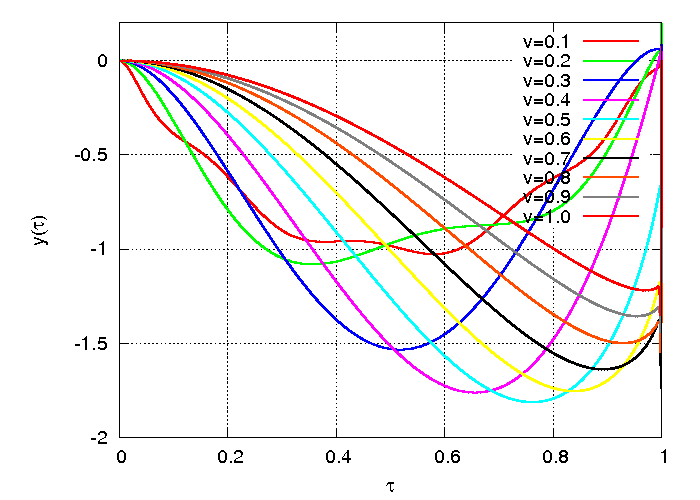
: y(\tau)=\frac{w(vt,t)}{w_{st}}\ ,\ \ \ \ \tau\ =\ \frac{vt}{l}\ , where wst is the static deflection in the middle of the string. The solution is given by a sum : y(\tau)=\frac{4,\alpha}{\alpha,-,1},\tau,(\tau-1),\sum_{k=1}^\infty,\prod_{i=1}^k\frac{(a+i-1)(b+i-1)}{c+i-1};\frac{\tau^k}{k!}\ , where α is the dimensionless parameters : : \alpha=\frac{Nl}{2mv2},,0\ \ \ \wedge\ \ \ \alpha,\neq,1\ . Parameters a, b and c are given below : a_{1,2}=\frac{3,\pm,\sqrt{1+8\alpha}}{2}\ ,\ \ \ \ \ b_{1,2}=\frac{3,\mp,\sqrt{1+8\alpha}}{2}\ ,\ \ \ \ \ c=2\ .

In the case of α=1, the considered problem has a closed solution: y(\tau )=\left[\frac{4}{3}\tau (1-\tau) -\frac{4}{3}\tau \left( 1+2 \tau\ln (1-\tau )+2\ln (1-\tau )\right)\right]\ .
References
References
- (1934). "A Mathematical Treatise on Vibrations in Railway Bridges". Cambridge University Press.
- (1937). "Schwingungen von Tragern bei bewegten Lasten". Stringer Nature.
- (2003). "On Asymptotics of the Solution of the Moving Oscillator Problem". J. Sound Vib..
- (1999). "Vibrations of Solids and Structures Under Moving Loads". Thomas Telford House.
- (2012). "Numerical Analysis of Vibrations of Structures Under Moving Inertial Load". Springer.
- (2009). "Paradox of the Particle's Trajectory Moving on a String". Arch. Appl. Mech..
- C.E. Smith. (1964). "Motion of a stretched string carrying a moving mass particle". J. Appl. Mech..
This article was imported from Wikipedia and is available under the Creative Commons Attribution-ShareAlike 4.0 License. Content has been adapted to SurfDoc format. Original contributors can be found on the article history page.
Ask Mako anything about Moving load — get instant answers, deeper analysis, and related topics.
Research with MakoFree with your Surf account
Create a free account to save articles, ask Mako questions, and organize your research.
Sign up freeThis content may have been generated or modified by AI. CloudSurf Software LLC is not responsible for the accuracy, completeness, or reliability of AI-generated content. Always verify important information from primary sources.
Report