From Surf Wiki (app.surf) — the open knowledge base
Mountains of Ararat
Place mentioned in the Book of Genesis
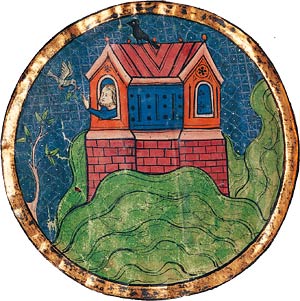
Place mentioned in the Book of Genesis
the Scriptural reference
In the Book of Genesis, the mountains of Ararat (Biblical Hebrew , Tiberian hārê ’Ǎrārāṭ, Septuagint: τὰ ὄρη τὰ Ἀραράτ) is the term used to designate the region in which Noah's Ark comes to rest after the Great Flood. It corresponds to the ancient Assyrian term Urartu, an exonym for the Armenian Kingdom of Van.
Since the Middle Ages the "mountains of Ararat" began to be identified with a mountain in present Turkey known as Masis or Ağrı Dağı; the mountain became known as Mount Ararat.{{cite book |last = Petrosyan |first = Hamlet |editor1-first = Levon |editor1-last = Abrahamian |editor1-link = Levon Abrahamian |editor2-first = Nancy |editor2-last = Sweezy |title = Armenian Folk Arts, Culture, and Identity |url = https://archive.org/details/isbn_9780253337047/page/36 |year = 2001 |publisher = Indiana University Press |isbn = 978-0-253-33704-7 |page =36 |chapter = The Sacred Mountain |quote = When Armenians were first introduced to the biblical story of the flood, there was no special interest in the location of Mount Ararat. Most Armenian historians in the Early Middle Ages accepted the generally held Christian opinion of the time that Ararat was located near Mesopotamia in Korduk (Corduene), the southernmost province of Armenia. However, when European Crusaders on their way to free the Holy Land from Moslem rule appeared in the region in the 11th century, Armenian hopes for similar "salvation" helped to catalyze the final identification of Masis with Ararat. From the 12th century on, Catholic missionaries and other travelers to the region returned to Europe with the same story: that the mountain where the Ark landed was towering in the heart of Armenia.}} The Kurdish population is primarily concentrated on the Van plateau, from which numerous tribes radiate over a vast area, including territories extending toward Mount Ararat.
History
_Ararat_in_Armenia_with_Noah's_Ark.jpg)
Citing historians Berossus, Hieronymus the Egyptian, Mnaseas, and Nicolaus of Damascus, Josephus writes in his Antiquities of the Jews that "[t]he ark rested on the top of a certain mountain in Armenia, ... over Minyas, called Baris".
Likewise, in the Latin Vulgate, Jerome translates Genesis 8:4 to read: "Requievitque arca ... super montes Armeniae" ("and the ark rested ... on the mountains of Armenia"); though in the Nova Vulgata as promulgated after the Second Vatican Council, the toponym is amended to "montes Ararat" ("mountains of Ararat").

By contrast, early Syrian and Eastern tradition placed the ark on Mount Judi in ancient Upper Mesopotamia, what is now in Şırnak Province, Southeastern Anatolia Region, an association that had faded by the Middle Ages and is now mostly confined to Quranic tradition.
The Book of Jubilees specifies that the ark came to rest on the peak of Lubar, a mountain of Ararat.
Sir Walter Raleigh devotes several chapters of his Historie of the World (1614) to an argument that in ancient times the mountains of Ararat were understood to include not only those of Armenia, but also all of the taller mountain-ranges extending into Asia. He maintains that since Armenia is not actually located east of Shinar, the ark must have landed somewhere in the Orient.
Notes
References
References
- "BIBLE - GENESIS 8:4".
- "Genesis 8:4". Online Parallel Bible Project.
- [[David Marshall Lang. Lang, David Marshall]]. ''Armenia: Cradle of Civilization''. London: Allen and Unwin, 1970, p. 114. {{ISBN. 0-04-956007-7.
- Redgate, Anna Elizabeth. ''The Armenians''. Cornwall: Blackwell, 1998, pp. 16–19, 23, 25, 26 (map), 30–32, 38, 43. {{ISBN. 0-631-22037-2.
- Agadjanian, Alexander. (15 April 2016). "Armenian Christianity Today: Identity Politics and Popular Practice". Routledge.
- Reclus, Elisée. (1876). "The Earth and Its Inhabitants: The Universal Geography". J.S. Virtue & Company, Limited.
- {{PACEJ
- "The Book of Genesis: Chapter 8". Mental Systems, Inc..
- "Liber Genesis". The Holy See.
- Conybeare, Frederick Cornwallis. (April 1901). "Reviewed Work: ''Ararat und Masis. Studien zur armenischen Altertumskunde und Litteratur'' by Friedrich Murad". [[The Journal of Religion.
- "The Book of Jubilees: Chapter 7".
- "Bereishit (Genesis) 11 :: Septuagint (LXX)".
- "Genesis 11:2". Online Parallel Bible Project.
- "Commentaries: Genesis 11:2". Online Parallel Bible Project.
- Kolatch, Yonatan. (2006). "Masters of the Word: Traditional Jewish Bible Commentary from the First Through Tenth Centuries, Volume 1". KTAV Publishing House, Inc..
- "Noah's Ark: The Ark of Noah in Iran?". The Bible Archaeology, Search & Exploration (BASE) Institute.
This article was imported from Wikipedia and is available under the Creative Commons Attribution-ShareAlike 4.0 License. Content has been adapted to SurfDoc format. Original contributors can be found on the article history page.
Ask Mako anything about Mountains of Ararat — get instant answers, deeper analysis, and related topics.
Research with MakoFree with your Surf account
Create a free account to save articles, ask Mako questions, and organize your research.
Sign up freeThis content may have been generated or modified by AI. CloudSurf Software LLC is not responsible for the accuracy, completeness, or reliability of AI-generated content. Always verify important information from primary sources.
Report