From Surf Wiki (app.surf) — the open knowledge base
Mountain formation
Geological processes that underlie the formation of mountains
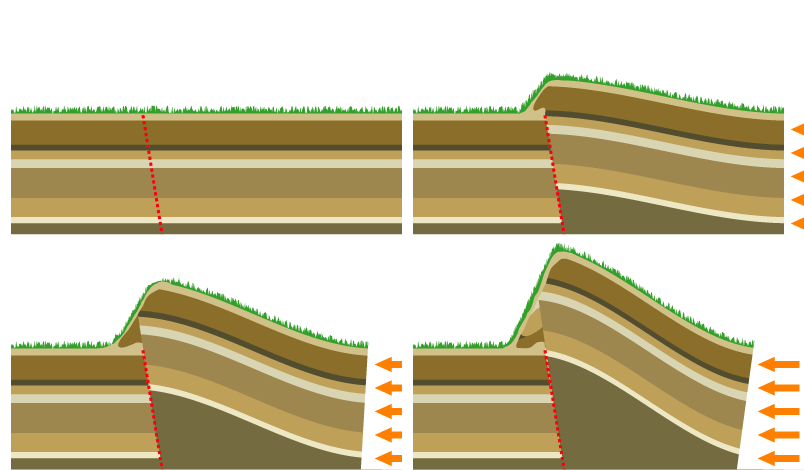
Geological processes that underlie the formation of mountains
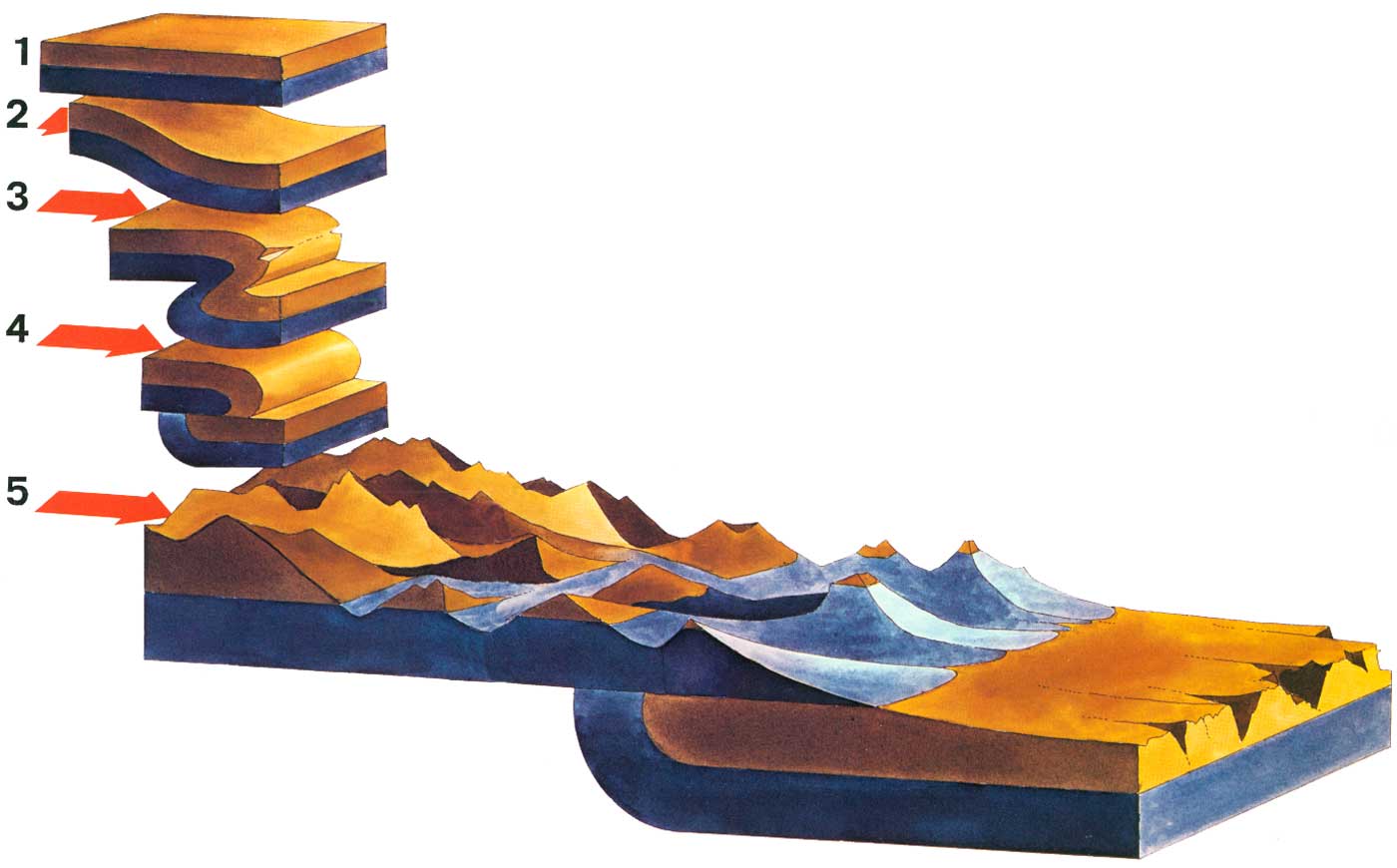
Mountain formation occurs due to a variety of geological processes associated with large-scale movements of Earth's crust (tectonic plates). Folding, faulting, volcanic activity, igneous intrusion and metamorphism can all be parts of the orogenic process of mountain building. The formation of mountains is not necessarily related to the geological structures found on it.
From the late 18th century until its replacement by plate tectonics in the 1960s, geosyncline theory was used to explain much mountain-building. The understanding of specific landscape features in terms of the underlying tectonic processes is called tectonic geomorphology, and the study of geologically young or ongoing processes is called neotectonics.
Types of mountains
There are five main types of mountains: volcanic, fold, plateau, fault-block, and dome. A more detailed classification useful on a local scale predates plate tectonics and adds to these categories.
Volcanic mountains

Movements of tectonic plates create volcanoes along the plate boundaries, which erupt and form mountains. A volcanic arc system is a series of volcanoes that form near a subduction zone where the crust of a sinking oceanic plate melts and drags water down with the subducting crust.
Most volcanoes occur in a band encircling the Pacific Ocean (the Pacific Ring of Fire), and in another that extends from the Mediterranean across Asia to join the Pacific band in the Indonesian Archipelago. The most important types of volcanic mountain are composite cones or stratovolcanoes and shield volcanoes.
A shield volcano has a gently sloping cone because of the low viscosity of the emitted material, primarily basalt. Mauna Loa is the classic example, with a slope of 4°-6°. (The relation between slope and viscosity falls under the topic of angle of repose.) A composite volcano or stratovolcano has a more steeply rising cone (33°-40°), because of the higher viscosity of the emitted material, and eruptions are more violent and less frequent than for shield volcanoes. Examples include Vesuvius, Kilimanjaro, Mount Fuji, Mount Shasta, Mount Hood and Mount Rainier.
Fold mountains
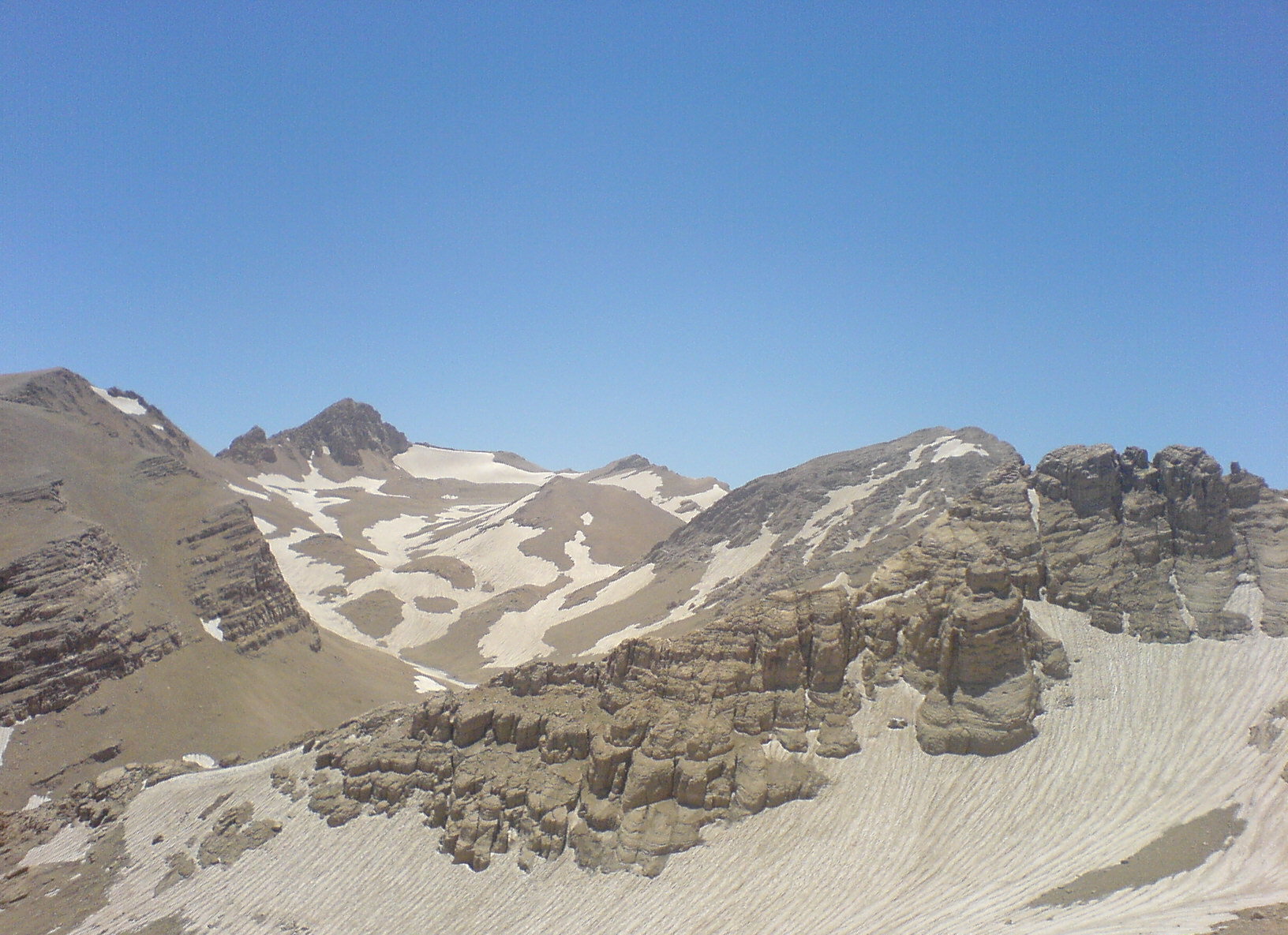
When plates collide or undergo subduction (that is, ride one over another), the plates tend to buckle and fold, forming mountains. While volcanic arcs form at oceanic-continental plate boundaries, folding occurs at continental-continental plate boundaries. Most of the major continental mountain ranges are associated with thrusting and folding or orogenesis. Examples are the Balkan Mountains, the Jura and the Zagros mountains.
Block mountains


When a fault block is raised or tilted, a block mountain can result. Higher blocks are called horsts, and troughs are called grabens. A spreading apart of the surface causes tensional forces. When the tensional forces are strong enough to cause a plate to split apart, it does so such that a center block drops down relative to its flanking blocks.
An example is the Sierra Nevada range, where delamination created a block 650 km long and 80 km wide that consists of many individual portions tipped gently west, with east facing slips rising abruptly to produce the highest mountain front in the continental United States.
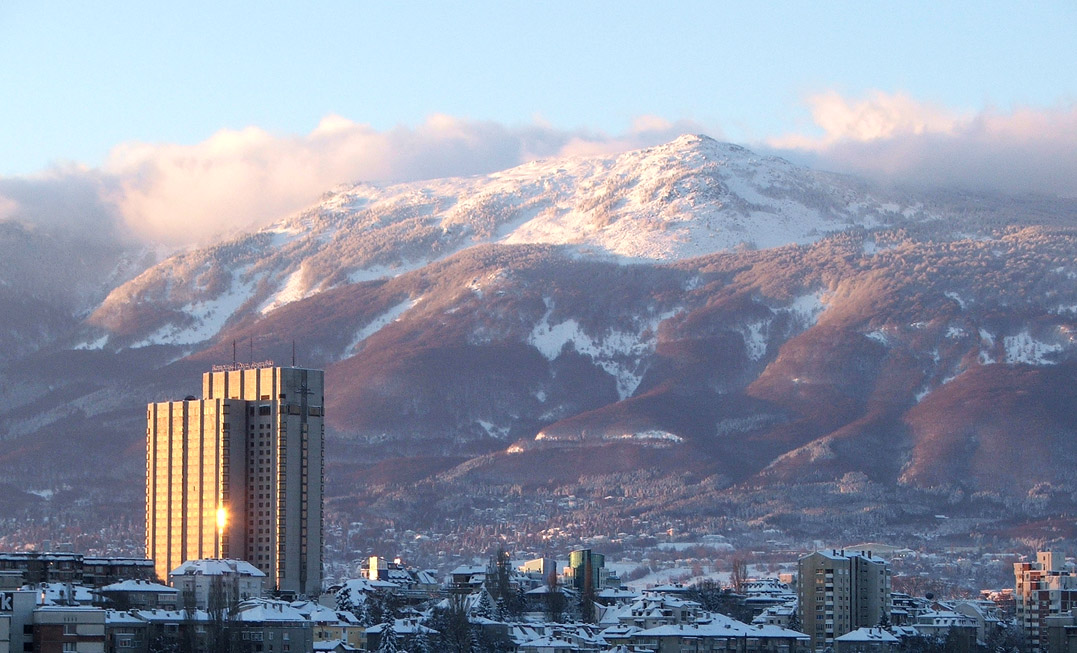
Another example is the Rila–Rhodope massif in Bulgaria, including the well defined horsts of Belasitsa (linear horst), Rila mountain (vaulted domed shaped horst) and Pirin mountain—a horst forming a massive anticline situated between the complex graben valleys of the Struma and Mesta rivers.{{cite book | ref= | script-title =bg: Географски речник на България | trans-title = Geographic Dictionary of Bulgaria | trans-title = Pirin National Park. Management Plan | script-title= bg:Национален парк "Пирин". План за управление | script-title=bg: Теми по физическа и социално-икономическа география на България | trans-title=Topics on Physical and Social-Economic Geography of Bulgaria
Uplifted passive margins
Unlike orogenic mountains there is no widely accepted geophysical model that explains elevated passive continental margins such as the Scandinavian Mountains, eastern Greenland, the Brazilian Highlands, or Australia's Great Dividing Range. Different elevated passive continental margins most likely share the same mechanism of uplift. This mechanism is possibly related to far-field stresses in Earth's lithosphere. According to this view elevated passive margins can be likened to giant anticlinal lithospheric folds, where folding is caused by horizontal compression acting on a thin to thick crust transition zone (as are all passive margins).
Models
Hotspot volcanoes
Hotspots are supplied by a magma source in the Earth's mantle called a mantle plume. Although originally attributed to a melting of subducted oceanic crust, recent evidence belies this connection. The mechanism for plume formation remains a research topic.
Fault blocks
Several movements of Earth's crust that lead to mountains are associated with faults. These movements actually are amenable to analysis that can predict, for example, the height of a raised block and the width of an intervening rift between blocks using the rheology of the layers and the forces of isostasy. Early bent plate models predicting fractures and fault movements have evolved into today's kinematic and flexural models.
References
References
- Steven M. Stanley. (2004). "Earth system history". Macmillan.
- [[Robert J. Twiss]]. (1992). "Structural Geology". Macmillan.
- (2000). "The Origin of Mountains". Routledge.
- "Geosynclinal Theory". University of Illinois at Urbana-Champaign.
- Kurt Stüwe. (2007). "Geodynamics of the lithosphere: an introduction". Springer.
- Andrew Goudie. (2004). "Encyclopedia of geomorphology; Volume 2". Routledge.
- [http://earthobservatory.nasa.gov/IOTD/view.php?id=82471 NASA - Activity at Kliuchevskoi]
- Stephen D Butz. (2004). "Science of Earth Systems". Thompson/Delmar Learning.
- John Gerrard. (1990). "Mountain environments: an examination of the physical geography of mountains". MIT Press.
- Arthur Holmes. (2004). "Holmes Principles of Physical Geology". Taylor & Francis.
- (1898). "Transactions of the American Society of Civil Engineers, Volume 39". American Society of Civil Engineers.
- James Shipman. (2007). "An Introduction to Physical Science". Cengage Learning.
- [[Michael Paul Searle. (2007). "4-D framework of continental crust". Geological Society of America.
- Chris C. Park. (2001). "The environment: principles and applications". Routledge.
- Scott Ryan. (2006). "CliffsQuickReview Earth Science". Wiley.
- John Gerrard. (1990-04-12). "Reference cited".
- (2000). "Osmium Isotopic Evidence for Mesozoic Removal of Lithospheric Mantle Beneath the Sierra Nevada, California". Science.
- (2009). "atlantens kustberg och högslätter – gamla eller unga?". Geografilärarnas Riksförening.
- (2013). "Stratigraphic landscape analysis, thermochronology and the episodic development of elevated, passive continental margins". [[Geological Survey of Denmark and Greenland.
- (2012). "Elevated, passive continental margins: Not rift shoulders, but expressions of episodic, post-rift burial and exhumation". [[Global and Planetary Change]].
- Løseth and Hendriksen 2005
- Y Niu. (2004). "Oceanic hotspots: intraplate submarine magmatism and tectonism". Springer.
- AB Watts. (2001). "Isostasy and flexure of the lithosphere". Cambridge University Press.
- GD Karner. (1999). "Continental tectonics". Geological society.
This article was imported from Wikipedia and is available under the Creative Commons Attribution-ShareAlike 4.0 License. Content has been adapted to SurfDoc format. Original contributors can be found on the article history page.
Ask Mako anything about Mountain formation — get instant answers, deeper analysis, and related topics.
Research with MakoFree with your Surf account
Create a free account to save articles, ask Mako questions, and organize your research.
Sign up freeThis content may have been generated or modified by AI. CloudSurf Software LLC is not responsible for the accuracy, completeness, or reliability of AI-generated content. Always verify important information from primary sources.
Report