From Surf Wiki (app.surf) — the open knowledge base
Mount Rushmore
Mountain in South Dakota with sculptures of four U.S. presidents

Mountain in South Dakota with sculptures of four U.S. presidents
| Field | Value |
|---|---|
| name | Mount Rushmore National Memorial |
| Shrine of Democracy | |
| Tȟuŋkášila Šákpe | |
| photo | Mount Rushmore detail view (100MP).jpg |
| photo_caption | View of Mount Rushmore, showing the sculpted heads of George Washington, Thomas Jefferson, Theodore Roosevelt and Abraham Lincoln |
| map | South Dakota#USA |
| relief | 1 |
| location | Pennington County, South Dakota |
| nearest_city | Keystone, South Dakota |
| coordinates | |
| area_acre | 1278 |
| authorized | |
| visitation_num | 2,440,449 |
| visitation_year | 2022 |
| visitation_ref | |
| governing_body | National Park Service |
| website | |
| embed | yes |
| name | Mount Rushmore National Memorial |
| nrhp_type | hd |
| built | 1927–1941 |
| architect | Gutzon Borglum and Lincoln Borglum |
| refnum | 66000718 |
| added |
Shrine of Democracy Tȟuŋkášila Šákpe
The Mount Rushmore National Memorial is a national memorial centered on a colossal sculpture carved into the granite face of Mount Rushmore (, or Six Grandfathers) in the Black Hills near Keystone, South Dakota, United States. The sculptor, Gutzon Borglum, named it the Shrine of Democracy, and oversaw the execution from 1927 to 1941 with the help of his son, Lincoln Borglum. The sculpture features 60 ft depictions of the heads of four United States presidents: George Washington, Thomas Jefferson, Theodore Roosevelt, and Abraham Lincoln, respectively chosen to represent the nation's foundation, expansion, development, and preservation. Mount Rushmore attracts more than two million visitors annually to the memorial park which covers 1278 acre. The mountain's elevation is 5725 ft above sea level.
Borglum chose Mount Rushmore in part because it faces southeast for maximum sun exposure. The carving was the idea of Doane Robinson, South Dakota's state historian. Robinson originally wanted the sculpture to feature American West heroes, such as Lewis and Clark, their expedition guide Sacagawea, Oglala Lakota chief Red Cloud, Buffalo Bill Cody, and Oglala Lakota chief Crazy Horse. Borglum, arguing that the sculpture should be national in scope rather than regional, convinced them to choose the four presidents instead.
Peter Norbeck, U.S. senator from South Dakota, sponsored the project and secured federal funding. Construction began in 1927 and the presidents' faces were completed between 1934 and 1939. After Gutzon Borglum died in March 1941, his son Lincoln took over as leader of the construction project. Each president was originally to be depicted from head to waist, but lack of funding forced construction to end on October 31, 1941, and only Washington's sculpture includes any detail below chin level.
The sculpture at Mount Rushmore was built on land that was taken from the Sioux Nation in the 1870s. The Sioux continue to demand return of the land, and in 1980 the US Supreme Court ruled in United States v. Sioux Nation of Indians that the taking of the Black Hills required just compensation, and awarded the tribe $102 million. The Sioux have refused the money, and demand the return of the land. This conflict continues, leading some critics of the monument to refer to it as a "Shrine of Hypocrisy".
History
"Six Grandfathers" to "Mount Rushmore"
Mount Rushmore and the surrounding Black Hills (Pahá Sápa) are considered sacred by Plains Indians such as the Arapaho, Cheyenne, and Lakota Sioux, who used the area for centuries as a place to pray and gather food, building materials, and medicine. The Lakota called the mountain "Six Grandfathers" (Tȟuŋkášila Šákpe), symbolizing ancestral deities personified as the six directions: north, south, east, west, above (sky), and below (earth). In the latter half of the 19th century, expansion by the United States into the Black Hills led to the Sioux Wars. In the 1868 Treaty of Fort Laramie, the U.S. government granted exclusive use of all of the Black Hills, including Six Grandfathers, to the Sioux in perpetuity.
Six Grandfathers was a significant part of the spiritual journey taken in the early 1870s by Lakota leader Black Elk (Heȟáka Sápa, also known as "The Sixth Grandfather") that culminated at the nearby Black Elk Peak (Hiŋháŋ Káǧa*,* "Making of Owls"). U.S. general George Armstrong Custer summited Black Elk Peak a few years later in 1874 during the Black Hills Expedition, which triggered the Black Hills Gold Rush and Great Sioux War of 1876. In 1877, the U.S. broke the Treaty of Fort Laramie and asserted control over the area, leading to an influx of settlers and prospectors.
Among those prospectors was New York mining promoter James Wilson, who organized the Harney Peak Tin Company, and hired New York attorney Charles E. Rushmore to visit the Black Hills and confirm the company's land claims. Rushmore visited the area on three or four trips over the span of 1884 and 1885. During one of these visits, Rushmore was traveling near the base of the peak and, impressed with it, asked his guide, Bill Challis, the mountain's name; Challis replied that the mountain did not have a name, but that it would henceforth be named after Rushmore. The name "Mount Rushmore" continued to be used locally, and was officially recognized by the United States Board of Geographic Names in June 1930.
Concept, design and funding
By the 1920s, South Dakota had become a U.S. state, and was a popular destination for road trippers visiting the Black Hills National Forest, Wind Cave National Park, and Needles Highway. In 1923, the Secretary of the South Dakota State Historical Society, Doane Robinson, who would come to be known as the "Father of Mount Rushmore", learned about the "Shrine to the Confederacy", a project to carve the likenesses of Confederate generals into the side of Stone Mountain, Georgia, that had been underway since 1915. Seeking to boost tourism to South Dakota, Robinson began promoting the idea of a similar monument in the Black Hills.
Robinson's plan had some support in South Dakota, but it also faced opposition, with opposition being particularly vehement in the Black Hills area. Many people there opposed the project on conservationist grounds, wishing to leave the appearance of the area unaltered. Many others opposed it because they did not want an influx of tourism to the area. Cora Babbitt Johnson, editor of the Hot Springs, South Dakota newspaper, the Hot Springs Star, was particularly outspoken in her opposition to the planned sculptures. Others opposed to the plan included the Black Hills Federation of Women's Clubs and the Yankton Daily Press & Dakotan. Through 1924, predominant opinion in South Dakota was either opposed or indifferent to the memorial project, and it was only through considerable lobbying on the part of Robinson and Borglum that the project began to gain support in early 1925. South Dakota Governor Carl Gunderson also leaned toward opposition to the project, but informed Senator Norbeck that he would not actively oppose it.
Although many Lakota and other Native Americans would come to oppose the Mount Rushmore statues as a desecration of their sacred land during the modern era of Native American civil rights movement, Native groups did not openly protest the monument during the time of its planning and construction. Indeed, Black Elk would visit the site in 1936 while it was still under construction.
On August 20, 1924, Robinson wrote to Gutzon Borglum, the sculptor of "Shrine to the Confederacy", asking him to travel to the Black Hills region to determine whether the carving could be accomplished. Borglum, who had involved himself with the Ku Klux Klan, one of the Stone Mountain memorial's funders, had been having disagreements with the Stone Mountain Memorial Association, and on September 24, 1924, travelled to South Dakota to meet Robinson. The press reported a later, March 7, 1925, conference between Norbeck and Borglum, with specific mention of the Washington-Lincoln design and the use of Black Elk Peak (Mount Harney). Borglum was formally offered the project, but said he would withhold his decision until conflicts with the Stone Mountain Confederate Memorial Carving were settled.
Borglum's original plan was to make the carvings in 490 ft granite pillars known as "The Needles" (Hiŋháŋ Káǧa). The Needles were an established area landmark, being a centerpiece of Custer State Park and the scenic Needles Highway. The proposal to turn the Needles into sculptures had aroused some of the strongest opposition to the project, and the idea was abandoned in order to assuage opposition. (It was later noted that the Needles would have been too small and unstable to support carving on the scale that Borglum wished to carry out.) On August 14, 1925, Borglum summitted Black Elk Peak while scouting alternative locations, and reportedly said upon seeing Mount Rushmore, "America will march along that skyline." He chose Mount Rushmore, a grander location, partly because it faced southeast and enjoyed maximum exposure to sunlight.
Borglum rejected Robinson's original plan of depicting characters from the Old West, such as Lewis and Clark, Red Cloud, Sacagawea, John C. Fremont, and Crazy Horse, and instead decided to depict four American presidents: George Washington, Thomas Jefferson, Abraham Lincoln, and Theodore Roosevelt. The four presidential faces were said to be carved into the granite with the intention of symbolizing "an accomplishment born, planned, and created in the minds and by the hands of Americans for Americans".
Senator Norbeck and Congressman William Williamson of South Dakota introduced bills in early 1925 for permission to use federal land, which passed easily. South Dakota legislation had less support, only passing narrowly on its third attempt, which Governor Gunderson signed into law on March 5, 1925. The approval came without any allocated funds, however, leaving the project to be financed by private sources. Private funding came slowly and Borglum invited President Calvin Coolidge to the dedication ceremony, at which he promised federal funding. The dedication ceremony was held on August 10, 1927, and carving of the sculpture got underway in October 4. The Mount Rushmore National Memorial Act, which authorized up to $250,000 in matching funds, was introduced to Congress in 1928 and signed into law by Coolidge on February 25, 1929, just before leaving office. The 1929 presidential transition to Herbert Hoover delayed funding until an initial federal match of $54,670.56 was acquired.
Six Grandfathers.jpg|Mount Rushmore (Six Grandfathers) before construction, Mount Rushmore proposal reported in The Chicago Tribune November 28, 1926 (1).jpg|Early model of the design RushmoreWithLeftJefferson.jpg|Construction underway, with Jefferson leftmost, before unstable rock necessitated a design change Gutzon Borglum's model of Mt. Rushmore memorial.jpg|Original mockup of the Mount Rushmore sculpture "before funding ran out" Mount Rushmore2.jpg|Construction of George Washington's likeness Mount Rushmore Closeup 2017.jpg|Closeup view of final sculptures
Construction
Main article: Construction of Mount Rushmore
Between October 4, 1927, and October 31, 1941, Gutzon Borglum and 400 workers sculpted the colossal 60 ft carvings of United States Presidents George Washington, Thomas Jefferson, Theodore Roosevelt, and Abraham Lincoln to represent the first 150 years of American history. These presidents were selected by Borglum because of their role in preserving the Republic and expanding its territory. In total, about 450,000 ST of rock were blasted off the mountainside. The project was completed without a single fatality. The image of Thomas Jefferson was originally intended to appear in the area at Washington's right, but after the work there was begun, the rock was found to be unsuitable, so the work on Jefferson's figure was dynamited, and a new figure was sculpted to Washington's left.
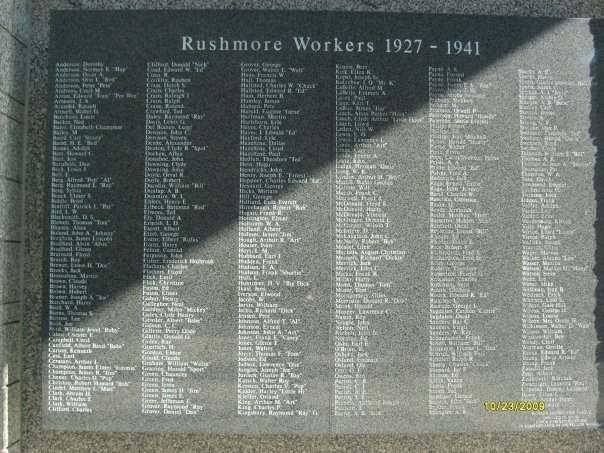
The chief carver of the mountain was Luigi Del Bianco, an artisan and stonemason who emigrated to the U.S. from Friuli in Italy and was chosen to work on this project because of his understanding of sculptural language and ability to imbue emotion in the carved portraits.
In 1933, the National Park Service took Mount Rushmore under its jurisdiction. Julian Spotts helped with the project by improving its infrastructure. For example, he had the tram upgraded so it could reach the top of Mount Rushmore for the ease of workers. By July 4, 1934, Washington's face had been completed and was dedicated. The face of Thomas Jefferson was dedicated in 1936, and Abraham Lincoln's on September 17, 1937. In 1937, a bill was introduced in Congress to add the head of civil-rights leader Susan B. Anthony, but a rider was passed on an appropriations bill requiring federal funds be used to finish only those heads that had already been started at that time. In 1939, the face of Theodore Roosevelt was dedicated.
The Sculptor's Studio – a display of unique plaster models and tools related to the sculpting – was built in 1939 under the direction of Borglum. Borglum died from an embolism in March 1941. His son, Lincoln Borglum, continued the project. Originally, it was planned that the figures would be carved from head to waist, but insufficient funding forced the carving to end. Borglum had also planned a massive panel in the shape of the Louisiana Purchase commemorating in 8 ft gilded letters the Declaration of Independence, U.S. Constitution, Louisiana Purchase, and seven other territorial acquisitions from the Alaska Purchase to the Panama Canal Zone. In total, the entire project cost US$989,992.32 (equivalent to $ in ).
Nick Clifford, the last remaining carver, died in November 2019 at age 98.
Later developments
Harold Spitznagel and Cecil Doty designed the original visitor center, finished in 1957, as part of the Mission 66 effort to improve visitors' facilities at national parks and monuments across the country. Ten years of redevelopment work culminated with the completion of extensive visitor facilities and sidewalks in 1998, such as a Visitor Center, the Lincoln Borglum Museum, and the Presidential Trail.
On October 15, 1966, Mount Rushmore was listed on the National Register of Historic Places. A 500-word essay giving the history of the United States by Nebraska student William Andrew Burkett was selected as the college-age group winner in a 1934 competition, and that essay was placed on the Entablature on a bronze plate in 1973.
Members of the American Indian Movement led an occupation of the monument in 1971, naming it "Mount Crazy Horse", and Lakota holy man John Fire Lame Deer planted a prayer staff on top of the mountain. Lame Deer said that the staff formed a symbolic shroud over the presidents' faces "which shall remain dirty until the treaties concerning the Black Hills are fulfilled."
In 1991, President George H. W. Bush officially dedicated Mount Rushmore National Memorial. In 2004, Gerard Baker was appointed superintendent of the park, the first and so far only Native American in that role. Baker stated that he will open up more "avenues of interpretation", and that the four presidents are "only one avenue and only one focus."
Proposals to add additional faces
In 1937, when the sculpture was not yet complete, a bill in Congress supporting the addition of women's rights activist Susan B. Anthony failed. When the sculpture was completed in 1941, the sculptors said that the remaining rock was not suitable for additional carvings. This stance was shared by RESPEC, an engineering firm charged with monitoring the stability of the rock in 1989. Proposals of additional sculptures include John F. Kennedy after his assassination in 1963, and Ronald Reagan in 1985 and 1999 – the latter proposal receiving a debate in Congress at the time. Barack Obama was asked about his own potential addition in 2008 and he joked that his ears were too large.
Donald Trump has expressed interest in his own addition to the mountain. During a 2017 rally in Ohio, Trump said, "I'd ask whether or not you some day think I will be on Mount Rushmore... If I did it joking, totally joking, having fun, the fake news media will say, 'He believes he should be on Mount Rushmore.' So I won't say it." South Dakota Governor Kristi Noem described the potential addition as Trump's "dream" in 2018. On January 28, 2025, Rep. Anna Paulina Luna (R-FL) introduced a bill, H.R. 792, in the House of Representatives to add Trump's likeness to the monument.
It is not possible to add another president to the memorial because the rock that surrounds the existing faces is not suitable for additional carving, and because additional sculpting could create instabilities in the existing carvings.
Black Hills land dispute
Main article: Black Hills land claim
The Black Hills, in which Mount Rushmore is situated, is the subject of a land claim by the Lakota people that both precedes the construction of the memorial and is ongoing. The Treaty of Fort Laramie (1868) had granted the Black Hills to the Lakota in perpetuity, but the United States took the area from the tribe after the Great Sioux War of 1876. The 1980 United States Supreme Court decision United States v. Sioux Nation of Indians ruled that the Sioux had not received just compensation for their land in the Black Hills. The court proposed $102 million as compensation for the loss of the Black Hills. However, the tribe has refused the settlement, arguing that this would amount to payment for land they never agreed to sell.
Crazy Horse Memorial
Construction on the Crazy Horse Memorial began in 1940 elsewhere in the Black Hills. Ostensibly to commemorate the Native American leader and as a response to Mount Rushmore, if completed it would be larger than Mount Rushmore. The Crazy Horse Memorial Foundation has rejected offers of federal funds. Its construction has the support of some Lakota chiefs, but it is the subject of controversy, even among Native American tribes.
National Memorial site description

The 1278 acre site of Mount Rushmore National Memorial extends northward from the sculptures to include the entirety of Mount Rushmore and half of Old Baldy Mountain, and southward to Grizzly Bear Creek, where it borders on the Black Elk Wilderness and has a trail connection to the South Dakota Centennial Trail. The main road through the park is South Dakota Highway 244, which branches off of U.S. Route 16A near the eastern entrance to the park, beyond which lies the town of Keystone. The National Memorial is bounded by Black Hills National Forest on all sides.
Mount Rushmore National Memorial is centered on the monumental sculptures, which are faced by a building and terrace complex that is designed to optimize viewing of the sculptures. A broad walkway known as Avenue of Flags is situated between the main parking lot, the park shops, and the Grand View Terrace. The walkway was added during the 1976 United States Bicentennial and is lined with the flags of all 50 current states, as well as the District of Columbia, three territories, and two commonwealths, arranged in alphabetical order.
At the end of the Avenue of Flags lies the Grand View Terrace (added in 1998, along with the amphitheater), which is designed to offer a prime vantage point for the sculptures. The terrace is built atop the Lincoln Borglum Visitor Center, which serves as a museum housing exhibits on the history of Mount Rushmore and its construction and on the presidents depicted in the sculpture. A large amphitheater extends below the museum and terrace and offers a place for seated viewing of the sculptures, as well as ranger talks, and is the central point for the memorial's evening program.
The Presidential Trail is a 0.6 mile loop trail that begins at and returns to the Visitor Center, and includes close views of the sculpture from the edge of Mount Rushmore's talus slope, as well as access to the Sculptor's Studio. The studio is connected to the Visitor Center by a series of long stairways (160 and 262 steps, respectively) with the Borglum Viewing Terrace between the two. The Sculptor's Studio, built in 1939, was Gutzon Borglum's second on-site studio. It was kept intact after the 1941 opening of the memorial to showcase Borglum's models, tools, and working effects and to house exhibits on the techniques used in build the sculptures.
An additional scenic viewpoint can be found farther away from the main memorial complex, to the west, along Highway 244. The spot is known as Profile View, and as the name suggests, offers a profile view of the sculptures. U.S. Route 16A, known locally as Iron Mountain Road, routes through the hills east of the park and offers more distant viewpoints at several key points along its route, such as the Doane Robinson Tunnel and Norbeck Overlook.
|File:Mount_Rushmore_South_Dakota_-2.jpg |Avenue of Flags |File:Photo_of_a_display_in_the_Exhibit_Hall_with_blacksmith_equipment_on_the_right,a_piece_of_honeycombed_granite_in_the_center_and(f50a806c-155d-4519-3e8c-b63c3fcd8ceb).jpg |Exhibit, Borglum Visitor Center|File:Mount_Rushmore_-_panoramio.jpg |Amphitheater and sculptures|File:Sculptors_Studio_Interior_Mt_Rushmore_2024.jpg| Sculptor's Studio|File:Washington_on_Mt_Rushmore_9-2019.jpg|Close up view of George Washington, Presidential Trail|File:The_Top_of_Mt._Rushmore_looking_out.JPG|Memorial complex, as seen from Mount Rushmore.}}
Hall of Records

Borglum originally envisioned a grand Hall of Records where America's greatest historical documents and artifacts, including the United States Constitution and Declaration of Independence, could be protected and exhibited for visitors. The Hall of Records was to be located in a vault that was cut into the interior of the mountain, with an entrance near the top, behind the presidential heads. Borglum envisioned the construction of a long series of stairways that would lead up the side of Mount Rushmore to the vault's entrance.
Borglum and his workers managed to start the project, beginning a vault high on Mount Rushmore, in a crag behind the Abraham Lincoln figure. However, they only managed to cut about 70 feet into the rock, before work stopped in 1939 to focus on the heads. No further work on the Hall of Records was carried out after completion of the statues in 1941. No trail was ever built to the uncompleted vault and because of the general policy of keeping visitors away from the mountaintop, the vault has been off-limits to the public, except for a few individuals who have been allowed to document the site while accompanied by park rangers.
In 1998, a stone time capsule was constructed inside the mouth of the cave housing 16 enamel panels with biographical and historical information about Mount Rushmore, as well as the texts of the documents Borglum wanted to preserve there. The repository consists of a teakwood box inside of a titanium vault placed in the ground with an engraved granite capstone. The capstone is typically covered by a wooden lid to further protect it from the elements.
Monument conservation
The ongoing conservation of the site is overseen by the National Park Service. Maintenance of the memorial requires mountain climbers to monitor and seal cracks annually. Due to budget constraints, the memorial is not regularly cleaned to remove lichens. However, in 2005 Alfred Kärcher, a German manufacturer of pressure washing and steam cleaning machines, conducted a free cleanup operation which lasted several weeks, using pressurized water at over 200 F. Other efforts to conserve the monument have included replacement of the sealant applied originally to cracks in the stone by Gutzon Borglum, which had proved ineffective at providing water resistance. The components of Borglum's sealant included linseed oil, granite dust, and white lead, but a modern silicone replacement for the cracks is now used, disguised with granite dust.
In 1998, electronic monitoring devices were installed to track movement in the topology of the sculpture to an accuracy of 0.12 in. The site was digitally recorded in 2009 using a terrestrial laser scanning method as part of the international Scottish Ten project, providing a high-resolution record to aid the conservation of the site. This data was made publicly accessible online.
Geology
Mount Rushmore is largely composed of granite. The memorial is carved on the northwest margin of the Black Elk Peak granite batholith in the Black Hills of South Dakota, so the geologic formations of the heart of the Black Hills region are also evident at Mount Rushmore. The batholith magma intruded into the pre-existing mica schist rocks during the Proterozoic, 1.6 billion years ago. Coarse grained pegmatite dikes are associated with the granite intrusion of Black Elk Peak and are visibly lighter in color, thus explaining the light-colored streaks on the foreheads of the presidents.
The Black Hills granites were exposed to erosion during the Neoproterozoic, but were later buried by sandstone and other sediments during the Cambrian. Remaining buried throughout the Paleozoic, they were re-exposed again during the Laramide orogeny around 70 million years ago. Subsequent erosion stripped the granite of the overlying sediments and the softer adjacent schist. Some schist does remain and can be seen as the darker material just below the sculpture of Washington.
The tallest mountain in the region is Black Elk Peak (7,242 ft). Borglum selected Mount Rushmore as the site for several reasons. The rock of the mountain is composed of smooth, fine-grained granite. The durable granite erodes only 1 in every 10,000 years, thus was more than sturdy enough to support the sculpture and its long-term exposure. The mountain's height of 5725 ft above sea level made it suitable, and because it faces the southeast, the workers also had the advantage of sunlight for most of the day.
Soils and hydrology
The Mount Rushmore area is underlain by well drained alfisol soils of very gravelly loam (Mocmount) to silt loam (Buska) texture, brown to dark grayish brown.
The area receives about 18 in of precipitation on average per year, enough to support abundant animal and plant life. Trees and other plants help to control surface runoff. Dikes, seeps, and springs help to dam up water that is flowing downhill, providing watering spots for animals. In addition, stones like sandstone and limestone help to hold groundwater, creating aquifers.
Climate
Mount Rushmore has a dry-winter humid continental climate (Dwb in the Köppen climate classification). The two wettest months of the year are May and June. Orographic lift causes brief but strong afternoon thunderstorms during the summer.{{Weather box |Jan record high F = 70 |Feb record high F = 68 |Mar record high F = 78 |Apr record high F = 85 |May record high F = 93 |Jun record high F = 99 |Jul record high F = 100 |Aug record high F = 99 |Sep record high F = 97 |Oct record high F = 86 |Nov record high F = 75 |Dec record high F = 68 |year record high F = 100
|Jan avg record high F = 57.8 |Feb avg record high F = 57.3 |Mar avg record high F = 65.2 |Apr avg record high F = 72.9 |May avg record high F = 81.5 |Jun avg record high F = 89.2 |Jul avg record high F = 92.7 |Aug avg record high F = 90.9 |Sep avg record high F = 87.2 |Oct avg record high F = 77.0 |Nov avg record high F = 65.4 |Dec avg record high F = 57.2 |year avg record high F = 94.0
|Jan avg record low F = -5.8 |Feb avg record low F = -4.2 |Mar avg record low F = 3.8 |Apr avg record low F = 15.3 |May avg record low F = 26.9 |Jun avg record low F = 39.8 |Jul avg record low F = 48.1 |Aug avg record low F = 45.9 |Sep avg record low F = 32.2 |Oct avg record low F = 17.2 |Nov avg record low F = 6.8 |Dec avg record low F = -2.2 |year avg record low F = -12.6
|Jan record low F = −38 |Feb record low F = −29 |Mar record low F = −16 |Apr record low F = 1 |May record low F = 14 |Jun record low F = 27 |Jul record low F = 40 |Aug record low F = 33 |Sep record low F = 19 |Oct record low F = −4 |Nov record low F = −12 |Dec record low F = −31 |year record low F = −38
Biodiversity and ecology
Mount Rushmore falls within the EPA ecoregion of the Black Hills Plateau (17b), an extension of the Middle Rockies ecoregion (17) that is entirely surrounded by the Northwestern Great Plains ecoregion (43).
Flora and fauna

The flora and fauna of Mount Rushmore are similar to those of the rest of the Black Hills region of South Dakota. The forested areas of the park are largely composed of ponderosa pine, with the majority of it consisting of old-growth stands. Other tree species are found individually or in small groves and include quaking aspen, bur oak, white spruce, and paper birch. Nine species of shrubs grow near Mount Rushmore. There are also a wide variety of wildflowers, including common blanketflower, common sunflower, purple coneflower, upright prairie coneflower, pale agoseris, sawsepal penstemon, Lewis flax, purple prairie clover, wild bergamot, and hoary vervain. Towards higher elevations, plant life becomes sparser.
Avibase lists 154 species of birds as occurring within the park. Common birds include turkey vultures, red-tailed hawks, red-naped sapsuckers, white-breasted nuthatches, mountain bluebirds, and dark-eyed juncos. Herps found in the park include western chorus frogs and northern leopard frogs, along with several species of snake. Grizzly Bear Creek and Starling Basin Creek, the two streams in the memorial, support fish such as longnose dace and brook trout.

Mountain goats are a common sight in the park, but are not native fauna. They are descendants of a herd that the Canadian government gifted to Custer State Park in 1924, which later escaped and are now widespread through the Black Hills. Common native terrestrial mammals include mule deer, yellow-bellied marmots, American red squirrels, least chipmunks, and eastern and white-footed deer mice. Coyotes and northern flying squirrels are also occasionally seen. The monument is also an important habitat for bats, and 11 species of bats have been reported from the park, including silver-haired and hoary bats and the endangered northern myotis. The fungus causing white-nose syndrome in bats has not been detected in the park, but has been detected at the nearby Badlands National Park.
Forest ecology
A 2007 study found that almost two-thirds of the park's acreage (850 acre) consisted of old-growth ponderosa pine forest, and of this 44% had no history of logging at all. This is unusual in the Black Hills, which has been heavily logged in the years since Euroamerican settlement, and represents one of the largest contiguous area of old-growth forest in the Black Hills, second only to Custer State Park. Forest fires occur in the ponderosa forests surrounding Mount Rushmore with a mean interval of every 27 years, as indicated by dendrochronology studies of local trees. Large fires are not common. Most events have been ground fires that serve to clear forest debris.
A 2010 article by a National Park Service fire ecologist notes that due to historical fire suppression policies in and around the park, much of the park's forested area had become overgrown with small understory trees that could serve as fuel for a large forest fire. The article recommended a regime of mechanical thinning and woodchipping followed by prescribed burning to mitigate the fire hazard, as well as to make the forest more resilient against pine beetle infestation and to restore the natural stand structure in these woodlands.
Environmental issues
A 2016 investigation by the U.S. Geological Survey found unusually high concentrations of perchlorate in the surface water and groundwater of the area. A sample collected from a stream had a maximum perchlorate concentration of 54 micrograms per liter, roughly 270 times higher than samples taken from locations outside the area. The report concluded the probable cause of the contamination was the aerial fireworks displays that had taken place on Independence Days from 1998 to 2009. The National Park Service also reported that at least 27 forest fires around Mount Rushmore in that same period (1998 to 2009) have been caused by fireworks displays. Nevertheless, an environmental impact assessment issued in 2020 left room for the possibility of returning fireworks to the memorial in the future.
Recreation
The centerpiece of the park is the monument and viewing the monument and associated activities is the main attraction of the National Memorial. However, the larger 1278 acre park includes natural areas beyond the memorial itself.
Rock climbing and bouldering are popular activities within the park and nearby areas, though climbing anywhere close to the statues is prohibited and carries legal penalties. However, areas to the north of the memorial are popular climbing areas, and include the face of Mount Rushmore opposite the statues and the neighboring peak Old Baldy Mountain, as well as numerous other needles, peaks, and boulders. Noted climbers Jan and Herb Conn pioneered many climbing routes in this area in the 1940s and eventually came to make their home in the Black Hills in 1949. The area has over 800 climbing routes today, most requiring a high degree of technical skill.
The best-known walking trail in the park is the Presidential Trail, near to the main memorial complex. However, there are also two hiking trails that are found in more remote areas of the park. The Blackberry Trail extends from just across from the main parking lot through the southern part of the park and into the Black Elk Wilderness, connecting to the Centennial Trail about 0.8 mile from the trailhead. There is also a trail to the top of Old Baldy Mountain at the northern edge of the park. The trail begins at the Wrinkled Rock trailhead, just outside of the west entrance to the park and most of its course is outside of the boundaries of the National Memorial. It leads to the summit of Old Baldy after 1.5 mile, where there is a panoramic view of the Black Hills from the summit. However, only the backside of Mount Rushmore is in the line of sight from the summit and the statues cannot be seen.
Camping is not allowed within the boundaries of the National Memorial, however, there are public and private campgrounds and dispersed camping in the neighboring Black Hills National Forest.
Tourism
| Year | Visitors |
|---|---|
| 1941 | 393,000 |
| 1950 | 740,499 |
| 1960 | 1,067,000 |
| 1970 | 1,965,700 |
| 1980 | 1,284,888 |
| 1990 | 1,671,673 |
| 2000 | 1,868,876 |
| 2010 | 2,331,237 |
| 2020 | 2,074,986 |
Tourism is South Dakota's second-largest industry, and Mount Rushmore is the state's top tourist attraction. A total of 2,440,449 people visited the park in 2022.
The popularity of the location, as with many other national monuments, derives from its immediate recognizability; "there are no substitutes for iconic resources such as the Statue of Liberty, the Lincoln Memorial, or Mount Rushmore. These locations are one of a kind places".
In the 1950s and 1960s, local Lakota Sioux elder Benjamin Black Elk (son of medicine man Black Elk, who had been present at the Battle of the Little Bighorn) was known as the "Fifth Face of Mount Rushmore", posing for photographs with thousands of tourists daily in his native attire. The South Dakota State Historical Society notes that he was one of the most photographed people in the world over that 20-year period.
Legacy and commemoration

Borglum titled his sculpture at Mount Rushmore as the Shrine of Democracy, but the illegal seizure of the Black Hills where the memorial is located has led to some critics to refer to it as the "Shrine of Hypocrisy".
On August 11, 1952, the U.S. Post Office issued the Mount Rushmore Memorial 3-cent commemorative stamp on the 25th anniversary of the dedication of the Mount Rushmore National Memorial. On January 2, 1974, a 26-cent airmail stamp depicting the monument was also issued. In 1991 the United States Mint released commemorative silver dollar, half-dollar, and five-dollar coins celebrating the 50th anniversary of the monument's dedication, and the sculpture was the main subject of the 2006 South Dakota state quarter.
In music, American composer Michael Daugherty's 2010 piece for chorus and orchestra, "Mount Rushmore", depicts each of the four presidents in separate movements. The piece sets texts by George Washington, William Billings, Thomas Jefferson, Maria Cosway, Theodore Roosevelt, and Abraham Lincoln. By contrast, the song, "Little Snakes", by Protest The Hero, "addresses the violent colonial history involved in the sculpting of Mount Rushmore", critiquing the monument as a symbol of colonialism, referencing the genocide of indigenous peoples and the ownership of slaves by George Washington and Thomas Jefferson.
The Washington Nationals baseball club uses large foam rubber depictions of the "Rushmore Four" in both their marketing campaigns and in a series of in-stadium promotions such as the Presidents Race.
In popular culture
Main article: Mount Rushmore in popular culture
.jpg)
Mount Rushmore has been depicted in multiple films, comic books, and television series. Its functions vary from settings for action scenes to the site of hidden locations. Its most famous appearance is as the location of the final chase scene in the 1959 film North by Northwest. It is used as a secret base of operations by the protagonists in the 2004 film Team America: World Police, and the secret underground city of Cíbola is located there in the 2007 film National Treasure: Book of Secrets. In the Phineas and Ferb episode Candace Loses Her Head, both Phineas and Ferb sculpt Candace's face on the monument for her 15th birthday. In some films, the presidential faces are replaced with others; examples include the 1980 film Superman II and the 1996 film Mars Attacks! where the villains add their faces to the monument, and the 2003 film Head of State where the newly elected president's face is added. In works showing attacks on landmarks to signify the scope of a threat, Mount Rushmore is a common target; examples include the aforementioned facial replacements in Superman II and Mars Attacks! as well as natural disasters in works like the 2006 miniseries 10.5: Apocalypse and terrorist attacks as in the 1997 film The Peacekeeper. An atypical representation of the monument appears in the 2013 film Nebraska, where instead of being treated with reverence it is criticized for being unfinished.
References
References
- . ["Annual Park Ranking Report for Recreation Visits in: 2022"](https://irma.nps.gov/Stats/SSRSReports/National%20Reports/Annual%20Park%20Ranking%20Report%20(1979%20-%20Last%20Calendar%20Year)). *National Park Service*.
- Rosenberg, Jennifer. (January 16, 2021). "10 Things You Didn't Know About Mount Rushmore".
- Roberts, Sam. (June 28, 2016). "An Immigrant's Contribution to Mount Rushmore Is Recognized, 75 Years Later". [[The New York Times]].
- Andrews, John. (May 2014). "Slight of Hand".
- [http://www.mountrushmoreinfo.com/ Mount Rushmore National Memorial] {{Webarchive. link. (August 23, 2017 . December 6, 2005.60 SD Web Traveler, Inc. Retrieved April 7, 2006.)
- "Why These Four Presidents?". National Park Service.
- McGeveran, William A. Jr. et al. (2004). ''The World Almanac and Book of Facts 2004''. New York: World Almanac Education Group, Inc. {{ISBN. 0-88687-910-8.
- "[http://www.peakbagger.com/peak.aspx?pid=6234 Mount Rushmore, South Dakota]". Peakbagger.com. Retrieved March 13, 2006.
- ''!'', episode 5x08 "Mount Rushmore", May 10, 2007.
- "Making Mount Rushmore | Mount Rushmore". Oh, Ranger!.
- Pekka Hamalainen, ''Lakota America, a New History of Indigenous Power'' (New Haven: Yale University Press, 2019), p. 382.
- "Senator Peter Norbeck". PBS.
- "Complete Program Transcript . Mount Rushmore". PBS.
- (July 1, 1980). "Sioux Win $105 Million". The Washington Post.
- (1999). "The Politics of Hallowed Ground: Wounded Knee and the Struggle for Indian Sovereignty". [[University of Illinois Press]].
- McKeever, Amy. (October 28, 2020). "South Dakota's Mount Rushmore has a strange, scandalous history". [[National Geographic]].
- Harmanşah, Ömür. (2015). "Place, Memory, and Healing: An Archaeology of Anatolian Rock Monuments". [[Routledge]].
- Morton, Mary Caperton. (September 3, 2020). "Mount Rushmore's Six Grandfathers and Four Presidents". [[Eos (magazine).
- Neihardt, John Gneisenau. (1985). "The Sixth Grandfather: Black Elk's Teachings Given to John G. Neihardt". [[University of Nebraska Press]].
- Saum, Bradley. (2017). "Black Elk Peak: A History". [[Arcadia Publishing]].
- Saum, Bradley. (2017). "Black Elk Peak: A History". [[Arcadia Publishing]].
- Saum, Bradley. (2017). "Black Elk Peak: A History". [[Arcadia Publishing]].
- (2023-03-28). "Charles E. Rushmore".
- Fite, Gilbert C.. (1975). "Gutzon Borglum: Mercurial Master of Colossal Art". [[Montana: The Magazine of Western History]].
- (November 29, 2022). "Timeline – Mount Rushmore National Memorial".
- (January 25, 2023). "Doane Robinson".
- Fite, Gilbert C.. (1975). "Gutzon Borglum: Mercurial master of colossal art". Montana: The Magazine of Western History.
- Freeman, John F. (2015). "Black Hills Forestry: A History". University Press of Colorado.
- Taliaferro, John. (2002). "Great White Fathers: The Story of the Obsessive Quest to Create Mount Rushmore". PublicAffairs.
- Smith, Rex Alan. (1985). "The Carving of Mount Rushmore". Abbeville Press.
- (1925-04-29). "Oppose Borglum's project". The Sioux City Journal.
- Ostler, Jeffrey. (2010). "The Lakotas and the Black Hills: The Struggle for Sacred Ground". Penguin.
- (August 2, 2004). "Carving History". National Park Service.
- Michael Patrick Cullinane. (2017). "Theodore Roosevelt's Ghost: The History and Memory of an American Icon". LSU Press.
- "People & Events: The Carving of Stone Mountain". PBS.
- "Norbeck Seeks Borglum." Lincoln (NE) Journal-Star, March 7, 1925, 1.
- "New Offer Made to Sculptor Borglum" Nashville Manner, March 8, 1925, 8.
- Saum, Bradley. (2017). "Black Elk Peak: A History". Arcadia Publishing.
- Boime, Albert. "Patriarchy Fixed in Stone: Gutzon Borglum's 'Mount Rushmore'". American Art 5:1–2 (Winter–Spring 1991), 142–167.
- (May 23, 2022). "Historical Letters and Legislation".
- (May 23, 2022). "Memorial History".
- "Rare Photos From The Past".
- "Carving History". National Park Service.
- (June 14, 2004). "Honeycombing process explained from". nps.gov.
- (January 4, 2005). "Geology Fieldnotes". nps.gov.
- "Frequently Asked Questions". National Park Service.
- Thiessen, Michael. (nd). "Mount Rushmore National Memorial, South Dakota, United States".
- [https://www.pbs.org/wgbh/amex/rushmore/timeline/timeline2.html American Experience] {{Webarchive. link. (November 14, 2012 "Timeline: Mount Rushmore" (2002). Retrieved March 20, 2006.)
- (July 7, 1939). "Remember Stone Mountain's Mighty Memorial?". The Atlanta Constitution.
- link. (December 3, 2013 .)
- Boime, Albert. (Winter–Spring 1991). "Patriarchy Fixed in Stone: Gutzon Borglum's 'Mount Rushmore'". [[American Art (journal).
- [http://iml.jou.ufl.edu/projects/students/Ahmann/rushmore.html Mount Rushmore National Memorial] {{Webarchive. link. (February 24, 2006 . Tourism in South Dakota. Laura R. Ahmann. Retrieved March 19, 2006.)
- Reagan, Nick. (November 23, 2019). "Last carver of Mount Rushmore dies at 98".
- Lathrop, Alan K.. (Winter 2007). "Designing for South Dakota and the Upper Midwest: The Career of Architect Harold T. Spitznagel, 1930—1974". South Dakota History.
- Allaback, Sarah. (2000). "Mission 66 Visitor Centers: The History of a Building Type".
- "Text of 1934 Essay – History of the United States".
- Matthew Glass, "Producing Patriotic Inspiration at Mount Rushmore", ''Journal of the American Academy of Religion'', Vol. 62, No. 2. (Summer, 1994), pp. 265–283.
- (July 3, 1991). "George Bush: Remarks at the Dedication Ceremony of the Mount Rushmore National Memorial in South Dakota". The American Presidency Project.
- David Melmer. (December 13, 2004). "Historic changes for Mount Rushmore". Indiancountrytoday.
- (March 1, 1999). "World: Americas Reagan for Rushmore". BBC.
- Lawrence, Tom. (June 26, 2020). "Adding fifth face to Mount Rushmore National Memorial has been political football for decades". USA Today Network.
- (July 25, 2017). "Trump: 'I won't say' that I should be on Mount Rushmore". The Hill.
- Ehrlich, Jamie. (August 9, 2020). "New York Times: White House reached out to South Dakota governor about adding Trump to Mount Rushmore". CNN.
- (January 28, 2025). "H.R.792 – To direct the Secretary of the Interior to arrange for the carving of the figure of President Donald J. Trump on Mount Rushmore National Memorial". U.S. Congress.
- Klinski, Michael. (April 24, 2018). "Mount Trumpmore? It's the president's 'dream,' Rep. Kristi Noem says".
- "United States v. Sioux Nation of Indians, 448 U.S. 371 (1980)".
- (May 12, 2015). "Significant Indian Cases". United States Government.
- (2011-08-24). "Why the Sioux are refusing $1.3 billion". PBS NewsHour.
- Lame Deer, John (Fire) and Richard Erdoes. ''Lame Deer Seeker of Visions''. Simon and Schuster, New York, 1972. Paperback {{ISBN. 0-671-55392-5
- (nd). "Avenue of Flags, Mount Rushmore National Memorial".
- (nd). "Grand View Terrace, Mount Rushmore National Memorial".
- (nd). "Lincoln Borglum Visitor Center".
- (nd). "Mount Rushmore National Memorial Amphitheater".
- (nd). "Presidential Trail, Mount Rushmore National Memorial".
- (nd). "Borglum View Terrace, Mount Rushmore National Memorial".
- (nd). "Sculptor's Studio, Mount Rushmore National Memorial".
- (nd). "Profile View, Mount Rushmore National Memorial".
- (2025-02-19). "Black Hills National Forest: Norbeck Overlook".
- (nd). "Iron Mountain Road (North Entrance), Mount Rushmore National Memorial".
- What's Inside?. (2020-06-25). "What's inside Mount Rushmore?".
- (June 14, 2004). "Hall of Records". National Park Service.
- "Hall of Records". U.S. National Park Service.
- "Caring for a Monumental Sculpture". National Park Service.
- (January 30, 2023). "Preservation".
- (July 11, 2005). "For Mount Rushmore, An Overdue Face Wash". [[The Washington Post]].
- "Preservation – Mount Rushmore National Memorial". National Park Service.
- "Mount Rushmore National Memorial". CyArk.
- [https://web.archive.org/web/20080616091103/http://www.nps.gov/archive/moru/pphtml/subenvironmentalfactors13.html Geologic Activity]. National Park Service.
- The Black Hills area was uplifted as an elongated geologic dome.Irvin, James R. [http://www.holoscenes.com/gallery5.html Great Plains Gallery] {{Webarchive. link. (July 20, 2006 (2001). Retrieved March 16, 2006.)
- "SoilWeb: An Online Soil Survey". [[University of California, Davis]].
- [https://web.archive.org/web/20070312115239/http://www.nps.gov/archive/moru/pphtml/subnaturalfeatures25.html Nature & Science- Groundwater]. National Park Service. Retrieved April 1, 2006.
- (June 23, 2004). "Weather History". National Park Service, U.S. Department of the Interior.
- (1998). "Map of Level III and Level IV ecoregions in North Dakota and South Dakota". US Environmental Protection Agency.
- (2015-11-25). "Ecoregions of North America".
- (2007). "Conservation value of Mount Rushmore National Memorial's forest". Natural Areas Journal.
- (2008). "Fire and forest history at Mount Rushmore". Ecological Applications.
- (nd). "Wildflowers". US National Park Service.
- "Mount Rushmore National Memorial: Flora and fauna".
- Lepage, Denis. (2025). "Mount Rushmore National Memorial bird checklist".
- (nd). "Birds". US National Park Service.
- (nd). "Birds at Mount Rushmore".
- (nd). "Amphibians". US National Park Service.
- (nd). "Mammals". US National Park Service.
- (2004-12-31). "Inventory of mammals at ten National Park Service units in the Northern Great Plains from 2002-2004". Northern Great Plains Inventory & Monitoring Network, US National Park Service.
- (August 2012). "Flying squirrel distribution and habitat use at Mount Rushmore National Memorial". US National Park Service (NPS Natural Resource Technical Report. NPS/MORU/NRTR 2012/607).
- Licht, Daniel S. (2019). "Bat acoustic monitoring at Mount Rushmore National Memorial".
- (nd). "Forests". US National Park Service.
- Wienk, Cody. (2010). "Management of ponderosa pine forest at Mount Rushmore National Memorial using thinning and prescribed fire". Park Science.
- (2016). "Scientific Investigations Report". US Geological Survey (Scientific Investigations Report 2016-5030).
- (May 2, 2016). "Fireworks Likely Caused Water Contamination at Mount Rushmore". United States Geological Survey.
- (May 3, 2016). "Mt. Rushmore H2O pollution: Fireworks to blame?". WGBA.
- (May 3, 2016). "Officials knew fireworks at Mount Rushmore could cause a fire. But they didn't expect this.". The Washington Post.
- (July 3, 2020). "50 Years After Mount Rushmore Occupation, Native Americans Are 'Still Fighting'".
- (February 2020). "Mount Rushmore National Memorial Independence Day holiday fireworks event: Environmental assessment". US National Park Service, Planning, Environment and Public Comment (PEPC).
- (nd). "Safety". US National Park Service.
- Burr, Andrew. (2012-05-16). "Monumental". Outside Inc.
- Higbee, Paul. (2012-02-01). "Explorers of an unseen world".
- (2012). "The Needles of Rushmore: Climbing in and Around South Dakota's Mt Rushmore National Memorial". Fixed Pin Publishing.
- (nd). "Hiking The Blackberry Trail, Mount Rushmore National Memorial".
- Zimny, Michael. (2020-09-09). "The Black Hills' other Old Baldy".
- (nd). "Hike to Old Baldy Mountain".
- (nd). "Eating & Sleeping". US National Park Service.
- (nd). "Camping". US National Park Service.
- (nd). "Black Hills National Forest: Camping & Cabins".
- "Popular South Dakota Attractions >>South Dakota". southdakota.com.
- Thomas J. Liu, John B. Loomis, and Linda J. Bilmes, "[https://books.google.com/books?id=rgiiDwAAQBAJ&pg=PT88 Exploring the contribution of National Parks to the entertainment industry's intellectual property]", in Linda J. Bilmes and John B. Loomis, ''Valuing U.S. National Parks and Programs: America's Best Investment'' (Routledge, 2020), [https://books.google.com/books?id=RT33DwAAQBAJ&pg=PA95 p. 95–98].
- Kilen Ode, Jeanne. (1984). "Dakota Images: Benjamin Black Elk". [[South Dakota State Historical Society]].
- Hoople, Robin. (December 1, 2006). "Great Stone Faces: Henry James, Theodore Roosevelt, and the Quest for American Authenticity". [[Canadian Review of American Studies]].
- Louie, Clarence. (November 16, 2021). "Rez Rules: My Indictment of Canada's and America's Systemic Racism Against Indigenous Peoples". [[McClelland & Stewart]].
- Estes, Nick. (February 26, 2019). "Our History Is the Future: Standing Rock Versus the Dakota Access Pipeline, and the Long Tradition of Indigenous Resistance". [[Verso Books]].
- "3c Mt. Rushmore single". Smithsonian National Postal Museum.
- (1981). "Scotts United States Stamp catalogue, 1982". Scott's Publishing Company.
- (June 10, 2009). "1991 Mount Rushmore Silver Dollar".
- (June 9, 2009). "1991 Mount Rushmore Half Dollar Commemorative Coin".
- (June 11, 2009). "1991 Mount Rushmore $5 Gold Commemorative Coin".
- Jim Noles, ''A Pocketful of History: Four Hundred Years of America—One State Quarter at a Time" (Da Capo Press, May 6, 2008) {{ASIN. B009K44LT8.''
- [http://www.boosey.com/cr/news/Michael-Daugherty-s-Mount-Rushmore-Premieres-with-the-Pacific-Symphony-and-Chorale/11964 "Michael Daugherty's Mount Rushmore Premieres with the Pacific Symphony and Chorale"] Retrieved August 27, 2014.
- Rolli, Bryan. (June 16, 2020). "Protest the Hero's Rody Walker: Trump's Vision of Greatness Is America's 'Tragic Flaw'".
- Slingerland, Calum. (June 18, 2020). "Protest the Hero Give American History a Scathing Rewrite on 'Palimpsest'".
- (October 21, 2019). "The history of the Nationals Presidents Race: Who is winning and why".
- . (October 3, 2012). ["'Teddy' wins for 1st time in 534 races"](https://www.espn.com/mlb/story/_/id/8457719/teddy-mascot-wins-washington-nationals-presidents-race). *[[ESPN]]*.
- Gunderson, Jessica. (July 1, 2014). "Mount Rushmore: Myths, Legends, and Facts". Capstone.
- Knight, Gladys L.. (August 11, 2014). "Pop Culture Places: An Encyclopedia of Places in American Popular Culture [3 volumes]". ABC-CLIO.
- Powell, Laura. "Mount Rushmore on the Big Screen".
- Freund, Charles Paul. (2003). "Big schlock candy Mountain: the many meanings of Mount Rushmore".
- "9 Famous Pop Culture Spots in the USA You Don't Want to Miss".
- Honeycutt, Kirk. (October 15, 2019). "'Team America: World Police': THR's 2004 Review".
- (December 30, 2015). "The subversive non-subversiveness of "Phineas and Ferb"".
- Doss, Erika. (September 7, 2012). "Memorial Mania: Public Feeling in America". University of Chicago Press.
- Walter Metz, "[https://muse.jhu.edu/article/565609 Review: Nebraska. Dir. Alexander Payne. Paramount Vantage, 2013]". ''Middle West Review'' Volume 1, Number 1, (University of Nebraska Press, Fall 2014), p. 154–55.
This article was imported from Wikipedia and is available under the Creative Commons Attribution-ShareAlike 4.0 License. Content has been adapted to SurfDoc format. Original contributors can be found on the article history page.
Ask Mako anything about Mount Rushmore — get instant answers, deeper analysis, and related topics.
Research with MakoFree with your Surf account
Create a free account to save articles, ask Mako questions, and organize your research.
Sign up freeThis content may have been generated or modified by AI. CloudSurf Software LLC is not responsible for the accuracy, completeness, or reliability of AI-generated content. Always verify important information from primary sources.
Report