From Surf Wiki (app.surf) — the open knowledge base
Mount Kilimanjaro
Mountain in Tanzania, highest in Africa
Mountain in Tanzania, highest in Africa
| Field | Value |
|---|---|
| fetchwikidata | ALL |
| photo | Kilimanjaro from Amboseli.jpg |
| photo_caption | Kilimanjaro from Amboseli National Park, Kenya |
| name | Mount Kilimanjaro |
| map | Tanzania#Africa#World |
| map_caption | Kilimanjaro's location in Tanzania |
| location | Kilimanjaro Region, Tanzania |
| label_position | right |
| elevation_ref | |
| prominence_ref | |
| Ranked 4th | |
| listing | |
| range | The Eastern Rift mountains |
| coordinates | |
| topo | Kilimanjaro map and guide by Wielochowski |
| formed_by | Volcanism along the Gregory Rift |
| type | Stratovolcano |
| age | 4 million years |
| last_eruption | Between 150,000 and 200,000 years ago |
| first_ascent | 6 October 1889 by Hans Meyer and Ludwig Purtscheller |
Ranked 4th
Mount Kilimanjaro () is a large dormant volcano in Tanzania. It is the highest mountain in Africa and the highest free-standing mountain above sea level in the world, at 5,895 m above sea level and 4900 m above its plateau base. It is also the highest volcano in the Eastern Hemisphere and the fourth most prominent peak on Earth.
Kilimanjaro's southern and eastern slopes served as the home of the Chagga Kingdoms until their abolition in 1963 by Julius Nyerere. The origin and meaning of the name Kilimanjaro is unknown, but may mean "mountain of greatness" or "unclimbable". Although described in classical sources, German missionary Johannes Rebmann is credited as the first European to report the mountain's existence, in 1848. After several European attempts, Hans Meyer reached Kilimanjaro's highest summit in 1889.
The mountain was incorporated into Kilimanjaro National Park in 1973. As one of the Seven Summits, Kilimanjaro is a major hiking and climbing destination. There are seven established routes to Uhuru Peak, the mountain's highest point. Although not as technically challenging as similar mountains, the prominence of Kilimanjaro poses a serious risk of altitude sickness.
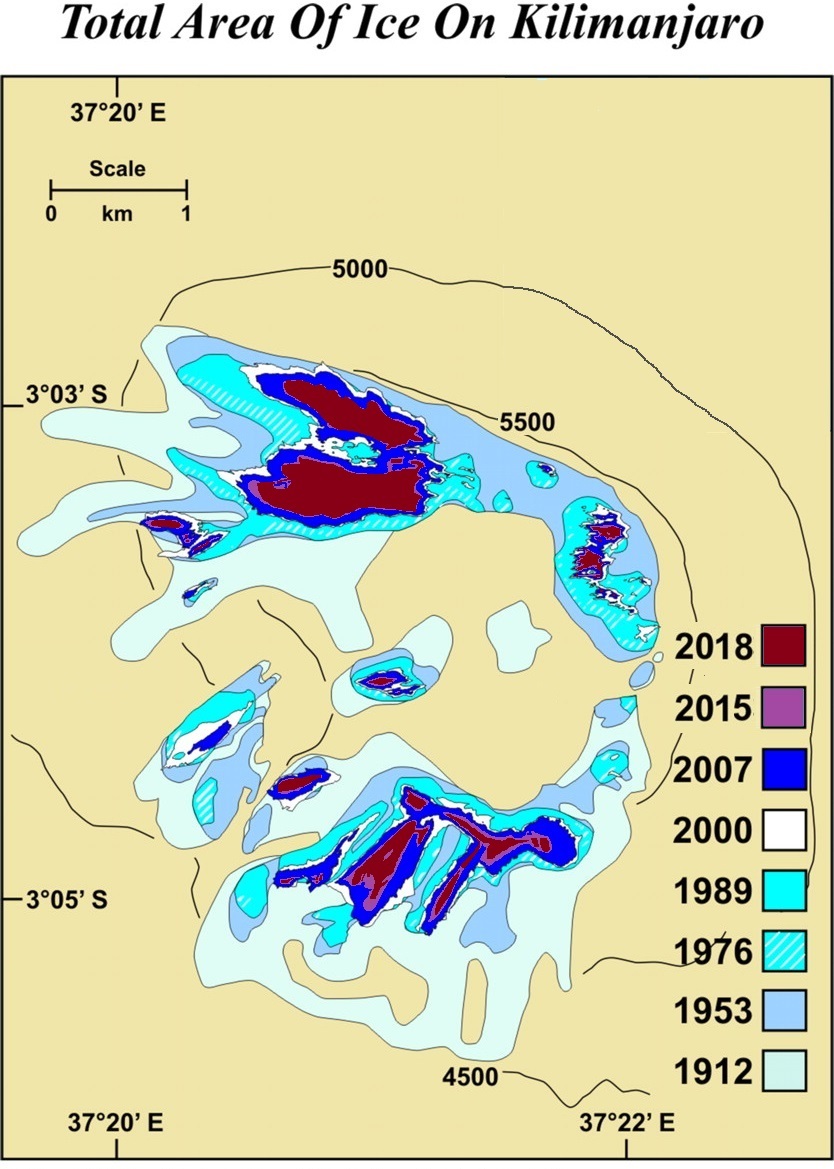
One of several mountains arising from the East African Rift, Kilimanjaro was formed from volcanic activity over 2 million years ago. Its slopes host montane forests and cloud forests. Multiple species are endemic to Mount Kilimanjaro, including the giant groundsel Dendrosenecio kilimanjari. The mountain possesses a large ice cap and the largest glaciers in Africa, including Credner Glacier, Furtwängler Glacier, and the Rebmann Glacier. This ice cap is rapidly shrinking, with over 80% lost in the 20th century. The cap is projected to disappear entirely by the mid-21st century.
Toponymy
The origin and meaning of the name Kilimanjaro is disputed. Although the Chagga people of the Kilimanjaro Region have no name for the mountain, they call its two peaks Kipoo and Kimawenze. The peaks' names—usually rendered Kibo and Mawenzi—mean "spotted" in reference to Kibo's snow and "broken top" due to Mawenzi's jagged peak. "Kilimanjaro" may originate from the Chagga calling the mountain unclimbable—kilemanjaare or kilemajyaro—and explorers misinterpreting this as its name. This Kichagga language etymology relies on kileme, "that which defeats", or kilelema, "that which has become difficult or impossible". The -jaro could be derived from njaare, a bird, or jyaro, a caravan.
Early Western etymologies used a compound Swahili origin, with kilima translated as "mountain". In 1860, Johann Ludwig Krapf wrote that the Swahilis used the name Kilimanjaro and that it meant either "mountain of greatness" or "mountain of caravans", with a translation of njaro as greatness or jaro as "caravans". In 1885, Scottish explorer Joseph Thomson reported "white mountain" as an alternative, with njaro denoting whiteness. This Swahili etymological approach is criticized as kilima is a diminutive of mlima (mountain) and actually means "hill". However, mlima may have been misreported as kilima via conflation with the two peaks' names, Kipoo and Kimawenze.
Krapf mentions an 1849 visit with a Wakamba chief that called the mountain Kima jajeu, meaning "mountain of whiteness". Another explanation is that jyaro may refer to a god or a deity that guarded the mountain from trespassers.
In the 1880s, the mountain became part of German East Africa and was called Kilima-Ndscharo in German. In 1889, Hans Meyer reached the highest summit on Kibo, which he named Kaiser-Wilhelm-Spitze for Kaiser Wilhelm. Following the Zanzibar Revolution and the formation of Tanzania in 1964, the summit was renamed Uhuru Peak: "Freedom Peak" in Swahili.
Geology and geography
Kilimanjaro is a large dormant stratovolcano composed of three distinct volcanic cones: Kibo, the highest; Mawenzi at 5149 m; and Shira, the lowest at 4005 m. Mawenzi and Shira are extinct, while Kibo is dormant and could erupt again.
Uhuru Peak is the highest summit on Kibo's crater rim. The Tanzania National Parks Authority, a Tanzanian government agency, and the United Nations Educational, Scientific and Cultural Organization both list the height of Uhuru Peak as 5895 m, based on a British survey in 1952. The height has since been measured as 5,892 m in 1999, 5902 m in 2008, and 5,899 m in 2014.
A map of the Kibo cone on Mount Kilimanjaro was published by the British government's Directorate of Overseas Surveys (DOS) in 1964 based on aerial photography conducted in 1962 as the "Subset of Kilimanjaro, East Africa (Tanganyika) Series Y742, Sheet 56/2, D.O.S. 422 1964, Edition 1, Scale 1:50,000". Tourist mapping was first published by the Ordnance Survey in England in 1989 based on the original DOS mapping at a scale of 1:100,000, with 100 ft contour intervals, as DOS 522. West Col Productions produced a map with tourist information in 1990, at a scale of 1:75,000, with 100 m contour intervals; it included inset maps of Kibo and Mawenzi on 1:20,000 and 1:30,000 scales respectively and with 50 m contour intervals. In recent years, numerous other maps have become available, of various qualities.
Volcanology
The volcanic interior of Kilimanjaro is poorly known because there has not been any significant erosion to expose the igneous strata that comprise the volcano's structure.
Eruptive activity at the Shira center commenced about 2.5 million years ago, with the last important phase occurring about 1.9 million years ago, just before the northern part of the edifice collapsed. Shira is topped by a broad high plain at 3800 m, which may be a filled caldera. The remnant caldera rim has been degraded deeply by erosion. Before the caldera formed and erosion began, Shira might have been between 4,900 and 5,200 m high. It is mostly composed of basaltic lavas, with some pyroclastics. The formation of the caldera was accompanied by lava emanating from ring fractures, but there was no large-scale explosive activity. Two cones formed subsequently, the phonolitic one at the northwest end of the ridge and the doleritic Platzkegel in the caldera center.
Both Mawenzi and Kibo began erupting about 1 million years ago. They are separated by the Saddle Plateau at 4400 m elevation.
The youngest dated rocks at Mawenzi are about 448,000 years old. Mawenzi forms a horseshoe-shaped ridge with pinnacles and ridges opening to the northeast, with a tower-like shape resulting from deep erosion and a mafic dike swarm. Several large cirques cut into the ring and the largest of these sits on top of the Great Barranco gorge. Also notable are the East and West Barrancos on the northeastern side of the mountain. Most of the eastern side of the mountain has been removed by erosion. Mawenzi has a subsidiary peak, Neumann Tower, 4425 m.
Kibo is the largest cone on the mountain and is more than 24 km wide at the Saddle Plateau altitude. The last activity here, dated to 150,000–200,000 years ago, created the current Kibo summit crater. Kibo still has gas-emitting fumaroles in its crater. Kibo is capped by an almost symmetrical cone with escarpments rising 180 to on the south side. These escarpments define a 2.5 km caldera caused by the collapse of the summit.
Within this caldera is the Inner Cone and within the crater of the Inner Cone is the Reusch Crater, which the Tanganyika government in 1954 named after Gustav Otto Richard Reusch, upon his climbing the mountain for the 25th time (out of 65 attempts during his lifetime). The Ash Pit, 350 m deep, lies within the Reusch Crater. About 100,000 years ago, part of Kibo's crater rim collapsed, creating the area known as the Western Breach and the Great Barranco.
An almost continuous layer of lava buries most older geological features, except exposed strata within the Great West Notch and the Kibo Barranco. The former exposes intrusions of syenite. Kibo has five main lava formations:
- Phonotephrites and tephriphonolites of the Lava Tower group, on a dyke cropping out at 4600 m, dated to 482,000 years ago.
- Tephriphonolite to phonolite lavas "characterized by rhomb mega-phenocrysts of sodic feldspars" of the Rhomb Porphyry group, dated to 460,000–360,000 years ago.
- Aphyric phonolite lavas, "commonly underlain by basal obsidian horizons", of the Lent group, dated to 359,000–337,000 years ago
- Porphyritic tephriphonolite to phonolite lavas of the Caldera Rim group, dated to 274,000–170,000 years ago
- Phonolite lava flows with aegirine phenocrysts, of the Inner Crater group, which represents the last volcanic activity on Kibo
Kibo has more than 250 parasitic cones on its northwest and southeast flanks that were formed between 150,000 and 200,000 years ago and erupted picrobasalts, trachybasalts, ankaramites, and basanites. They reach as far as Lake Chala and Taveta in the southeast and the Lengurumani Plain in the northwest. Most of these cones are well preserved, except the Saddle Plateau cones which were heavily affected by glacial action. Despite their mostly small size, lava from the cones has obscured large portions of the mountain. The Saddle Plateau cones are mostly cinder cones with terminal effusion of lava, while the Upper Rombo Zone cones mostly generated lava flows. All Saddle Plateau cones predate the last glaciation.
According to reports gathered in the 19th century from the Maasai, Lake Chala on Kibo's eastern flank was the site of a village that was destroyed by an eruption.
Glaciers
Kibo's ice cap exists because Kilimanjaro is a little-dissected, massive mountain that rises above the snow line. The cap is divergent and at the edges splits into individual glaciers. The central portion of the ice cap is interrupted by the presence of the Kibo crater. The summit glaciers and ice fields do not display significant horizontal movements because their low thickness precludes major deformation.
Geological evidence shows five successive glacial episodes during the Quaternary period, namely First (500,000 BP), Second (greater than 360,000 years ago to 240,000 BP), Third (150,000 to 120,000 BP), Fourth (also known as "Main") (20,000 to 17,000 BP), and Little (16,000 to 14,000 BP). The Third may have been the most extensive, and the Little appears to be statistically indistinguishable from the Fourth.
A continuous ice cap covering approximately 400 km2 down to an elevation of 3200 m covered Kilimanjaro during the Last Glacial Maximum in the Pleistocene epoch (the Main glacial episode), extending across the summits of Kibo and Mawenzi. Because of the exceptionally prolonged dry conditions during the subsequent Younger Dryas stadial, the ice fields on Kilimanjaro may have become extinct around 11,500 years BP. Ice cores taken from Kilimanjaro's Northern Ice Field (NIF) indicates that the glaciers there have a basal age of about 11,700 years, although an analysis of ice taken in 2011 from exposed vertical cliffs in the NIF supports an age extending only to 800 years BP. Higher precipitation rates at the beginning of the Holocene epoch (11,500 years BP) allowed the ice cap to reform. The glaciers survived a widespread drought during a three century period beginning around 4,000 years BP.
.jpg)
In the late 1880s, the summit of Kibo was completely covered by an ice cap about 20 km2 in extent with outlet glaciers cascading down the western and southern slopes, and except for the inner cone, the entire caldera was buried. Glacier ice also flowed through the Western Breach. The slope glaciers retreated rapidly between 1912 and 1953, in response to a sudden shift in climate at the end of the 19th century that made them "drastically out of equilibrium", and more slowly thereafter. Their continuing demise indicates they are still out of equilibrium in response to a constant change in climate over the past century.
In contrast to the persistent slope glaciers, the glaciers on Kilimanjaro's crater plateau have appeared and disappeared repeatedly during the Holocene epoch, with each cycle lasting a few hundred years. It appears that decreasing specific humidity instead of temperature changes has caused shrinkage of the slope glaciers since the late 19th century. No clear warming trend at the elevation of those glaciers occurred between 1948 and 2005. Although air temperatures at that elevation are always below freezing, solar radiation causes melting on vertical faces. Vertical ice margin walls are a unique characteristic of the summit glaciers and a major place of the shrinkage of the glaciers. They manifest stratifications, calving, and other ice features. "There is no pathway for the plateau glaciers other than to continuously retreat once their vertical margins are exposed to solar radiation." The Kilimanjaro glaciers have been used for deriving ice core records, including two from the southern icefield. Based on this data, this icefield formed between 1,250 and 1,450 years BP.
.jpg)
Almost 85 percent of the ice cover on Kilimanjaro disappeared between October 1912 and June 2011, with coverage decreasing from 11.40 km2 to
The Furtwangler Glacier on Kilimanjaro is a remnant of the ice cap that once covered the mountain. This has retreated dramatically over the last century with over 80 percent glacial retreat. The glacier is named after Walter Furtwangler, who along with Ziegfried Koenig, was the fourth to ascend to the summit of Kilimanjaro in 1912.
A complete disappearance of the ice would be of only "negligible importance" to the water budget of the area around the mountain. The forests of Kilimanjaro, far below the ice fields, "are [the] essential water reservoirs for the local and regional populations".
Drainage
Kilimanjaro is drained by a network of rivers and streams, especially on the wetter and more heavily eroded southern side and primarily above 1200 m. Below that altitude, increased evaporation and human water usage reduce the water flows. The Lumi and Pangani rivers drain Kilimanjaro on the eastern and southern sides, respectively.
IUGS geological heritage site
In respect of it being 'the highest stratovolcano of the East African Rift that maintains a glacier on its summit', the International Union of Geological Sciences (IUGS) included 'The Pleistocene Kilimanjaro volcano' in its assemblage of 100 'geological heritage sites' around the world in a listing published in October 2022. The organization defines an IUGS Geological Heritage Site as 'a key place with geological elements and/or processes of international scientific relevance, used as a reference, and/or with a substantial contribution to the development of geological sciences through history.'
Human history
Chagga states
Kilimanjaro is attested to in numerous stories by the people who live in East Africa. The Chagga, who traditionally lived on the southern and eastern slopes of the mountain in sovereign Chagga states, tell how a man named Tone once provoked a god, Ruwa, to bring famine upon the land. The people became angry at Tone, forcing him to flee. Nobody wanted to protect him but a solitary dweller who had stones that turned miraculously into cattle. The dweller bid that Tone never open the stable of the cattle. When Tone did not heed the warning and the cattle escaped, Tone followed them, but the fleeing cattle threw up hills to run on, including Mawenzi and Kibo. Tone finally collapsed on Kibo, ending the pursuit.
Another Chagga legend tells of ivory-filled graves of elephants on the mountain, and of a cow named Rayli that produces miraculous fat from her tail glands. If a man tries to steal such a gland but is too slow in his moves, Rayli will blast a powerful snort and blow the thief down onto the plain.
Early records
The mountain may have been known to non-Africans since antiquity. Sailors' reports recorded by Ptolemy mention a "moon mountain" and a spring lake of the Nile, which may indicate Kilimanjaro, although available historical information does not allow differentiation among others in East Africa like Mount Kenya, the mountains of Ethiopia, the Virunga Mountains, the Rwenzori Mountains, and Kilimanjaro. Before Ptolemy, Aeschylus and Herodotus referred to "Egypt nurtured by the snows" and to a spring between two mountains, respectively. One of these mentions two tall mountains in the coastal regions with a valley with traces of fire between them. Martín Fernández de Enciso, a Spanish traveler to Mombasa who obtained information about the interior from native caravans, said in his Summa de Geografía (1519) that west of Mombasa "stands the Ethiopian Mount Olympus, which is exceedingly high, and beyond it are the Mountains of the Moon, in which are the sources of the Nile".
European exploration
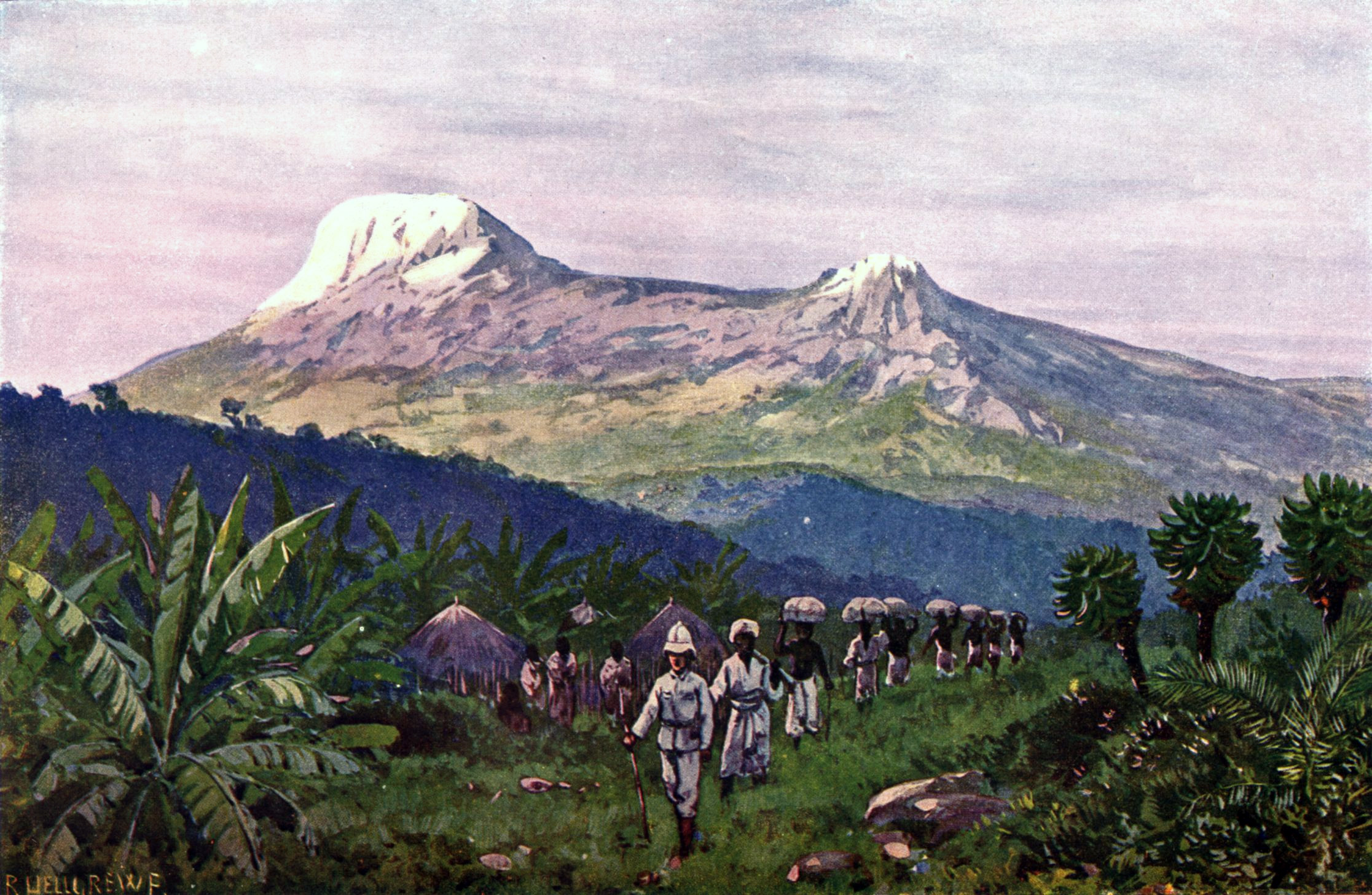
The German missionaries Johannes Rebmann of Mombasa and Johann Krapf were the first Europeans known to have attempted to reach the mountain. According to English geographer Halford Mackinder and English explorer Harry Johnston, Rebmann in 1848 was the first European to report the existence of Kilimanjaro. Hans Meyer has claimed that Rebmann first arrived in Africa in 1846 and quotes Rebmann's diary entry of 11 May 1848 as saying,
In August 1861, the Prussian officer Baron Karl Klaus von der Decken accompanied by English geologist Richard Thornton attempted to climb Kibo but "got no farther than 8200 ft owing to the inclemency of the weather". In December 1862, von der Decken tried a second time together with Otto Kersten, reaching a height of 14000 ft.
.jpg)
In August 1871, missionary Charles New became the "first European to reach the equatorial snows" on Kilimanjaro at an elevation of slightly more than 13000 ft. Later in 1887, the German geology professor Hans Meyer reached the lower edge of the ice cap on Kibo, where he was forced to turn back because he lacked the equipment needed to progress across the ice. The following year, Meyer planned another attempt with Oscar Baumann, a cartographer, but the mission was aborted after the pair were held hostage and ransomed during the Abushiri Revolt. In the autumn of 1888, the American naturalist Abbott and the German explorer Otto Ehrenfried Ehlers approached the summit from the northwest. While Abbott turned back earlier, Ehlers at first claimed to have reached the summit rim, but after severe criticism of the claim, withdrew it.
In 1889, Meyer returned to Kilimanjaro with the Austrian mountaineer Ludwig Purtscheller for a third attempt. This attempt was based on the establishment of several campsites with food supplies so that multiple attempts at the top could be made without having to descend too far. Meyer and Purtscheller pushed to near the crater rim on 3 October but turned back exhausted from hacking footsteps in the icy slope. Three days later, they reached the highest summit, on the southern rim of the crater. They were the first to confirm that Kibo has a crater. After descending to the saddle between Kibo and Mawenzi, Meyer and Purtscheller attempted to climb the more technically challenging Mawenzi but could only reach the top of Klute Peak, a subsidiary peak, before retreating due to illness. On 18 October, they reascended Kibo to enter and study the crater, cresting the rim at Hans Meyers Notch. In total, Meyer and Purtscheller spent 16 days above 15000 ft during their expedition. They were accompanied in their high camps by Mwini Amani of Pangani, who cooked and supplied the sites with water and firewood.
First women climbers
In 1909, London-born Gertrude Benham attempted to reach the summit of Mount Kilimanjaro. After her porters abandoned the expedition upon discovering the skeletons of previous climbers, Benham continued alone and reached the edge of Kibo Crater, later named Gilman’s Point. Adverse weather conditions, including heavy snow and fog, made navigation difficult, leading her to turn back. The first woman to successfully reach the summit of Kilimanjaro was Sheila MacDonald, who completed the ascent on 30 September 1927.
Modern
The first ascent of the highest summit of Mawenzi was made on 29 July 1912, by the German climbers Eduard Hans Oehler and Fritz Klute, who named it Hans Meyer Peak. Oehler and Klute went on to make the third-ever ascent of Kibo, via the Drygalski Glacier, and descended via the Western Breach. The mountain lent its name to the 1914 Battle of Kilimanjaro during World War I.
In 1989, the organizing committee of the 100-year celebration of the first ascent decided to award posthumous certificates to the African porter-guides who had accompanied Meyer and Purtscheller. One person in pictures or documents of the 1889 expedition was thought to match a living inhabitant of Marangu, Yohani Kinyala Lauwo. Lauwo did not know his own age, nor remember Meyer or Purtscheller. He did recall joining a Kilimanjaro expedition involving a Dutch doctor who lived near the mountain, and that he did not wear shoes during the climb. Lauwo claimed that he had climbed the mountain three times before the beginning of World War I. The committee concluded that he had been a member of Meyer's team and therefore must have been born around 1871. Lauwo died on 10 May 1996, 107 years after the first ascent. It is sometimes suggested that he was a co-first-ascendant of Kilimanjaro.
Fauna and flora
Animals
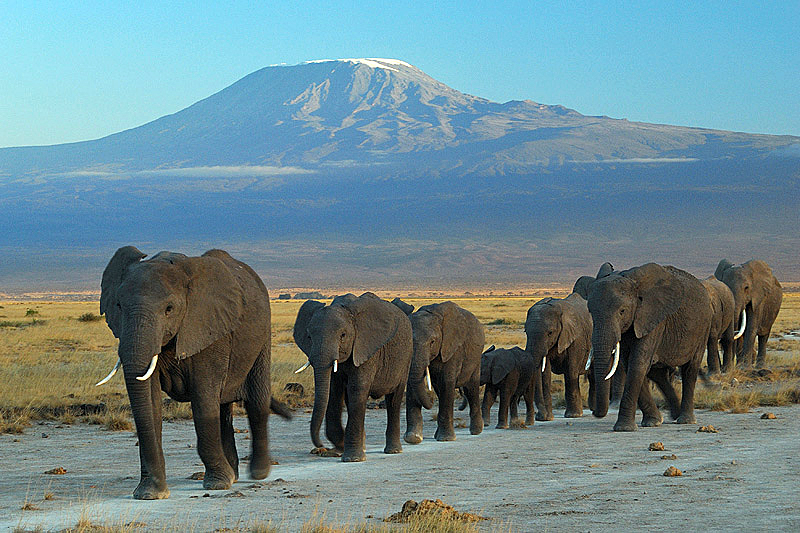
Large animals are rare on Kilimanjaro and are more frequent in the forests and lower parts of the mountain. Elephants and Cape buffaloes are among the animals that can be potentially hazardous to trekkers. Bushbucks, chameleons, dik-diks, duikers, mongooses, sunbirds, and warthogs have also been reported. Zebras, leopards and hyenas have been observed sporadically on the Shira plateau. Specific species associated with the mountain include the Kilimanjaro shrew and the chameleon Kinyongia tavetana.
Vegetation
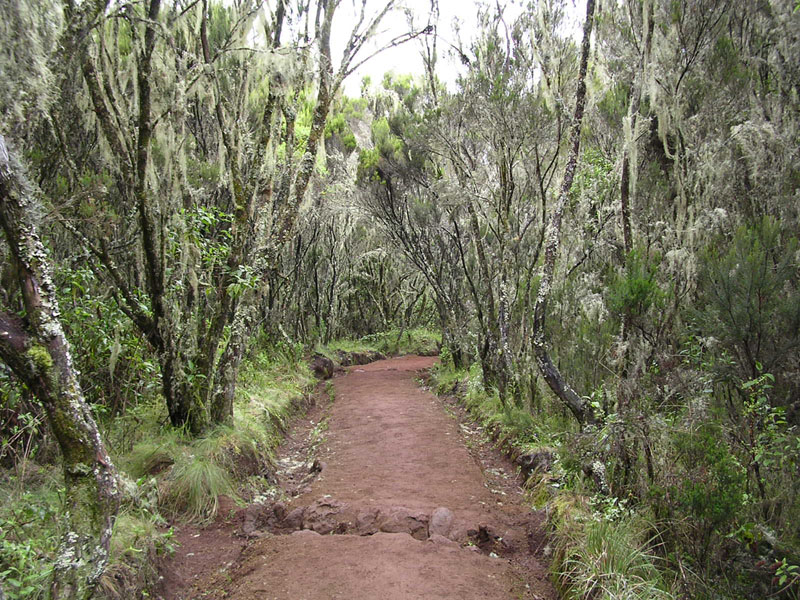
Natural forests cover about 1000 km2 on Kilimanjaro. In the foothill area, maize, beans, sunflowers and, on the western side, wheat are cultivated. There are remnants of the former savanna vegetation with Acacia, Combretum, Terminalia and Grewia. Between 1000 m and 1800 m, coffee appears as part of the "Chagga home gardens" agroforestry. Native vegetation at this altitude range (Strombosia, Newtonia, and Entandrophragma) is limited to inaccessible valleys and gorges and is different from vegetation at higher altitudes. On the southern slope, montane forests first contain Ocotea usambarensis as well as ferns and epiphytes; farther up in cloud forests Podocarpus latifolius, Hagenia abyssinica and Erica excelsa grow, as well as fog-dependent mosses. On the drier northern slopes olive, Croton-Calodendrum, Cassipourea, and Juniperus form forests in order of increasing altitude. Between 3100 m and 3900 m lie Erica bush and heathlands, followed by Helichrysum, until 4500 m. Neophytes have been observed, including Poa annua.
The lower northern and western slopes are dominated by Acacia savanna, while most of the wooded grassland of the lower southern and eastern slopes have been destroyed for cultivation.
Records from the Maundi crater at 2780 m indicate that the vegetation of Kilimanjaro has varied over time. Forest vegetation retreated during the Last Glacial Maximum and the ericaceous vegetation belt lowered by 1500 m between 42,000 and 30,000 years ago because of the drier and colder conditions.
The Tussock Grassland is an area on the slopes of Mount Kilimanjaro that contains many unique species of vegetation, such as the water holding cabbage.
Conservation
Since 1973, Mount Kilimanjaro has been designated as a national park, prohibiting human activities within its boundaries to preserve its ecosystem. The government has also implemented a ban on tree harvesting to prevent environmental degradation and protect the park's biodiversity.
Climate
The climate of Kilimanjaro is influenced by the height of the mountain, which allows the simultaneous influence of the equatorial trade winds and the high altitude anti-trades, and by the isolated position of the mountain. Kilimanjaro has daily upslope and nightly downslope winds, a regimen stronger on the southern than the northern side of the mountain. The flatter southern flanks are more extended and affect the atmosphere more strongly.
Kilimanjaro has two distinct rainy seasons, one from March to May and another around November. The northern slopes receive much less rainfall than the southern ones. The lower southern slope receives 800 to annually, rising to 1500 to at 1500 m altitude and peaking "partly over" 3000 mm in the forest belt at 2000 to. In the alpine zone, annual precipitation decreases to 200 mm.
The average temperature in the summit area is approximately -7 C. Nighttime surface temperatures on the Northern Ice Field (NIF) fall on average to -9 C, with an average daytime high of -4 C. During nights of extreme radiational cooling, the NIF can cool to as low as -15 to.
Snowfall can occur at any time of year but is mostly associated with northern Tanzania's two rainy seasons. Precipitation in the summit area occurs principally as snow and graupel of 250 to per year and ablates within days or years.
| Jan record high C = 5.6 | Feb record high C = 6.2 | Mar record high C = 4.0 | Apr record high C = 3.7 | May record high C = 5.3 | Jun record high C = 6.5 | Jul record high C = 4.5 | Aug record high C = 2.9 | Sep record high C = 4.7 | Oct record high C = 4.8 | Nov record high C = 4.6 | Dec record high C = 5.8 | Jan record low C = -12.4 | Feb record low C = -11.9 | Mar record low C = -12.3 | Apr record low C = -11.2 | May record low C = -11.2 | Jun record low C = -13.4 | Jul record low C = -13.1 | Aug record low C = -12.3 | Sep record low C = -12.5 | Oct record low C = -11.8 | Nov record low C = -11.2 | Dec record low C = -11.0 |access-date = 8 May 2025}}
Climatic zones
- Bushland / Lower Slope:, 800 to
- Rainforest: 1800 to
- Heather / Moorland: 2800 to
- Alpine Desert: 4000 to
- Arctic: 5000 to.
Climate
|Jan record high C= |Feb record high C= |Mar record high C= |Apr record high C= |May record high C= |Jun record high C= |Jul record high C= |Aug record high C= |Sep record high C= |Oct record high C= |Nov record high C= |Dec record high C= |year record high C= |Jan record low C= |Feb record low C= |Mar record low C= |Apr record low C= |May record low C= |Jun record low C= |Jul record low C= |Aug record low C= |Sep record low C= |Oct record low C= |Nov record low C= |Dec record low C= |year record low C=
Tourism industry
Main article: Mount Kilimanjaro climbing routes

Kilimanjaro National Park generated US$51 million in revenue in 2013, the second-most of any Tanzanian national park. The Tanzania National Parks Authority reported that the park recorded 57,456 tourists during the 2011–12 budget year, of whom 16,425 hiked the mountain; the park's General Management Plan specifies an annual capacity of 28,470. The mountain hikers generated irregular and seasonal jobs for about 11,000 guides, porters, and cooks in 2007. Concerns have been raised about the poor working conditions and inadequate wages of these workers. Due to Kilimanjaro National Park's popularity as a destination, the Tanzanian government has invested in road infrastructure to improve accessibility. In Tanzania, Kilimanjaro International Airport also serves as an important transportation hub.
There are seven official trekking routes by which to ascend and descend Kilimanjaro: Lemosho, Lemosho Western-Breach, Machame, Marangu, Mweka, Rongai, Shira, and Umbwe. The Machame route can be completed in six or seven days, Lemosho in six to eight, and the Northern Circuit routes in seven or more days. The Lemosho Route can also be continued via the Western-Breach, submitting via the western side of the mountain. The Western Breach is more secluded and avoids the 6-hour midnight ascent to the summit (like other routes). The Rongai is the easiest of the camping routes. The Marangu is also relatively easy, if frequently busy; accommodation is in shared huts. The Lemosho Western-Breach Route commences on the western side of Kilimanjaro at Lemosho and continues to the summit via the Western-Breach Route.
Mawenzi technical climbing
Technical climbing routes are available on the Mawenzi cone of Mount Kilimanjaro. Unlike the traditional routes to Uhuru Peak on Kibo, which are open to the general public, climbing Mawenzi requires a special permit from the Tanzania National Parks Authority. These permits are issued exclusively to experienced climbers with appropriate equipment. Climbing on Mawenzi is limited to a maximum of two climbers at a time and is restricted to daytime hours.
Climbing records

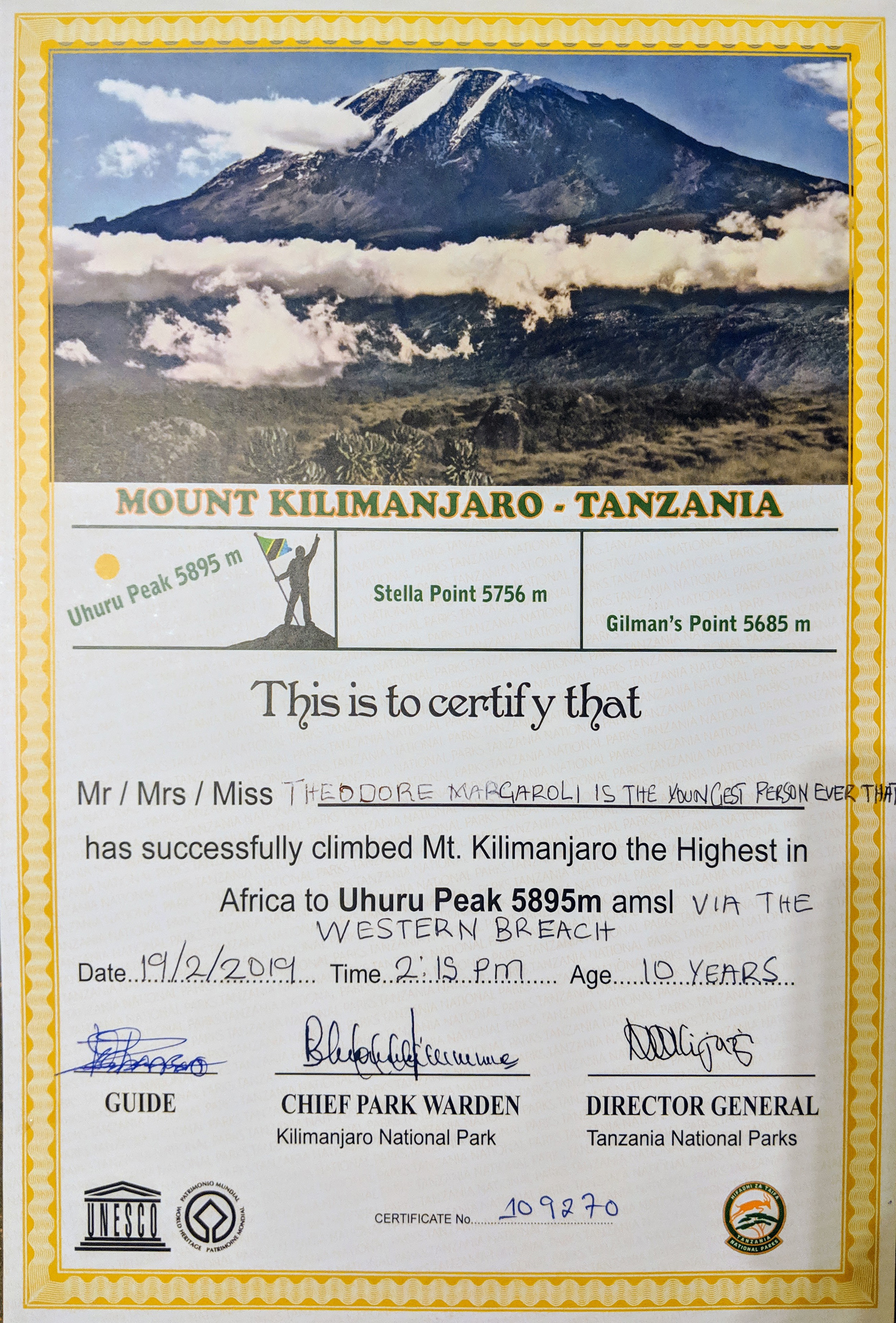
The oldest person to climb Mount Kilimanjaro is Anne Lorimor, aged 89 years and 37 days, who reached Uhuru Peak at 3:14 p.m. local time on 18 July 2019. The oldest man to summit is American Fred Dishelhorst, who reached the top on 19 July 2017 at the age of 88 years, 5 months, and 28 days old. Dishelhorst used supplemental oxygen on summit day. The second oldest man to reach the summit is American Charlie Winger, who reached the top on 5 July 2025. He was 88 years, 1 month, and 26 days old and did not use supplemental oxygen. The third oldest man to summit the mountain is the American Robert Wheeler, who was 85 years and 201 days when he summited on 2 October 2014. Maxwell J. Ojerholm of Massachusetts, USA, reached Uhuru Peak, the true summit, unassisted, at the age of ten years, on 4 July 2009, taking the difficult Machame Route. Colin M. Barker of Missouri, USA, later completed the same route at the age of ten on 22 December 2020. Theodore Margaroli from London, age 10, reached the summit unassisted by the Western Breach, the hardest but most scenic route, in 2019. On 11 July 2025, Lydia Zhong Chew from Boulder, Colorado, USA, reached Uhuru Peak via the six-day-five-night Machame route, unassisted, at the age of 10. She and her 12-year-old sister Julia Zhong Chew are believed to be the two youngest climbers of Chinese descent. Despite an age limit of 10 years for a climbing permit, Keats Boyd from Los Angeles reached the summit on 21 January 2008 at the age of 7. This record was equaled by Montannah Kenney from Texas in March 2018 and again in July 2018 by Coaltan Tanner from New Mexico. The fastest ascent and the fastest round trip have been recorded by the Swiss-Ecuadorian mountain guide Karl Egloff. On 13 August 2014, after guiding a party to the summit the previous days, he ran from Umbwe Gate to the top in 4 hours and 56 minutes and returned to the Mweka Gate at 1630 m in a total time of 6 hours, 42 minutes and 24 seconds. Previous records, using the same route, were held by Spanish mountain runner Kílian Jornet (ascent in 5:23:50, round trip 7:14 on 29 September 2010) and by Tanzanian guide Simon Mtuy (an unsupported round trip in 9:21 on 22 February 2006).
The female round trip record is held by Fernanda Maciel from Brazil in a time of 10 hours and 6 minutes.
Several climbs by disabled people have drawn attention. Wheelchair user Bernard Goosen from South Africa scaled Kilimanjaro in six days in 2007. In 2012, Kyle Maynard who has no forearms or lower legs, crawled unassisted to the summit of Mount Kilimanjaro.
On 9 February 2015, Red Bull athlete Valerii Rozov performed the first wing-suit BASE jump from the summit of Mount Kilimanjaro. He flew approximately 3 kilometres before landing on the southern slope.
In 2020, a team featuring two double above-knee amputees, Hari Budha Magar and Justin Oliver Davis, summited Kilimanjaro. It took them six days to cover the 56 km distance to the summit.
Safety
The climb is not technically as challenging as the Himalayas or Andes, but the high elevation, low temperature, and occasional high winds can make Kilimanjaro a difficult trek. Acclimatization is required, and even experienced and physically fit trekkers may suffer some degree of altitude sickness. A study of people attempting to reach the summit of Kilimanjaro in July and August 2005 found that 61.3 percent succeeded and 77 percent experienced acute mountain sickness (AMS). A retrospective study of 917 persons who attempted to reach the summit via the Lemosho or Machame routes found that 70.4 percent experienced AMS, defined in this study to be headache, nausea, diarrhea, vomiting, or loss of appetite.
Kilimanjaro's summit is well above the altitude at which life-threatening high altitude pulmonary edema (HAPE) or high altitude cerebral edema (HACE), the most severe forms of AMS, can occur. These health risks are increased substantially by excessively fast climbing schedules motivated by high daily national park fees, busy holiday travel schedules, and the lack of permanent shelter on most routes. The six-day Machame route, which involves one day of "climbing high" to Lava Tower (15190 ft and "sleeping low" at Barranco Camp (13044 ft), may delay the onset of AMS but does not ultimately prevent its occurrence.
Falls on steep portions of the mountain and rock slides have killed trekkers. For this reason, the route via the Arrow Glacier was closed for several years, reopening in December 2007. Now again it officially closed as of 20 January 2024. Due to strong El Niño, the Western Breach has washed down the mountain. This huge runoff has carved new ravines on the slopes and seems to be dislodging the sediment that cements the rock together, disrupting the rock stability. At the route's base, rain water has opened new drainages and there is an active, flowing river through the Arrow Glacier Camp where there has been no water at all for decades. The improper disposal of human waste on the mountain environment has created a health hazard, necessitating the boiling of all water.
According to the Kilimanjaro Christian Medical Centre in Moshi, 25 people died from January 1996 to October 2003 while climbing the mountain. Seventeen were female and eight were male, ranging in age from 29 to 74. Fourteen died from advanced high altitude illness, including one with HACE, five with HAPE, and six with both HACE and HAPE. The remaining eleven deaths resulted from "trauma (3), myocardial infarction (4), pneumonia (2), cardio-pulmonary failure of other underlying cause (1), and acute appendicitis (1). The overall mortality rate was 13.6 per 100,000 climbers."
In literature and film
Journalist Tom Bissell noted that Kilimanjaro is "perhaps the world's most literary mountain". The mountain is prominently featured in Ernest Hemingway's 1936 short story The Snows of Kilimanjaro, which was adapted into a 1952 film starring Gregory Peck. Dave Eggers wrote about his ascent in the short story Up the Mountain Coming Down Slowly. The ascent of Kilimanjaro is depicted in Andrei Gusev's 2020 novel Once in Malindi (in the 17th chapter). Writer Douglas Adams climbed the mountain in a rubber rhinoceros suit to raise money for African rhino conservation efforts.
Kilimanjaro was featured in Toto's 1982 song "Africa". An IMAX film documenting an ascent—Kilimanjaro: To The Roof Of Africa—was released in 2002. Kilimanjaro is also prominently featured in the Lion King franchise.
Notes
References
Citations
Works cited
Academic articles
Books
References
- (2009). "Kilimanjaro Map and tourist Guide". EWP.
- "Kilimanjaro, Mount". [[Oxford University Press]]}} {{Cite web.
- {{citation needed. (January 2025)
- Briggs, Philip (1996). ''Guide to Tanzania'', 2nd edition. Bradt Guides.
- Demhardt, I. J.. "German Contributions to the Cartography of South West and East Africa from Mid-19th Century to World War I". University of Technology Darmstadt.
- Dangar, D. F. O.. (1965). "Dangar Alpine Notes". The Alpine Journal.
- (1945). "Further Notes on the Kibo Inner Crater and Glaciers of Kilimanjaro and Mount Kenya". The Geographical Journal.
- (24 March 2016). "Mount Kilimanjaro Volcanic Cones: Shira, Kibo And Mawenzi Peaks".
- (2006). "Kilimanjaro Glaciers: Recent areal extent from satellite data and new interpretation of observed 20th-century retreat rates". Geophysical Research Letters.
- (2008). "New K Ar age determinations of Kilimanjaro volcano in the North Tanzanian diverging rift, East Africa". Journal of Volcanology and Geothermal Research.
- (26 April 2022). "8 Common Mistakes I Wish I Knew Before Climbing Mount Kilimanjaro As A Beginner {{!}} How To Climb Mount Kilimanjaro?".
- "Kilimanjaro National Park". UNESCO World Heritage Centre.
- Pascal Sirguey, Nicolas J. Cullen and Jorge Filipe Dos Santos. "The New Digital Orthometric Elevation Model of Kilimanjaro". CEUR Workshop Proceedings.
- (2014). "A Century of Photogrammetry on Kilimanjaro".
- Alex Stewart. (23 April 2012). "Kilimanjaro: A Complete Trekker's Guide: Preparations, practicalities and trekking routes to the 'Roof of Africa'". Cicerone Press Limited.
- (1956). "Preliminary Notes on the Geology of Kilimanjaro". Geological Magazine.
- "Kilimanjaro Geology".
- "Kilimanjaro Geology".
- John Barry Dawson. (2008). "The Gregory Rift Valley and Neogene-recent Volcanoes of Northern Tanzania". Geological Society of London.
- (1923). "An Ascent of Kilimanjaro". The Geographical Journal.
- "Gustav Otto Richard Reusch". The Center for Volga German Studies at Concordia University.
- Richard Leider. (10 May 2010). "The Power of Purpose: Find Meaning, Live Longer, Better". Berrett-Koehler Publishers.
- (25 April 2011). "Kilimanjaro". Oregon State University.
- Alex Stewart. (23 April 2012). "Kilimanjaro: A Complete Trekker's Guide: Preparations, practicalities and trekking routes to the 'Roof of Africa'". Cicerone Press Limited.
- (2008). "Quaternary glaciation in Africa: Key chronologies and climatic implications". Journal of Quaternary Science.
- (2014). "Deglaciated areas of Kilimanjaro as a source of volcanic trace elements deposited on the ice cap during the late Holocene". Quaternary Science Reviews.
- Thompson, Lonnie G. (2002). "Kilimanjaro Ice Core Records: Evidence of Holocene Climate Change in Tropical Africa". Science.
- (2015). "The controversial age of Kilimanjaro's plateau glaciers". EGU General Assembly Conference Abstracts.
- (2009). "Glacier loss on Kilimanjaro continues unabated". Proceedings of the National Academy of Sciences.
- Young, James A. T.. "Glaciers of the Middle East and Africa". U.S. Department of the Interior.
- (2010). "Is the decline of ice on Kilimanjaro unprecedented in the Holocene?". The Holocene.
- (2007). "Encyclopedia of Quaternary Science".
- (2024). "Tropical glacier loss in East Africa: recent areal extents on Kilimanjaro, Mount Kenya, and in the Rwenzori Range from high-resolution remote sensing data". Environmental Research: Climate.
- (2013). "A century of ice retreat on Kilimanjaro: the mapping reloaded". The Cryosphere.
- Zeinab, Noura Abou. (15 October 2020). "'Big pieces' of Kilimanjaro 'missing' due to climate crisis, says ice climber Will Gadd".
- Nkonge, Peninah. (15 October 2022). "'Hiking Adventures In East Africa's Tallest Mountains".
- (2013). "East African glacier loss and climate change: Corrections to the UNEP article ''Africa without ice and snow''". Environmental Development.
- William Dubois Newmark. (1991). "The Conservation of Mount Kilimanjaro". IUCN.
- "The First 100 IUGS Geological Heritage Sites". IUGS.
- (2 January 2018). "THE GEOGRAPHY PEOPLE AND MYTHOLOGY OF AFRICA'S HIGHEST PEAK".
- Charles Dundas. (12 November 2012). "Kilimanjaro and Its People: A History of Wachagga, their Laws, Customs and Legends, Together with Some". Routledge.
- J. Shearson Hyland. (1889). "Ueber die Gesteine des Kilimandscharo und dessen Umgebung". Mineralogische und Petrographische Mitteilungen.
- Hans Meyer. (1891). "Across East African glaciers: an account of the first ascent of Kilimanjaro". Nature.
- Cameron M. Burns. (2006). "Kilimanjaro & East Africa: A Climbing and Trekking Guide". The Mountaineers Books.
- Mackinder, Halford. (1900). "A Journey to the Summit of Mount Kenya, British East Africa". [[The Geographical Journal]].
- (1916). ""Kilimanjaro", authored by Sir. H. H. Johnston, in ''The Twentieth Century'', published by Nineteenth Century and After, printed by Spottswoode, Ballantine & Co. Ltd., London, June 1916, volume 79, page 879".
- (August 2011). "Mr Thornton, I presume?: Everyone has heard of Livingstone, but the name of Richard Thornton, Livingstone's geologist, has been completely forgotten. Richard Boak tells his sad story.".
- Dundas, Charles. (2012). "Kilimanjaro and its People: A History of the Wachagga, Their Laws, Customs and Legends, Together with Some Account of the Highest Mountain in Africa". Routledge.
- "Baron Carl Claus von der Decken – 1833–1865 – Collectors in East Africa – 31.". Conchological Society of Great Britain and Ireland.
- Alex Stewart. (9 September 2010). "Kilimanjaro: A Complete Trekker's Guide: Preparations, Practicalities and Trekking Routes to the 'Roof of Africa'". Cicerone Press Limited.
- "The amazing story of the first woman on Kilimanjaro".
- (2016-09-30). "Woman's ascent of Kilimanjaro: London girl's triumph – archive". The Guardian.
- (1 January 1990). "Meyer And Purtscheller Were Not Alone". Tanzanian Affairs.
- "The Old Man of Mt. Kilimanjaro". Another Land.
- Cameron M. Burns. (2006). "Kilimanjaro & East Africa: A Climbing and Trekking Guide". The Mountaineers Books.
- "Climbing Mount Kilimanjaro". Ascend Tanzania.
- "Kinyongia tavetana (STEINDACHNER, 1891)". Zoological Museum Hamburg.
- (2006). "Continuum or zonation? Altitudinal gradients in the forest vegetation of Mt. Kilimanjaro". Plant Ecology.
- (2012). "Vegetation, climate and fire-dynamics in East Africa inferred from the Maundi crater pollen record from Mt Kilimanjaro during the last glacial-interglacial cycle". Quaternary Science Reviews.
- (6 January 2011). "Tropical Montane Cloud Forests: Science for Conservation and Management". Cambridge University Press.
- (2008). "Introduced plants on Kilimanjaro: Tourism and its impact". Plant Ecology.
- Tanzania National Parks Authority. "Kilimanjaro National Park Celebrating the Golden Anniversary in Biodiversity Conservation and Tourism".
- (1997). "Historical dictionary of Tanzania". Scarecrow Press.
- (1 July 2011). "Encyclopedia of Snow, Ice and Glaciers". Springer Science & Business Media.
- "Best time to visit Kilimanjaro National Park".
- (5 June 2015). "Mountaineering Tourism". Routledge.
- (2014). "Tourism in Africa: Harnessing Tourism for Growth and Improved Livelihoods". World Bank Publications.
- (16 March 2014). "The official site of the Tanzania National Parks – Latest news".
- ""Making success work for the poor: Package tourism in Northern Tanzania", Overseas Development Institute, authored by Jonathan Mitchell, Jodie Keane, and Jenny Laidlaw, 9 January 2008, accessed 31 July 2015".
- Ihucha, Adam. (28 November 2015). "Kilimanjaro airport upgrade to double its capacity". [[The EastAfrican]].
- "Mt. Kilimanjaro Routes: The Advantages and Disadvantage of All Mount Kilimanjaro Climbing Routes". Mount Kilimanjaro Guide.
- "Climbing Mount Kilimanjaro on the Machame Route". Mount Kilimanjaro Guide.
- "Climbing Mount Kilimanjaro on the Lemosho Route". Climbing Kilimanjaro.
- "Climbing Mount Kilimanjaro on the Rongai Route". Mount Kilimanjaro Guide.
- "Marangu Route". Kilimanjaro Routes.
- "Information about Mt Kilimanjaro".
- "Kiliwarrior Expeditions – Climb Kilimanjaro and become a Kiliwarrior!".
- "Mawenzi Peak — A Volcano in the Kilimanjaro Massif".
- "Mawenzi technical climbing guidelines". Tanzania National Parks Authority.
- "Oldest person to climb Mount Kilimanjaro".
- (26 July 2019). "Anne Lorimor breaks record twice on Mount Kilimanjaro".
- (23 July 2017). "Oldest man climbs Kilimanjaro".
- Lifestyle, Montrose. (2025-07-14). "Montrose Man Sets Age Record Climbing Kilimanjaro".
- "Youngest person to climb Mount Kilimanjaro via the Western Breach route".
- (10 April 2018). "Girl Who Wanted to 'Be Closer to Her Dad' Becomes Youngest Female to Hike Mount Kilimanjaro".
- (19 October 2022). "The youngest Person to Climb Mount Kilimanjaro | Seven Brave Children".
- (1 November 2018). "Albuquerque boy becomes youngest ever to summit Mt. Kilimanjaro".
- [https://fastestknowntime.com/route/kilimanjaro-tanzania Route: Kilimanjaro] {{Webarchive. link. (9 December 2018 at fastest known time.com)
- Matt Hart, [http://www.outsideonline.com/1931036/where-world-did-karl-egloff-come Where in the World Did Karl Egloff Come From?] {{Webarchive. link. (1 April 2015 , [[Outside (magazine)). Outside]] 5, Mar 2015
- [https://www.climbkilimanjaroguide.com/kilimanjaro-fastect-ascent/ Swiss Sets New Kilimanjaro Fastest Ascent And Descent Record] {{Webarchive. link. (19 July 2018 at climbkilimanjaroguide.com)
- "Amazing Kilimanjaro Records". Climb Kilimanjaro Guide.
- "Kilimanjaro records". Climb Mount Kilimanjaro Ltd.
- link. (9 December 2018 at gearjunkie.com)
- "Trip Report: the First BASE Jump from Kilimanjaro".
- "Two double amputees, Hari and Justin, successfully climb Mt Kilimanjaro".
- (2004). "Altitude Acclimatization Guide". US Army Research Inst. Of Environmental Medicine Thermal and Mountain Medicine Division Technical Report.
- Stoppelenburg, R.. "Prepare yourself for the Kilimanjaro climb".
- (2009). "Determinants of Summiting Success and Acute Mountain Sickness on Mt Kilimanjaro (5895 m)". Wilderness & Environmental Medicine.
- (2014). "A Retrospective Study of Acute Mountain Sickness on Mt. Kilimanjaro Using Trekking Company Data". Aviation, Space, and Environmental Medicine.
- "Medical Problems in High Mountain Environments. A Handbook for Medical Officers". US Army Research Inst. of Environmental Medicine Thermal and Mountain Medicine Division Technical Report.
- (2009). "Determinants of Summiting Success and Acute Mountain Sickness on Mt Kilimanjaro (5895 m)". Wilderness and Environmental Medicine.
- Meyer, Joel. (2012). "Twice-Daily Assessment of Trekkers on Kilimanjaro's Machame Route to Evaluate the Incidence and Time-Course of Acute Mountain Sickness". High Altitude Medicine & Biology.
- (2019-12-17). "Machame Route".
- "Western Breach Route". Climbing Kilimanjaro.
- "Lava Tower en route to Barranco Camp". About.com.
- (2017). "The good, the bad and the ugly–three approaches to the management of human waste in a high-mountain environment". International Journal of Environmental Studies.
- Markus Hauser. (2004). "Deaths Due to High Altitude Illness Among Tourists Climbing Mt Kilimanjaro". Proceedings of the 2004 South African Travel Medicine Society.
- Bissell, Tom. (28 October 2007). "Up the Mountain Slowly, Very Slowly". The New York Times.
- Crowther, Bosley. (19 September 1952). "The Screen in Review; 'Snow of Kiliminjaro,' Based on Hemingway's Story, Is New Feature at Rivoli". The New York Times.
- [http://mliterature.narod.ru/Old_Novelist.htm Review of ''"Once in Malindi"''] on the site of public fund "Union of writers of Moscow", 2021 {{in lang. ru
- [https://proza.ru/2020/08/15/2 ''"Once in Malindi"''] {{Webarchive. link. (2020-10-16 — on Proza.ru, 2020 {{in lang). ru
- ''[[Andrei Gusev. Андрей Гусев]]'' [http://Gusev.webs.com/Malindi_Andy.htm "Однажды в Малинди"], 2020. {{Webarchive. link. (2020-11-04)
- (24 September 2014). "Up Kilimanjaro with the Adams Family". BBC.
- Hann, Michael. (13 June 2018). "The strange appeal of Toto's Africa – and why it's cover-proof". Financial Times.
- (20 April 2023). "Kilimanjaro: To The Roof Of Africa".
This article was imported from Wikipedia and is available under the Creative Commons Attribution-ShareAlike 4.0 License. Content has been adapted to SurfDoc format. Original contributors can be found on the article history page.
Ask Mako anything about Mount Kilimanjaro — get instant answers, deeper analysis, and related topics.
Research with MakoFree with your Surf account
Create a free account to save articles, ask Mako questions, and organize your research.
Sign up freeThis content may have been generated or modified by AI. CloudSurf Software LLC is not responsible for the accuracy, completeness, or reliability of AI-generated content. Always verify important information from primary sources.
Report