From Surf Wiki (app.surf) — the open knowledge base
Mother Goose
Imaginary author of nursery rhymes and tales
Imaginary author of nursery rhymes and tales
the fairy-tale character
Mother Goose is a character that originated in children's fiction, as the imaginary author of a collection of French fairy tales and later of English nursery rhymes. She also appeared in a song, the first stanza of which often functions now as a nursery rhyme. The character also appears in a pantomime tracing its roots to 1806.
The term's appearance in English dates back to the early 18th century, when Charles Perrault's fairy tale collection, Contes de ma Mère l'Oye, was first translated into English as Tales of My Mother Goose. Later a compilation of English nursery rhymes, titled Mother Goose's Melody, or, Sonnets for the Cradle, helped perpetuate the name both in Britain and the United States.
The character
Mother Goose's name was identified with English collections of stories and nursery rhymes popularised in the 17th century. English readers would already have been familiar with Mother Hubbard, a stock figure when Edmund Spenser published the satire Mother Hubberd's Tale in 1590, as well as with similar fairy tales told by "Mother Bunch" (the pseudonym of Madame d'Aulnoy) in the 1690s. An early mention appears in an aside in a versified French chronicle of weekly events, Jean Loret's La Muse Historique, collected in 1650. His remark, comme un conte de la Mère Oye ("like a Mother Goose story") shows that the term was readily understood. Additional 17th-century Mother Goose/Mere l'Oye references appear in French literature in the 1620s and 1630s.
Speculation about origins
In the 20th century, Katherine Elwes-Thomas theorised that the image and name "Mother Goose" or "Mère l'Oye" might be based upon ancient legends of the wife of King Robert II of France, known as "Berthe la fileuse" ("Bertha the Spinner") or Berthe pied d'oie ("Goose-Footed Bertha" ), often described as spinning incredible tales that enraptured children. Other scholars have pointed out that Charlemagne's mother, Bertrada of Laon, came to be known as the goose-foot queen (regina pede aucae). There are even sources that trace Mother Goose's origin back to the biblical Queen of Sheba. Stories of Bertha with a strange foot (goose, swan or otherwise) exist in many languages including Middle German, French, Latin and, Italian. Jacob Grimm theorised that these stories are related to the Upper German figure Perchta or Berchta (English Bertha). Like the legends of "Bertha la fileuse" in France and the story of Mother Goose Berchta was associated with children, geese, and spinning or weaving, although with much darker connotations.

Despite evidence to the contrary, it has been stated in the United States that the original Mother Goose was the Bostonian wife of Isaac Goose, either named Elizabeth Foster Goose (1665–1758) or Mary Goose (d. 1690, age 42). She was reportedly the second wife of Isaac Goose (alternatively named Vergoose or Vertigoose), who brought to the marriage six children of her own to add to Isaac's ten. After Isaac died, Elizabeth went to live with her eldest daughter, who had married Thomas Fleet, a publisher who lived on Pudding Lane (now Devonshire Street). According to Early, "Mother Goose" used to sing songs and ditties to her grandchildren all day, and other children swarmed to hear them. Finally, it was said, her son-in-law gathered her jingles together and printed them. No evidence of such printing has been found, and historians believe this story was concocted by Fleet's great-grandson John Fleet Eliot in 1860.
Iona and Peter Opie, leading authorities on nursery lore, give no credence to either the Elwes-Thomas or the Boston suppositions. It is generally accepted that the term does not refer to any particular person.
Nursery tales and rhymes
Main article: Tales of Mother Goose

Charles Perrault, one of the initiators of the literary fairy tale genre, published a collection of such tales in 1695 called Histoires ou contes du temps passés, avec des moralités under the name of his son, which became better known under its subtitle of Contes de ma mère l'Oye or Tales of My Mother Goose. Perrault's publication marks the first authenticated starting-point for Mother Goose stories. An English translation of Perrault's collection, Robert Samber's Histories or Tales of Past Times, Told by Mother Goose, appeared in 1729 and was reprinted in America in 1786.
Nursery rhymes were once believed to have been published in John Newbery's compilation Mother Goose's Melody, or, Sonnets for the cradle published some time in London in the 1760s, but the first edition was probably published in 1780 or 1781 by Thomas Carnan, Newbery's stepson and successor. Although this edition was registered with the Stationers' Company in 1780, no copy has ever been confirmed, and the earliest surviving edition is dated 1784. The name "Mother Goose" has been associated in the English-speaking world with children's poetry ever since.
Pantomime
_MS_Thr_847.jpg)
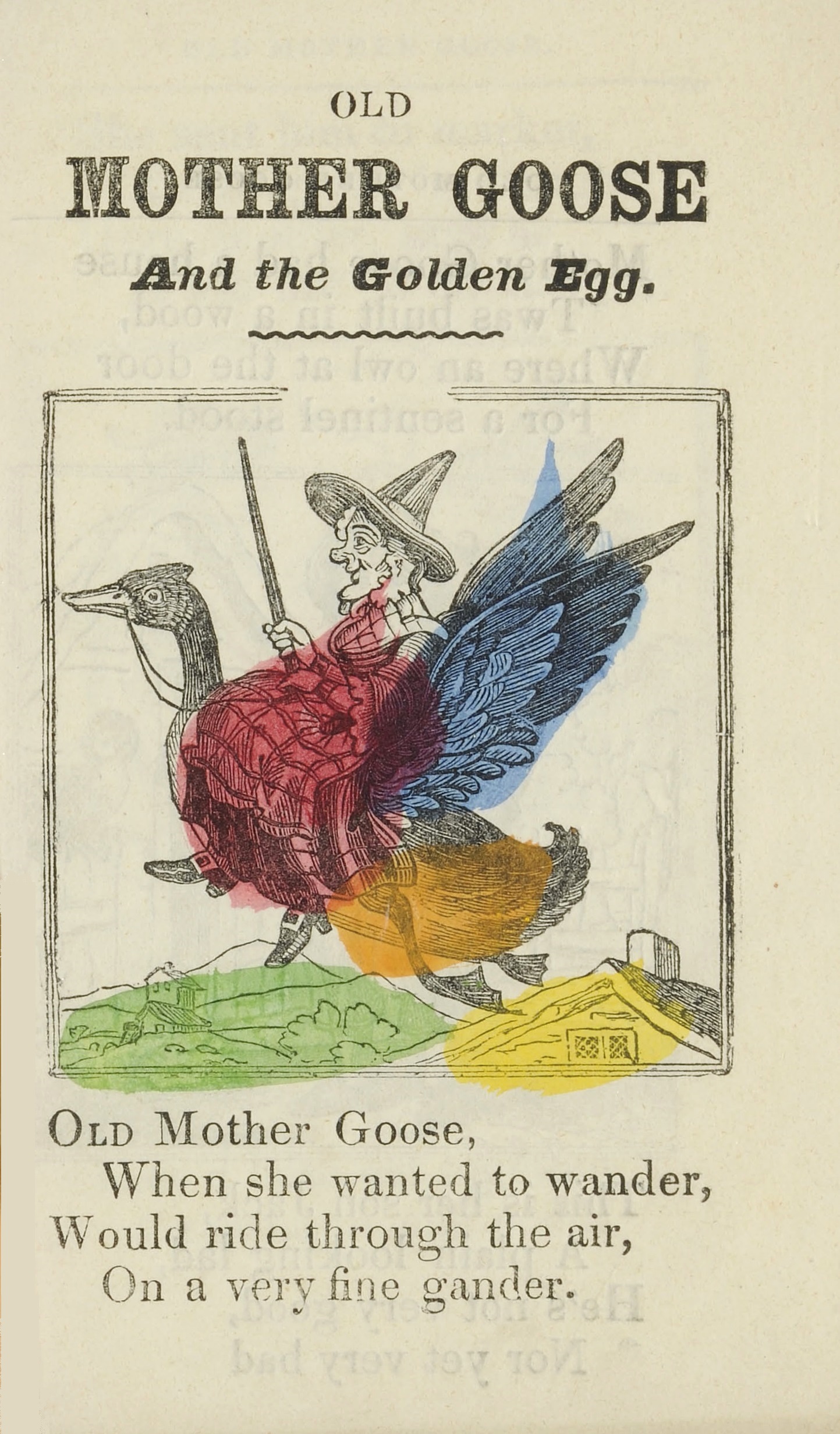
In addition to being the purported author of nursery rhymes, Mother Goose is herself the title character in one recorded by the Opies, only the first verse of which figures in later editions of their book. Titled "Old Mother Goose and the Golden Egg", this verse prefaced a 15-stanza poem that rambled through a variety of adventures involving not only the egg but also Mother Goose's son Jack. There exists an illustrated chapbook omitting their opening stanza that dates from the 1820s and another version was recorded by J. O. Halliwell in his The Nursery Rhymes of England (1842). Other shorter versions were also recorded later.
All of them, however, were dependent on a very successful pantomime first performed in London in 1806, and it is only by reference to its script that the unexplained gaps in the poem's narration are made clear. The stage version became a vehicle for the clown Joseph Grimaldi, who played the part of Avaro, but there was also a shorter script for shadow pantomime which allowed special effects of a different kind.

Special effects were needed since the folk elements in the story made a witch-figure of Mother Goose. In reference to this, and especially the opening stanza, illustrations of Mother Goose began depicting her as an old lady with a strong chin who wears a tall pointed hat and flies astride a goose. Ryoji Tsurumi has commented on the folk aspects of this figure in his monograph on the play. In the first scene, the stage directions show her raising a storm and, for the first time onstage, flying a gander – and she later raises a ghost in a macabre churchyard scene. These elements contrast with others from the harlequinade tradition in which the old miser Avaro transforms into Pantaloon, while the young lovers Colin and Colinette become Harlequin and Columbine.
A new Mother Goose pantomime was written for the comedian Dan Leno by J. Hickory Wood and Arthur Collins for performances at Theatre Royal, Drury Lane in 1902. This had a different story line in which the poor but happy Mother Goose is tempted with wealth by the Devil. This was the ancestor of all the pantomimes of that title that followed, adaptations of which continue to appear. Playwright John J. McNally adapted the libretto by Wood and Collins for the 1903 Broadway musical Mother Goose which starred comedian Joseph Cawthorn in the title role. It used music by composer Frederick Solomon and lyrics by George V. Hobart.
Because nursery rhymes are usually referred to as Mother Goose songs in the US, however, children's entertainments in which a medley of nursery characters are introduced to sing their rhymes often introduced her name into American titles. Early 20th century examples of these include A dream of Mother Goose and other entertainments by J. C. Marchant and S. J. Mayhew (Boston, 1908); Miss Muffet Lost and Found : a Mother Goose play by Katharine C. Baker (Chicago, 1915); The Modern Mother Goose: a play in three acts by Helen Hamilton (Chicago, 1916); and the up-to-the-moment The Strike Mother Goose Settled by Evelyn Hoxie (Franklin Ohio and Denver Colorado, 1922).
Sculpture
In the United States there is a granite statue of a flying Mother Goose by Frederick Roth at the entrance to Rumsey Playfield in New York's Central Park. Installed in 1938, it has several other nursery rhyme characters carved into its sides. On a smaller scale, there is Richard Henry Recchia's contemporary bronze rotating statue in the Rockport, Massachusetts, public library. There Mother Goose is depicted telling the tales associated with her to two small children, with twelve reliefs illustrating such stories about its round base.
References
References
- ''Macmillan Dictionary for Students'' Macmillan, Pan Ltd. (1981), p. 663. Retrieved 2010-7-15.
- See, for instance, item 364 in [[Peter and Iona Opie]], ''The Oxford Dictionary of Nursery Rhymes'', 1997.
- Jeri Studebaker, ''Breaking the Mother Goose Code'', Moon Books 2015, [https://books.google.com/books?id=5P1JBgAAQBAJ Chapter 6]
- (December 1996). "Comment l'auteur des «Fées à la mode» devint «Mother Bunch»: Métamorphoses de Comtesse d'Aulnoy en Angleterre" ("How the Author of 'Fairies à la mode' became 'Mother Bunch': Metamorphoses of Countess d'Aulnoy in England". Wayne State University Press.
- Ryoji Tsurumi, "The Development of Mother Goose in Britain in the Nineteenth Century" ''Folklore'' '''101'''.1 (1990:28–35) p. 330 instances these, as well as the "Mother Carey" of sailor lore—"Mother Carey's chicken" being the [[European storm-petrel]]—and the Tudor period prophetess "[[Mother Shipton]]".
- Shahed, Syed Mohammad. (1995). "A Common Nomenclature for Traditional Rhymes". Asian Folklore Studies.
- (1626). "Les satyres de Saint-Regnier – ... Saint-Regnier – Google Books".
- (21 September 2009). "De la nature, vertu et utilité des plantes – Guido de Labrosse – Google Boeken".
- (1644). "Pièces curieuses en suite de celles du Sieur de St. Germain – Google Boeken".
- ''The Real Personages of Mother Goose'', Lothrop, Lee & Shepard Co., 1930, [https://archive.org/details/in.ernet.dli.2015.75797 p.28]
- (2004). "Developing Creative Leadership". Teacher Ideas Press.
- Grimm, J. L. C. [. w. (1882). Teutonic mythology, tr. by J.S. Stallybrass. United Kingdom: (n.p.).
- Grimm, Jacob Ludwig C. [single works]. Teutonic mythology, tr. by J.S. Stallybrass. United Kingdom, n.p, 1882.
- Benton, Joel. (4 February 1899). "MOTHER GOOSE – Longevity of the Boston Myth – The Facts of History in this Matter – Review". The New York Times.
- [ Displaying Abstract ]. (20 October 1886). "MOTHER GOOSE". THE New York Times.
- Wilson, Susan. (2000). "Literary Trail of Greater Boston". Houghton Mifflin Company.
- (1983). "The Oxford Companion to Children's Literature". Oxford University Press.
- ''The Oxford Dictionary of Nursery Rhymes'', Oxford University Press 1997; see the section "Mother Goose in America", pp. 36–39
- (2007). "Motifs: An Introduction to French". Thomson Higher Education.
- Charles Francis Potter, "Mother Goose", ''Standard Dictionary of Folklore, Mythology, and Legends'' II (1950), p. 751f.
- "Mother Goose's melody: Prideaux, William Francis, 1840–1914".
- Nigel Tattersfield in ''Mother Goose's melody ...'' (a facsimile of an edition of c. 1795, Oxford: Bodleian Library, 2003).
- (2003). "A Child's Introduction Poetry". Black Dog & Leventhal Publishers.
- ''The Oxford Dictionary of Nursery Rhymes'', pp. 373–4]
- [https://static.torontopubliclibrary.ca/da/pdfs/37131053604708d.pdf Available as a PDF] from Toronto Public Library
- Google Books, [https://books.google.com/books?id=7CkEAAAAQAAJ pp.32-4]
- "Diploma thesis".
- Dibdin, Thomas. "Harlequin and Mother Goose; or, the golden egg! A comic pantomime". Thomas Hailes Lacy.
- (August 21, 1864). "Mother Goose; or, Harlequin and the Golden Egg: an original shadow pantomime".
- (2001). "The Continuum Encyclopedia of Children's Literature". Continuum.
- Ryoji Tsurumi (1990) "The Development of Mother Goose in Britain in the Nineteenth Century", ''Folklore'' 101:1, [https://www.tandfonline.com/doi/abs/10.1080/0015587X.1990.9715776?journalCode=rfol20 pp.28-35]
- Wearing, J. P.. (2013). "The London Stage 1900-1909: A Calendar of Productions, Performers, and Personnel". [[Scarecrow Press]].
- Caroline Radcliffe, [https://books.google.com/books?id=ULOADAAAQBAJ&dq=Leno+%22Mother+goose%22&pg=PA127 p. 127–9 "Dan Leno, Dame of Drury Lane"] in ''Victorian Pantomime: A Collection of Critical Essays'', Palgrave Macmillan 2010
- Michael Billington's Mother Goose review, ''The Guardian'', [https://www.theguardian.com/stage/2016/dec/12/mother-goose-review-roy-hudd-wiltons-music-hall-london 12 Dec. 2016]
- (2022). "The Complete Book of 1900s Broadway Musicals". [[Rowman & Littlefield Publishers]].
- ''The Oxford Dictionary of Nursery Rhymes'', p. 1
- (August 21, 1908). "A dream of Mother Goose and other entertainments". [[Walter H. Baker]].
- (August 21, 1915). "Miss Muffet lost and found: a Mother Goose play".
- (1916). "The modern Mother Goose ..: Hamilton, Helen. [old catalog heading]: Free Download, Borrow, and Streaming". Chicago, Rand McNally & Co..
- (1922). "The strike Mother goose settled ..: Hoxie, Evelyn. [from old catalog]: Free Download, Borrow, and Streaming". Franklin, Ohio, Eldridge Entertainment House.
- Raymond Carroll, ''The Complete Illustrated Map and Guidebook to Central Park'', Sterling Publishing Company, 2008, [https://books.google.com/books?id=xKjS342df7YC&dq=Rumsey+%22mother+goose%22&pg=PA39 p. 26]
- (February 2025)
- [https://goodmorninggloucester.com/2020/02/13/mother-goose-genius-design-1938-rotating-sculpture-by-artist-richard-h-recchia-and-sam-hershey-wpa-mural-rockport-public-library-rockportma "Mother Goose genius design"]
This article was imported from Wikipedia and is available under the Creative Commons Attribution-ShareAlike 4.0 License. Content has been adapted to SurfDoc format. Original contributors can be found on the article history page.
Ask Mako anything about Mother Goose — get instant answers, deeper analysis, and related topics.
Research with MakoFree with your Surf account
Create a free account to save articles, ask Mako questions, and organize your research.
Sign up freeThis content may have been generated or modified by AI. CloudSurf Software LLC is not responsible for the accuracy, completeness, or reliability of AI-generated content. Always verify important information from primary sources.
Report