From Surf Wiki (app.surf) — the open knowledge base
Mossos d'Esquadra
Autonomous police force of Catalonia
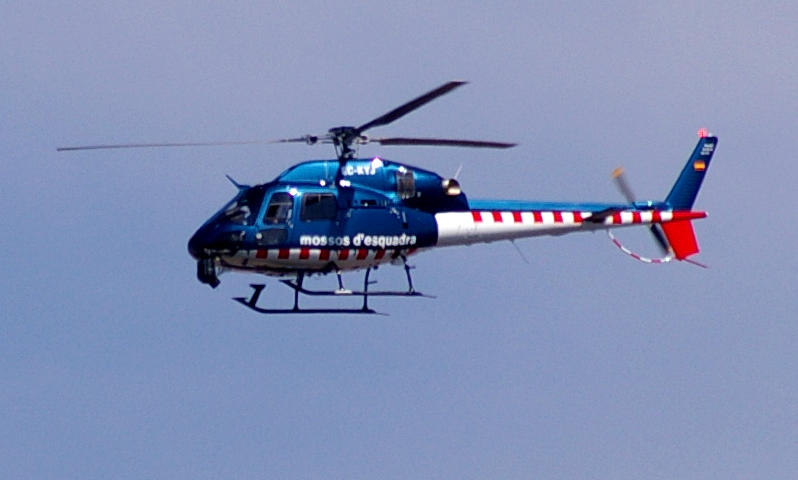
Autonomous police force of Catalonia
| Field | Value |
|---|---|
| agencyname | Mossos d'Esquadra |
| patch | Escut Mossos d’Esquadra.png |
| patchcaption | Patch |
| logo | Mossos d'Esquadra.svg |
| logocaption | Logo |
| commonname | Mossos |
| formed | |
| divname | Catalonia |
| map | Catalonia location map 2023 vegueries.svg |
| sizearea | 32108 km2 |
| sizepopulation | 7,727,029 |
| governingbody | Generalitat de Catalunya |
| legalpersonality | Police force |
| police | yes |
| headquarters | Complex Central Egara, Sabadell (Barcelona), Catalonia, Spain |
| sworntype | Mosso/a |
| sworn | 18.355 (2023) |
| electeetype | Minister |
| minister1name | Núria Marín |
| minister1pfo | Minister of the Interior |
| chief1name | Eduard Sallent i Peña |
| chief1position | Head Commissioner |
| stations | 106 |
| website | mossos.gencat.cat |
The Mossos d'Esquadra (; ), also known as the Policia de la Generalitat de Catalunya and informally as Mossos, is the police force of the autonomous community of Catalonia. Their origins can be traced back to squads formed in 1719, however, after various abolitions and refoundations, the body was definitively reestablished in 1950, becoming the official police of Catalonia in 1983 and being progressively deployed throughout the Catalan territory between 1994 and 2008.
History
Previous Catalan forces
The Escuadras de Paisanos, later known as the Esquadres de Catalunya, (and informally known as the Mossos d'Esquadra), were men-at-arms who had fought as irregulars in the War of the Spanish Succession, and were brought together by the mayor of the town of Valls near Tarragona between 1719 and 1721. The corps was constituted as a militia to provide security to trade routes and fairs. It was created as a complement to the regular troops of the Bourbon army, which opposed the Miquelets, who survived as rebel supporters of Archduke Charles.
The Mossos was manned by local people, who had to speak Catalan and be familiar with local paths, caves, and hiding places. It was eventually placed under military jurisdiction, but was less centralised than the Spanish police force (then known as the Intendencia General de Policía) formed in 1817, or the yet-to-be-established Guardia Civil. Throughout the centuries, control of the Mossos passed back and forth several times from Catalan authority to Spanish military command.
The Mossos were dissolved in 1868 by General Prim after the fall of Queen Isabella II of Spain, since the Mossos had always been royalists. They were reinstated in 1876 under the reign of Isabella's son king Alfonso XII of Spain, but only in the province of Barcelona. Under his son Alfonso XIII of Spain, the Mossos were not well regarded in Catalonia, especially by the Commonwealth of Catalonia, who paid them but had no control over them.
The Mossos flourished under Primo de Rivera's dictatorship; despite this, when the Second Spanish Republic was proclaimed, the Mossos sided with the Generalitat de Catalunya (the government of Catalonia). After the Spanish Civil War, the last Mossos left Catalonia with the President of the Generalitat, and the corps was dissolved by the Francoist authorities until its recreation in 1950.
Current body
On 21 July 1950 the Francoist-controlled Provincial Deputation of Barcelona was authorised to create a small security force using the historical title Mossos d'Esquadra. These new Mossos were a militarized corps having little similarity to the earlier incarnations, with limited powers and small numbers, which was in charge of protecting the government buildings of the Province of Barcelona. With the return of democracy to Spain, the Mossos d'Esquadra grew in number and powers. Since 25 October 1980 the force has been under the authority of the Generalitat de Catalunya.
Current role
The Mossos d'Esquadra have now replaced the Guardia Civil and National Police within the territory of Catalonia. This process of substitution began in 1994 and was completed in 2008.
The Statute of Autonomy of Catalonia (Catalan: Estatut d'Autonomia de Catalunya) defines the scope of action of the Generalitat Police Force – Mossos d'Esquadra as the whole of the Catalan territory, and states that it exercises all the functions of a police force in the following fields:
- Public safety and public order
- Administrative policing, including that deriving from State regulations
- Judicial policing and criminal investigation, including the various forms of organised crime and terrorism, in the terms established by law
- Patrolling and ensuring the safety of highways within Catalonia
The Mossos d'Esquadra operate under the authority of the Generalitat de Catalunya within the territory of the autonomous community of Catalonia (through the Catalan Ministry of Home Affairs; Catalan: Departament d'Interior). The National Police and the Civil Guard, by contrast, are commanded directly by the Spanish Ministry of the Interior. The National Police keep some officers in Catalonia to support anti-terrorism operations, handle identity documents, police immigration, and execute other limited responsibilities of the central government.
The sidearms officers can pick from are the Heckler & Koch USP or the Walther P99 both of which are chambered for 9×19mm. Regular Mossos can also use the Heckler & Koch UMP sub-machine gun, used by the Mossos during the 2017 Barcelona attacks.
The Mossos are trained in the Institut de Seguretat Pública de Catalunya (Public Safety Institute of Catalonia), which also trains local police officers.
| Insignia | Title | English translation | |||
|---|---|---|---|---|---|
| [[File:Ensenya major mossos d'esquadra.png | 100x100px]] | [[File:Ensenya comissari mossos d'esquadra.png | 100x100px]] | [[File:Ensenya intendent mossos d'esquadra.png | 100x100px]] |
| Major | Comissari | Intendent | |||
| Major | Commissioner | Intendent |
Special intervention group (GEI)

The Special Intervention Group (GEI; in Catalan: Grup Especial d'Intervenció) is a Mossos d'Esquadra body that specializes in situations with a high risk of armed violence such as terrorist detention, rescues of hostages, and VIP protection. This group is under the command of the Intervention Division.
This group was created in 1984 with the collaboration of Spezialeinsatzkommando (SEK) of Germany. It was kept secret in anticipation of the security challenges that would be posed with the holding of the Barcelona Olympic Games in 1992. Another rationale for its creation was to transfer responsibility for prisons to the Generalitat de Catalonia; this was felt to require a protocol to deal with riots or hostage-taking.
Armament
The force has a large quantity and variety of weapons. Each of the weapons is assigned only to one GEI.
| Weapon | Origin | Type |
|---|---|---|
| Heckler & Koch P30 | Germany | Sidearm |
| Heckler & Koch USP Compact | ||
| Glock 17 Gen 5 | Austria | |
| Walther P99 | Germany | |
| FN Five-seveN | Belgium | |
| Heckler & Koch MP5 | Germany | Submachine gun |
| Heckler & Koch MP7 | ||
| FN P90 | Belgium | |
| Heckler & Koch G36 | Germany | Assault rifle |
| FN SCAR | Belgium | |
| Heckler & Koch HK417 | Germany | Precision rifle |
| Remington 870 | USA | Shotgun |
| Heckler & Koch PSG1 | Germany | Sniper rifle |
| SAKO TRG-22 | Finland | |
| M110 Semi-Automatic Sniper System | USA | |
| AMP DSR-1 | Germany |
Vehicles
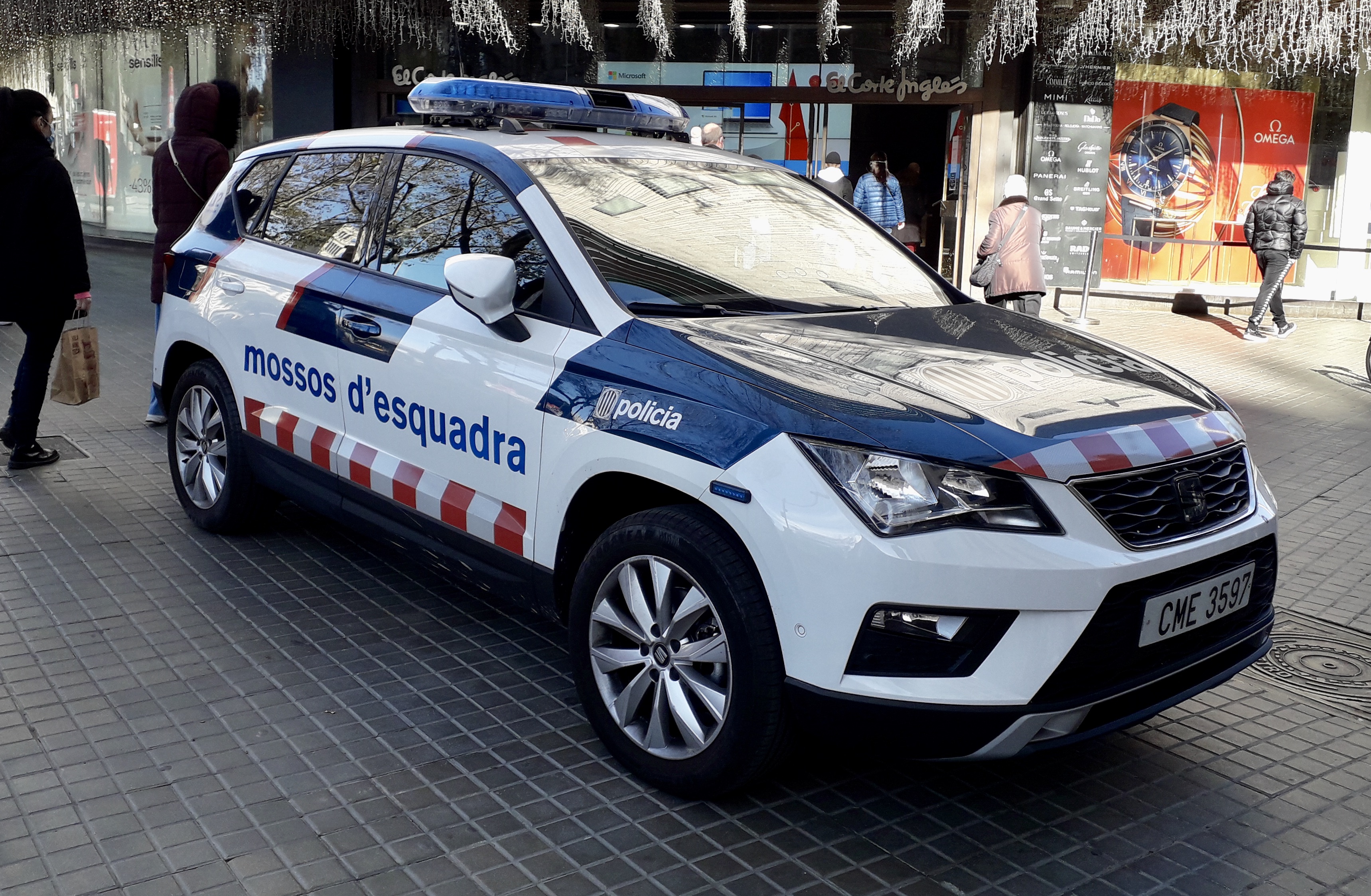
The Mossos employs several makes of vehicles, for both patrol and undercover operations. These vehicles are high-powered SUVs, vans, motorbikes and 4x4 vehicles. They also operate helicopters and drones for aerial operations.
Controversies and legal cases
Controversies related to the Mossos d'Esquadra include:
- In 2008, three Mossos were sentenced to six years of imprisonment for the torture and injury of an alleged delinquent who was later proven not guilty. In 2009, the Tribunal Supremo reduced the sentence. In 2012, the offending Mossos were paroled.
- In 2016, six agents were detained for their involvement in a cardiac failure of a businessman in the Raval neighbourhood.
- In 2017, the central government suspended the Chief of Police Major Trapero during the 2017–18 Spanish constitutional crisis, and also placed the force under investigation. The Mossos were eventually cleared of any wrongdoing and Trapero was reinstated.
Gallery
File:Seat Ateca dels Mossos 01.jpg|Patrol car. File:Llanxa aquàtica Mossos d'Esquadra.jpg|Maritime unit of Mossos d'Esquadra. File:Mollet del Valles-Av Llibertat - Mossos - 2015-05-30 1 - JTCurses.jpg|Old patrol car of the Mossos. File:03-GEI-Octavio-Díez-Cámara-1030x773.jpg|Special Intervention Group of the Mossos. File:Anon mossos retallades.jpg|Mossos of the public order unit (BRIMO) in a protest. File:Vestit blanc.JPG|Equipment for entering the sewers. File:Mossos d'Esquadra Palau de la Generalitat.png|Mosso d'Esquadra in dress uniform. File:Represión sobre liberales en la ciudadela de Barcelona durante el gobierno del Conde de España, los soldados son mosis escuadra.jpg|1714–1719, the soldiers are Mossos d'Esquadra. File:Rastreig d'un bosc durant el s. XIX 2.JPG|Forest tracking in XIX century.
References
References
- "Autonomous Police – Mossos d'Esquadra. Members. By sex and rank. Areas.". Statistical Institute of Catalonia.
- "Police stations". Mossos d'Esquadra.
- "La nostra història".
- (November 2006). "El desplegament de la Policia de la Generalitat – Mossos d'Esquadra". Generalitat de Catalunya.
- [http://web.gencat.cat/en/generalitat/estatut/estatut2006/titol_4/ Statue of Autonomy of Catalonia 2006, Article 164.5 on Public Security]
- "Funcions de la Policia de la Generalitat – Mossos d'Esquadra". Generalitat de Catalunya.
- (2008-11-26). "Seis años de cárcel para tres 'mossos' por torturas y lesiones a un detenido". El País.
- (15 December 2009). "El TS rebaja la pena a los "mossos" condenados por torturas a un detenido". ABC.
- "El Gobierno indulta de nuevo a cuatro Mossos condenados por torturas". La Razón.
- "Los mossos del "caso Benítez" acuerdan a última hora una pena mínima para librarse de la cárcel". abc.
- Shields, Cillian. "Trapero and former Catalan police leadership acquitted by Spain's National Court".
This article was imported from Wikipedia and is available under the Creative Commons Attribution-ShareAlike 4.0 License. Content has been adapted to SurfDoc format. Original contributors can be found on the article history page.
Ask Mako anything about Mossos d'Esquadra — get instant answers, deeper analysis, and related topics.
Research with MakoFree with your Surf account
Create a free account to save articles, ask Mako questions, and organize your research.
Sign up freeThis content may have been generated or modified by AI. CloudSurf Software LLC is not responsible for the accuracy, completeness, or reliability of AI-generated content. Always verify important information from primary sources.
Report