From Surf Wiki (app.surf) — the open knowledge base
Morse potential
Model for the potential energy of a diatomic molecule

Model for the potential energy of a diatomic molecule
The Morse potential, named after physicist Philip M. Morse, is a convenient interatomic interaction model for the potential energy of a diatomic molecule. It is a better approximation for the vibrational structure of the molecule than the quantum harmonic oscillator because it explicitly includes the effects of bond breaking, such as the existence of unbound states. It also accounts for the anharmonicity of real bonds and the non-zero transition probability for overtone and combination bands. The Morse potential can also be used to model other interactions such as the interaction between an atom and a surface. Due to its simplicity (only three fitting parameters), it is not used in modern spectroscopy. However, its mathematical form inspired the MLR (Morse/Long-range) potential, which is the most popular potential energy function used for fitting spectroscopic data.
Potential energy function
The Morse potential energy function is of the form
:V(r) = D_e ( 1-e^{-a(r-r_e)} )^2
Here r is the distance between the atoms, r_e is the equilibrium bond distance, D_e is the well depth (defined relative to the dissociated atoms), and a controls the 'width' of the potential (the smaller a is, the larger the well). The dissociation energy of the bond can be calculated by subtracting the zero point energy E_0 from the depth of the well. The force constant (stiffness) of the bond can be found by Taylor expansion of V'(r) around r=r_e to the second derivative of the potential energy function, from which it can be shown that the parameter, a, is
: a = \sqrt{ \frac{k_e}{2D_e}\ }\ ,
where k_e is the force constant at the minimum of the well.
Since the zero of potential energy is arbitrary, the equation for the Morse potential can be rewritten any number of ways by adding or subtracting a constant value. When it is used to model the atom-surface interaction, the energy zero can be redefined so that the Morse potential becomes
:V(r)= V'(r)-D_e = D_e ( 1-e^{-a(r-r_e)} )^2 -D_e which is usually written as
:V(r) = D_e ( e^{-2a(r-r_e)}-2e^{-a(r-r_e)} )
where r is now the coordinate perpendicular to the surface. This form approaches zero at infinite r and equals -D_e at its minimum, i.e. r=r_e. It clearly shows that the Morse potential is the combination of a short-range repulsion term (the former) and a long-range attractive term (the latter), analogous to the Lennard-Jones potential.
Vibrational states and energies
Like the quantum harmonic oscillator, the energies and eigenstates of the Morse potential can be found using operator methods. One approach involves applying the factorization method to the Hamiltonian.
To write the stationary states on the Morse potential, i.e. solutions \ \Psi_n(r)\ and \ E_n\ of the following Schrödinger equation:
:\left(-\frac{\hbar ^2 }{2 m }\frac{\partial ^2}{\partial r^2}+V(r)\right)\Psi_n(r)=E_n\Psi_n(r)\ ,
it is convenient to introduce the new variables:
: x \equiv a\ r\ \text{;} \quad x_e \equiv a\ r_e\ \text{;} \quad
\lambda \equiv \frac{\ \sqrt{ 2 m D_e\ }\ }{ a \hbar }\ \text{;} \quad
\varepsilon_n \equiv \frac{ 2 m }{\ a^2 \hbar^2\ }\ E_n = \frac{\lambda^2}{D_e}E_n ~.
Then, the Schrödinger equation takes the simplified form:
: \left( -\frac{ \partial^2 }{ {\partial x}^2 } + V(x) \right)\ \Psi_n(x) = \varepsilon_n\ \Psi_n(x)\ , : V(x) = \lambda^2 \left( 1 - e^{-\left( x - x_e \right)} \right)^2 ~. Its eigenvalues (reduced by \ D_e\ ) and eigenstates can be written as: : \varepsilon_n = \lambda^2 - \left(\lambda - n - \tfrac{1}{2} \right)^2 = 2\lambda \left( n +\tfrac{1}{2} \right) - \left( n + \tfrac{1}{2} \right)^2 = \left( 2\lambda - n - \tfrac{1}{2} \right) \left( n + \tfrac{1}{2} \right)\ , where : n = 0,\ 1,\ \ldots\ ,\ \left\lfloor \lambda - \tfrac{1}{2} \right\rfloor\ , with \ \lfloor x \rfloor\ denoting the largest integer smaller than \ x\ , and : \Psi_n(z) = N_n\ z^{\left( \lambda - n - \tfrac{1}{2} \right) }\ e^{\left( - \tfrac{1}{2} z \right) }\ L_n^{ (2 \lambda - 2n - 1 )}(z)\ , where ~ z \equiv 2\ \lambda\ e^{-\left( x - x_e \right)} ~ and ~ N_n \equiv \sqrt{ \frac{\ n! \left( 2\lambda - 2n - 1 \right)\ a\ }{\ \Gamma(2\lambda - n)\ }\ } ~ which satisfies the normalization condition : \int \Psi_n^{*}(r)\ \Psi_n(r)\ \operatorname{d}r = 1
and where \ L_n^{ (\alpha) }(z)\ is a generalized Laguerre polynomial:
: L_n^{ (\alpha) }(z) = \frac{\ z^{-\alpha}\ e^z\ }{ n! }\ \frac{\operatorname{d}^n}{ {\operatorname{d} z}^n } \left( z^{n + \alpha} e^{-z} \right) = \frac{\ \Gamma( \alpha + n + 1)\ \Gamma( \alpha + 1 )\ }{ n! } ; {}_1 F_1( -n,\alpha + 1, z ) ~.
There also exists the following analytical expression for matrix elements of the coordinate operator: : \left\langle \Psi_m \bigl|\ x\ \bigr| \Psi_n \right\rangle = \frac{\ 2\ (-1)^{m-n+1}\ }{\ (m-n)(2N-n-m)\ }\ \sqrt{ \frac{\ (N-n)(N-m)\ \Gamma( 2N - m + 1 )\ m!\ }{\ \Gamma( 2N - n + 1 )\ n!\ }\ } ~. which is valid for ~ m n ~ and ~ N = \lambda - \tfrac{1}{2} ~.
The eigenenergies in the initial variables have the form: : E_n = h\ \nu_0 \left( n + \tfrac{1}{2} \right) - \frac{\ \left[\ h\ \nu_0 \left( n + \tfrac{1}{2} \right)\ \right]^2\ }{ 4\ D_e }
where \ n\ is the vibrational quantum number and \ \nu_0\ has units of frequency. The latter is mathematically related to the particle mass, \ m\ , and the Morse constants via
: \nu_0 = \frac{a}{2\pi} \sqrt{ \frac{\ 2 D_e\ }{ m }\ } ~.
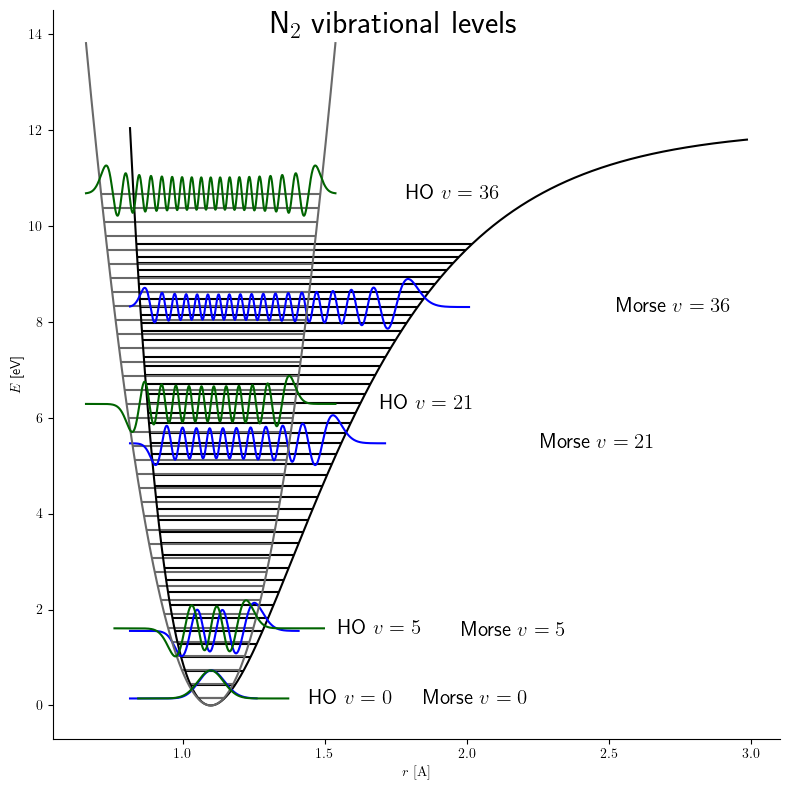
Whereas the energy spacing between vibrational levels in the quantum harmonic oscillator is constant at \ h\ \nu_0\ , the energy between adjacent levels decreases with increasing \ v\ in the Morse oscillator. Mathematically, the spacing of Morse levels is
:E_{n+1} - E_n = h\ \nu_0 - \frac{\ \left( n + 1 \right) \left( h\ \nu_0 \right)^2\ }{ 2 D_e } ~.
This trend matches the inharmonicity found in real molecules. However, this equation fails above some value of \ n_m\ where \ E(n_m + 1) - E(n_m)\ is calculated to be zero or negative. Specifically,
: n_m = \frac{\ 2 D_e - h \nu_0\ }{ h \nu_0 }\ (integer part only).
This failure is due to the finite number of bound levels in the Morse potential, and some maximum \ n_m\ that remains bound. For energies above \ n_m\ , all the possible energy levels are allowed and the equation for \ E_n\ is no longer valid.
Below \ n_m\ , \ E_n\ is a good approximation for the true vibrational structure in non-rotating diatomic molecules. In fact, the real molecular spectra are generally fit to the form
: E_n / hc = \omega_e \left( n + \tfrac{1}{2} \right) - \omega_e\ \chi_e \left( n +\tfrac{1}{2} \right)^2\
in which the constants \ \omega_e\ and \ \omega_e\ \chi_e\ can be directly related to the parameters for the Morse potential. Specifically,
: a = \sqrt{ \frac{\ \pi^2 c\ m\ \omega_e\ \chi_e\ }{ h }\ }
and
: D_e = \frac{ \omega_e }{\ 4 \chi_e\ }
Note that if \ \omega_e\ and \ \omega_e\ \chi_e\ are given in \ \mathsf{cm}^{-1}\ , \ c\ is in cm/s (not m/s), \ m\ is in kg, and \ h\ is in in which case \ a\ will be in \ \mathsf{m}^{-1}\ and \ D_e\ will be in \mathsf{cm}^{-1} ~.
As is clear from dimensional analysis, for historical reasons the last equation uses spectroscopic notation in which \ \omega_e\ represents a wavenumber obeying \ E = h\ c\ \omega\ , and not an angular frequency given by \ E = \hbar\ \omega ~.
Morse/Long-range potential
Main article: Morse/Long-range potential
An extension of the Morse potential that made the Morse form useful for modern (high-resolution) spectroscopy is the MLR (Morse/Long-range) potential. Ca2, KLi, MgH, several electronic states of Li2, Cs2, Sr2, ArXe, LiCa, LiNa, Br2, Mg2, HF, HCl, HBr, HI, MgD, Be2, BeH, and NaH. More sophisticated versions are used for polyatomic molecules.
References
- 1 CRC Handbook of chemistry and physics, Ed David R. Lide, 87th ed, Section 9, SPECTROSCOPIC CONSTANTS OF DIATOMIC MOLECULES pp. 9–82
- {{cite journal
- {{cite journal |hdl-access=free
- {{cite journal
- {{cite journal
- {{cite journal
- {{cite journal
- {{ Cite journal
- Khordad, R; Edet, C.O; and Ikot, A.N. (2022). "Application of Morse potential and improved deformed exponential-type potential (IDEP) model to predict thermodynamics properties of diatomic molecules" International Journal of Modern Physics C 33 (08): 2250106 https://www.worldscientific.com/doi/10.1142/S0129183122501066 doi:10.1142/S0129183122501066
- Varshni, Yatendra Pal, (1957) "Comparative Study of Potential Energy Functions for Diatomic Molecules" Rev. Mod. Phys. 29: 664 doi:10.1103/RevModPhys.29.664
- Kaplan, I.G. (2003) Handbook of Molecular Physics and Quantum Chemistry, Wiley, p207.
- Haynes W M, David R and Lide T J B (eds) (2017) CRC Handbook of Chemistry and Physics, Boca Raton, FL: CRC Press
References
- (2001). "Supersymmetry in Quantum Mechanics". World Scientific.
- (1988). "The Morse oscillator in position space, momentum space, and phase space". The Journal of Chemical Physics.
- (2005). "Matrix elements for the Morse potential under an external field". Journal of Physics B.
- Le Roy, R. J.. (2006). "An accurate analytic potential function for ground-state N2 from a direct-potential-fit analysis of spectroscopic data". Journal of Chemical Physics.
- Le Roy, Robert J.. (2007). "A new potential function form incorporating extended long-range behaviour: application to ground-state Ca2". Molecular Physics.
- Salami, H.. (2007). "A full analytic potential energy curve for the a3Σ+ state of KLi from a limited vibrational data set". Journal of Chemical Physics.
- Shayesteh, A.. (2007). "Ground State Potential Energy Curve and Dissociation Energy of MgH". The Journal of Physical Chemistry A.
- Le Roy, Robert J.. (25 November 2009). "Accurate analytic potentials for Li2(X) and Li2(A) from 2 to 90 Angstroms, and the radiative lifetime of Li(2p)". Journal of Chemical Physics.
- Dattani, N. S.. (8 May 2013). "A DPF data analysis yields accurate analytic potentials for Li2(a) and Li2(c) that incorporate 3-state mixing near the c-state asymptote". Journal of Molecular Spectroscopy.
- (2013). "High-resolution photoassociation spectroscopy of the 6Li2 ''A''(11Σ{{su". Physical Review A.
- (2013). "High-resolution photoassociation spectroscopy of the 6Li2 c-state". Phys. Rev. A.
- Le Roy, R. J.. (February 2011). "Long-range damping functions improve the short-range behaviour of 'MLR' potential energy functions". Molecular Physics.
- Xie, F.. (2011). "Joint analysis of the Cs2 a-state and 1 g (33Π1g ) states". Journal of Chemical Physics.
- Coxon, J. A.. (2010). "The ground X 1Σ+g electronic state of the cesium dimer: Application of a direct potential fitting procedure". Journal of Chemical Physics.
- Stein, A.. (April 2010). "The 1S+1S asymptote of Sr2 studied by Fourier-transform spectroscopy". The European Physical Journal D.
- Piticco, Lorena. (December 2010). "Rovibrational structure and potential energy function of the ground electronic state of ArXe". Journal of Molecular Spectroscopy.
- Ivanova, Milena. (2011). "The X2Σ+ state of LiCa studied by Fourier-transform spectroscopy". Journal of Chemical Physics.
- Steinke, M.. (27 April 2012). "X-state of LiNa studied by Fourier-transform spectroscopy". Physical Review A.
- Yukiya, T.. (January 2013). "Direct-potential-fit analysis for the system of Br2". Journal of Molecular Spectroscopy.
- Knockel, H.. (2013). "The X-state of Mg2 studied by Fourier-transform spectroscopy". Journal of Chemical Physics.
- Li, Gang. (July 2013). "Reference spectroscopic data for hydrogen halides, Part II:The line lists". Journal of Quantitative Spectroscopy & Radiative Transfer.
- (2015). "Improved direct potential fit analyses for the ground electronic states of the hydrogen halides: HF/DF/TF, HCl/DCl/TCl, HBr/DBr/TBr and HI/DI/TI". Journal of Quantitative Spectroscopy and Radiative Transfer.
- Henderson, R. D. E.. (4 October 2013). "Accurate Analytic Potential and Born–Oppenheimer Breakdown Functions for MgH and MgD from a Direct-Potential-Fit Data Analysis". The Journal of Physical Chemistry A.
- (2014). "Direct-potential-fit analyses yield improved empirical potentials for the ground XΣg+1 state of Be2". The Journal of Chemical Physics.
- (2015). "Beryllium monohydride (BeH): Where we are now, after 86 years of spectroscopy". Journal of Molecular Spectroscopy.
- (2015). "Dissociation energies and potential energy functions for the ground X 1Σ+ and "avoided-crossing" A 1Σ+ states of NaH". The Journal of Chemical Physics.
This article was imported from Wikipedia and is available under the Creative Commons Attribution-ShareAlike 4.0 License. Content has been adapted to SurfDoc format. Original contributors can be found on the article history page.
Ask Mako anything about Morse potential — get instant answers, deeper analysis, and related topics.
Research with MakoFree with your Surf account
Create a free account to save articles, ask Mako questions, and organize your research.
Sign up freeThis content may have been generated or modified by AI. CloudSurf Software LLC is not responsible for the accuracy, completeness, or reliability of AI-generated content. Always verify important information from primary sources.
Report