From Surf Wiki (app.surf) — the open knowledge base
Moroccans
People of Morocco

People of Morocco
| Field | Value |
|---|---|
| group | Moroccans |
| المغاربة | |
| image | Map of the Moroccan Diaspora in the World.svg |
| caption | Map of the Moroccan diaspora in the world |
| population | **** |
| popplace | Morocco |
| 38,700,000 | |
| region2 | France |
| pop2 | 1,314,000 |
| ref2 | |
| region3 | Spain |
| pop3 | 1,026,371 |
| ref3 | |
| region4 | Belgium |
| pop4 | 530,000 |
| ref4 | |
| region5 | Italy |
| pop5 | 487,249 |
| ref5 | |
| region6 | Israel |
| pop6 | 472,800 |
| ref6 | |
| region7 | Netherlands |
| pop7 | 419,272 |
| ref7 | |
| region8 | Germany |
| pop8 | 240,000 |
| ref8 | |
| region9 | US |
| pop9 | 120,402 |
| ref9 | |
| region10 | Canada |
| pop10 | 103,945 |
| ref10 | |
| region11 | United Arab Emirates |
| pop11 | 100,000 |
| ref11 | |
| region12 | Libya |
| pop12 | 100,000 |
| region13 | United Kingdom |
| pop13 | 70,000 |
| ref13 | |
| region14 | Algeria |
| pop14 | 63,000 |
| ref14 | |
| region15 | Saudi Arabia |
| pop15 | 60,000 |
| ref15 | |
| region16 | Malaysia |
| pop16 | 48,000 |
| region19 | Denmark |
| pop19 | 12,391 |
| ref19 | |
| region17 | Sweden |
| pop17 | 17,602 |
| ref17 | |
| region18 | Norway |
| pop18 | 13,008 |
| ref18 | |
| region20 | Qatar |
| pop20 | 9,000 |
| ref20 | |
| region21 | Switzerland |
| pop21 | 7,270 |
| ref21 | |
| region22 | Ukraine |
| pop22 | 7,000 |
| ref22 | |
| region23 | Australia |
| pop23 | 4,200 |
| ref23 | |
| region24 | Finland |
| pop24 | 4,106 |
| region25 | Portugal |
| pop25 | 4,000 |
| ref25 | |
| region26 | Oman |
| pop26 | 4,000 |
| ref26 | |
| region27 | Brazil |
| pop27 | 3,991 |
| ref27 | |
| region28 | Russia |
| pop28 | 3,400 |
| region29 | South Africa |
| pop29 | 2,100 |
| region30 | Greece |
| pop30 | 2,000 |
| region31 | Ivory Coast |
| pop31 | 1,800 |
| region32 | Mauritania |
| pop32 | 1,056 |
| region33 | Poland |
| pop33 | 1,000 |
| region34 | Hungary |
| pop34 | 1,000 |
| region35 | China |
| pop35 | 1,000 |
| region36 | Mexico |
| pop36 | 1,000 |
| region37 | Venezuela |
| pop37 | 1,000 |
| region38 | New Caledonia |
| pop38 | 1,000 |
| region39 | Gibraltar |
| pop39 | 1,000 |
| region40 | Malta |
| pop40 | 1,000 |
| languages | Majority: Arabic (Moroccan, Modern Standard, Hassaniya, Saharan) |
| Minority: Berber languages (Tashelhit, Tarifit, Tamazight) | |
| religions | Majority: Sunni Islam |
| Minority: Non-denominational Islam, Shia Islam, Judaism, Christianity | |
| native_name_lang | ar |
المغاربة 38,700,000 Minority: Berber languages (Tashelhit, Tarifit, Tamazight) Minority: Non-denominational Islam, Shia Islam, Judaism, Christianity
Moroccans () are the citizens and nationals of Morocco. The country's population is predominantly composed of Arabs and Berbers. The term also applies more broadly to any people who share a common Moroccan culture and identity, as well as those who natively speak Moroccan Arabic or other languages of Morocco.
In addition to the approximately 37 million residents of Morocco, there is a large Moroccan diaspora. Considerable Moroccan populations can be found in France, Spain, Belgium, Italy, and the Netherlands; with smaller notable concentrations in other Arab states as well as Germany, the United Kingdom, the United States, and Canada.
Ethnic groups
Main article: Demographics of Morocco, Arabs, Berbers
In Morocco, ethnic identity is deeply intertwined with language and culture, with the population primarily comprising two major groups: Arabs and Berbers. Moroccans are primarily of Arab and Berber origin as in other neighboring countries in the Maghreb region. Arabs form the largest and majority ethnic group, making up between 65% and 80% of the Moroccan population. It is estimated that the indigenous Berbers constitute between 30% and 35% of the population.
According to Encyclopædia Britannica, 44% of Moroccans are Arab, 24% are Arabized Berbers, 21% are Berbers and 10% are Mauritanian Moors. Additionally, Minority Rights Group International estimates that around 90,000 Sahrawis reside in internationally recognized Morocco, compared to approximately 190,000 in the disputed Western Sahara. Socially, there are two contrasting groups of Moroccans: those living in the cities and those in the rural areas. Among the rural, several classes have formed such as landowners, peasants, and tenant farmers. Moroccans live mainly in the north and west portions of Morocco. However, they prefer living in the more fertile regions near the Mediterranean Sea.
The Arab population of Morocco is a result of the inflow of nomadic Arab tribes from the Arabian Peninsula since the Muslim conquest of the Maghreb in the 7th century with a major wave in the 11th century. Since the 7th century, the influx of Arab migrants from the Arabian Peninsula has contributed to shaping Morocco's demographic, cultural, and genetic landscape. The major migration to the region by Arab tribes was in the 11th century when the tribes of Banu Hilal and Banu Sulaym, along with others, were sent by the Fatimids to defeat a Berber rebellion and then settle in the Maghreb. According to Ibn Khaldun, whole tribes set off with women, children, ancestors, animals and camping equipment. These tribes, who arrived in the region of Morocco around the 12th-13th centuries, and later the Ma'qil in the 14th century, contributed to a more extensive ethnic, genetic, cultural, and linguistic Arabization of Morocco over time, especially beyond the major urban centres and the northern regions which were the main sites of Arabization up to that point.
A small minority of the population are identified as Haratin and Gnawa, These are sedentary agriculturalists of non-Arab and non-Berber origin, who inhabit the southern and eastern oases and speak either Berber or Arabic. Even though it is commonly believed that the Haratin all descend from West African slaves, many of them were native to southern Morocco descending from black people who inhabited the Draa since time immemorial. Some parts of the population are descendants of refugees who fled Spain after the Reconquista in the 15th century called Moriscos. The Trans-Saharan slave trade brought a population of Sub-Saharan Africans to Morocco. After the founding of Israel and start of the Arab-Israeli conflict in 1948, many Jews felt compelled to leave Morocco especially after the anti-Jewish riots in Oujda, and many fled to Israel, Europe, and North America, and by 1967, 250,000 Jews left Morocco.
History
Main article: History of Morocco
Early Arab era (670–1031)
Main article: Umayyad Caliphate, Idrisid dynasty, Fatimid Caliphate, Caliphate of Córdoba
In 670 AD, the first Arab conquest of the North African coastal plain took place under Uqba ibn Nafi, a general serving under the Umayyad Caliphate, marking the first wave of Arab migration to Morocco. Arab tribes such as Banu Muzaina migrated, and the Arab Muslims in the region had more impact on the culture of the Maghreb than the region's conquerors before and after them. The Umayyads brought their language, their system of government, and Islam to Morocco and many Berbers converted to Islam. The first independent state in the area of modern Morocco was the Emirate of Nekor, an Arab emirate in north Morocco ruling as a client state of the Umayyad Caliphate. It was founded by the Himyarite descendant Salih ibn Mansur in 710. After the outbreak of the Berber Revolt in 739, the Berbers formed other independent states such as the Emirate of Sijilmasa and the Barghawata Confederation.
After the Battle of Fakhkh in 786, Idris ibn Abdallah, who traced his ancestry back to Ali ibn Abi Talib, fled from the Arabian Peninsula to Morocco. He first went to Tangier before going to Walili and founding the Arab Idrisid dynasty in 788, ruling most of Morocco. The Idrisids established Fes as their capital and Morocco became a centre of Muslim learning and a major regional power. The Idrisids were ousted in 927 by the Fatimid Caliphate and their Miknasa allies. After Miknasa broke off relations with the Fatimids in 932, they were removed from power by the Maghrawa of Sijilmasa in 980. In 973, the Caliphate of Cordoba under the Umayyads took over parts of Morocco.
Berber dynasties (1053–1549)
Main article: Almoravid dynasty, Almohad Caliphate, Marinid Sultanate
From the 11th century onwards, a series of dynasties of Berber origin arose. Under the Almoravid dynasty and the Almohad dynasty dominated the Maghreb, much of present-day Spain and Portugal, and the western Mediterranean region. In the 13th and 14th centuries the Merinids held power in Morocco and strove to replicate the successes of the Almohads by military campaigns in Algeria and Iberia. They were followed by the Wattasids. In the 15th century, the Reconquista ended Muslim rule in central and southern Iberia and many Muslims and Jews fled to Morocco. Portuguese efforts to control the Atlantic coast in the 15th century did not greatly affect the interior of Morocco. According to Elizabeth Allo Isichei, "In 1520, there was a famine in Morocco so terrible that for a long time other events were dated by it. It has been suggested that the population of Morocco fell from 5 to under 3 million between the early sixteenth and nineteenth centuries."
Arab dynasties (1549–present)
Main article: Saadi Sultanate, 'Alawi dynasty
The major migration to the region by Arab tribes was in the 11th century when the tribes of Banu Hilal and Banu Sulaym, along with others, were sent by the Fatimids to defeat a Berber rebellion and then settle in the Maghreb. These tribes advanced in large numbers all the way to Morocco, contributing to a more extensive ethnic, genetic, cultural, and linguistic Arabization in the region. The Arab tribes of Maqil migrated to the Maghreb a century later and even immigrated southwards to Mauritania.
From 1549, a series of Arab dynasties arose. First the Saadian dynasty who ruled from 1549 to 1659, and then the 'Alawi dynasty, who remain in power since the 17th century. Both dynasties are Sharifian.
Under the Saadian dynasty, the country repulsed Ottoman incursions and a Portuguese invasion at the battle of Ksar el Kebir in 1578. The reign of Ahmad al-Mansur brought new wealth and prestige to the Sultanate, and a large expedition to West Africa inflicted a crushing defeat on the Songhay Empire in 1591. However, managing the territories across the Sahara proved too difficult. After the death of al-Mansur the country was divided among his sons. The Saadi dynasty is credited with the birth of a Moroccan national consciousness. Historian Dahiru Yahaya describes it as the "most lasting impact that the Saʿdīs had upon Morocco".
In 1666, Morocco was reunited by the Arab 'Alawi dynasty, who have been the ruling house of Morocco ever since. Morocco was facing aggression from Spain and the Ottoman Empire lies pressing westward. The 'Alawis succeeded in stabilizing their position, and while the kingdom was smaller than previous ones in the region, it remained quite wealthy. Against the opposition of local tribes Ismail Ibn Sharif (1672–1727) began to create a unified state.
Morocco was the first nation to recognize the fledgling United States as an independent nation in 1777. In the beginning of the American Revolution, American merchant ships in the Atlantic Ocean were subject to attack by the Barbary pirates. On 20 December 1777, Morocco's Sultan Mohammed III declared that American merchant ships would be under the protection of the sultanate and could thus enjoy safe passage. The Moroccan–American Treaty of Friendship, signed in 1786, stands as the U.S.'s oldest non-broken friendship treaty.
Genetic composition
Main article: Genetic studies on Moroccans
| Population | Language | n | E | G | I | J1 | L | N | R1 | T | Reference | Morocco | Arabs (Morocco) | Arabs (Morocco) | Arabs (Morocco) | Berbers (North Morocco) | Berbers (Marrakesh) | Berbers (Middle Atlas) | Berbers (South Morocco) | Berbers (Central Morocco) | Rifians | Sahrawi (Morocco) | Jews (Morocco) | |||||||||||
|---|---|---|---|---|---|---|---|---|---|---|---|---|---|---|---|---|---|---|---|---|---|---|---|---|---|---|---|---|---|---|---|---|---|---|
| AA (Semitic) | 51 | 73 | — | — | 20 | — | — | 4 | — | Onofri et al. 2008 | ||||||||||||||||||||||||
| AA (Semitic) | 87 | 52.8 | — | — | 26.4 | — | — | — | — | Fadhlaoui-Zid et al. 2013 | ||||||||||||||||||||||||
| AA (Semitic) | 28 | 14.3 | — | 3.6 | 60.7 | — | — | 17.8 | — | Underhill et al. 2000 | ||||||||||||||||||||||||
| AA (Semitic) | 49 | — | — | — | — | Semino et al. 2004 | ||||||||||||||||||||||||||||
| AA (Berber) | 63 | 87 | — | — | 11.1 | — | — | — | — | Bosch et al. 2001 | ||||||||||||||||||||||||
| AA (Berber) | 29 | — | — | — | — | — | — | — | Semino et al. 2000 | |||||||||||||||||||||||||
| AA (Berber) | 69 | — | — | 5.8 | — | — | — | — | Cruciani et al. 2004 | |||||||||||||||||||||||||
| AA (Berber) | 62 | — | 0 | 10.0 | 0 | 0 | — | 0 | Bosch et al. 2001 | |||||||||||||||||||||||||
| AA (Berber) | 40 | 93.8 | — | 0 | 11.1 | 0 | 0 | — | 0 | Bosch et al. 2001 | ||||||||||||||||||||||||
| AA (Berber) | 54 | — | — | — | — | — | — | — | — | Dugoujon 2005 | ||||||||||||||||||||||||
| AA (Semitic) | 89 | 59.5 | — | — | 20.2 | — | — | — | — | Fregel et al. 2009 | ||||||||||||||||||||||||
| AA (Semitic) | 19 | 21.1 | 26.3 | — | 31.5 | — | — | 10.5 | — | Francalacci et al. 2008 |
Geographic distribution
Morocco
Main article: Demographics of Morocco
Morocco has a population of around inhabitants ( estimate). Morocco's population was 11.6 million in 1960. In 2024, 49.7% of the population is female, while 50.3% of it is male. According to the 2014 Morocco population census, there were around 84,000 immigrants in the country. Of these foreign-born residents, most were of French origin, followed by individuals mainly from various nations in West Africa and Algeria. There are also a number of foreign residents of Spanish origin. Some of them are descendants of colonial settlers, who primarily work for European multinational companies, while others are married to Moroccans or are retirees. Prior to independence, Morocco was home to half a million Europeans, most of whom were Christians. Also, prior to independence, Morocco was home to 250,000 Spaniards. Morocco's once prominent Jewish minority has decreased significantly since its peak of 265,000 in 1948, declining to around 3,500 in 2022.
Moroccan diaspora
Main article: Moroccan diaspora
Morocco has a large diaspora, most of which is located in France, which has reportedly over one million Moroccans of up to the third generation. There are also large Moroccan communities in Spain (about 700,000 Moroccans), the Netherlands (360,000), and Belgium (300,000). Other large communities can be found in Italy, Canada, the United States and Israel, where Moroccan Jews are thought to constitute the second biggest Jewish ethnic subgroup. Morocco is also the country with the largest Berber population in the world, with estimates typically ranging between 40–60% of the population.
Culture
Main article: Culture of Morocco

The culture of Morocco is a blend of Arab, Berber, Jewish, and Western European cultures. Through Moroccan history, the country had many cultural influences (Europe, Middle East and sub-Saharan Africa). The culture of Morocco shares similar traits with those of neighboring countries, particularly Algeria and Tunisia and to a certain extent Spain.
Each region possesses its own uniqueness, contributing to the national culture. Morocco has set among its top priorities the protection of its diversity and the preservation of its cultural heritage.
The traditional dress for men and women is called djellaba (جلابة), a long, loose, hooded garment with full sleeves. For special occasions, men also wear a red cap called a bernousse, more commonly known as a fez. Women wear kaftans decorated with ornaments. Nearly all men, and most women, wear balgha (بلغة). These are soft leather slippers with no heel, often dyed yellow. Women also wear high-heeled sandals, often with silver or gold tinsel.
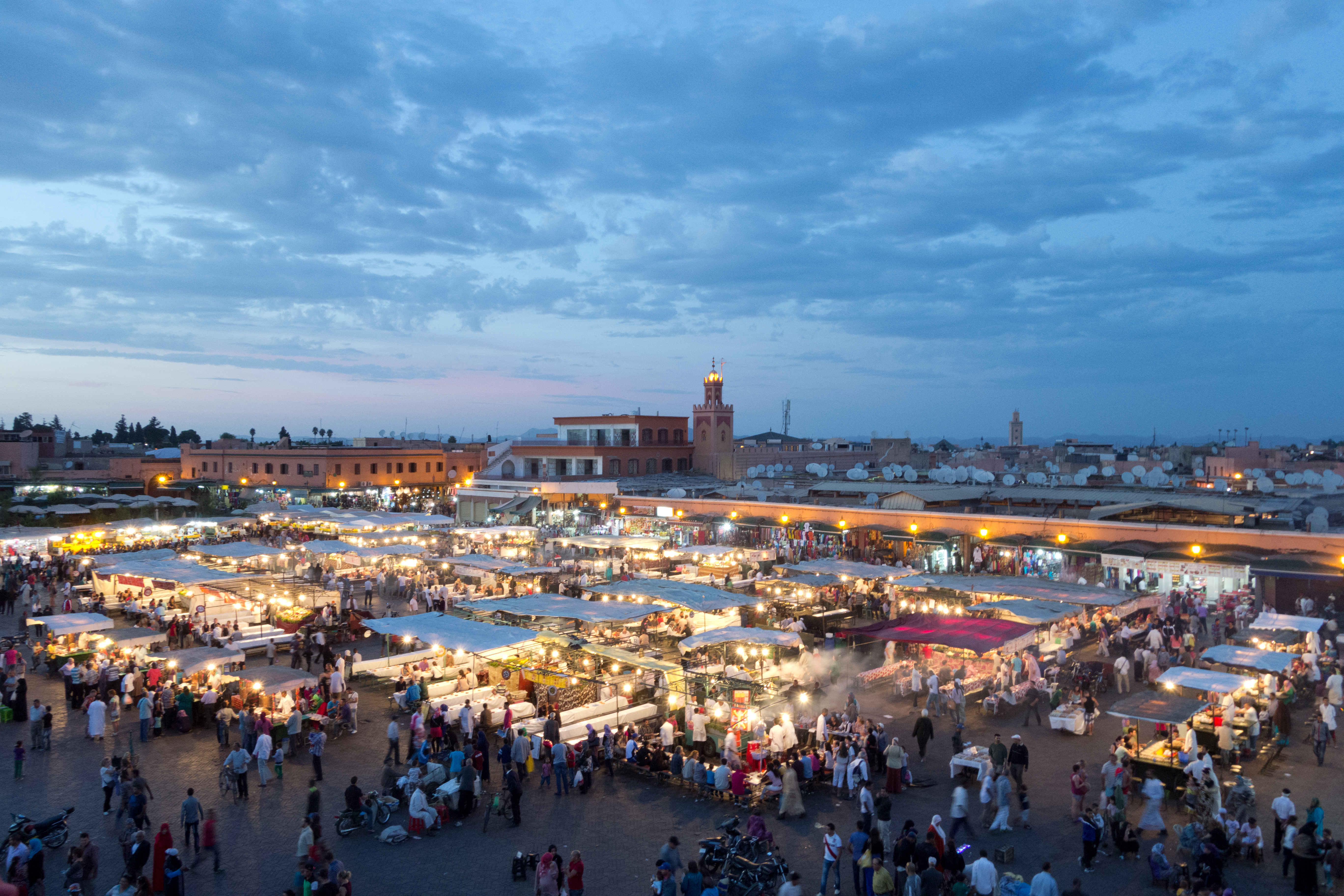
Moroccan style is a new trend in decoration, which takes its roots from Moorish architecture. It has been made popular by the vogue of riad renovation in Marrakech. Dar is the name given to one of the most common types of domestic structures in Morocco; it is a home found in a medina, or walled urban area of a city. Dar exteriors are typically devoid of ornamentation and windows, except occasional small openings in secondary quarters, such as stairways and service areas. These piercings provide light and ventilation. Moroccan cuisine primarily consists of a blend of Arab, Berber, and Andalusi influences. It is known for dishes like couscous and pastilla, among others. Spices such as cinnamon are also used in Moroccan cooking. Sweets like halwa are popular, as well as other confections. Cuisines from neighboring areas have also influenced the country's culinary traditions. Additionally, Moroccan craftsmanship has a rich tradition of jewellery-making, pottery, leather-work and woodwork.
_в_Тан-Тане_(Марокко).jpg)
The music of Morocco ranges and differs according to the various areas of the country. Moroccan music has a variety of styles from complex sophisticated orchestral music to simple music involving only voice and drums. There are three varieties of folk music: village and ritual music, and the music performed by professional musicians. Chaabi (الشعبي) is a music consisting of numerous varieties which descend from the multifarious forms of Moroccan folk music. Chaabi was originally performed in markets, but is now found at any celebration or meeting. Gnawa is a form of music that is mystical. It was gradually brought to Morocco by the Gnawa and later became part of the Moroccan tradition. Sufi brotherhoods (tariqas) are common in Morocco, and music is an integral part of their spiritual tradition. This music is an attempt at reaching a trance state which inspires mystical ecstasy.
Cuisine
Main article: Moroccan cuisine

Moroccan cuisine is considered one of the most diversified cuisines in the world. This is a result of the centuries-long interaction of Morocco with the outside world. The cuisine of Morocco is mainly a fusion of Moorish, European and Mediterranean cuisines. Spices are used extensively in Moroccan cuisine. While spices have been imported to Morocco for thousands of years, many ingredients such as saffron from Tiliouine, mint and olives from Meknes, and oranges and lemons from Fez, are home-grown.
Chicken is the most widely eaten meat in Morocco. The most commonly eaten red meat in Morocco is beef; lamb is preferred but is relatively expensive. The main Moroccan dish most people are familiar with is couscous, the old national delicacy. Beef is the most commonly eaten red meat in Morocco, usually eaten in a tagine with vegetables or legumes. Chicken is also very commonly used in tagines; one of the most famous tagine is the tagine of chicken, potatoes and olives. Lamb is also consumed, but as Northwest African sheep breeds store most of their fat in their tails, Moroccan lamb does not have the pungent flavor that Western lamb and mutton have. Poultry is also very common, and the use of seafood is increasing in Moroccan food. In addition, there are dried salted meats and salted preserved meats such as kliia/khlia and "g'did" which are used to flavor tagines or used in "el ghraif", a folded savory Moroccan pancake.
Among the most famous Moroccan dishes are Couscous, Pastilla (also spelled Bsteeya or Bestilla), Tajine, Tanjia and Harira. Although the latter is a soup, it is considered a dish in itself and is served as such or with dates especially during the month of Ramadan. Pork consumption is forbidden in accordance with Sharia, religious laws of Islam.
A big part of the daily meal is bread. Bread in Morocco is principally from durum wheat semolina known as khobz. Bakeries are very common throughout Morocco and fresh bread is a staple in every city, town and village. The most common is whole grain coarse ground or white flour bread. There are also a number of flat breads and pulled unleavened pan-fried breads. The most popular drink is "atai", green tea with mint leaves and other ingredients.
Languages
Main article: Languages of Morocco

Morocco's official languages are Modern Standard Arabic and Berber.
The majority of the population speaks Moroccan Arabic. According to the 2024 Moroccan census, 92.7% of the population spoke Arabic, whereas 24.8% spoke Berber languages. The census also indicated that 99.2%, or almost the entire literate population of Morocco, could read and write in Arabic, while only 1.5% of the population could read and write in Berber. The census also reveals that 80.6% of Moroccans consider Arabic to be their native language, while 18.9% regard any of the various Berber languages as their mother tongue.
Hassaniya Arabic is spoken in the southern part of the country, spoken by over 200,000 people. Morocco has recently included the protection of Hassaniya in the constitution as part of the July 2011 reforms.
French is taught universally and still serves as Morocco's primary language of commerce and economics; it is also used in education, sciences, government and most education fields.
Spanish is also spoken in the northern and southern parts of the country as a secondary foreign language after French. Meanwhile, English is increasingly becoming more popular among the educated, particularly in the science fields.
Religion
Main article: Religion in Morocco
In 2010, the Pew Forum estimated that 99% of Morocco's population was Muslim, with all other religious groups making up less than 1%. The majority of Moroccan Muslims follow the Maliki Sunni school of thought, while other significant groups include adherents of Zahirism and non-denominational Muslims. With a deep-rooted history in Morocco, Islam remains the dominant faith. Since Islamic culture profoundly influences Moroccan society, many Moroccans are considered nominal or cultural Muslims. The rhythm of life for Moroccans is dictated by religious celebrations throughout the year, such as Ramadan and Eid Al Adha. During these celebrations, most of them being public holidays, Moroccans focus on praying and spending time with their family. Moroccans also celebrate al-Mawlid al-Nabawi, the birthday of Muhammad, and the Islamic New Year.
Moroccan Jews form an ancient community dating back to Roman times, with Jewish migration to the region beginning as early as 70 CE. A second wave of Jewish immigrants arrived from the Iberian Peninsula during and after the issuance of the 1492 Alhambra Decree, which expelled Jews from Spain, followed shortly by their expulsion from Portugal. This wave significantly influenced Moroccan Jewry, leading to the widespread adoption of the Andalusian Sephardic liturgy and a shift toward a predominantly Sephardic identity. Before the establishment of the State of Israel in 1948, Morocco had approximately 265,000 Jews, making it home to the largest Jewish community in the Muslim world. Today, the historic Jewish community of Morocco is estimated to number around 2,000. The majority of Moroccan Jews emigrated, primarily to Israel and France. As of 2019, Israel was home to approximately 472,800 Jews of Moroccan descent, accounting for around 5% of the country's total population.
Christianity in Morocco dates back to Roman times when it was practiced by Christian Berbers in the Roman province of Mauretania Tingitana. However, its presence began to decline following the Islamic conquests in the 7th century. Indigenous Christianity in North Africa persisted after the Muslim conquest until the early 15th century. During the French and Spanish protectorates, Morocco had a significant Catholic population. On the eve of independence, an estimated 470,000 Catholics lived in the country, and Catholicism held a strong historical legacy and influence. Today, Christianity is the second-largest religion in Morocco. The number of Moroccan converts to Christianity, most of whom practice in secret, is estimated to range between 8,000 and 50,000. Since the 1960s, an increasing number of Moroccan Muslims have converted to Christianity. Additionally, among the Moroccan diaspora, there are Christian communities; for example, according to a 2020 national survey conducted by INSEE, 5% of people of Moroccan origin in France identified as Christian.
References
References
- (2022). "Horloge de la population". [[Haut Commissariat au Plan.
- "Présentation du Maroc".
- (2011). "Répartition des étrangers par nationalité en 2011". INSEE.
- "Répartition des étrangers par nationalité". INSEE.
- "Être né en France d'un parent immigré". INSEE.
- [http://www.insee.fr/fr/themes/document.asp?reg_id=0&ref_id=IMMFRA12_g_Flot1_pop Fiches thématiques - Population immigrée - Immigrés - Insee Références - Édition 2012], Insee 2012
- "Esta es la población residente en España en 2024 que ha nacido en el extranjero: número de personas según su país de origen".
- (26 September 2024). "Se dispara la llegada de marroquíes: más de un millón residen ya en España y se suman 200.000 en dos años".
- "Población por comunidades y provincias, país de nacimiento, edad (Grupos quinquenales) y sexo".
- (20 February 2014). "Les Marocains, 1ère communauté hors UE affiliée à la sécurité sociale espagnole".
- (2 March 2016). "90 secondes pour comprendre pourquoi beaucoup de Marocains sont venus s'installer en Belgique dès 1964".
- Mahieu, Rilke. (2020). "Diaspora Policies, Consular Services and Social Protection for Moroccan Citizens Abroad". Springer International Publishing.
- "Marocchini in Italia - statistiche e distribuzione per regione".
- (2016). "The Moroccan Community".
- "הלשכה המרכזית לסטטיסטיקה - cbs.gov.il".
- (2009-11-13). "Statistical Abstract of Israel 2009 - No. 60 Subject 2 - Table No. 24".
- "CBS StatLine - Bevolking; generatie, geslacht, leeftijd en herkomstgroepering, 1 januari".
- "Population in private households by migrant background in the wider sense and by selected countries of birth, selected countries".
- "Table B04006 - People Reporting Ancestry - 2020 American Community Survey 5-Year Estimates". [[United States Census Bureau]].
- Statistics Canada. "Immigration and Ethnocultural Diversity Highlight Tables".
- Lamiaâ Khalloufi. (23 November 2013). "Soirée artistique en l'honneur de la communauté marocaine".
- "Archived copy".
- "Marocains à l'étrangeret etrangers au Maroc".
- "Chômage en Arabie Saoudite: Les MRE irréguliers sous menace d'expulsion".
- (11 August 2025). "National statistics of Denmark". statistikbanken.dk.
- (December 2024). "Befolkning efter födelseland och ursprungsland, 31 december 2024, totalt". Statistiska centralbyrån.
- "Immigrants and Norwegian-born to immigrant parents".
- Snoj, Jure. (7 December 2014). "Population of Qatar by nationality". bq magazine.
- "Väestö 31.12. Muuttujina Alue, Taustamaa, Sukupuoli, Vuosi ja Tiedot".
- "مجلس الجالية المغربية بالخارج - إفطار جماعي مغربي في لشبونة البرتغالية".
- [https://www.nepo.unicamp.br/observatorio/bancointerativo/numeros-imigracao-internacional/sincre-sismigra/ Immigrants in Brazil (2024, in Portuguese)]
- (10 February 2014). "Immigrant and Emigrant Populations by Country of Origin and Destination {{!}} migrationpolicy.org".
- (10 February 2014). "Immigrant and Emigrant Populations by Country of Origin and Destination {{!}} migrationpolicy.org".
- (10 February 2014). "Immigrant and Emigrant Populations by Country of Origin and Destination {{!}} migrationpolicy.org".
- (10 February 2014). "Immigrant and Emigrant Populations by Country of Origin and Destination {{!}} migrationpolicy.org".
- (10 February 2014). "Immigrant and Emigrant Populations by Country of Origin and Destination {{!}} migrationpolicy.org".
- (10 February 2014). "Immigrant and Emigrant Populations by Country of Origin and Destination {{!}} migrationpolicy.org".
- (10 February 2014). "Immigrant and Emigrant Populations by Country of Origin and Destination {{!}} migrationpolicy.org".
- (10 February 2014). "Immigrant and Emigrant Populations by Country of Origin and Destination {{!}} migrationpolicy.org".
- (10 February 2014). "Immigrant and Emigrant Populations by Country of Origin and Destination {{!}} migrationpolicy.org".
- (25 April 2017). "Religious Beliefs In Morocco".
- [http://www.refworld.org/docid/4f4361e72.html Morocco: General situation of Muslims who converted to Christianity, and specifically those who converted to Catholicism; their treatment by Islamists and the authorities, including state protection (2008–2011)]. Refworld.org. Retrieved on 12 June 2016.
- Erwin Fahlbusch. (2003). "The Encyclopedia of Christianity". Wm. B. Eerdmans Publishing.
- (23 March 2015). "'House-Churches' and Silent Masses —The Converted Christians of Morocco Are Praying in Secret – VICE News".
- Carnes, Nat. (2012). "Al-Maghred, the Barbary Lion: A Look at Islam". University of Cambridge Press.
- "Morocco - The World Factbook".
- "Moroccan Arabs of Morocco".
- Mahieu, Rilke. (2020). "Diaspora Policies, Consular Services and Social Protection for Moroccan Citizens Abroad". Springer International Publishing.
- (2012). "The Report: Morocco 2012". Oxford Business Group.
- El Haimeur, Amar. (2017). "Ethnolinguistic Identity in Morocco". Field Notes: A Journal of Collegiate Anthropology.
- "Maroc: population".
- Bosch, Elena et al. "Genetic structure of north-west Africa revealed by STR analysis." European Journal of Human Genetics (2000) 8, 360–366. Pg. 365
- (1997). "Genetic Disorders Among Arab Populations". Oxford University Press.
- (2015-04-22). "Sustainable Development and Human Security in Africa: Governance as the Missing Link". CRC Press.
- (2012). "The Report: Morocco 2012". Oxford Business Group.
- (2002-12-26). "Encyclopedic World Atlas". Oxford University Press, USA.
- Sun, Xiaoming. (2019-12-12). "World Health Systems". John Wiley & Sons.
- Arnold, Guy. (2014-01-27). "Guide to African Political and Economic Development". Routledge.
- (2017-08-01). "Who Are the Berber People?".
- (23 August 2024). "Climate of Morocco".
- "Saharawis in Western Sahara".
- (2001). "The Encyclopedia of World History: Ancient, Medieval, and Modern, Chronologically Arranged". [[Houghton Mifflin Harcourt]].
- (February 2017). "Recent Historical Migrations Have Shaped the Gene Pool of Arabs and Berbers in North Africa". Molecular Biology and Evolution.
- (1966). "Ibn Khaldun, laudateur et contempteur des Arabes". Revue de l'Occident Musulman et de la Méditerranée.
- (1998). "Peuplement et arabisation au Maghreb occidental: dialectologie et histoire". Casa de Velazquez.
- "Morocco - University of Texas Libraries GeoData".
- "Morocco - Climate {{!}} Britannica".
- (2015-04-22). "Sustainable Development and Human Security in Africa: Governance as the Missing Link". CRC Press.
- Khazaal, Natalie. (2013-08-01). "Re-evaluating Mohamed Choukri's Autobiography Al-Khubz al-Ḥāfi: The Oppression of Morocco's Amazigh Population, the Ṣaʿālīk, and Backlash". Middle Eastern Literatures.
- J. Desanges, "The proto-Berbers" 236–245, at 237, in ''General History of Africa, v.II Ancient Civilizations of Africa'' (UNESCO 1990).
- Mário Curtis Giordani, ''História da África. Anterior aos descobrimentos'' (Petrópolis, Brasil: Editora Vozes 1985) at 42–43, 77–78. Giordani references Bousquet, ''Les Berbères'' (Paris 1961).
- "Demographics of Morocco".
- Mohamed, Mohamed Hassan. (2012-02-22). "Between Caravan and Sultan: The Bayruk of Southern Morocco: A Study in History and Identity". [[Brill Publishers.
- El Hamel, Chouki. (2006). "Diasporic Africa: A Reader". [[NYU Press]].
- el-Hasan, Hasan Afif. (2019-05-01). "Killing the Arab Spring". Algora Publishing.
- Picard, Christophe. (2018-01-21). "Sea of the Caliphs". Harvard University Press.
- Georges Duby, ''Atlas Historique Mondial'', Larousse Ed. (2000), pp.220 & 224 ({{ISBN. 2702828655)
- ''Idris I'', D. Eustache, The Encyclopaedia of Islam, Vol. III, ed. B.Lewis, V. L. Menage, C. Pellat and J. Schact, (Brill, 1986), 1031.
- Benchekroun, Chafik T.. (2018). "Idrīsids". Brill Online.
- Abun-Nasr, Jamil. (1987). "A history of the Maghrib in the Islamic period". Cambridge University Press.
- (2007-01-01). "Concise Encyclopaedia of World History". Atlantic Publishers & Dist.
- "Almoravides".
- "Marīnid dynasty".
- "North Africa :: The Maghrib under the Almoravids and the Almohads". Britannica.
- "Morocco – History". Britannica.
- Allo Isichei, Elizabeth (1997). ''[https://archive.org/details/historyofafrican00isic A history of African societies to 1870]''. Cambridge University Press. p. 264. {{ISBN. 0-521-45599-5
- el-Hasan, Hasan Afif. (2019-05-01). "Killing the Arab Spring". Algora Publishing.
- Nelson, Harold D.. (1985). "Morocco, a Country Study". Headquarters, Department of the Army.
- Greengrass, Mark. (2015). "Christendom destroyed: Europe, 1517-1648". Penguin Books.
- Abitbol, Michel. (2009). "Histoire du Maroc". Perrin.
- (2012). "Ahmad al-Mansur: the beginnings of modern Morocco". Simon and Schuster.
- de la Véronne, Chantal. "Saʿdids".
- Cory, Stephen. (2016-04-08). "Reviving the Islamic Caliphate in Early Modern Morocco". [[Routledge]].
- "[https://web.archive.org/web/20091030183303/http://encarta.msn.com/encyclopedia_761572952_8/Morocco.html Morocco (Page 8 of 9)]". Microsoft Encarta Online Encyclopedia 2009. 2009-11-01.
- (2013-11-22). "Joint Statement by the United States of America and the Kingdom of Morocco". [[whitehouse.gov]].
- (2004). "Morocco Foreign Policy and Government Guide". International Business Publications, USA.
- "Defense Department News".
- Kozaryn, Linda D.. "Cohen Renews U.S.-Morocco Ties". U.S. Department of Defense.
- Roberts, Priscilla H. and Richard S. Roberts, ''Thomas Barclay (1728–1793): Consul in France, Diplomat in Barbary'', Lehigh University Press, 2008, pp. 206–223 {{ISBN. 093422398X.
- "Milestones of American Diplomacy, Interesting Historical Notes, and Department of State History". U.S. Department of State.
- (2008-08-01). "Y-chromosome markers distribution in Northern Africa: High-resolution SNP and STR analysis in Tunisia and Morocco populations". Forensic Science International: Genetics Supplement Series.
- (2013-11-27). "Genome-Wide and Paternal Diversity Reveal a Recent Origin of Human Populations in North Africa". PLOS ONE.
- Underhill, Peter A. (December 2000). "Y chromosome sequence variation and the history of human populations". Nature Genetics.
- (2004-05-01). "Origin, Diffusion, and Differentiation of Y-Chromosome Haplogroups E and J: Inferences on the Neolithization of Europe and Later Migratory Events in the Mediterranean Area". American Journal of Human Genetics.
- (2000). "The Genetic Legacy of Paleolithic Homo sapiens sapiens in Extant Europeans: A Y Chromosome Perspective". Science.
- (2004). "Phylogeographic Analysis of Haplogroup E3b (E-M215) Y Chromosomes Reveals Multiple Migratory Events Within and Out of Africa". The American Journal of Human Genetics.
- (2001). "High-Resolution Analysis of Human Y-Chromosome Variation Shows a Sharp Discontinuity and Limited Gene Flow between Northwestern Africa and the Iberian Peninsula". American Journal of Human Genetics.
- J.-M. Dugoujon and G. Philippson (2005) [http://www.ddl.ish-lyon.cnrs.fr/Fulltext/philippson/AUSSOIS_2005_final.pdf The Berbers. Linguistic and genetic diversity] {{Webarchive. link. (18 June 2013 . CNRS.)
- (2009-08-03). "Demographic history of Canary Islands male gene-pool: replacement of native lineages by European". BMC Evolutionary Biology.
- Francalacci, Paolo. (2008). "History and geography of human Y-chromosome in Europe: a SNP perspective". Journal of Anthropological Sciences.
- Maaroufi, Youssef. "Population du Maroc par année civile (en milliers et au milieu de l'année) par milieu de résidence: 1960 – 2050".
- (2017). "Talent Abroad: A Review of Moroccan Emigrants". OECD Publishing.
- link. (1 November 2022''. Council of Europe. p. 25. {{ISBN). 92-871-2611-9.
- link. (21 January 2014, Migration Information Source)
- (2022). "2022 Report on International Religious Freedom: Morocco". [[United States Department of State]].
- (2009). "Avance del Padrón a 1 de enero de 2009. Datos provisionales". [[Instituto Nacional de Estadística (Spain).
- (October 2005). "Morocco: From Emigration Country to Africa's Migration Passage to Europe". Migrationinformation.org.
- (2015). "Table 2.8 – Jews, by country of origin and age". [[Israel Central Bureau of Statistics]].
- Colon, Alexis. (2018-10-01). "Who and What is Amazigh? Self-Assertion, Erasure, and Standardization". Independent Study Project (ISP) Collection.
- "Berber {{!}} Definition, People, Languages, & Facts {{!}} Britannica".
- (2024-08-17). "Victory for Africa or the Arab world? Moroccan nationalism, Arab exceptionalism, pan-African solidarity and digital fandom during the 2022 FIFA World Cup". Soccer & Society.
- Laaguid, Brahim Ait. (2022-05-08). "Amazigh in Morocco through the Lens of the U.S. State Department's Reports between 1999 and 2020: A Critical Discourse Analysis". Jurnal Arbitrer.
- "Morocco: a rich blend of cultures".
- "Return to Morocco".
- (10 October 2007). "The Art of Moroccan Cuisine".
- (10 October 2007). "The Art of Moroccan Cuisine".
- (2023-05-16). "The food in Morocco, a delight for the senses.".
- [http://maroccankitchenrecipes.blogspot.com/2014/05/moroccan-couscous.html "Moroccan Couscous Recipe"] {{Webarchive. link. (31 May 2014 . [http://maroccankitchenrecipes.blogspot.com/ Maroccan Kitchen Recipes] {{Webarchive). link. (31 May 2014 (Website). Retrieved 1 April 2014.)
- 2011 Constitution of Morocco [http://www.maroc.ma/NR/rdonlyres/EE8E1B01-9C86-449B-A9C2-A98CC88D7238/8650/bo5952F.pdf Full text of the 2011 Constitution (French)] {{webarchive. link. (2012-02-29)
- "2014 General Population and Habitat Census".
- Gauthier, Christophe. "كلمة افتتاحية للسيد المندوب السامي للتخطيط بمناسبة الندوة الصحفية الخاصة بتقديم معطيات الإحصاء العام للسكان والسكنى 2024".
- Babas, Latifa. (18 December 2024). "How many Moroccans consider Tamazight their mother tongue, and where do they live ?". Yabiladi.
- "Hassaniyya".
- "Religious Composition by Country". Pew Forum.
- Burke III, Edmund. (2014). "The Ethnographic State: France and the Invention of Moroccan Islam". University of California.
- (27 February 2013). "Morocco film searches out Jews who left for Israel". [[Al Arabiya]].
- Rosenberg, Jerry M.. (2009-09-28). "The Rebirth of the Middle East". Hamilton Books.
- (15 September 2020). "Population, by Religion". Central Bureau of Statistics, Israeli government.
- Asiwaju, A.I.. (January 1985). "Partitioned Africans: Ethnic Relations Across Africa's International Boundaries". C. Hurst & Co.
- [https://books.google.com/books?id=IgYqDwAAQBAJ&pg=PA322 Ancient African Christianity: An Introduction to a Unique Context and Tradition] By David E. Wilhite, page 322
- "Office of the President – Bethel University".
- (2023). "Decolonization and the Remaking of Christianity". University of Pennsylvania Press.
- [https://www.pewresearch.org/fact-tank/2015/06/22/what-is-each-countrys-second-largest-religious-group/ What is each country's second-largest religious group?]
- (23 March 2015). "'House-Churches' and Silent Masses - The Converted Christians of Morocco Are Praying in Secret - VICE News".
- (8 June 2018). "Christians want marriages recognized in Morocco". reuters.
- Carnes, Nat. (2012). "Al-Maghred, the Barbary Lion: A Look at Islam". University of Cambridge Press.
- (23 March 2015). "'House-Churches' and Silent Masses - The Converted Christians of Morocco Are Praying in Secret - VICE News".
- (30 March 2023). "La diversité religieuse en France: transmissions intergénérationnelles et pratiques selon les origines". INSEE.
This article was imported from Wikipedia and is available under the Creative Commons Attribution-ShareAlike 4.0 License. Content has been adapted to SurfDoc format. Original contributors can be found on the article history page.
Ask Mako anything about Moroccans — get instant answers, deeper analysis, and related topics.
Research with MakoFree with your Surf account
Create a free account to save articles, ask Mako questions, and organize your research.
Sign up freeThis content may have been generated or modified by AI. CloudSurf Software LLC is not responsible for the accuracy, completeness, or reliability of AI-generated content. Always verify important information from primary sources.
Report